

vCISO vs MSP vs MDR: What Does Your Business Need?
A vCISO directs security strategy, an MSP manages day-to-day technology, and MDR detects and responds to active threats. Most growing businesses need defined responsibilities across more than one of these functions, not a single provider label.
Cybersecurity proposals can sound interchangeable. One provider offers vCISO services. Another promises managed IT with security included. A third sells managed detection and response backed by a security operations center. Each may be valuable, but they solve different problems.
The practical question is not which acronym is best. It is whether your business has clear ownership for security decisions, reliable operation of its technology, and qualified people watching for and acting on threats. If any of those responsibilities are missing, a tool or service can create the appearance of coverage while leaving a real gap.
For construction companies, engineering firms, architecture practices, and related businesses, the handoffs matter. Project data may move between an office, job sites, mobile devices, Microsoft 365, cloud applications, vendors, and clients. A strategic plan without daily execution will stall. Well-managed systems without after-hours threat monitoring can leave attacks unnoticed. Fast alerting without authority to contain a device can still result in delay.
The Short Answer
- Choose vCISO services when leadership needs a security strategy, risk priorities, policies, executive reporting, compliance guidance, and accountability across providers.
- Choose an MSP when the business needs ongoing management of users, devices, Microsoft 365, networks, patching, backups, help desk support, and technology vendors.
- Choose managed detection and response when the business needs continuous security monitoring, expert investigation, threat hunting, escalation, and defined response actions for active threats.
These choices are not mutually exclusive. A vCISO may define the security roadmap and MDR requirements. The MSP may configure endpoints, identities, backups, and networks to support that roadmap. The MDR team may monitor the resulting telemetry and contain threats under preapproved rules. The business remains accountable for selecting the model, approving risk decisions, and confirming that the contracts fit together.
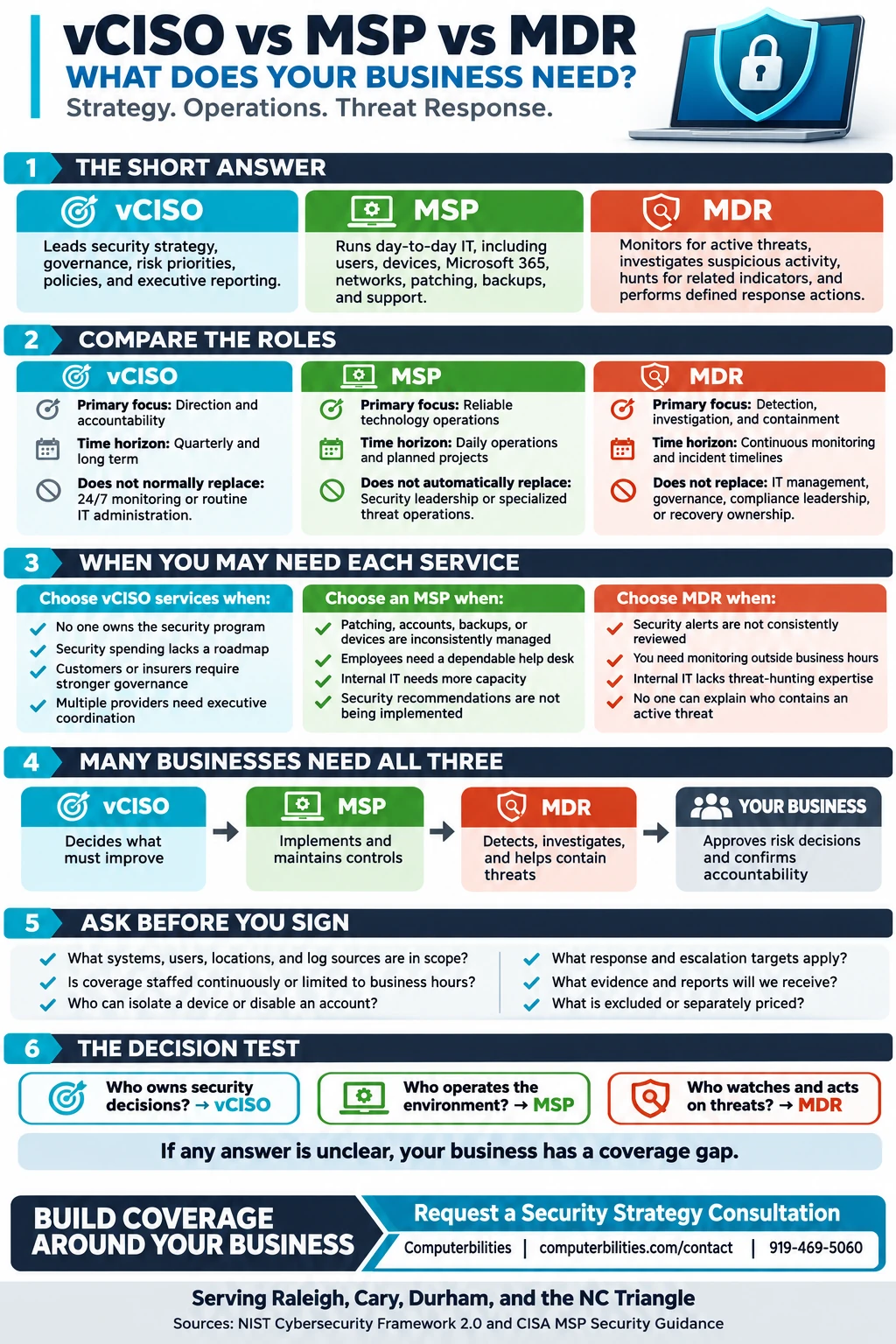
vCISO, MSP, and MDR at a Glance
| Decision area | vCISO | MSP | MDR |
|---|---|---|---|
| Primary purpose | Lead security strategy and governance | Operate and support business technology | Detect, investigate, and respond to threats |
| Typical time horizon | Quarterly and multi-year priorities | Daily operations and planned projects | Continuous monitoring and incident timelines |
| Common work | Risk roadmap, policies, executive reporting, vendor and compliance guidance | Help desk, identity, devices, patching, cloud, network, backup, and vendor coordination | Telemetry monitoring, alert triage, threat hunting, investigation, containment, and escalation |
| Usually does not replace | 24/7 monitoring or routine IT administration | Independent security leadership or specialized threat operations unless scoped | IT management, governance, compliance leadership, or recovery ownership |
| Primary business contact | Executives, risk owners, legal, compliance, and IT leadership | Operations, internal IT managers, and employees | IT, security, incident contacts, and authorized responders |
| Best evidence | Risk register, roadmap, decisions, owners, due dates, and executive reports | Service records, patch and backup status, inventories, and operational reporting | Detection coverage, investigations, response records, escalation times, and lessons learned |
What vCISO Services Actually Do
A virtual chief information security officer is a fractional or outsourced security leader. The role translates business goals, contractual obligations, cyber risk, and technical findings into decisions. Strong vCISO services create a repeatable governance process rather than a collection of documents that no one uses.
Typical responsibilities include establishing a security program, maintaining a risk register, selecting an appropriate framework, defining policies, prioritizing investments, clarifying incident roles, preparing leadership or board reporting, coordinating compliance readiness, reviewing third-party risk, and holding internal and external teams accountable for agreed actions.
The deliverables should connect to business operations. For a contractor, that might mean deciding which project information is most critical, how field access should be controlled, who approves payment changes, how long the business can operate without a key platform, and which incidents require executive or legal escalation. The vCISO should help leadership decide what risk to reduce, accept, transfer, or avoid.
A vCISO normally does not answer help desk tickets, deploy every patch, or monitor alerts around the clock. Some providers bundle operational work, but the agreement should distinguish leadership from implementation. A quarterly account review, technology sales meeting, or vCIO discussion is not automatically a vCISO engagement. Look for explicit security governance deliverables, decision records, and an accountable cadence.
When a Business Needs a vCISO
- Customers, insurers, lenders, or regulators ask who owns the security program.
- Security spending is reactive and leadership lacks a prioritized roadmap.
- Multiple providers deliver security tools, but no one evaluates the combined outcome.
- The business needs policies, risk reporting, tabletop exercises, or compliance preparation.
- An internal IT leader needs executive-level security support without a full-time CISO hire.
What an MSP Actually Does
A managed service provider takes responsibility for an agreed part of everyday IT operations. That scope may include employee support, onboarding and offboarding, endpoint management, Microsoft 365 administration, network maintenance, approved patching, backup monitoring, vendor coordination, device inventory, and technology planning. A co-managed MSP performs selected work alongside internal IT staff.
An MSP is often the team best positioned to implement security improvements because it already manages the systems involved. It can enforce multifactor authentication, deploy endpoint tools, remove former employees’ access, maintain supported software, manage backups, and correct configurations. It also gives employees a known route for reporting suspicious behavior or technical problems.
However, the term MSP does not prove a particular security capability. One provider may include endpoint detection with a monitored security operations service; another may install antivirus and forward alerts to the customer. One may support incident containment after hours; another may wait until the next business day. CISA guidance for MSP customers emphasizes defining access, logging, incident notification, communication, and responsibilities contractually.
Computerbilities’ published construction IT plans illustrate why scope matters: they identify EDR with SOC monitoring, operational reviews, backup follow-up, recovery testing, executive guidance, and separately scoped work rather than treating the word managed as a universal promise. Buyers should expect that level of clarity from any provider they evaluate.
When a Business Needs an MSP
- Technology responsibilities are scattered among employees whose primary jobs are not IT.
- Patching, account changes, backups, device management, or vendor follow-up are inconsistent.
- Employees need a dependable help desk and leadership needs operational reporting.
- The internal IT team needs additional capacity, specialist skills, or coverage across locations.
- Security recommendations repeatedly stall because no team owns implementation.
What Managed Detection and Response Actually Does
Managed detection and response combines security technology with remotely delivered human expertise. The service collects and analyzes telemetry from defined sources such as endpoints, identities, email, cloud services, networks, or logs. Analysts investigate suspicious activity, separate likely threats from routine noise, hunt for related indicators, and initiate or recommend response actions according to the contract.
The word response deserves close attention. Some MDR providers can isolate an endpoint, disable an account, block a malicious indicator, or take other predefined containment steps. Others notify the customer’s IT team and wait for approval. Both models can be valid, but the difference is critical at 2 a.m. The agreement should state which actions are automatic, which require authorization, who receives escalations, and what happens when the primary contact cannot be reached.
MDR is narrower than a complete security program. It does not normally run the help desk, own patch management, write the business’s risk strategy, decide compliance priorities, or guarantee recovery. It may identify an unmanaged device or compromised account, but another team still needs authority and access to fix the underlying condition. NIST’s Cybersecurity Framework 2.0 reinforces this broader view: Govern, Identify, Protect, Detect, Respond, and Recover work together as a continuous risk-management system.
When a Business Needs MDR
- No qualified person consistently reviews endpoint, identity, cloud, or network security alerts.
- The business needs monitoring and escalation outside normal office hours.
- Internal IT can administer systems but lacks time or expertise for threat hunting and investigation.
- Cyber insurance, customer requirements, or risk assessments identify a detection and response gap.
- Leadership cannot explain who would contain a compromised account or device during an active incident.
Why Many Businesses Need a Coordinated Combination
The three models align naturally to different parts of the security lifecycle. The vCISO emphasizes governance, priorities, and accountability. The MSP emphasizes implementation, maintenance, and user support. MDR emphasizes detection, investigation, and response. Recovery may involve the MSP, MDR provider, application vendors, insurer, legal counsel, incident-response specialists, and business leadership depending on the event.
Consider a stolen Microsoft 365 session. The MDR provider might detect suspicious sign-ins, investigate related activity, and disable the account if authorized. The MSP may reset access, review mailbox rules, secure the employee’s device, and restore normal service. The vCISO may coordinate executive communication, assess reporting obligations with counsel, document lessons learned, and adjust identity controls or policy. If those handoffs were never defined, each provider may correctly complete its own task while the incident remains unresolved.
Common Service Combinations
Small business without internal IT: An MSP can operate the environment and coordinate a defined security baseline. Add MDR when continuous monitoring and active response exceed the MSP’s included scope. Add vCISO support when leadership needs a formal roadmap, customer assurance, regulatory readiness, or governance across vendors.
Growing company with an IT manager: A co-managed MSP can handle selected operations and projects, while MDR supplies threat operations. A vCISO can help the IT manager present risk, budget, priorities, and decisions to executives.
Regulated or contract-driven organization: vCISO services can organize governance and evidence; the MSP can implement and maintain controls; MDR can supply monitoring and response records. None of the three should promise certification merely because it operates tools or provides advice.
How to Decide What Your Business Needs
Start with responsibilities, not vendors. Ask three questions in order.
1. Who Owns Security Decisions?
Someone must translate risk into priorities, policies, budgets, accepted exceptions, and executive decisions. If that owner does not exist or lacks capacity, evaluate vCISO services. Confirm that the role can challenge providers, document tradeoffs, and report in business language.
2. Who Operates and Improves the Environment?
Identify who manages identities, endpoints, cloud settings, networks, patches, backups, and employee support. If ownership is fragmented or improvements remain unfinished, evaluate an MSP or co-managed MSP. Match the agreement to systems, users, locations, support hours, and internal resources.
3. Who Watches and Acts on Threats?
List the telemetry being monitored, the hours of coverage, the analysts responsible for investigation, and the actions they may take. If alerts depend on an employee noticing email during business hours, evaluate managed detection and response. Require a clear path from detection to containment and recovery.
Questions to Ask Before Signing
- What exact systems, users, locations, log sources, and cloud services are in scope?
- Which responsibilities belong to our company, the vCISO, the MSP, the MDR provider, and other vendors?
- Is coverage staffed continuously, automated continuously, or limited to stated business hours?
- Who can isolate a device, disable an account, block traffic, or make an emergency configuration change?
- What response targets apply to alerts, incidents, support requests, and executive escalation?
- What evidence will we receive: risk registers, roadmaps, service records, investigation reports, response actions, and recovery-test results?
- How are provider access, privileged accounts, remote tools, logging, and subcontractors secured?
- How do the providers share information without exposing sensitive data or creating duplicate alerts?
- What is excluded, separately priced, or dependent on another product, license, project, or retainer?
- How will we test the handoffs through a tabletop exercise and improve them afterward?
Ask for a responsibility matrix as part of the proposal. It should name an owner for prevention, detection, containment, eradication, recovery, communication, legal coordination, insurance notification, and post-incident improvement. Marketing language matters far less than whether someone is authorized and prepared to act.
Frequently Asked Questions
Can an MSP also provide vCISO and MDR services?
Yes. One provider may deliver all three functions directly or through partners. Evaluate each function separately. Confirm the named personnel, hours, tools, authority, deliverables, response scope, and conflicts of interest. A bundled service can simplify coordination, but the contract still needs clear boundaries and evidence.
Does MDR replace an MSP?
No. MDR focuses on detecting, investigating, and responding to security threats within an agreed scope. It typically does not replace employee support, device lifecycle management, routine patching, Microsoft 365 administration, backups, network maintenance, or general technology planning.
Does an MSP automatically include MDR?
No. Some MSPs include EDR with SOC monitoring or a managed detection and response partner; others offer those capabilities as an add-on or do not provide them. Ask which assets are monitored, who reviews alerts, when analysts are available, and what response actions are included.
Is a vCISO the same as a vCIO?
No. A vCIO generally focuses on technology strategy, operations, systems, vendors, budgets, and business enablement. A vCISO focuses on cybersecurity governance, risk, policies, assurance, compliance coordination, and incident readiness. The roles can collaborate or be combined, but the security responsibilities should be explicit.
Which service should a small business buy first?
Start with the most consequential uncovered responsibility. A company with unmanaged accounts, devices, and backups may need operational control through an MSP first. A well-run IT environment with no after-hours threat response may prioritize MDR. A business facing customer requirements and uncoordinated security spending may need a vCISO. A short assessment should identify the sequence and the minimum viable coverage.
How much do vCISO, MSP, and MDR services cost?
Pricing depends on the depth of leadership, supported users and devices, locations, systems, telemetry volume, hours of coverage, response authority, regulatory needs, and included projects or software. Compare scopes and outcomes rather than monthly prices alone. A lower fee can exclude the exact response, recovery, or governance work the business assumed was included.
Build the Coverage Around the Business
The right answer to vCISO vs MSP vs MDR is often a designed combination. Security leadership decides what matters and what must improve. Managed IT keeps the environment reliable and implements controls. Managed detection and response looks for active threats and helps contain them. The contracts, contacts, access, and escalation paths must make those functions operate as one system.
Computerbilities helps construction companies and related businesses across Raleigh, Cary, Durham, and the NC Triangle define managed IT, cybersecurity, monitoring, recovery, and leadership responsibilities around the work they depend on. Request a security strategy consultation to identify your current coverage, the gaps between providers, and the next decisions your leadership team should make.
Request a Security Strategy Consultation
Call 919-469-5060