
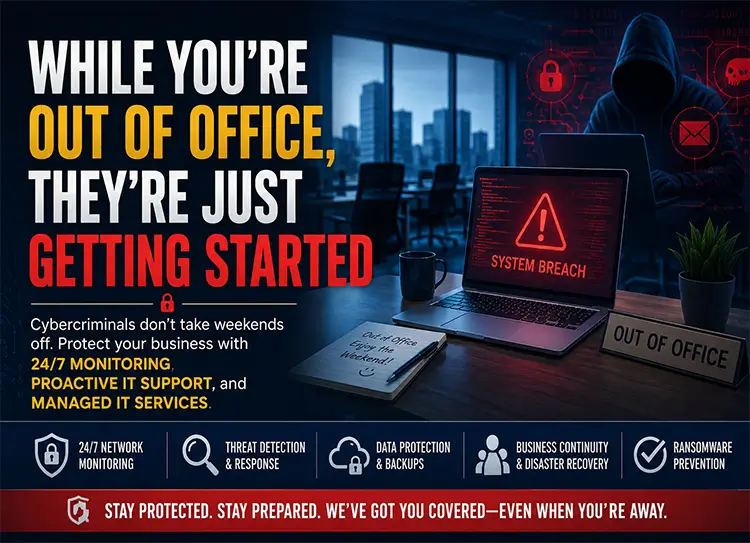
While You’re Out of Office, They’re Just Getting Started
For many businesses, a long weekend or company holiday means a chance to unplug, recharge, and step away from daily operations. Employees set up their out-of-office replies, offices become quieter, and leadership teams finally take a breath after a busy quarter.
Unfortunately, cybercriminals see these quiet moments very differently.
While your staff is relaxing, attackers are often just getting started.
Cybersecurity experts have repeatedly warned that ransomware attacks, phishing attacks, and weekend cyberattacks frequently increase during holidays and extended business closures. Why? Because cybercriminals understand something most businesses underestimate: slower response times create bigger opportunities.
For small and medium-sized businesses in Raleigh, Cary, Durham, and across North Carolina, the risk is even greater. Many SMBs lack dedicated overnight security teams or 24/7 cybersecurity monitoring, making them easier targets during off-hours.
This is why proactive cybersecurity, managed IT services, and continuous network security monitoring are no longer optional. They are critical safeguards for business continuity and ransomware prevention.
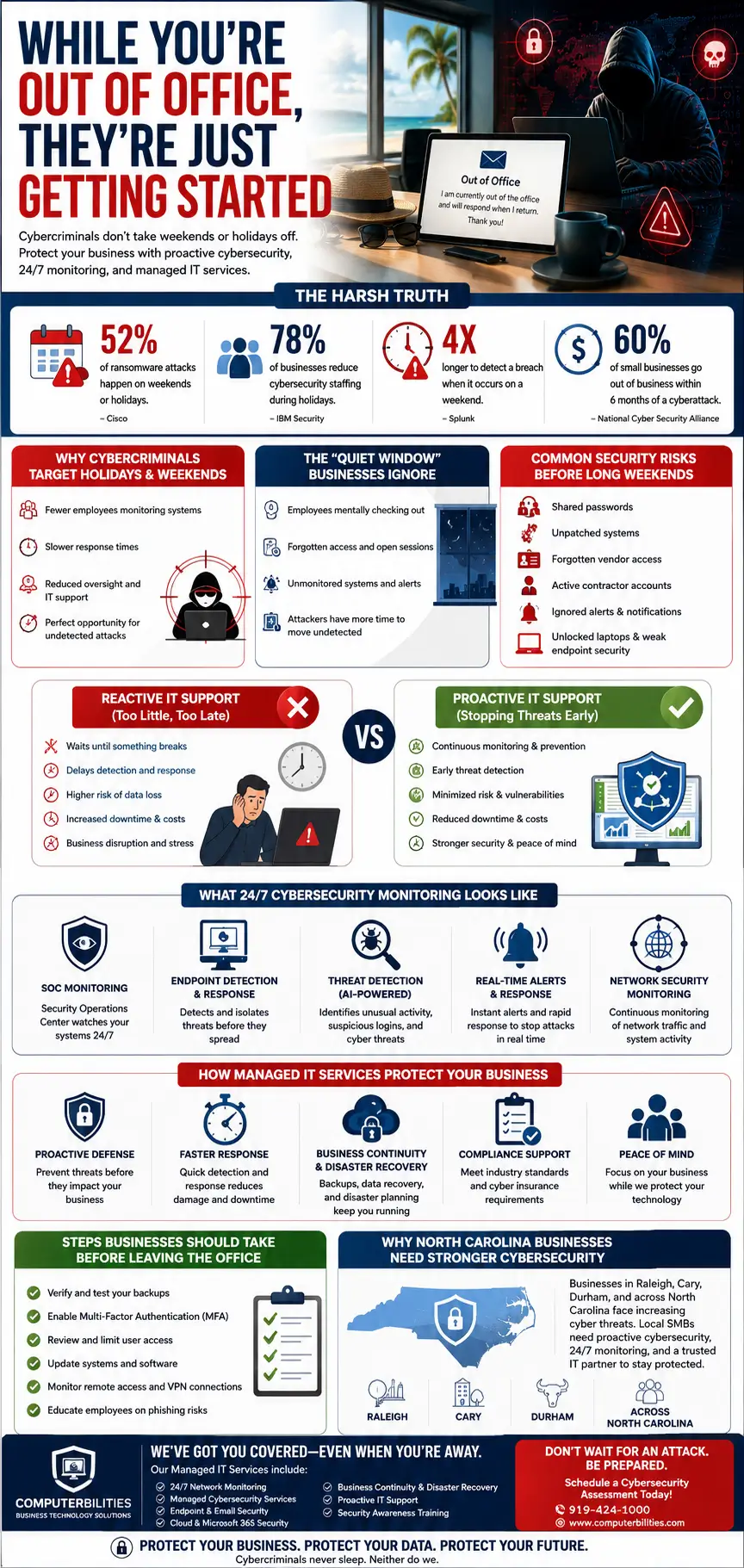
Why Cybercriminals Target Holidays and Weekends
Cybercriminals are strategic. They don’t randomly choose attack times.
Most ransomware attacks and cyber threats occur during periods when:
- Employees are unavailable
- IT teams are understaffed
- Security alerts go unnoticed
- Leadership response times slow down
Long weekends and holidays create the perfect environment for cybercriminal activity.
Imagine a hacker gains access to your network Friday evening before Memorial Day weekend. If nobody notices suspicious login attempts until Tuesday morning, attackers have nearly four full days to:
- Encrypt files
- Steal sensitive data
- Move laterally across systems
- Disable backups
- Deploy ransomware
That delay can turn a small breach into a devastating business interruption.
For businesses relying on reactive IT support instead of proactive cybersecurity services, these quiet windows can become extremely expensive.
The “Quiet Window” Businesses Ignore
One of the biggest cybersecurity risks during holiday weekends is not technology failure — it’s human behavior.
As employees prepare to leave for vacations or long weekends, attention shifts away from security practices. Teams rush to finish tasks, people become distracted, and routine cybersecurity checks are often skipped.
This creates what cybersecurity professionals call the “quiet window.”
During this period, businesses commonly experience:
- Forgotten software updates
- Open remote access sessions
- Shared credentials
- Weak password practices
- Unreviewed vendor access
- Ignored security notifications
Even something as simple as an unlocked laptop or unused contractor account can become an entry point for attackers.
Many ransomware groups actively monitor businesses during these low-activity periods because they know detection takes longer.
For SMBs in North Carolina and NYC, where internal IT teams are often smaller, the risk increases significantly without proper cyber threat monitoring.
Common Security Risks Before Long Weekends
Before leaving the office, many businesses unknowingly create security vulnerabilities that attackers can exploit.
Here are some of the most common cybersecurity mistakes businesses make before vacations and holidays:
Shared Passwords and Weak Credential Security
Employees sometimes share credentials to “help cover” responsibilities during absences. Unfortunately, this weakens access management and increases security exposure.
Cybercriminals often target compromised credentials because they provide easy access without triggering alarms.
Unpatched Systems
Delayed software updates remain one of the leading causes of ransomware attacks.
Businesses that postpone updates until after holidays leave known vulnerabilities exposed for days.
Attackers actively scan for outdated systems during weekends because they know businesses are less likely to respond quickly.
Forgotten Vendor Access
Third-party vendors and contractors often retain unnecessary system access long after projects are completed.
Without proper access reviews, these dormant accounts become easy targets.
Ignored Alerts and Notifications
Security alerts received late Friday afternoon are frequently overlooked until Monday or Tuesday.
By then, cybercriminal activity may already be spreading across the network.
Weak Endpoint Security
Remote employees accessing company systems from personal devices increase cybersecurity risks during holiday periods.
Without strong endpoint security and Microsoft 365 security protections, attackers can exploit unsecured devices and cloud applications.
Reactive IT Support Is No Longer Enough
For years, many SMBs operated with a “break-fix” IT model.
Something breaks.
You call IT support.
The problem gets fixed.
But modern cybersecurity threats move too fast for reactive IT support.
Today’s ransomware attacks can:
- Encrypt networks within hours
- Steal sensitive customer information
- Shut down operations entirely
- Damage brand reputation
- Trigger compliance penalties
Waiting until after an incident occurs is no longer a safe strategy.
This is where proactive IT support and managed cybersecurity services make a major difference.
Instead of reacting after damage happens, proactive cybersecurity focuses on:
- Continuous monitoring
- Early threat detection
- Vulnerability management
- Security awareness training
- Real-time response
Businesses that invest in proactive cybersecurity services are far more likely to detect suspicious activity before it becomes a crisis.
What 24/7 Cybersecurity Monitoring Looks Like
Many SMB owners hear terms like “24/7 network monitoring” or “security operations center” but are unsure what they actually involve.
In reality, modern cybersecurity monitoring combines people, processes, and technology to protect businesses around the clock.
Security Operations Center (SOC) Monitoring
A SOC continuously watches for:
- Unusual network activity
- Failed login attempts
- Unauthorized access
- Malware behavior
- Suspicious data transfers
Staffed monitoring and response coverage must be defined in the service agreement, including nights, weekends, holidays and escalation.
Endpoint Detection and Response
Endpoint security tools monitor:
- Laptops
- Servers
- Workstations
- Mobile devices
If ransomware or malware appears, the system can isolate infected devices before threats spread.
AI-Powered Threat Detection
Modern cybersecurity platforms use AI to identify:
- Abnormal behavior patterns
- Unusual login locations
- Unexpected data movement
- Insider threats
AI-powered cybersecurity helps businesses detect attacks earlier and reduce response times.
Real-Time Alerts and Incident Response
Automated monitoring can generate alerts on covered systems. Staffed review and response times follow the agreed coverage, incident priority and escalation process.
Instead of discovering breaches days later, cybersecurity teams can:
- Contain attacks
- Disable compromised accounts
- Block malicious traffic
- Restore operations quickly
This significantly reduces downtime and financial damage.
How Managed IT Services Protect Your Business
Many SMBs in Raleigh, Cary, Durham, and across North Carolina lack the internal resources to maintain full-time cybersecurity teams.
This is why managed IT services have become essential for modern businesses.
A managed service provider (MSP) helps businesses strengthen cybersecurity without hiring large in-house IT departments.
Continuous Monitoring
Managed cybersecurity services provide:
- 24/7 network security monitoring
- Threat detection
- Security patch management
- Cloud security oversight
- Email security protection
Faster Threat Response
Speed matters during cyberattacks.
The longer attackers remain undetected, the greater the damage.
Managed IT services reduce response times dramatically through:
- Automated threat alerts
- Remote monitoring and management
- Real-time escalation
- Security incident response
Business Continuity and Disaster Recovery
Cybersecurity is not only about prevention — it’s also about recovery.
A strong business continuity strategy includes:
- Secure backups
- Disaster recovery planning
- Data recovery processes
- Operational continuity
Businesses with tested recovery plans recover far faster after cyber incidents.
Compliance Support
Many industries now require:
- Cyber insurance compliance
- Multi-factor authentication
- Data protection standards
- Security audits
Managed cybersecurity providers help businesses meet these evolving requirements.
Steps Businesses Should Take Before Leaving the Office
Before the next holiday weekend or company shutdown, businesses should complete a cybersecurity checklist.
Verify Backups
Ensure:
- Backups are current
- Recovery systems work properly
- Critical data is protected
Backups remain one of the most effective ransomware prevention tools.
Enable Multi-Factor Authentication (MFA)
MFA dramatically reduces unauthorized access risks.
All critical systems should require:
- MFA
- Strong password policies
- Credential security controls
Review Access Permissions
Conduct access reviews for:
- Former employees
- Contractors
- Vendors
- Temporary staff
Remove unnecessary accounts immediately.
Update Systems and Software
Do not delay patches until after vacations.
Update:
- Operating systems
- Security tools
- Cloud platforms
- Microsoft 365 environments
Monitor Remote Access
Review:
- VPN access
- Remote desktop protocols
- Cloud application permissions
Limit exposure wherever possible.
Why North Carolina Businesses Need Stronger Cybersecurity
North Carolina businesses face increasing cybersecurity threats as ransomware groups continue targeting SMBs nationwide.
Businesses in Raleigh, Cary, and Durham are becoming attractive targets because many organizations:
- Store sensitive client information
- Depend heavily on digital operations
- Lack advanced cybersecurity monitoring
- Operate hybrid work environments
Cybercriminals understand that smaller businesses often have fewer defenses than large enterprises.
This makes cybersecurity services in North Carolina more important than ever.
Whether you operate a law firm, healthcare office, financial company, manufacturing facility, or professional services business, investing in proactive cybersecurity protection is critical for long-term stability.
How Computerbilities Helps Businesses Stay Protected
At Computerbilities, we understand that cybercriminals don’t take weekends off — and neither should your cybersecurity strategy.
Our managed IT services in Raleigh and across North Carolina help SMBs strengthen their cybersecurity posture through:
- 24/7 network monitoring
- Managed cybersecurity services
- Endpoint security
- Business continuity planning
- Disaster recovery solutions
- Cloud security management
- Microsoft 365 security
- Security awareness training
- Proactive IT support
We help businesses identify vulnerabilities before attackers exploit them.
Computerbilities provides automated monitoring on covered systems. Staffed support hours and after-hours escalation follow your selected plan and service agreement. Leadership adds 24/7 remote Level 1 intake and troubleshooting after activation; higher-level response is separately defined in the agreement.
Conclusion
While your employees are out of office, cybercriminals are often increasing their activity.
Weekend cyberattacks, ransomware attacks, phishing scams, and unauthorized access attempts continue to rise because attackers know businesses become less responsive during holidays and vacations.
The good news is that proactive cybersecurity can dramatically reduce these risks.
Managed IT services, agreed support coverage, cybersecurity monitoring and continuity planning can help businesses detect threats and reduce disruption. No service can guarantee prevention of every incident.
If your organization wants to strengthen its cybersecurity posture, protect your business from ransomware, and secure your network before the next holiday weekend, now is the time to act.
Schedule a cybersecurity assessment with Computerbilities today and discover how proactive cybersecurity services can help keep your business safe — even when your office is empty.
FAQs
Why do ransomware attacks happen during holidays?
Cybercriminals target holidays because businesses typically have fewer employees monitoring systems, slower response times, and reduced IT staffing. This gives attackers more time to spread ransomware before detection.
Why do businesses need 24/7 IT monitoring?
Cyber threats can occur at any time, including nights, weekends, and holidays. 24/7 network monitoring helps businesses detect suspicious activity early and respond before major damage occurs.
What are the signs a business lacks cybersecurity monitoring?
Common signs include:
- Delayed threat detection
- No real-time alerts
- Unpatched systems
- Weak endpoint security
- Lack of backup testing
- Reactive IT support only
How do managed IT services help prevent ransomware attacks?
Managed IT services provide:
- Continuous monitoring
- Threat detection
- Security patching
- Backup management
- Incident response
- Employee security awareness training
These services reduce vulnerabilities and improve response times.
What cybersecurity steps should businesses take before vacations?
Businesses should:
- Enable MFA
- Verify backups
- Update systems
- Review user access
- Monitor remote connections
- Train employees on phishing risks
Why are SMBs frequent targets for cybercriminals?
Small and medium businesses often have fewer cybersecurity resources than large enterprises, making them easier targets for ransomware groups and phishing attacks.