

The One Business Resolution That Actually Sticks (Unlike Your Gym Membership)
Every January, business owners across Raleigh, Durham, and Cary approach the new year with renewed optimism. Calendars are cleared, goals are written down, and leadership meetings begin with the same hopeful refrain: “This year, we’ll do things differently.”
It’s the season of the business New Year’s resolution—and just like personal resolutions, many don’t survive past the first quarter.
If this sounds familiar, you’re not alone. From fast-growing tech firms in Raleigh to professional service providers in Durham and small-to-mid-sized businesses in Cary, leaders across North Carolina face the same challenge: setting goals that sound right in January but quietly disappear by spring.
The good news? There is a business resolution that sticks—and it works precisely because it doesn’t rely on motivation, willpower, or good intentions alone.
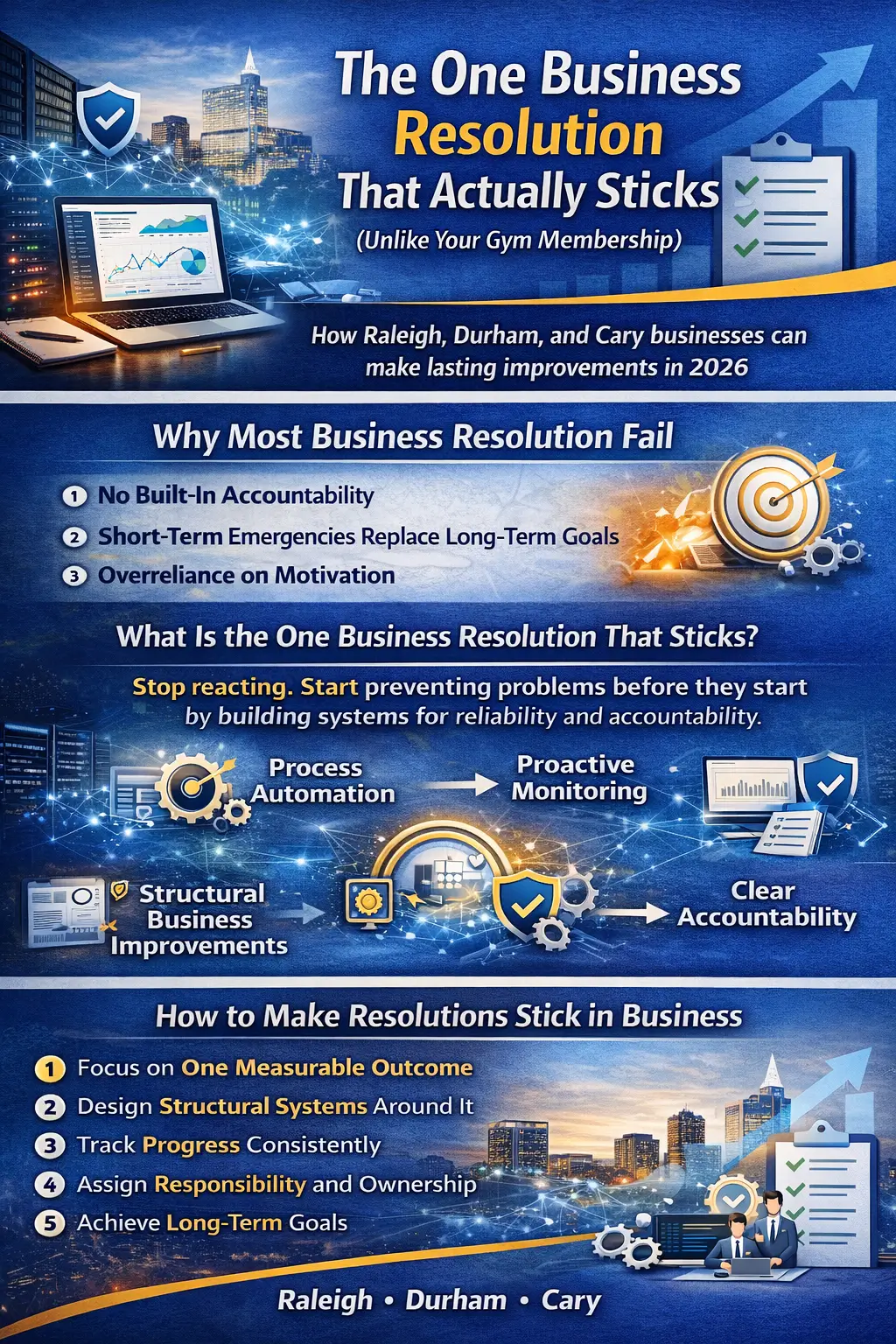
Why Business Goals Fail—Even When They’re Smart
Most business leaders don’t fail because they aim too high. They fail because their goals depend on constant attention in an environment designed to demand reaction.
This explains why business goals fail, even when they are logical, achievable, and well-intentioned.
Think about the gym membership analogy. People don’t stop going to the gym because they don’t want to be healthy. They stop because:
- Work emergencies interfere
- Results feel slow
- There’s no built-in accountability
The same principle applies to business.
In many Raleigh and Durham companies, leadership teams start the year with clear objectives—improve efficiency, reduce downtime, strengthen security, scale operations. But when systems are fragile, leaders spend their time reacting instead of executing.
This is where business goals motivation fades, and why so many resolutions quietly collapse.
Motivation vs. Systems in Business: The Turning Point
One of the most important distinctions successful organizations understand is the difference between motivation vs systems in business.
Motivation is temporary. Systems are permanent.
A motivated team can push through chaos—for a while. But without systems, even the best teams burn out. Businesses that thrive in Cary’s competitive commercial environment don’t rely on daily heroics; they rely on structural business improvements.
That’s why why structural change beats motivation alone is a consistent theme among high-performing organizations.
The One Business Resolution That Actually Works
If there is one resolution that consistently delivers results, it is this:
Stop running your business reactively. Build systems that prevent problems before they happen.
This single commitment supports:
- Long-term business goals
- Sustainable business improvement
- Business productivity growth
- Clear business decision-making strategy
And for most modern organizations, this resolution begins with technology.
Why Technology Determines Whether Resolutions Stick
In 2026, technology is not just a support function—it is the backbone of how businesses operate across North Carolina.
From cloud platforms used by Raleigh startups to compliance-driven systems in Durham’s healthcare and research sectors, reliable technology determines whether a company grows smoothly or struggles constantly.
When systems fail, leaders shift into survival mode:
- Emails stop
- Systems slow down
- Security risks emerge
- Teams wait instead of work
This constant disruption makes it nearly impossible to focus on long-term business planning.
That’s why so many top-ranking articles emphasize the need to stop tech firefighting in business.
Stop Tech Firefighting in Business—Especially During Growth
Many Cary-based and Raleigh-area businesses unknowingly adopt firefighting as a daily routine.
Servers go down unexpectedly. Software updates are postponed. Security patches are applied only after incidents occur. IT becomes a source of stress instead of stability.
This reactive approach limits growth and erodes trust internally and externally.
A true technology improvement resolution focuses on:
- Proactive IT monitoring benefits
- Predictable performance
- Clear accountability
In other words, IT systems that last.
Why Managed IT Services Create Accountability That Sticks
One reason managed IT services resolution content performs so well in search results is because it addresses the root issue: accountability.
When technology ownership is unclear, issues linger. When systems are proactively managed, problems are resolved—or avoided—without leadership intervention.
For businesses in Raleigh, Durham, and Cary, managed services provide:
- Continuous monitoring
- Defined response times
- Regular performance reviews
- Clear ownership of outcomes
This creates IT accountability and consistency, which is essential for achieving IT infrastructure goals for 2026.
How to Make Resolutions Stick in Business
The companies that succeed don’t set more goals—they set better systems.
Here’s how to make resolutions stick in business:
- Choose One Outcome That Matters
Focus on a measurable result, such as uptime, security posture, or operational efficiency.
- Design Systems That Support That Outcome
Automate best practices and remove reliance on memory or urgency.
- Track Progress Consistently
Visibility builds momentum. Dashboards outperform checklists.
- Assign Clear Ownership
The role of accountability in success cannot be overstated. Someone must own the result.
This approach explains what makes business resolutions stick.
Long-Term Business Goals Require Structural Thinking
Organizations across North Carolina that achieve real scale understand that growth without structure creates instability.
Long-term business goals require:
- Reliable infrastructure
- Predictable operations
- Reduced dependency on individuals
This is especially important for businesses in fast-growing markets like Raleigh and Durham, where expansion can outpace systems.
Best Business Resolution Ideas for 2026 (That Actually Work)
Among the best business resolution ideas for 2026, one stands above the rest:
Commit to proactive systems that work quietly in the background.
This includes:
- Proactive IT monitoring
- Preventive maintenance
- Strategic planning reviews
- Ongoing system optimization
These practices enable leaders to stop reacting and start planning in business.
From Daily Chaos to Confident Leadership
When systems are reliable, something remarkable happens.
Leaders regain time. Teams regain confidence. Planning replaces panic.
This shift transforms organizations—from constantly responding to issues to intentionally shaping their future.
That is the real power behind reliable business tech systems.
How to Build Lasting Business Habits
Just as personal fitness success depends on routine, business success depends on repeatability.
To build lasting business habits, organizations must:
- Remove friction
- Automate consistency
- Reinforce accountability
Habits stick when they are embedded into daily operations—not when they depend on constant discipline.
FAQ Business Resolution That Actually Sticks.
- What is the one business resolution that actually sticks?
A business resolution that sticks is committing to systems—especially reliable business technology and accountability processes—that prevent recurring problems instead of reacting to them.
- Why do most business resolutions fail by March?
Most business resolutions fail because motivation fades and daily emergencies take over. Without a system for tracking, ownership, and accountability, goals quickly get deprioritized. - Why do business goals fail even when they’re realistic?
Business goals fail when they depend on willpower rather than structure. If processes, tools, and responsibilities are not clearly defined, teams revert to old habits under pressure. - How do you make resolutions stick in business?
To make resolutions stick in business, choose one measurable outcome, assign ownership, build repeatable processes around it, and review progress consistently. - What makes business resolutions stick long term?
Business resolutions stick long term when they are tied to systems—such as documented processes, automation, scheduled reviews, and clear accountability—rather than one-time motivation. - What are the best business resolution ideas for 2026?
The best business resolution ideas for 2026 include improving operational efficiency, strengthening cybersecurity, reducing downtime, and shifting from reactive IT fixes to proactive monitoring. - What does “stop tech firefighting in business” mean?
Stopping tech firefighting means moving away from constant emergency fixes and instead using proactive monitoring, maintenance, and planning to prevent outages and recurring issues. - How can a business stop reacting and start planning?
A business can stop reacting and start planning by stabilizing core systems, setting clear responsibilities, using recurring check-ins, and reducing preventable disruptions like IT downtime. - What are the benefits of proactive IT monitoring?
Proactive IT monitoring helps detect issues early, reduces downtime, improves security, supports predictable performance, and gives leadership more time to focus on long-term business goals. - How do managed IT services support long-term business goals?
Managed IT services support long-term business goals by providing continuous monitoring, documented processes, consistent maintenance, and accountability—helping businesses build IT systems that last. - What are common IT support goals for businesses in 2026?
Common IT support goals for businesses in 2026 include improving uptime, strengthening cybersecurity, optimizing cloud performance, ensuring backup reliability, and creating a clear technology roadmap. - How can Raleigh, Durham, and Cary businesses improve organizational efficiency?
Raleigh, Durham, and Cary businesses can improve organizational efficiency by standardizing workflows, reducing recurring IT issues, automating routine tasks, and creating accountability systems. - What’s the difference between willpower and systems in business success?
Willpower depends on motivation and attention, while systems create consistency automatically. Systems help companies execute goals reliably, even during busy or stressful periods. - Why do gym memberships fail and what does that teach businesses?
Gym memberships often fail because there is no accountability and progress feels slow. Businesses learn the same lesson: goals stick when systems make progress visible and consistent. - What should a business technology strategy include in 2026?
A 2026 business technology strategy should include cybersecurity protections, proactive monitoring, backup and recovery planning, cloud optimization, lifecycle management, and ongoing reviews.
A Resolution That Outlasts January
Most business resolutions fail because they demand constant attention. The one that sticks reduces the need for attention over time.
By focusing on:
- Systems over motivation
- Structure over reaction
- Accountability over intention
Businesses across Raleigh, Durham, and Cary can finally break the cycle of failed resolutions.
Unlike a gym membership that relies on willpower, this resolution works quietly, consistently, and reliably—supporting growth long after the excitement of the new year fades.