
New “VVS Stealer” Malware Targets Discord Accounts: What North Carolina Users Need to Know
Cybersecurity threats rarely announce themselves loudly. More often, they slip in quietly—hidden behind legitimate-looking files, fake system messages, or trusted applications. The recently discovered VVS Stealer malware is a textbook example of this modern, stealth-first approach to cybercrime.
Security researchers have confirmed that VVS Stealer, sometimes written as VVS $tealer, is actively targeting Discord accounts, harvesting sensitive credentials, authentication tokens, and browser-stored data. For users and organizations across North Carolina, where Discord is widely used by students, professionals, gaming communities, and businesses alike, this threat deserves close attention.
This article takes a clear, human-focused look at what VVS Stealer is, how it works, why it is dangerous, and—most importantly—what you can do to protect yourself and your organization.
Understanding VVS Stealer: A New Generation of Infostealer Malware
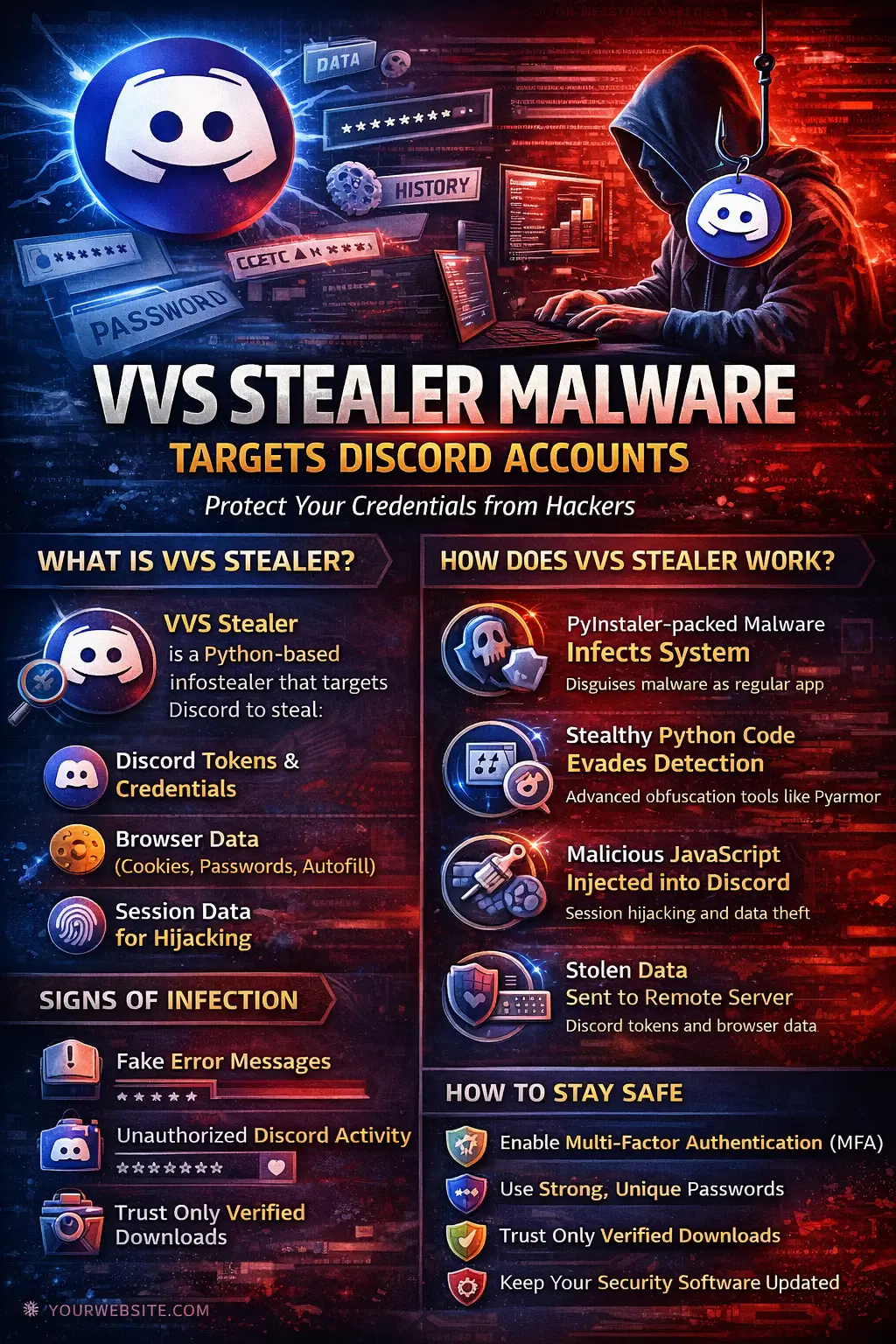
At its core, VVS Stealer is a Python-based infostealer—a category of malware specifically designed to collect and exfiltrate sensitive user information. Unlike broad ransomware attacks that announce their presence, infostealers are built to remain invisible for as long as possible.
What makes VVS Stealer particularly concerning is its precision targeting. Rather than attempting to compromise everything on a system, it focuses on high-value data:
- Discord authentication tokens
- Discord credentials
- Active session data for session hijacking
- Browser-stored information, including cookies, passwords, browsing history, and autofill data
In practical terms, this means an attacker does not need your Discord password at all. If they obtain your authentication token, they can take over your session exactly as you left it—no login alerts, no warnings, and often no immediate signs of compromise.
Why Discord Is an Attractive Target
Discord has evolved far beyond its origins as a gaming platform. Today, it serves as a communication hub for:
- University study groups and student organizations
- Small businesses and startups
- Remote teams and freelancers
- Technology communities and professional networks
Across North Carolina, Discord is commonly used by colleges, creative agencies, IT teams, and community groups. That widespread adoption makes it a valuable target.
Once attackers gain access to a Discord account, they can:
- Impersonate trusted users
- Send malicious links to servers and private messages
- Harvest additional credentials from contacts
- Spread malware further using social engineering
In many cases, compromised Discord accounts become stepping stones to much larger security incidents.
How VVS Stealer Infects Systems
One reason VVS Stealer is ranking prominently in cybersecurity research reports is its clean, methodical infection process.
Python-Based Architecture and Packaging
VVS Stealer is written in Python and packaged using PyInstaller, a legitimate development tool that converts Python scripts into Windows executables. This allows the malware to masquerade as a harmless program—often appearing no different from a standard application download.
To the average user, there is nothing immediately suspicious about the file. And that is precisely the point.
Persistence Through Startup Execution
Once executed, the malware establishes persistence by copying itself into the Windows Startup folder. From that moment on, it automatically launches every time the system starts.
This persistence mechanism ensures that even if the user reboots their device—often after seeing an error—the malware remains active.
Deception via Fake Error Messages
To further reduce suspicion, VVS Stealer displays a fake system error message, often styled as a “fatal error” or application crash. Many users assume the program simply failed to run and move on.
In reality, the malware is already operating silently in the background.
Advanced Obfuscation and Detection Evasion
One of the most technically sophisticated aspects of VVS Stealer is its use of PyArmor obfuscation.
Obfuscation is the digital equivalent of hiding instructions in a locked box. While the code still runs normally, it becomes extremely difficult for antivirus engines and analysts to understand what it is doing.
VVS Stealer’s obfuscated Python code:
- Conceals malicious logic from static analysis
- Slows down reverse engineering efforts
- Helps the malware bypass traditional security tools
This heavy focus on detection evasion explains why some infected systems may not trigger immediate alerts—even when antivirus software is installed.
Credential Theft and Session Hijacking Explained Simply
To understand the real danger of VVS Stealer, it helps to use an analogy.
Think of your Discord password as a house key. Your authentication token, however, is more like a security badge that says, “This person is already inside—no questions asked.”
VVS Stealer focuses on stealing that badge.
Using malicious JavaScript injection, the malware hooks into Discord sessions through the browser environment, allowing it to capture:
- Authentication tokens
- Session cookies
- Active login states
This enables session hijacking, meaning attackers can access accounts without ever knowing the password—or triggering two-factor authentication in some cases.
Once stolen, this data is quietly exfiltrated to attacker-controlled servers, where it can be used immediately or sold within the commercial malware ecosystem.
The Commercial Malware Ecosystem Behind VVS Stealer
VVS Stealer is not an isolated experiment. It is part of a growing malware-as-a-service economy.
Researchers have observed the malware being sold openly on Telegram, with pricing models that include:
- Weekly or monthly subscriptions
- Lifetime licenses
- Tiered feature access
This commercialization dramatically lowers the barrier to entry for cybercrime. Attackers no longer need deep technical knowledge—they simply need a subscription.
For defenders, this means more attacks, more variants, and faster evolution of threats.
Enterprise and Corporate Risk in North Carolina
While individual users are at risk, enterprise exposure is where the damage can multiply.
Many organizations now rely on Discord for:
- Internal team communication
- Community engagement
- Customer support channels
- Developer collaboration
If a single employee’s account is compromised, attackers may gain access to internal conversations, shared links, and even credentials exchanged informally.
This can lead to:
- Lateral movement within networks
- Targeted phishing campaigns
- Data leakage
- Reputational damage
For North Carolina businesses—especially small and mid-sized organizations—these risks are very real.
Indicators of Compromise to Watch For
Because VVS Stealer is designed to stay hidden, detection often relies on subtle signals rather than obvious symptoms.
Common Indicators of Compromise (IOCs) include:
- Unexpected files appearing in startup directories
- Discord sessions remaining logged in across devices
- Unrecognized account activity or messages
- Browser credentials behaving inconsistently
- Frequent but unexplained system error messages
Organizations should rely on endpoint detection rules, behavioral monitoring, and anomaly detection rather than signature-based tools alone.
Defensive Measures That Actually Work
No single security control can stop every threat—but layered defenses dramatically reduce risk.
Enable Multi-Factor Authentication Everywhere
While session hijacking can bypass some protections, multi-factor authentication (MFA) still significantly raises the bar for attackers and limits damage after credential theft.
Adopt Modern Endpoint Security
Behavior-based endpoint detection solutions are far more effective against obfuscated malware than traditional antivirus software.
Limit Credential Exposure
Encourage password managers instead of browser-stored credentials, and avoid sharing sensitive access information through chat platforms.
User Awareness Still Matters
Most infections still begin with a single click. Teaching users to question unexpected downloads and “helpful tools” remains one of the strongest defenses.
A Real-World Scenario
Consider a small creative agency in Durham that uses Discord to collaborate with freelancers. One contractor installs a tool advertised as a productivity enhancer. Unbeknownst to them, it contains VVS Stealer.
Within hours, Discord sessions are hijacked, messages are sent from trusted accounts, and project files are exposed. The breach does not start with ransomware—it starts with trust.
This is how modern cyber incidents unfold.
Final Thoughts
The emergence of VVS Stealer malware targeting Discord accounts highlights a broader truth about today’s threat landscape: attacks are quieter, smarter, and more commercially driven than ever before.
For users and organizations across North Carolina, awareness is the first line of defense. Understanding how these threats operate—and why they are effective—empowers better decisions, stronger security practices, and faster response when something goes wrong.
Cybersecurity is no longer just a technical concern. It is a daily operational reality.
Staying informed is not optional. It is essential.