
European Space Agency Data Breach: What the Cyberattack Reveals About Global Cybersecurity Risks
When news broke that the European Space Agency (ESA) had suffered a major cybersecurity breach, it quickly became one of the most searched and discussed cyber incidents of the year. For an organization synonymous with scientific precision and technological advancement, the confirmation that ESA was hacked sent a clear message: even the most sophisticated institutions are not immune to modern cyber threats.
For businesses, universities, and government organizations across North Carolina, this incident is more than international news. It is a practical case study in how external servers, stolen credentials, and overlooked vulnerabilities can lead to large-scale data exposure.
This article explains how the European Space Agency cyberattack happened, what data was stolen, why this story ranks highly on Google, and what organizations can learn to reduce their own cyber risk.
What Happened in the European Space Agency Cyberattack?
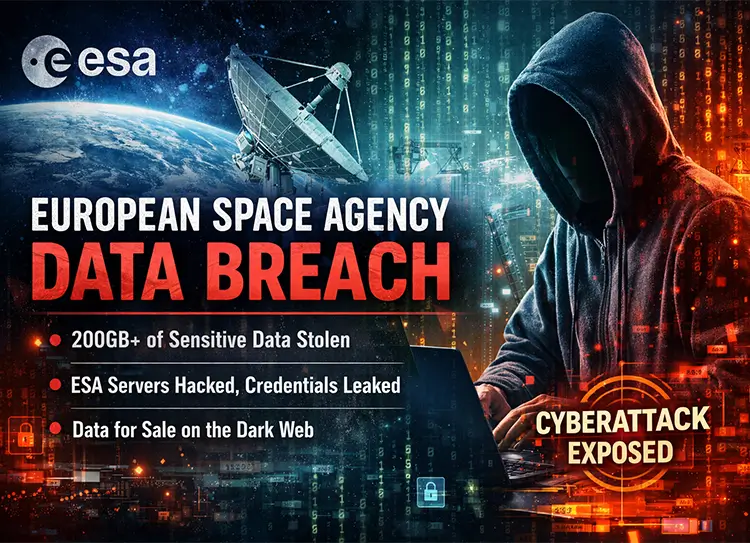
The European Space Agency data breach became public after a threat actor claimed responsibility for stealing a massive volume of data from ESA systems. Initial claims referenced 200GB of stolen data, while subsequent reporting suggested the total ESA data theft may exceed 700GB.
ESA later confirmed a cybersecurity incident involving external servers, clarifying that the breach did not affect mission-critical spacecraft operations. However, the exposed systems still contained valuable digital assets that attackers routinely exploit.
Why This ESA Cybersecurity Incident Matters
- ESA is a high-value scientific organization, not a typical corporate target
- The breach involved credentials, project files, and internal documentation
- Portions of the stolen data were reportedly advertised for sale online
- The incident highlights increasing space sector cybersecurity risks
How Did the European Space Agency Get Hacked?
According to available disclosures, attackers compromised ESA external servers, not the agency’s internal core network. This distinction is critical and increasingly common in modern cyberattacks.
External vs. Corporate Network Breach Explained
External servers often host:
- Collaboration platforms
- Software development tools
- Partner-facing services
These systems are frequently exposed to the internet, making them attractive targets for attackers seeking quick access without breaching heavily fortified internal networks.
In the ESA case, investigators believe the breach involved:
- Unpatched vulnerabilities exploited
- Hardcoded credentials leaked
- API keys and access tokens stolen
This method reflects a broader trend: attackers are targeting the “edges” of organizations rather than attempting direct assaults on core infrastructure.
What Data Was Stolen in the ESA Data Breach?
Based on public reporting and ESA statements, the ESA confidential data stolen may include:
- Internal project documents
- Source code repositories
- Software configuration files
- Usernames and ESA email credentials
- Collaboration data used by science and engineering teams
While ESA emphasized that the exposed data was unclassified, cybersecurity professionals understand that unclassified does not mean harmless.
Even non-classified data can be weaponized for phishing, social engineering, and follow-up attacks.
ESA Data Leak on Dark Web Forums
Reports indicate the attacker attempted to monetize the stolen data through a data sale on BreachForums, a well-known underground marketplace. This confirmed fears of an ESA dark web data leak.
Once data reaches cybercrime forums:
- It is often copied and redistributed
- Credentials may be tested against other platforms
- Stolen information can enable secondary attacks
This is particularly concerning given reports that ESA partners may be affected, including organizations connected to aerospace research and development.
ESA Servers Breached: Collaboration Tools in the Spotlight
Several reports suggest that ESA science and collaboration servers were breached, including systems used for software development and project coordination.
These platforms often contain:
- Engineering documentation
- Shared credentials
- Access paths to additional systems
In many organizations, collaboration tools receive less security attention than core infrastructure—yet they often store just as much sensitive data.
The Growing Risk of Infostealer Malware
Although this specific incident was not conclusively linked to a single malware strain, it reflects a wider trend involving infostealer malware.
Recent campaigns—such as VVS Stealer targeting Discord accounts—demonstrate how attackers harvest:
- Browser-stored credentials
- Session cookies
- Authentication tokens
In enterprise environments, similar tools can expose:
- Developer accounts
- Cloud access credentials
- Source code repositories
This underscores the infostealer malware risk to space agencies and research institutions, as well as private organizations.
ESA Cybersecurity Investigation and Forensic Analysis
Following confirmation of the breach, ESA initiated a full cybersecurity investigation, including detailed ESA forensic analysis.
Such investigations typically involve:
- Reviewing access logs and intrusion timelines
- Identifying compromised accounts
- Mapping attacker activity
- Assessing the full scope of data exposure
Establishing a clear space agency cybersecurity breach timeline is essential for recovery, accountability, and future risk reduction.
Space Sector Cybersecurity Risks Are Increasing
The cyberattack on a space agency highlights a broader challenge: space organizations are becoming increasingly digital and interconnected.
Key risks include:
- Collaborative engineering data leaks
- Supply-chain vulnerabilities
- Long-term espionage campaigns
As scientific institutions rely more on cloud services and global collaboration, cyber threats to space infrastructure will continue to grow.
What North Carolina Organizations Can Learn From the ESA Hack
For businesses, universities, and public sector organizations across North Carolina, this incident offers practical lessons.
- External Systems Are High-Risk Targets
Attackers often bypass core defenses by exploiting:
- Development environments
- File-sharing platforms
- Remote access services
- Credentials Are a Primary Target
Once credentials are stolen, attackers can:
- Access multiple systems
- Target partners and vendors
- Launch follow-up attacks
- Incident Response Planning Is Critical
Organizations must know how to detect, respond, and recover—not just how to prevent attacks.
Cybersecurity Measures After the ESA Hack
Best-practice takeaways reinforced by this incident include:
- Regular patch management
- Enforced multi-factor authentication
- Limiting API permissions
- Continuous monitoring of external systems
These measures are particularly important for organizations handling research, intellectual property, or sensitive collaboration data.
Frequently Asked Questions
How did the European Space Agency get hacked?
Attackers breached external ESA servers, likely through exposed credentials or unpatched vulnerabilities.
What data was stolen in the ESA breach?
Project documents, source code, and credentials were reportedly stolen, primarily from collaboration systems.
Is the ESA data breach affecting space missions?
ESA has stated there is no direct impact on mission operations, though investigations continue.
Was ESA data leaked on the dark web?
Attackers reportedly attempted to sell stolen data on underground cybercrime forums.
What cybersecurity steps followed the ESA hack?
ESA launched forensic investigations, reviewed access controls, and strengthened security around external systems.
Why This Breach Matters Beyond Europe
The European Space Agency cybersecurity incident is not just an isolated event—it is a reflection of today’s cyber landscape. Attackers no longer discriminate based on prestige or mission. If an organization has valuable data and an exposed system, it is a potential target.
For organizations across North Carolina and beyond, the lesson is clear:
Cybersecurity is no longer optional, reactive, or limited to IT teams—it is a core organizational responsibility.
Understanding incidents like the ESA breach helps leaders make informed decisions before they become the next headline.