
Ongoing Aftermath of the Oracle Enterprise Breach: What North Carolina Organizations Must Prepare for Now
When the Oracle enterprise breach first entered the headlines, it appeared—at least on the surface—to be another high-profile cybersecurity incident that would be investigated, patched, and eventually fade from public attention. That assumption has proven to be dangerously optimistic.
Months later, organizations across the United States are still dealing with the ongoing impact of the Oracle breach, including persistent ransom demands, legal exposure, regulatory scrutiny, and long-term data risk. For many, especially those running Oracle E-Business Suite environments, the breach has become a prolonged operational and reputational challenge rather than a closed event.
For businesses, healthcare providers, educational institutions, and government-adjacent organizations across North Carolina, the Oracle E-Business Suite breach offers a sobering reminder: enterprise software breaches do not end when systems are patched. In today’s threat landscape, the aftermath often lasts far longer than the initial compromise.
At Computerbilities, we work closely with organizations that depend on enterprise systems to support mission-critical operations. What we are seeing in the wake of this incident is not panic—but uncertainty. Leaders want clarity on what happened, why the damage continues, and what steps they must take now to protect their organizations.
Why the Oracle Enterprise Breach Is Still Making Headlines
One of the reasons this story continues to dominate Oracle breach news is that it defies the traditional breach timeline. Instead of a single ransomware detonation or immediate shutdown, this incident unfolded quietly—then resurfaced repeatedly.
The breach originated from the exploitation of a zero-day vulnerability in Oracle E-Business Suite, tracked as CVE-2025-61882. This vulnerability enabled remote code execution, allowing attackers to gain unauthorized access to ERP systems that manage financial records, payroll data, HR files, and sensitive customer information.
What followed was not immediate system encryption. Instead, attackers focused on data exfiltration from ERP systems, quietly extracting high-value information that could be monetized later. This strategy has proven particularly effective, fueling what is now recognized as a long-running Oracle ransomware extortion campaign.
This shift in attacker behavior explains why organizations are still facing consequences long after remediation efforts began.
Understanding the Oracle E-Business Suite Breach Aftermath
The Oracle EBS breach aftermath has highlighted a critical reality: once sensitive enterprise data leaves an organization’s control, the damage timeline resets.
Persistent Extortion Pressure
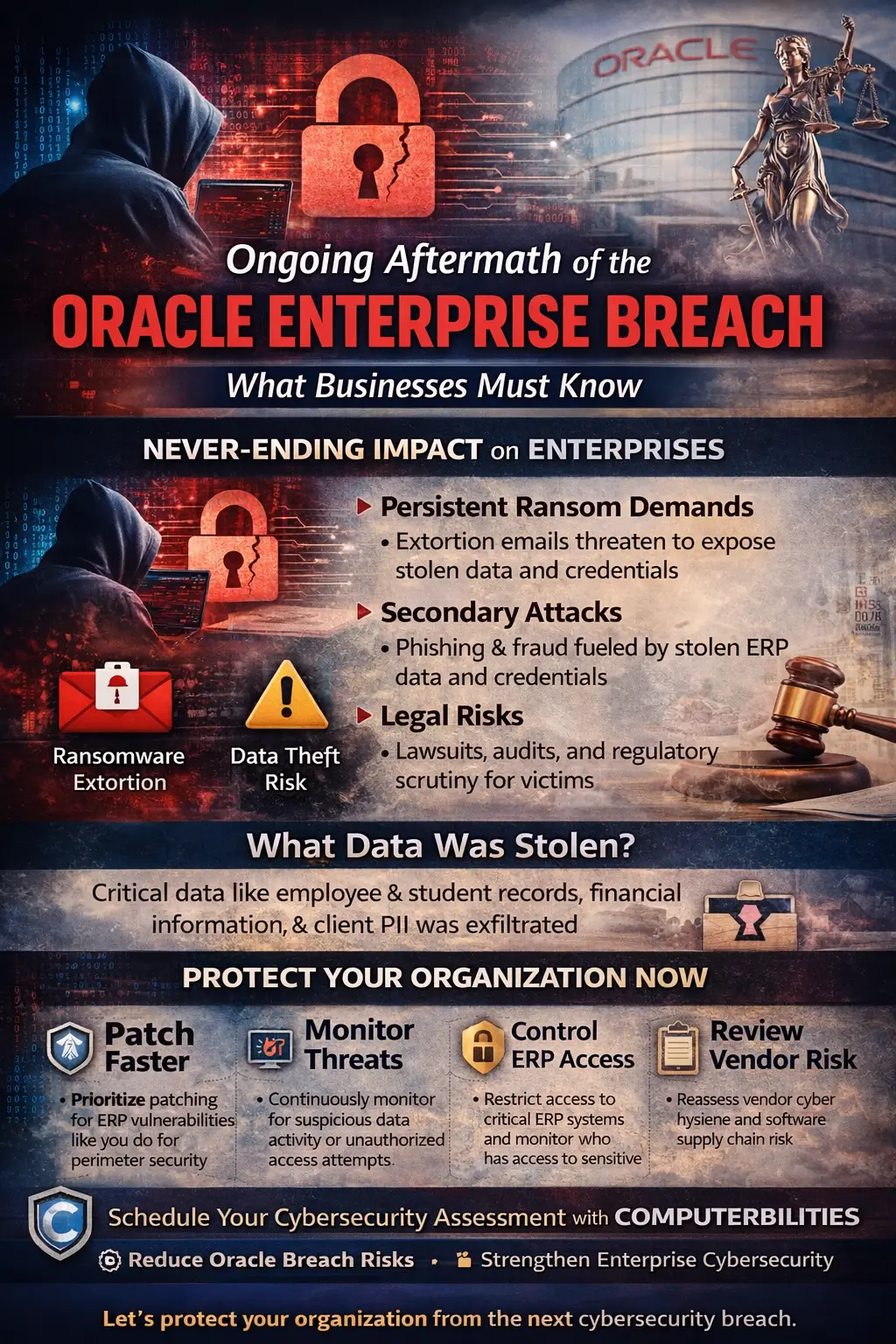
Many affected organizations have received Oracle breach extortion emails months after applying security patches. These messages typically reference stolen data and threaten public disclosure or resale unless ransom demands are met.
This tactic—commonly associated with the CL0P ransomware group and linked activity from FIN11—relies on leverage rather than disruption. Systems may be operational, but the business risk remains active.
Secondary and Tertiary Attacks
Stolen ERP data is rarely used just once. We have observed follow-on attacks including:
- Targeted phishing campaigns
- Identity fraud
- Credential reuse attacks
- Insider impersonation attempts
In practical terms, this means organizations may experience multiple security incidents stemming from a single breach.
Long-Term Trust and Compliance Challenges
For regulated industries, the breach has triggered investigations, audits, and in some cases class action lawsuits. These outcomes are not theoretical—they are already unfolding, particularly within the education and healthcare sectors.
Who Was Affected by the Oracle Breach?
A common question we hear from clients is: “Were organizations like ours affected?”
While there is no officially published Oracle breach victims list, public disclosures and legal filings indicate that the breach impacted:
- Universities and educational institutions
- Healthcare systems
- Public-sector and quasi-government organizations
- Large enterprises running on-premise Oracle EBS environments
In North Carolina, these categories represent a significant portion of the state’s economic and institutional infrastructure. Any organization relying on ERP platforms to manage sensitive data should assume heightened risk until proven otherwise.
What Data Was Exposed—and Why It Matters
Another key concern driving search interest is: “What data was stolen in the Oracle E-Business Suite breach?”
Based on breach investigations and litigation disclosures, compromised data may include:
- Personally identifiable information (PII)
- Employee and student records
- Payroll and financial data
- Internal operational reports
- System credentials and configuration data
ERP systems are attractive targets precisely because they centralize this information. Once accessed, attackers gain insight into how an organization operates—information that can be exploited repeatedly.
The Bigger Picture: Enterprise Software and Supply Chain Risk
Beyond Oracle itself, this incident has intensified concerns about business software supply chain risk. Many organizations assume that enterprise platforms are inherently secure simply because they are widely used and vendor-supported.
The Oracle breach challenged that assumption.
Even trusted ERP systems can contain zero-day vulnerabilities, and patch delays—whether due to operational complexity or resource constraints—can create significant exposure. This incident reinforces a fundamental truth in cybersecurity: security responsibility cannot be fully outsourced to software vendors.
Legal and Regulatory Fallout: Still Unfolding
The Oracle breach regulatory response and remediation phase is ongoing. Several trends are becoming increasingly clear:
- Lawsuits related to delayed disclosure and insufficient safeguards are rising
- Regulatory scrutiny is intensifying around patch management practices
- Third-party risk assessments are expanding to include ERP platforms
For North Carolina organizations, these developments align with broader national enforcement trends and underscore the need for documented, proactive cybersecurity governance.
How Organizations Can Protect Against Oracle EBS Exploitation
One of the most important questions we help clients answer is: “What should we do now?”
Protecting against active exploitation of Oracle vulnerabilities requires more than technical fixes. It requires a strategic approach to enterprise cybersecurity.
Practical Cybersecurity Best Practices
At Computerbilities, we recommend a layered defense strategy that includes:
- Prioritized Patch Management
ERP systems should receive the same urgency as perimeter defenses. Delayed patching is no longer a low-risk decision. - Continuous Monitoring and Threat Detection
Organizations should actively monitor for signs of data misuse—even after vulnerabilities are addressed. - Access Control and Data Segmentation
Limit who can access ERP systems and ensure sensitive data is segmented wherever possible. - Incident Response Preparedness
Plan not only for outages, but for extortion scenarios involving stolen data. - Vendor and Third-Party Risk Review
Reevaluate how enterprise software fits into your overall risk profile.
These steps form the foundation of Oracle breach cybersecurity best practices, but they must be tailored to each organization’s operational realities.
Why This Breach Still Matters Heading Into 2026
Searches like “How Oracle customers are still being extorted 2026” reflect a growing understanding: modern breaches do not end when systems come back online.
As long as stolen data remains valuable, organizations remain exposed. The Oracle data breach of 2025 is a clear example of how cyber incidents can persist quietly—then resurface at the most damaging moments.
How Computerbilities Helps North Carolina Organizations Stay Ahead
At Computerbilities, we understand that enterprise cybersecurity is not just a technical challenge—it is a business imperative.
We help organizations across North Carolina:
- Identify and remediate ERP and enterprise software vulnerabilities
- Strengthen patch management and monitoring processes
- Prepare for regulatory and compliance scrutiny
- Develop incident response strategies that address data extortion risks
- Build long-term resilience against evolving cyber threats
Our role is not just to respond to incidents, but to help organizations reduce the likelihood and impact of future breaches.
A Lasting Lesson for Enterprise Security
The ongoing aftermath of the Oracle enterprise breach serves as a defining case study in modern cybersecurity risk. It demonstrates that the true cost of a breach is often paid long after the initial vulnerability is patched.
For organizations in North Carolina, this incident is a call to action—to reassess enterprise system security, strengthen governance, and treat cybersecurity as an ongoing operational priority rather than a reactive task.
If your organization relies on Oracle E-Business Suite or other enterprise platforms, now is the time to ask hard questions about visibility, preparedness, and long-term risk.
Ready to Strengthen Your Enterprise Security?
If you are concerned about ERP vulnerabilities, ongoing breach exposure, or enterprise cybersecurity readiness, Computerbilities is here to help.
📞 Schedule a cybersecurity assessment
🔐 Talk to our managed security experts
🏢 Protect your organization before the next breach becomes your problem
Because in today’s threat landscape, prevention is no longer optional—it’s essential.