

New Year’s Resolutions for Cybercriminals (Spoiler: Your Business Is on Their List)
As businesses across North Carolina step into a new year with fresh goals, renewed budgets, and ambitious growth plans, cybercriminals are doing the exact same thing. While organizations focus on expansion and efficiency, threat actors are quietly refining their cybercrime goals for 2026—and many small and mid-sized businesses are at the top of their list.
The idea of New Year’s resolutions for cybercriminals may sound tongue-in-cheek, but it reflects a serious reality. Modern cybercrime is no longer random or opportunistic. It is strategic, calculated, and increasingly targeted. Understanding how cybercriminals plan, prioritize, and adapt is now essential for protecting your organization.
For businesses in Raleigh, Cary, Durham, Wake Forest, and across North Carolina, this knowledge can be the difference between a secure year and a costly security incident.
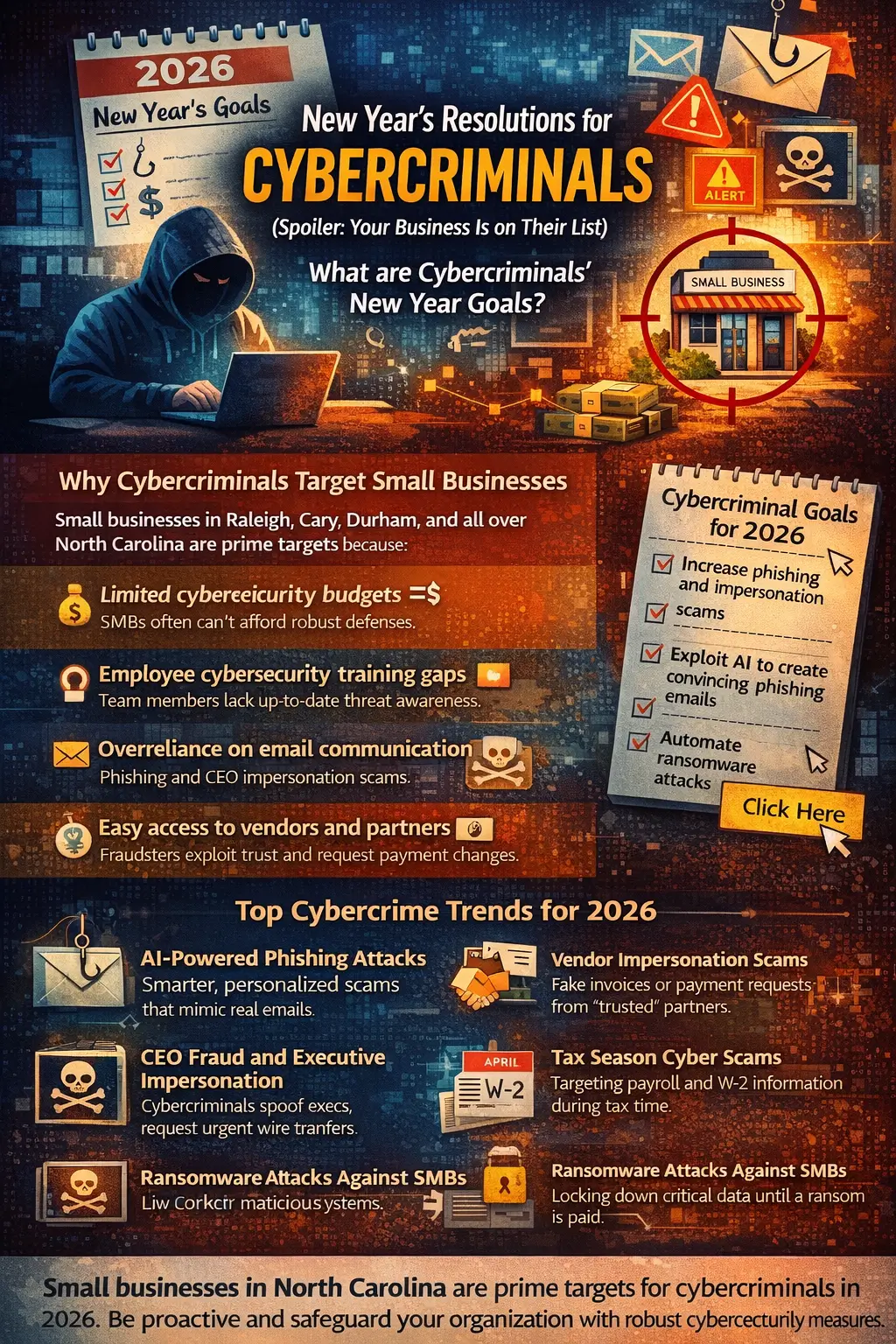
What Are Cybercriminals’ New Year Goals?
Just like legitimate businesses conduct year-end reviews and strategic planning sessions, cybercriminal groups assess what worked, what failed, and where the biggest opportunities lie. These cybercriminal resolutions for 2026 are driven by data, automation, and evolving technologies.
Their primary goals often include:
- Increasing attack success rates
- Reducing detection time
- Targeting organizations with limited security maturity
- Leveraging AI to scale attacks
- Exploiting trust within business ecosystems
This shift explains why businesses are on cybercriminals’ list—particularly small and mid-sized organizations that lack enterprise-grade defenses but still handle valuable data and financial assets.
Why Cybercriminals Target Small Businesses in 2026
A common misconception among North Carolina business owners is that cybercriminals only pursue large enterprises. In reality, cybercriminals target small businesses precisely because they offer the best return on effort.
Key Reasons SMBs Are Prime Targets
- Limited cybersecurity budgets
- Inconsistent employee training
- Overreliance on email communication
- Third-party vendor dependencies
- Lack of dedicated IT security staff
From healthcare clinics in Durham to law firms in Raleigh and manufacturing companies in Cary, small business cybersecurity threats in 2026 are escalating because attackers know many organizations still rely on outdated defenses.
Cybercrime Trends 2026: What’s Changing This Year?
The cyber threat landscape for 2026 reflects a shift from brute-force attacks to subtle, trust-based manipulation. Cybercriminals are no longer just hackers—they are social engineers, impersonators, and data analysts.
Top Cybercrime Trends Affecting SMBs
- AI-Powered Phishing Attacks
Traditional phishing emails were often poorly written and easy to spot. Today, AI-powered phishing attacks use natural language processing to create convincing, personalized messages that mirror real communication styles.
These attacks analyze:
- Email tone and frequency
- Job titles and reporting structures
- Vendor and client relationships
The result is a dramatic rise in successful business email compromise tactics.
- Vendor Impersonation Scams
Cybercriminals increasingly impersonate trusted vendors—accountants, IT services providers, logistics partners—to request payment changes or sensitive data. Without strong vendor verification policies, these scams often go unnoticed until financial damage is done.
- CEO Fraud and Executive Impersonation
CEO fraud cybersecurity incidents spike during busy periods when employees are less likely to verify urgent requests. Attackers exploit authority and urgency to bypass internal controls.
- Tax Season Cyber Scams
Every year, cybercriminal tactics during tax season become more sophisticated. Payroll data, W-2 forms, and financial records are prime targets, especially for businesses without proper email filtering and access controls.
Cyberattack Planning 2026: How Threat Actors Prepare
Cybercrime is no longer reactive. Cyberattack planning in 2026 involves reconnaissance, testing, and optimization.
A typical attack cycle includes:
- Identifying vulnerable organizations
- Mapping internal communication patterns
- Selecting high-impact targets (finance, HR, leadership)
- Deploying multi-stage phishing or impersonation campaigns
- Monetizing access through fraud or ransomware
This strategic approach explains how cybercriminals target small businesses with alarming precision.
Real-World Cyber Threats Your Business Faces
Consider this scenario:
A small accounting firm in North Carolina receives an email appearing to come from a long-term client. The message references a recent conversation and requests updated banking details. Everything looks legitimate—until funds are transferred to an attacker-controlled account.
This is not hypothetical. These examples of email impersonation attacks on businesses are happening daily across the state.
Common Cybercriminal Tactics Explained
Understanding common cybercriminal tactics empowers businesses to defend more effectively.
Most Frequent Attack Methods
- Phishing and spear-phishing
- Credential harvesting
- Ransomware deployment
- Vendor impersonation
- Fake invoice schemes
- Account takeover attacks
Each method relies less on technical exploitation and more on human trust, making employee awareness a critical defense.
Cybersecurity Predictions 2026: What Experts Expect
Security analysts predict:
- Continued growth in AI-assisted attacks
- Increased targeting of SMBs and professional services
- Higher regulatory scrutiny around data protection
- Rising demand for managed cybersecurity services
For North Carolina businesses, adapting to these business cybersecurity risks is no longer optional.
How to Protect Your Business from Modern Cybercrime
Effective defense in 2026 requires a layered approach combining technology, policy, and education.
Cybersecurity Best Practices for SMBs
- Multi-Factor Authentication (MFA)
The benefits of multi-factor authentication cannot be overstated. MFA dramatically reduces the success rate of credential-based attacks and should be mandatory for email, cloud platforms, and financial systems.
- Employee Training Against Cyber Threats
Regular cybersecurity training for employees transforms staff from liabilities into defenders. Training should include real-world simulations and updated threat examples.
- Email Filtering and Protection Tools
Advanced email filtering and protection tools powered by threat intelligence stop malicious emails before they reach inboxes.
- Vendor Verification Policies
Formal processes for verifying payment changes and sensitive requests prevent vendor impersonation scams.
- Ransomware Prevention Tips
Regular backups, patch management, and network segmentation remain essential ransomware prevention strategies.
Business Security Plan 2026: A Strategic Imperative
A modern business security plan for 2026 aligns cybersecurity with operational goals. It addresses:
- Risk assessment
- Incident response
- Compliance requirements
- Ongoing monitoring
Many organizations achieve this through SMB cybersecurity solutions and outsourced IT support for cybersecurity.
Managed Cybersecurity Services: A Practical Path Forward
For many North Carolina businesses, maintaining in-house expertise is impractical. Managed cybersecurity services provide access to enterprise-grade tools, 24/7 monitoring, and expert guidance without the overhead.
Whether you need cybersecurity services in Raleigh NC, IT security support in Cary NC, or managed security services in Durham NC, partnering with experienced providers strengthens resilience against evolving threats.
Frequently Asked Questions (FAQs)
Why is my business a target for cybercrime?
Because attackers view SMBs as accessible, profitable, and less protected.
Are cyber threats really increasing in 2026?
Yes. Cybercrime trends in 2026 show increased automation, AI use, and targeting of trusted relationships.
What is the most effective first step?
Implement MFA and employee security awareness training immediately.
Is cybersecurity only an IT issue?
No. It is a business risk management issue affecting finance, operations, and reputation.
Final Thoughts: Start the Year Ahead of Cybercriminals
Cybercriminals will continue refining their strategies, but businesses that understand attacker behavior and invest in proactive defense gain a decisive advantage. By recognizing New Year’s resolutions for cybercriminals, organizations can anticipate threats instead of reacting to them.
For small businesses across North Carolina, the goal for 2026 should be clear: stay informed, stay prepared, and treat cybersecurity as a strategic priority—not an afterthought.