
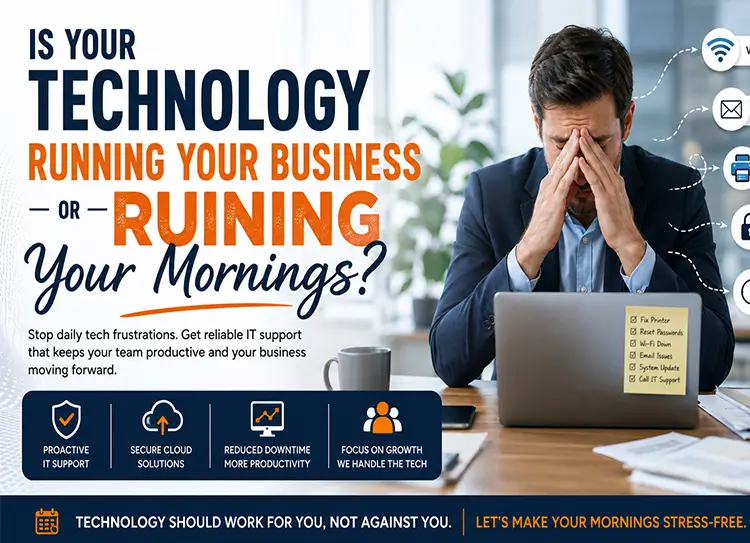
Is Your Technology Running Your Business or Ruining Your Monday Mornings?
Monday morning starts with good intentions.
Your team arrives ready to work. Coffee is brewing. Meetings are scheduled. Customer emails are waiting. Orders need processing. Deadlines are approaching.
Then it begins.
The printer refuses to connect. Wi-Fi slows to a crawl. Outlook won’t sync. Someone forgot their password again. QuickBooks freezes. A remote employee can’t access shared files. Your phones aren’t syncing with your CRM.
Before 9:00 a.m., your team is already frustrated.
For many small and medium businesses across Raleigh, Cary, Durham, and throughout North Carolina, this isn’t an occasional inconvenience — it’s become part of the daily routine.
The problem is not just broken technology. The real issue is that technology problems quietly drain productivity, frustrate employees, delay customer service, and create operational bottlenecks that cost businesses far more than they realize.
Technology should support your business, not interrupt it.
Yet many companies are unknowingly operating with systems that were assembled over time instead of strategically designed to help the business grow.
The result?
Constant interruptions. Technology downtime. Endless troubleshooting. Employee frustration. Lost revenue. And mornings that start with stress instead of progress.
The good news is that it doesn’t have to be this way.
With the right Managed IT Services, proactive IT support, and technology strategy, businesses can transform technology from a daily frustration into a competitive advantage.
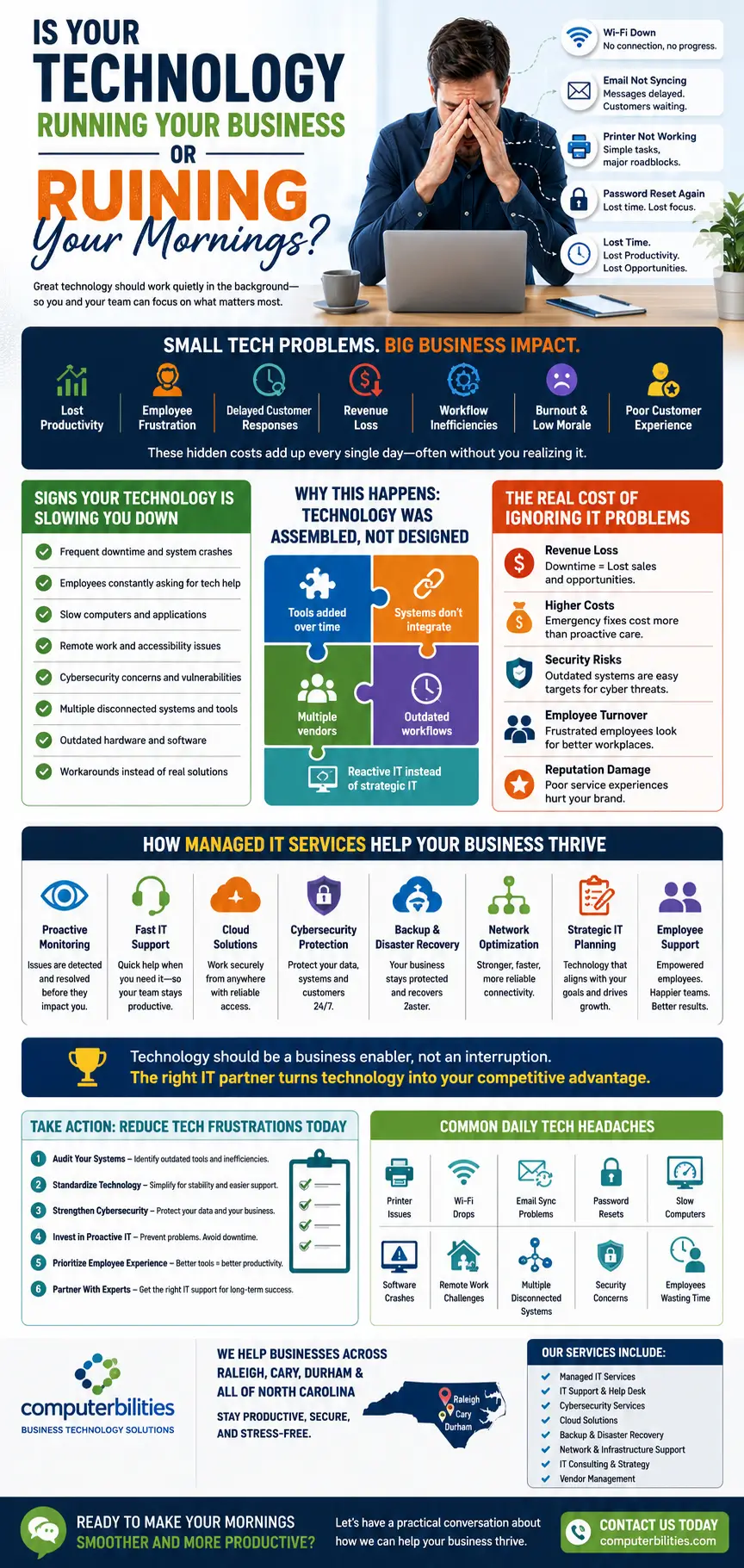
Why Small Technology Problems Become Big Business Problems
Many business owners underestimate the impact of small daily technology frustrations.
A single Wi-Fi interruption may only last five minutes. A printer issue might seem minor. Resetting passwords may feel routine.
But when these issues happen repeatedly across multiple employees, departments, and locations, they become a serious business productivity problem.
This is what experts often call “death by a thousand cuts.”
Small disruptions add up quickly:
- Employees lose focus
- Customer response times slow down
- Meetings get delayed
- Workflows become inefficient
- Staff morale decreases
- Productivity drains away quietly
According to multiple workplace productivity studies, employees can lose several hours each week dealing with technology frustrations in the workplace. Over the course of a year, those interruptions can cost businesses thousands of dollars in lost efficiency and downtime.
For SMBs in North Carolina, where lean teams often wear multiple hats, technology downtime can be especially damaging.
Unlike large corporations with massive IT departments, small businesses rely on efficiency. Every minute matters.
When your employees spend their mornings troubleshooting technology instead of serving customers, your business operations suffer.
The Hidden Cost of Daily IT Frustrations
Technology problems affect more than just systems.
They affect people.
Imagine an employee who starts every day dealing with slow computers, unstable internet connections, or software crashes. Eventually, frustration builds.
Over time, employees stop expecting technology to work properly.
Instead, they develop workarounds.
They save files in strange locations. They avoid certain applications. They delay updates. They create manual processes to bypass broken workflows.
While these workarounds may temporarily solve problems, they usually create larger issues later.
This leads to:
- Workflow inefficiencies
- Data inconsistencies
- Increased cybersecurity risks
- Communication breakdowns
- Reduced employee efficiency
- Poor customer experiences
Technology frustrations also contribute to burnout.
When employees constantly battle technology chaos, even simple tasks become mentally exhausting.
Instead of focusing on growth, innovation, or customer service, teams become distracted by constant interruptions.
That hidden productivity drain can quietly impact profitability for months or years before leadership fully recognizes the problem.
Signs Your Technology Is Slowing Down Your Business
Many business owners don’t realize their technology infrastructure is outdated until something major fails.
However, there are usually warning signs.
If any of the following sound familiar, your business technology may be hurting productivity instead of helping it:
Frequent Technology Downtime
If your systems regularly crash, disconnect, or slow down, it’s a clear sign your IT infrastructure needs attention.
Even short periods of downtime can disrupt entire workflows.
Employees Constantly Asking for Technical Help
If employees frequently struggle with login issues, software errors, or device problems, your technology environment may lack proper support and optimization.
Slow Computers and Applications
Outdated hardware and poorly managed systems reduce efficiency dramatically.
When employees spend several minutes waiting for systems to load multiple times per day, productivity suffers.
Remote Work Frustrations
Hybrid and remote work environments require stable cloud solutions, secure access, and reliable collaboration tools.
Without proper IT services, remote employees often face communication and connectivity challenges.
Cybersecurity Concerns
Outdated systems create security vulnerabilities.
Weak passwords, missing updates, phishing attacks, and unsecured networks can expose businesses to costly cyber threats.
For businesses across Raleigh, Cary, and Durham, cybersecurity services are no longer optional — they are essential.
Multiple Disconnected Systems
Many businesses add technology tools over time without considering long-term integration.
The result is a patchwork of disconnected platforms, vendors, and applications that create operational inefficiencies.
Technology Was Assembled — Not Strategically Designed
This is one of the biggest issues affecting small and medium businesses today.
Most companies didn’t intentionally create a complicated IT environment.
It happened gradually.
A new accounting system was added one year. A cloud platform came later. Employees started using personal devices. Different departments adopted separate software solutions.
Over time, the business technology environment became reactive instead of strategic.
The systems may technically function, but they don’t work together efficiently.
This creates:
- Duplicate work
- Communication gaps
- Security vulnerabilities
- Poor workflow optimization
- Vendor confusion
- Inefficient business operations
Instead of supporting growth, technology becomes a source of daily stress.
The businesses that operate most efficiently today are not necessarily the ones with the most technology.
They are the ones with the most organized, integrated, and strategically managed technology.
Why Reactive IT Support Is Costing Your Business More
Many businesses only call for IT support when something breaks.
Unfortunately, reactive IT support is often far more expensive than proactive maintenance.
Waiting for problems to happen creates:
- Unexpected downtime
- Emergency repair costs
- Lost productivity
- Employee frustration
- Customer service disruptions
- Security risks
Reactive support is similar to driving a car without regular maintenance and only visiting the mechanic after the engine fails.
By that point, the damage is already done.
Modern Managed IT Services focus on prevention rather than reaction.
Instead of constantly putting out fires, proactive IT support helps businesses prevent problems before they impact operations.
That shift can dramatically improve business continuity and employee productivity.
How Managed IT Services Improve Productivity
Businesses today rely on technology for nearly every aspect of operations.
That’s why Managed IT Services have become essential for SMBs throughout North Carolina.
A professional Managed Service Provider in North Carolina helps businesses maintain reliable, secure, and optimized technology environments without the cost of building a large in-house IT department.
Here’s how managed IT services improve productivity:
Instead of waiting for systems to fail, proactive monitoring identifies issues early.
Potential problems are resolved before employees even notice them.
This reduces technology downtime and keeps business operations running smoothly.
When employees experience issues, responsive help desk support minimizes disruption.
Quick resolutions help teams stay focused and productive.
Network Optimization
Reliable internet and network performance are critical for modern businesses.
Professional network support improves speed, stability, and connectivity across the organization.
Cloud services help teams collaborate securely from anywhere.
This is especially important for hybrid and remote work environments.
Cybersecurity threats continue to grow rapidly.
Managed IT providers offer cybersecurity services that include:
- Threat monitoring
- Firewall management
- Multi-factor authentication
- Security updates
- Employee cybersecurity training
- Data backup and disaster recovery
These protections reduce risk while improving peace of mind.
Strategic IT Planning
Technology should align with business goals.
IT consulting helps companies create long-term technology strategies that support growth, scalability, and operational efficiency.
Technology Should Support Your Business — Not Distract You
The best business technology is often invisible.
Employees should not spend their mornings troubleshooting printers or reconnecting to Wi-Fi.
Business owners should not lose sleep worrying about cybersecurity vulnerabilities or server failures.
Technology should quietly support productivity in the background.
When properly managed, technology becomes:
- A productivity driver
- A growth tool
- A competitive advantage
- A business enabler
- A foundation for operational efficiency
Instead of creating stress, technology creates momentum.
That shift changes the entire workplace experience.
Employees become more efficient. Customers receive faster service. Teams collaborate more effectively. Leadership can focus on strategic growth instead of daily technical issues.
The Connection Between Technology and Customer Experience
Technology problems don’t stay internal for long.
Customers notice them too.
Slow systems delay responses. Communication issues create confusion. Downtime interrupts service delivery. Cybersecurity incidents damage trust.
In today’s competitive environment, customer expectations are higher than ever.
Businesses cannot afford technology bottlenecks that hurt responsiveness and reliability.
For example:
- A law firm with unstable document systems may delay client communication.
- A medical office experiencing network issues may struggle with appointment scheduling.
- A retail business with POS downtime may lose sales opportunities.
- A professional services company with poor remote access may reduce employee collaboration.
Technology management directly impacts customer experience.
Businesses that prioritize reliable IT infrastructure are often able to deliver faster, smoother, and more professional service.
Hybrid Work Has Changed Technology Expectations
The workplace has changed dramatically in recent years.
Employees now expect seamless access to files, applications, communication platforms, and cloud systems whether they are in the office, at home, or traveling.
Unfortunately, many businesses are still relying on outdated infrastructure that was never designed for hybrid work.
This creates:
- VPN issues
- File-sharing frustrations
- Communication delays
- Security vulnerabilities
- Device management problems
Small Business IT Support must now account for flexibility, mobility, and cybersecurity simultaneously.
Businesses that modernize their technology strategy are better positioned to support employee productivity and long-term growth.
The Real Cost of Ignoring Technology Problems
Some businesses tolerate technology frustrations because they seem manageable.
But the long-term costs can be significant.
Ignoring recurring technology issues often leads to:
Revenue Loss
Downtime interrupts operations and delays customer transactions.
Employee Turnover
Frustrated employees may seek workplaces with better tools and systems.
Cybersecurity Incidents
Outdated systems increase vulnerability to ransomware, phishing, and data breaches.
Reputation Damage
Customers expect reliable service. Technology failures can harm credibility and trust.
Operational Inefficiency
Disorganized systems create ongoing workflow bottlenecks and wasted labor hours.
What Proactive IT Support Looks Like
Proactive IT support focuses on prevention, optimization, and long-term stability.
Instead of simply fixing problems, proactive support continuously improves the technology environment.
This includes:
- Regular system monitoring
- Security patch management
- Software updates
- Data backup verification
- Performance optimization
- Strategic IT consulting
- Employee support
- Vendor coordination
- Technology planning
The goal is simple:
Reduce stress. Improve productivity. Prevent downtime.
Businesses with proactive IT support often experience smoother operations, better employee morale, and fewer daily disruptions.
How Computerbilities Helps North Carolina Businesses Stay Productive
At Computerbilities, we understand how frustrating recurring technology issues can be for small and medium businesses.
For years, we’ve helped organizations across Raleigh, Cary, Durham, and throughout North Carolina improve operational efficiency with reliable IT Support and Managed IT Services.
Our approach focuses on helping businesses eliminate technology chaos so teams can stay productive and focused on growth.
Our services include:
- Managed IT Services North Carolina
- Business IT Support Raleigh
- Cybersecurity Services
- Cloud Solutions
- Data Backup & Disaster Recovery
- Network Support
- Technology Consulting
- Proactive IT Monitoring
- Help Desk Support
- Strategic Technology Management
We believe technology should simplify your business operations — not complicate them.
Whether your organization is struggling with daily tech headaches, recurring downtime, or outdated systems, our team helps create practical IT solutions designed for reliability, security, and long-term growth.
Actionable Ways to Reduce Technology Frustrations
If your business experiences regular technology problems, here are several practical steps you can take immediately:
Audit Your Existing Systems
Identify outdated hardware, unsupported software, and inefficient workflows.
Standardize Technology
Reducing unnecessary software and device variations improves stability and support efficiency.
Improve Cybersecurity Practices
Implement strong passwords, multi-factor authentication, regular updates, and employee training.
Invest in Proactive Maintenance
Preventative support reduces downtime and improves system reliability.
Prioritize Employee Experience
Technology should help employees work efficiently, not create constant interruptions.
Work With a Trusted IT Partner
An experienced IT company in North Carolina can help align your technology with your business goals.
Final Thoughts
Technology should not ruin your mornings.
It should not create daily frustrations, slow down employees, or distract your team from meaningful work.
The right technology strategy creates smoother workflows, stronger security, better employee experiences, and improved business productivity.
For small and medium businesses across North Carolina, proactive IT support and managed IT services are no longer optional — they are essential for long-term success.
At Computerbilities, we help businesses move beyond constant troubleshooting and toward stress-free technology that supports growth, efficiency, and peace of mind.
If your mornings are starting with technology chaos instead of productivity, it may be time for a practical conversation about how your IT environment can work better for your business.
Frequently Asked Questions (FAQs)
- Why do small technology problems hurt business productivity?
Small technology issues create constant interruptions that reduce employee focus, slow workflows, and increase downtime. Over time, these disruptions significantly impact operational efficiency and profitability.
- How do managed IT services improve productivity?
Managed IT Services provide proactive monitoring, faster issue resolution, network optimization, cybersecurity protection, and strategic IT planning that reduce downtime and improve employee efficiency.
- What are common technology problems in small businesses?
Common issues include slow computers, printer failures, Wi-Fi drops, password reset problems, software crashes, remote work frustrations, cybersecurity vulnerabilities, and disconnected systems.
- How can businesses reduce technology downtime?
Businesses can reduce downtime by investing in proactive IT support, regular maintenance, cybersecurity updates, cloud solutions, data backup systems, and strategic technology management.
- Why is proactive IT support better than reactive IT support?
Reactive support fixes problems after they occur, while proactive IT support prevents many issues before they disrupt operations. This reduces downtime, stress, and emergency repair costs.
- How does cybersecurity impact business operations?
Cybersecurity incidents can lead to downtime, financial loss, reputational damage, and operational disruptions. Strong cybersecurity services help businesses protect sensitive data and maintain business continuity.
- What industries benefit from Managed IT Services?
Nearly every industry benefits, including healthcare, legal services, professional services, retail, manufacturing, education, and financial organizations.
- How can Computerbilities help businesses in North Carolina?
Computerbilities provides Managed IT Services, IT Support, cybersecurity services, cloud solutions, network support, backup and disaster recovery, and strategic IT consulting to help businesses improve productivity and reduce technology frustrations.