
Your Password Is the Key Under the Doormat
The passwords are often the first — and sometimes only — line of defense protecting sensitive business information. Yet many small and medium-sized businesses (SMBs) across Raleigh, Cary, Durham, and throughout North Carolina still rely on weak password habits that leave their systems vulnerable to cyber threats.
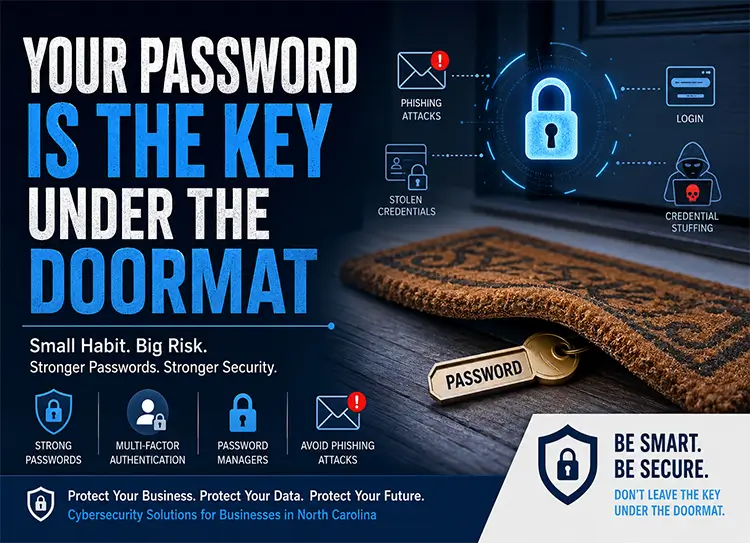
Think about it this way: reusing the same password across multiple accounts is like hiding your house key under the doormat. It may seem convenient, but if someone finds it once, they can unlock everything.
Unfortunately, this exact scenario plays out every day in the world of cybersecurity. One stolen password can give cybercriminals access to email systems, cloud platforms, customer databases, banking applications, CRMs, and more. For small businesses, the consequences can be devastating.
As phishing attacks, credential stuffing, and AI-powered cyber threats continue to rise, businesses can no longer afford to treat password security as an afterthought.
In this guide, we’ll explore why password reuse is dangerous, how hackers exploit stolen credentials, and what North Carolina businesses can do to improve account security and protect critical data.
Why Password Reuse Is a Massive Cybersecurity Risk
Most people know weak passwords are dangerous. What many business owners don’t realize is that password reuse is often even more dangerous.
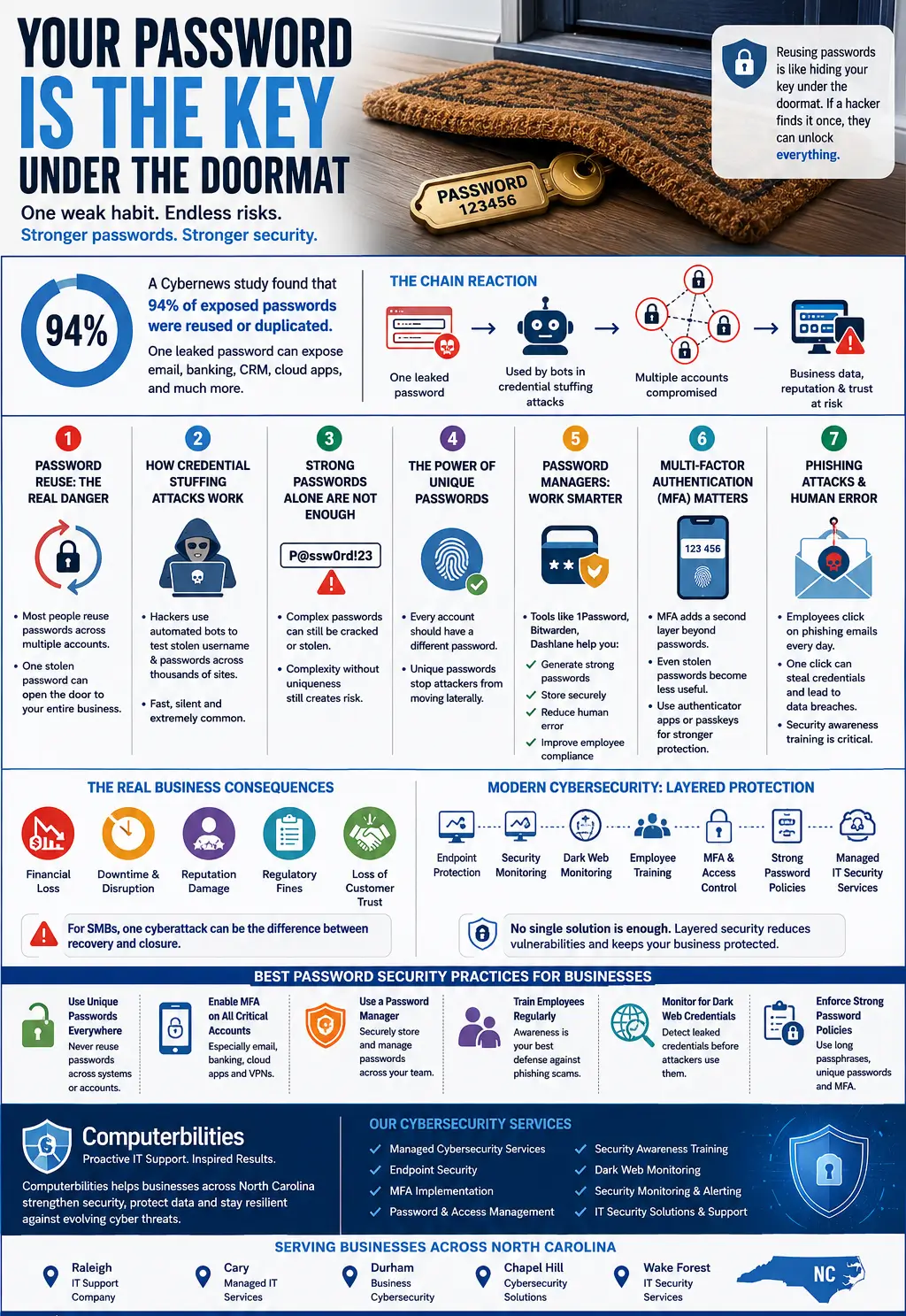
A recent cybersecurity study found that nearly 94% of exposed passwords were reused or duplicated across accounts. That means once hackers steal one password, they immediately try it everywhere else.
For example:
- Email accounts
- Banking platforms
- CRM systems
- Microsoft 365
- Google Workspace
- Payroll portals
- Cloud storage
- VPN access
This creates a chain reaction where one compromised login can expose an entire organization.
For SMBs in North Carolina, this is especially concerning because small businesses are frequently targeted due to weaker cybersecurity defenses.
How Credential Stuffing Attacks Work
One of the fastest-growing cyber threats today is credential stuffing.
Credential stuffing occurs when cybercriminals use automated bots to test stolen usernames and passwords across multiple websites and systems.
The process is simple:
- Hackers buy stolen credentials from the dark web.
- Automated tools test those credentials across thousands of sites.
- If passwords are reused, attackers gain access.
The attack happens rapidly and often goes unnoticed.
A single compromised employee password could expose:
- Business email
- Customer information
- Financial systems
- Internal communication tools
- Vendor accounts
This is why password protection is now a core part of business cybersecurity.
The Illusion of a “Strong Enough” Password
Many users believe adding symbols or numbers automatically creates secure passwords.
For example:
- Password123!
- Raleigh2025#
- Welcome@1
Technically, these passwords may appear “complex,” but they are still vulnerable if reused across multiple platforms.
Modern cybercriminals don’t rely on guessing passwords manually anymore. Instead, they use automation and massive databases of leaked credentials.
A password can be strong yet still dangerous if used repeatedly.
That’s why cybersecurity experts now emphasize:
- Unique passwords
- Secure authentication
- MFA security
- Password managers
Complexity alone is no longer enough.
Why Unique Passwords Matter More Than Ever
Every account within your business should have its own unique password.
Why?
Because unique passwords stop attackers from moving laterally through systems.
If an employee reuses the same password for:
- Payroll
- CRM
- Cloud storage
then one compromised account becomes a gateway to everything else.
Unique passwords help contain the damage from data breaches and improve business data protection.
Password Managers: The Smarter Way to Stay Secure
Remembering dozens of complex passwords is unrealistic for most employees. That’s where password managers become essential.
Popular password managers include:
- 1Password
- Bitwarden
- Dashlane
These tools help businesses:
- Generate strong passwords
- Store credentials securely
- Improve employee compliance
- Reduce human error
- Simplify secure login practices
Instead of employees reusing passwords or writing them down, password managers create secure authentication workflows.
For growing SMBs in Raleigh, Cary, and Durham, implementing a password manager is one of the easiest cybersecurity improvements available.
Why Businesses Need MFA Today
Multi-factor authentication (MFA) adds an extra layer of protection beyond passwords.
Even if cybercriminals steal credentials, MFA can prevent unauthorized access.
MFA security usually requires:
- A password
- A mobile authenticator code
- A biometric scan
- A hardware key
This dramatically reduces account takeover risks.
Businesses should prioritize:
- Authenticator apps
- Passkeys
- Hardware security keys
instead of relying solely on SMS-based authentication.
Modern phishing attacks can intercept text-message codes, making app-based MFA more secure.
For North Carolina businesses, MFA is no longer optional — it is a cybersecurity necessity.
How Phishing Attacks Lead to Data Breaches
Phishing attacks remain one of the leading causes of stolen credentials.
Cybercriminals create fake:
- Emails
- Login pages
- Microsoft alerts
- Banking notifications
- File-sharing requests
to trick employees into entering passwords.
Today’s phishing scams are becoming more sophisticated due to artificial intelligence.
AI-powered phishing can:
- Mimic writing styles
- Personalize emails
- Create convincing fake invoices
- Impersonate executives
One successful phishing attempt can compromise an entire organization.
This is why employee cybersecurity awareness training is critical for ransomware prevention and cyberattack prevention.
The Real Business Consequences of Weak Password Security
Many SMB owners underestimate the impact of cyber incidents until it’s too late.
Weak password security can lead to:
- Financial losses
- Operational downtime
- Regulatory fines
- Reputation damage
- Customer trust issues
For some small businesses, a single ransomware attack can permanently disrupt operations.
Businesses in industries like:
- Healthcare
- Legal
- Finance
- Retail
- Professional services
face especially high risks because they handle sensitive customer information.
AI-Powered Cyber Threats Are Changing the Game
Cybercriminals are increasingly using AI to automate attacks.
Modern AI-powered threats can:
- Generate phishing emails instantly
- Analyze employee behavior
- Crack weak passwords faster
- Launch large-scale credential stuffing attacks
This means businesses must evolve their cybersecurity strategies beyond traditional password protection alone.
Organizations should begin exploring:
- Passkeys
- Passwordless authentication
- Advanced endpoint security
- Dark web monitoring
- Security monitoring solutions
Modern Cybersecurity Requires Layered Protection
Strong cybersecurity is never built on one tool alone.
Businesses need layered protection that includes:
- Strong passwords
- MFA security
- Endpoint protection
- Security monitoring
- Password policies
- Employee training
- Managed cybersecurity services
- Dark web credential monitoring
A layered approach helps reduce vulnerabilities and improves resilience against evolving cyber threats.
Best Password Security Practices for Businesses
Here are some essential cybersecurity tips for small businesses:
Use Unique Passwords Everywhere
Never reuse passwords across systems or accounts.
Enable MFA on Every Critical Account
Especially for:
- Banking
- Cloud applications
- VPNs
Use a Password Manager
Centralized password management reduces risk.
Train Employees Regularly
Human error remains one of the biggest cybersecurity vulnerabilities.
Monitor for Dark Web Credentials
Stolen credentials often appear on dark web marketplaces before businesses realize they’ve been breached.
Update Password Policies
Require:
- Long passphrases
- Unique credentials
- MFA enforcement
How Computerbilities Helps North Carolina Businesses Stay Secure
At Computerbilities, we understand that SMBs need practical and effective cybersecurity solutions — not overly complicated technology.
Our team provides:
- Managed cybersecurity services in North Carolina
- Endpoint security
- Password policy management
- MFA implementation
- Security awareness training
- Dark web monitoring
- Business cybersecurity in Durham
- Managed IT services in Cary
- IT security services in Wake Forest
- Cybersecurity solutions in Chapel Hill
- IT support company in Raleigh
We help businesses strengthen account security while reducing operational risks from phishing attacks, ransomware, and stolen credentials.
Whether you’re a growing company in Raleigh or an established business in Durham, our cybersecurity experts can help protect your systems and sensitive data.
Final Thoughts
Your password may seem small, but in today’s cybersecurity landscape, it can open the door to your entire business.
Reusing passwords is no different than hiding your key under the doormat — convenient, but dangerously insecure.
As credential stuffing, phishing attacks, and AI-powered cyber threats continue to evolve, businesses must adopt stronger cybersecurity practices to stay protected.
By using:
- Unique passwords
- Password managers
- MFA security
- Employee training
- Layered cybersecurity solutions
businesses can dramatically reduce their risk and improve long-term resilience.
Cybersecurity is no longer just an IT issue — it’s a business survival issue.
Frequently Asked Questions (FAQs)
Why is password reuse dangerous?
Password reuse allows hackers to access multiple accounts using one stolen credential. If one password is compromised, attackers may gain access to email, banking, cloud systems, and more.
What is credential stuffing?
Credential stuffing is a cyberattack where hackers use automated bots to test stolen usernames and passwords across multiple websites and platforms.
How does multi-factor authentication improve security?
MFA adds a second layer of protection beyond passwords, making it harder for attackers to gain access even if credentials are stolen.
Are password managers safe for businesses?
Yes. Reputable password managers securely store and generate strong passwords, helping businesses improve account security and reduce human error.
What are the signs of a phishing attack?
Common signs include:
- Suspicious email addresses
- Urgent requests
- Fake login pages
- Unexpected attachments
- Requests for passwords or financial information
How often should businesses update passwords?
Businesses should update passwords regularly and immediately after any suspected compromise or data breach.
Can small businesses really be targeted by cybercriminals?
Absolutely. SMBs are often targeted because they may lack advanced cybersecurity defenses compared to larger enterprises.
What cybersecurity services does Computerbilities provide?
Computerbilities offers managed cybersecurity services, endpoint security, MFA implementation, password management support, employee training, dark web monitoring, and IT security solutions for businesses across North Carolina.