
Apple Warns Millions of iPhones Are Exposed to Attack: A Cybersecurity Wake-Up Call for North Carolina Users
Apple is not a company known for overreacting. When it issues a public iPhone security warning, it usually means one thing: the threat is real, active, and already being exploited.
That is exactly what happened in early 2026, when Apple confirmed that millions of iPhones are exposed to attack due to a critical security flaw in iOS. The warning, now widely covered by Forbes, Fox News, Yahoo, and other major outlets, highlights a sophisticated cyberattack targeting Apple’s WebKit framework—the technology that powers Safari and many iPhone apps.
For iPhone users across North Carolina, this warning deserves serious attention. Whether you’re a business owner in Raleigh, a healthcare professional in Durham, or a remote worker in Cary or Chapel Hill, your iPhone likely contains sensitive personal and business data. And right now, unpatched devices remain vulnerable.
This article breaks down what the Apple iPhone security warning really means, why these attacks are so dangerous, and—most importantly—what North Carolina individuals and businesses should do immediately to stay protected.
Apple Warns iPhones Are Vulnerable: What Actually Happened?
At the center of Apple’s warning is a critical WebKit vulnerability.
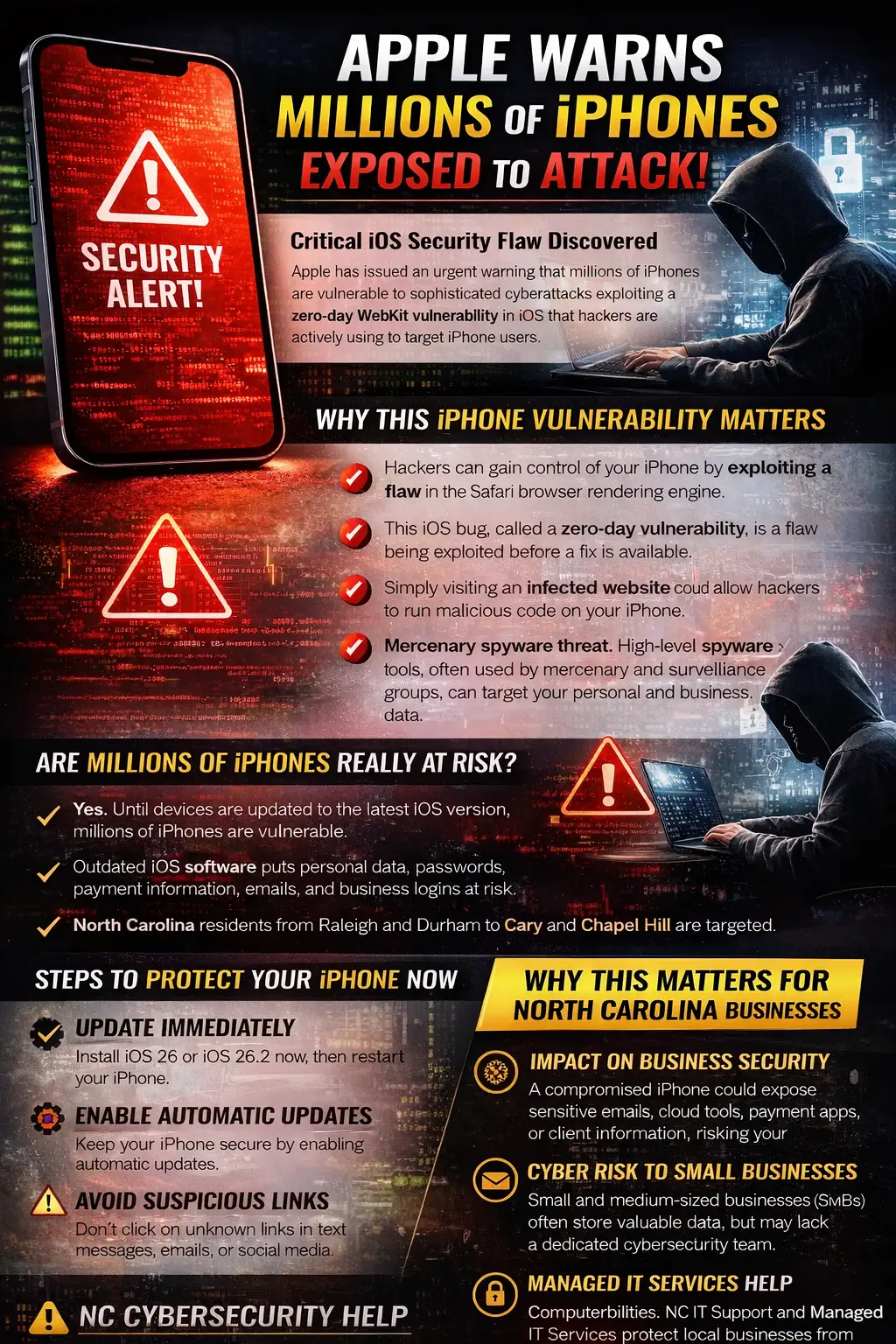
WebKit is the browser engine behind Safari and many iOS apps. When attackers discovered zero-day vulnerabilities in WebKit, they gained a dangerous advantage: the ability to exploit iPhones before Apple had a chance to patch the flaw.
According to Apple, these attacks were already happening in the wild.
That’s why this wasn’t a routine update notice. This was a clear iOS security warning acknowledging that iPhones were being actively targeted.
How WebKit Vulnerabilities Expose iPhones to Cyberattacks
To understand the risk, think of WebKit as a gatekeeper.
Even if your iPhone has strong encryption, Face ID, and app permissions, a flaw in WebKit can allow attackers to slip through unnoticed—sometimes simply by getting you to open a compromised webpage.
When exploited, this iPhone vulnerability exposed users to:
- Hackers gaining control of browser processes
- Background execution of malicious code
- Potential access to stored credentials
- Elevated risk of spyware installation
This means an iPhone exposed to cyberattack doesn’t always show obvious signs of compromise.
Why Millions of iPhones Are at Risk
Apple supports a wide range of devices, which is great for users—but it also means many people delay updates.
If an iPhone:
- Is running an older version of iOS 26
- Has not installed the latest Apple security patch
- Has automatic updates disabled
…it may still be exposed.
That’s why headlines emphasize millions of iPhones at risk. The threat isn’t theoretical—it affects everyday users, including professionals, students, and small businesses across North Carolina.
The Growing Concern: Mercenary Spyware Threats
One detail that raised red flags among cybersecurity professionals is Apple’s reference to mercenary spyware threats.
These are not amateur hackers. Mercenary spyware is often:
- Highly sophisticated
- Designed for stealth
- Capable of long-term surveillance
While these attacks may start as targeted operations, history shows that tools developed for “elite” use often spread quickly. That makes early action essential.
This is why Apple urges iPhone update messages should never be ignored.
iOS 26 Security Update: Why It Matters So Much
To stop the attacks, Apple released an iOS 26 security update, followed by additional fixes in iOS 26.2.
These updates:
- Close the WebKit exploit
- Address known zero-day vulnerabilities
- Strengthen Safari browser security
- Reduce the risk of malicious websites executing code
In some cases, Apple also advised users to restart iPhone security processes after updating—an unusually direct recommendation that underscores the seriousness of the issue.
Why Restarting Your iPhone Is Not Optional
Many users overlook this step, but restarting your device matters.
A restart:
- Clears memory-resident threats
- Forces security patches to activate properly
- Interrupts potential spyware processes
In cybersecurity terms, it’s the digital equivalent of resetting an alarm system after a breach attempt.
What iPhone Users in North Carolina Should Be Most Concerned About
For North Carolina residents, the risks go beyond personal inconvenience.
Modern iPhones store:
- Banking and payment apps
- Healthcare portals
- Corporate email and VPN access
- Two-factor authentication credentials
A compromised phone can expose not just individuals—but entire organizations.
This is where IT Support and Managed IT Services become critical, especially for small and mid-sized businesses that don’t have in-house security teams.
Steps to Protect Your iPhone From the Latest Hack
If you’re asking, “What should I do right now?”—start here.
- Install the Latest iOS Update Immediately
Go to Settings → General → Software Update
Install iOS 26 or iOS 26.2 without delay.
- Restart Your iPhone
This ensures the security patch is fully applied.
- Be Cautious With Links
Avoid clicking unknown links in emails, texts, or social media—even if they appear legitimate.
- Enable Automatic Updates
This ensures future security updates for iPhone install as soon as Apple releases them.
- Think Beyond the Device
If your iPhone connects to company email, cloud apps, or internal systems, the risk extends to your business network.
Why This Matters for Businesses Across North Carolina
At Computerbilities, we see firsthand how mobile device vulnerabilities can become entry points for larger cyber incidents.
A single compromised phone can lead to:
- Credential theft
- Unauthorized access to business systems
- Data breaches
- Compliance violations
This is why modern IT Services and Cybersecurity strategies must include mobile device protection—not just servers and desktops.
How Computerbilities Helps North Carolina Businesses Stay Secure
Computerbilities provides IT Support, Managed IT Services, and Cybersecurity solutions designed specifically for North Carolina businesses.
Our services help organizations:
- Monitor and manage device security
- Enforce update and patch policies
- Protect against phishing, spyware, and zero-day threats
- Respond quickly when vulnerabilities are discovered
Cyber threats evolve quickly. Your protection should too.
How to Protect Your iPhone—and Your Business—in 2026 and Beyond
Apple’s warning is a reminder of a larger truth:
Cybersecurity is no longer optional.
Staying secure requires:
- Consistent software updates
- Strong mobile security practices
- Professional IT oversight
- Proactive risk management
If you’re unsure whether your devices—or your business—are adequately protected, now is the time to ask.
Talk to a Local North Carolina IT Security Expert
If you’re based in Raleigh, Cary, Durham, Wake Forest, Apex, Holly Springs, or Chapel Hill, Computerbilities is here to help.
👉 Need expert IT Support you can trust?
👉 Concerned about mobile security and cyber threats?
👉 Looking for Managed IT Services tailored to North Carolina businesses?
Contact Computerbilities today to schedule a cybersecurity consultation and ensure your devices, data, and business are protected—now and in the future.