
April Fools Jokes Are Over, but These Scams Aren’t Fun Pranks
April Fools’ Day has always been about harmless fun—office pranks, fake announcements, and lighthearted jokes that bring a smile. But in today’s digital world, not everything that looks like a prank is innocent.
For small and medium-sized businesses (SMBs) in Raleigh, Cary, Durham, and across North Carolina, April is no longer just about jokes—it’s a time when cybercriminals exploit confusion, curiosity, and trust to launch sophisticated attacks.
And unlike a prank, these scams don’t end with laughter—they end with financial loss, data breaches, and reputational damage.
As we move into 2026, one thing is clear:
👉 The jokes may be over, but cyber scams are here to stay.
Why Cybercriminals Love April
April isn’t just tax season—it’s also prime time for cyber scams.
Here’s why attackers ramp up their efforts during this time:
- Increased Digital Activity
Businesses are busy with tax filings, audits, and financial reporting. Employees are more likely to:
- Open emails quickly
- Trust financial communications
- Overlook suspicious details
- Confusion from April Fools Messaging
Scammers disguise malicious emails as jokes or promotions.
A message that looks like a prank may actually be:
- A phishing attempt
- A fake login page
- A malware download
- Exploiting Urgency
Cybercriminals thrive on urgency:
“Your account will be suspended today!”
“Immediate payment required!”
During busy seasons, employees are more likely to react without verifying.
The Joke Is Over, But the Threats Are Real
Let’s be clear—modern cyber scams are no joke.
Unlike traditional spam emails from a decade ago, today’s attacks are:
- Highly personalized
- AI-generated
- Nearly impossible to detect at first glance
Imagine this scenario:
You receive an email from your CEO asking for an urgent wire transfer. The tone is perfect. The signature matches. Even the email address looks legitimate.
But it’s not your CEO.
It’s a Business Email Compromise (BEC) attack—one of the most damaging scams targeting businesses today.
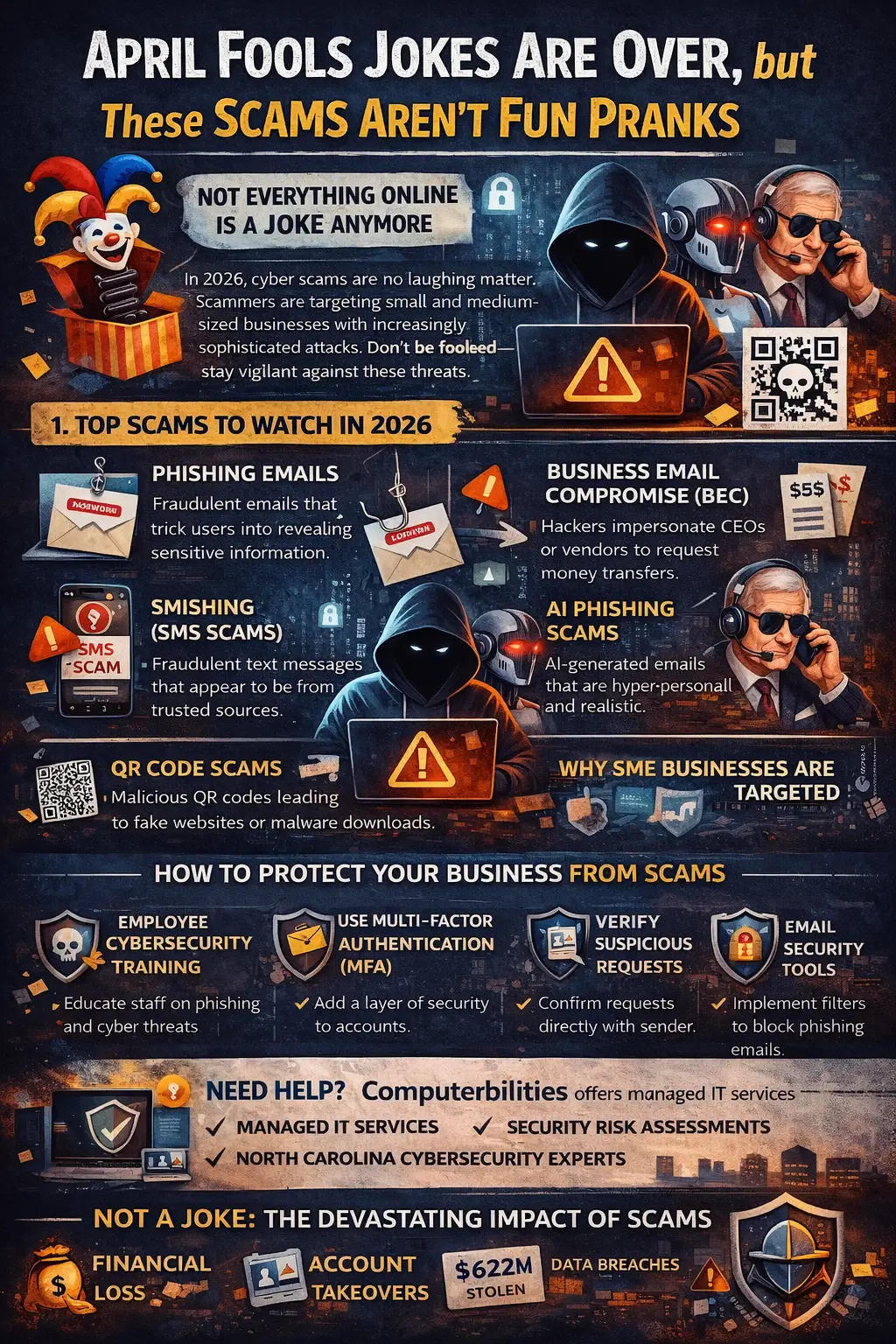
Top Scams You Need to Watch in 2026
Cyber scams are evolving rapidly. Here are the most common threats businesses face today:
- Phishing Scams (Email-Based Attacks)
Still the #1 cyber threat globally, phishing scams trick users into:
- Clicking malicious links
- Sharing login credentials
- Downloading malware
- Business Email Compromise (BEC)
Attackers impersonate executives or vendors to request:
- Wire transfers
- Invoice payments
- Sensitive data
- Smishing (SMS Phishing)
Text messages that appear to be from:
- Banks
- Delivery services
- Government agencies
- Vishing (Voice Scams)
Fraudulent phone calls using:
- Fake caller IDs
- AI-generated voices
- QR Code Scams
A growing trend where users scan a code that leads to:
- Fake login pages
- Malware downloads
- AI Phishing Scams
AI has changed everything. Attackers now create:
- Perfect grammar emails
- Personalized messages
- Deepfake voice/video impersonations
How AI Is Making Scams More Dangerous
Artificial Intelligence has become a powerful tool—not just for businesses, but for cybercriminals.
AI-Powered Threats Include:
- Deepfake CEO fraud
- Automated phishing campaigns
- Hyper-personalized attacks using LinkedIn data
These scams are:
✔ More convincing
✔ Harder to detect
✔ Scalable across thousands of targets
In fact, AI-generated phishing emails are now significantly more effective than traditional ones.
Why These Scams Work
Cybercriminals don’t rely on technology alone—they rely on human psychology.
- Urgency
“Act now or lose access.”
- Trust
Impersonating trusted brands or leadership
- Curiosity
“Check out this shocking update!”
- Personalization
Using real data to make scams believable
Red Flags of Modern Phishing Attacks
Even the most sophisticated scams leave clues. Here’s what to watch for:
- Suspicious or slightly altered email domains
- Unexpected attachments
- Urgent financial requests
- Requests for passwords or OTP codes
- Links that don’t match official websites
👉 Pro Tip: Always hover over links before clicking.
Real Business Impact: What’s at Stake
Cyber scams aren’t just IT issues—they’re business risks.
Financial Loss
Businesses lose millions annually to scams like BEC and account takeovers
Data Breaches
Sensitive customer and company data can be exposed
Reputation Damage
Trust is hard to rebuild once lost
Operational Disruption
Downtime can halt business operations
From Pranks to Cybercrime: The Evolution Timeline
Let’s take a quick look at how scams have evolved:
- Early 2000s: Basic spam emails
- 2010s: Phishing and malware attacks
- 2020s: Social engineering and ransomware
- 2026: AI-driven, hyper-personalized cybercrime
The transformation is clear:
👉 Scams have evolved from annoying to devastating
How Businesses Can Stay Protected
Cybersecurity isn’t optional—it’s essential.
Here are key cybersecurity tips for businesses in 2026:
- Employee Training
Educate your team to recognize phishing attempts
- Multi-Factor Authentication (MFA)
Adds an extra layer of protection
- Email Security Solutions
Filter out malicious emails before they reach inboxes
- Verify Requests
Always confirm financial or sensitive requests via a second channel
- Avoid Clicking Unknown Links
When in doubt, don’t click
- Regular IT Security Audits
Identify vulnerabilities before attackers do
Before You Click – 5 Questions to Ask
Use this quick checklist:
- Is this email expected?
- Does the sender look legitimate?
- Is there urgency or pressure?
- Are there suspicious links or attachments?
- Can I verify this request another way?
If any answer feels uncertain—pause.
Industry-Specific Risks
Different industries face different threats:
Healthcare
- Patient data breaches
- Ransomware attacks
Legal Firms
- Confidential document leaks
- Targeted phishing
SMBs
- Limited security resources
- High vulnerability to BEC scams
How Computerbilities Can Help Your Business
At Computerbilities, we understand that cybersecurity isn’t just about technology—it’s about protecting your business, your people, and your future.
Our Services Include:
✔ Managed IT Services
✔ Advanced Threat Protection
✔ Email Security Solutions
✔ Security Risk Assessments
✔ Employee Cybersecurity Training
For businesses in Raleigh, Cary, Durham, and across North Carolina, we provide proactive protection against evolving cyber threats.
👉 Don’t wait for a breach to take action.
Don’t Be the Next Victim
Cybercriminals are getting smarter—but so can you.
April Fools may be over, but scams don’t follow a calendar. They’re active year-round, targeting businesses of all sizes.
The question is:
👉 Is your business prepared?
FAQs
- What are April Fools scams?
April Fools scams are cyberattacks disguised as jokes or promotions, often used to trick users into clicking malicious links or sharing sensitive information.
- Why do scams increase in April?
Scams spike due to tax season, increased digital activity, and the confusion created by April Fools messaging.
- What is a phishing scam?
A phishing scam is a fraudulent attempt to steal sensitive information through emails, messages, or fake websites.
- How can I identify phishing emails in 2026?
Look for suspicious links, urgent requests, unusual sender addresses, and unexpected attachments.
- What are AI phishing scams?
AI phishing scams use artificial intelligence to create highly convincing and personalized fraudulent messages.
- How can small businesses protect themselves?
Implement MFA, train employees, use email security tools, and conduct regular security audits.
- What is Business Email Compromise (BEC)?
BEC is a scam where attackers impersonate executives or vendors to request money or sensitive information.
- Why are SMBs targeted more often?
SMBs often have fewer cybersecurity resources, making them easier targets for attackers.