
Companies Increasingly Paying Ransoms: A Growing Cybersecurity Crisis
Not long ago, paying a ransom after a cyberattack was considered a last resort—something organizations were strongly advised to avoid at all costs. Today, that narrative is quietly shifting.
Across the United States—and increasingly among small and mid-sized businesses in North Carolina cities like Raleigh, Durham, and Cary—companies are increasingly paying ransoms to cybercriminals. This shift is not driven by ignorance, but by necessity, pressure, and sometimes, desperation.
Ransomware has evolved into a sophisticated, multi-billion-dollar cybercrime economy. Threat actors are no longer just encrypting files; they are disrupting operations, threatening data leaks, and targeting businesses at their weakest points. As a result, businesses paying ransomware demands is becoming more common than many would like to admit.
This blog explores the ransomware payment trends of 2025, why companies are choosing to pay, and what your business can do to avoid ever being put in that position.
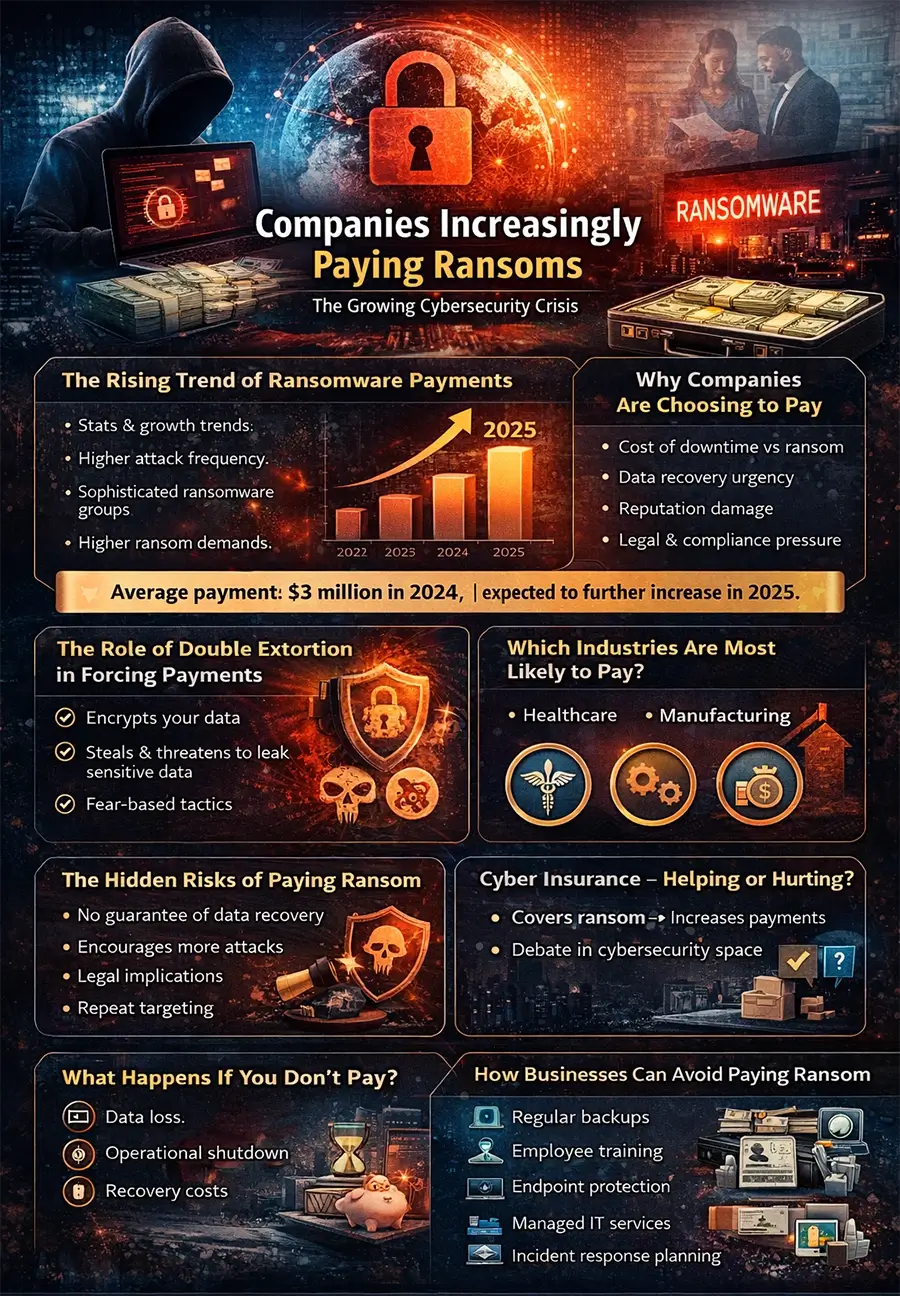
🔹 The Rising Trend of Ransomware Payments
The numbers tell a compelling—and concerning—story.
Recent ransomware statistics for 2025 show a clear increase in both the frequency of attacks and the likelihood of payment. More organizations are opting to pay ransoms than in previous years, even as cybersecurity agencies continue to discourage it.
📊 Key Trends Driving the Increase:
- A growing number of cyberattack ransom payments across industries
- Rising sophistication of ransomware groups
- Increased use of double extortion ransomware tactics
- Higher average ransom demands, often reaching six or seven figures
In fact, many reports indicate that while ransom demands are increasing, attackers are also becoming more “negotiable,” creating a disturbing normalization of ransom payments as part of incident response.
For small and medium-sized businesses, especially those without robust cybersecurity frameworks, the decision often comes down to one question:
“Can we afford not to pay?”
Why Companies Are Choosing to Pay
Understanding why companies pay ransomware requires looking beyond the surface. It’s rarely a simple decision—it’s a calculated risk made under pressure.
💸 Cost of Downtime vs Ransom
For many businesses, particularly in manufacturing or healthcare, downtime can cost thousands—or even millions—per hour.
Imagine a mid-sized manufacturing company in Raleigh unable to operate for three days. Orders halt, supply chains break, and customer trust erodes. In such cases, the cost of ransomware attacks often exceeds the ransom itself.
⏱️ Data Recovery Urgency
Even with backups, recovery is not always immediate or complete. Some organizations face:
- Corrupted backups
- Outdated data
- Complex recovery processes
When critical systems are locked, paying the ransom may seem like the fastest path to recovery.
🏢 Reputation Damage
In today’s digital-first world, trust is everything. A prolonged outage or data breach can severely damage a company’s reputation.
Businesses worry about:
- Losing customers
- Regulatory scrutiny
- Public disclosure of sensitive data
⚖️ Legal and Compliance Pressure
Certain industries must comply with strict regulations. Failing to restore data quickly can result in:
- Fines
- Legal action
- Compliance violations
In such scenarios, cyber extortion trends show that companies may prioritize operational continuity over principle.
The Role of Double Extortion in Forcing Payments
Modern ransomware attacks are no longer just about locking files.
They are about leverage.
🔐 What Is Double Extortion Ransomware?
Attackers now:
- Encrypt your data
- Steal sensitive information
- Threaten to leak it publicly if ransom is not paid
This tactic dramatically increases pressure on businesses.
😨 Fear-Based Tactics
Imagine customer data, financial records, or proprietary information being exposed online. For many businesses, especially in finance or healthcare, the consequences are devastating.
This is why data breach and ransom demands are now closely linked.
Even companies with strong backup systems may still choose to pay—simply to prevent data exposure.
Which Industries Are Most Likely to Pay?
Not all industries are equally vulnerable—or equally likely to pay.
🏥 Healthcare
- Lives depend on system availability
- Patient data is highly sensitive
- Downtime is unacceptable
🏭 Manufacturing
- Operational disruptions are costly
- Supply chain dependencies amplify impact
💰 Financial Services
- High-value data targets
- Strict regulatory requirements
🏛️ Public Sector & SMBs
- Often under-resourced
- Increasingly targeted by threat actors
📌 Real-World Insight
Many small businesses in North Carolina assume they are “too small to target.” In reality, attackers often see them as easier targets with weaker defenses.
The Hidden Risks of Paying Ransom
While paying may seem like a quick solution, it comes with serious risks.
❌ No Guarantee of Data Recovery
There is no assurance attackers will:
- Provide decryption keys
- Restore all data
- Avoid future attacks
🔁 Encourages More Attacks
Every payment fuels the cybercrime economy, incentivizing further attacks.
⚖️ Legal Implications
In some cases, paying ransom may:
- Violate sanctions laws
- Create compliance risks
🎯 Repeat Targeting
Organizations that pay once are often targeted again, as attackers see them as “willing payers.”
Cyber Insurance – Helping or Hurting?
Cyber insurance has become a major factor in ransomware payment trends 2025.
🛡️ The Upside
- Covers financial losses
- Supports incident response
- Provides access to cybersecurity experts
⚠️ The Downside
Some policies cover ransom payments, which may:
- Encourage attackers
- Increase overall ransom demands
This has sparked debate in the cybersecurity community about whether cyber insurance ransomware payments are part of the problem.
What Happens If You Don’t Pay?
Refusing to pay ransom is often the recommended approach—but it’s not without consequences.
📉 Data Loss
Without backups, data may be permanently lost.
🛑 Operational Shutdown
Businesses may face:
- Days or weeks of downtime
- Lost revenue
- Customer dissatisfaction
💰 Recovery Costs
Rebuilding systems can be more expensive than the ransom itself.
This is why the question “should businesses pay ransom after a cyberattack?” does not have a simple answer.
How Businesses Can Avoid Paying Ransom
The best strategy is simple:
Never put yourself in a position where paying is the only option.
For small and mid-sized businesses in Raleigh, Durham, and Cary, this requires a proactive approach.
💾 Regular Backups
- Maintain secure, offline backups
- Test recovery processes regularly
👩💻 Employee Training
Most ransomware attacks begin with phishing emails. Training employees reduces risk significantly.
🖥️ Endpoint Security
Protect all devices with:
- Antivirus
- EDR (Endpoint Detection & Response)
- Patch management
Partnering with experts ensures:
- Continuous monitoring
- Rapid response
- Proactive threat detection
📋 Incident Response Planning
A well-defined plan can mean the difference between:
- Controlled recovery
- Complete chaos
Final Thoughts: Prevention Is Cheaper Than Paying Hackers
The rise in companies increasingly paying ransoms is not a sign of weakness—it’s a reflection of how complex and damaging ransomware attacks have become.
But here’s the reality:
👉 Paying ransom is not a strategy—it’s a last resort.
For businesses in North Carolina, especially SMBs, investing in cybersecurity is no longer optional. It’s essential.
At Computerbilities, we help businesses:
- Strengthen cyber resilience
- Implement backup and disaster recovery solutions
- Build robust incident response strategies
Because the best ransom is the one you never have to pay.
❓ FAQs
- Why are more companies paying ransomware in 2025?
Because of increased attack sophistication, operational pressure, and the rise of double extortion tactics.
- Is it legal to pay ransomware attackers?
It depends on jurisdiction and whether the attackers are on sanctioned lists. Legal consultation is recommended.
- Should businesses pay ransom after a cyberattack?
Cybersecurity experts generally advise against it, but decisions depend on business impact and recovery options.
- What happens if you don’t pay ransomware?
You may lose data, face downtime, and incur high recovery costs—but you avoid funding cybercriminals.
- Which industries are most likely to pay ransomware?
Healthcare, manufacturing, financial services, and public sector organizations are among the most likely.
- How can small businesses prevent ransomware attacks?
By implementing backups, employee training, endpoint security, and managed IT services.
- What is the average ransomware payment in 2025?
It varies widely but often ranges from tens of thousands to millions, depending on the target.