
How a Cup of Coffee Can Take Down Your Entire Business
It starts like any other morning.
You grab a fresh cup of coffee, sit down at your desk, open your laptop—and then it happens.
A small slip. A quick spill. A few seconds of panic.
At first, it feels like a minor inconvenience. But within hours, that single moment spirals into something far more serious—lost files, halted operations, missed deadlines, and frustrated customers.
This isn’t just a story about a coffee spill.
It’s a story about how small, everyday incidents can expose major cybersecurity risks for businesses and lead to devastating consequences.
For small and medium-sized businesses in Raleigh, Cary, Durham, and across North Carolina, this scenario is more common—and more dangerous—than you might think.
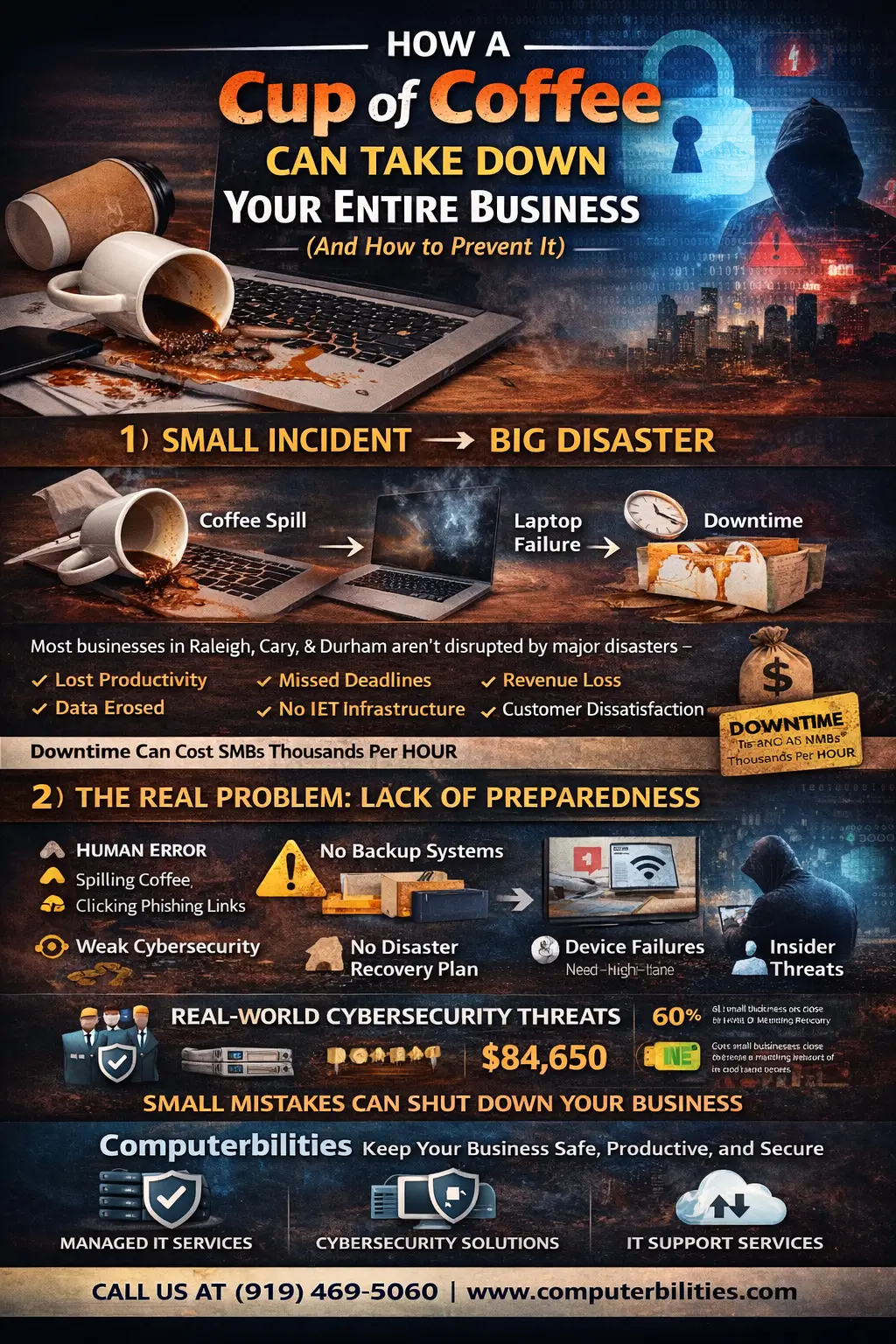
Small Incident → Big Disaster
Let’s break it down:
- Coffee spills on a laptop
- Laptop stops working
- Critical business files become inaccessible
- No backup available
- Operations come to a halt
👉 It starts with a spill… ends with lost revenue.
This is the reality of IT downtime impact on business.
Most businesses assume that disasters come in the form of cyberattacks or system failures. But in reality, it’s often the small, preventable incidents that cause the biggest disruptions.
The Hidden Cost of IT Downtime
Downtime isn’t just inconvenient—it’s expensive.
When your systems go down, your business experiences:
- Lost productivity – Employees can’t work
- Missed deadlines – Projects stall
- Revenue loss – Sales stop
- Customer dissatisfaction – Trust erodes
For small businesses, even a few hours of downtime can result in thousands of dollars in losses.
This is why small business cybersecurity and business continuity planning are no longer optional—they’re essential.
⚠️ The Real Problem: Lack of Preparedness
The coffee spill isn’t the real issue.
The real issue is what happens after.
Many businesses lack:
Without these, even minor incidents can escalate into major business failures.
This is one of the biggest cyber threats to businesses today—not being prepared.
👨💻 Human Error: The Biggest Cybersecurity Risk
It’s not just coffee spills.
Human behavior is the leading cause of:
- Accidental data loss
- Phishing attacks
- Weak password vulnerabilities
- Security breaches
Examples include:
- Clicking on a suspicious email link
- Using public Wi-Fi at a coffee shop
- Sharing sensitive data unknowingly
These are classic cases of human error in cybersecurity.
Even the strongest systems can fail if the human element is compromised.
Coffee as a Metaphor for Modern Business Risks
In today’s digital workplace, “coffee” represents more than just a drink.
It symbolizes:
- Physical risks → spills damaging hardware
- Casual habits → ignoring security practices
- Public exposure → working on unsecured networks
- Social engineering → attackers exploiting trust
For example:
An employee working from a café in Raleigh logs into company systems using public Wi-Fi. A hacker intercepts the connection, gaining access to sensitive business data.
That’s not just a coffee break—it’s a data breach waiting to happen.
Modern Workplace Risks You Can’t Ignore
Today’s businesses face a wide range of network security risks, including:
- Remote Work Vulnerabilities
Employees working outside secure networks increase exposure to cyber threats.
- Public Wi-Fi Risks
Unsecured networks are prime targets for attackers.
- IoT Devices
Even smart office devices—like coffee machines—can become entry points.
- Endpoint Failures
Damaged or compromised devices can disrupt entire systems.
What Happens When Business Systems Fail?
Let’s consider a real-world scenario:
A small business in Durham loses access to its CRM system due to a hardware failure.
Without a backup:
- Customer data is lost
- Sales pipeline disappears
- Communication breaks down
Within days:
- Clients lose confidence
- Revenue drops
- Reputation suffers
This is the true impact of IT downtime on small businesses.
🔐 Cybersecurity Threats Beyond the Spill
A coffee spill is just one example.
Other major threats include:
- Ransomware attacks
- Phishing scams
- Insider threats cybersecurity
- Social engineering attacks
These threats exploit both technology and human vulnerabilities.
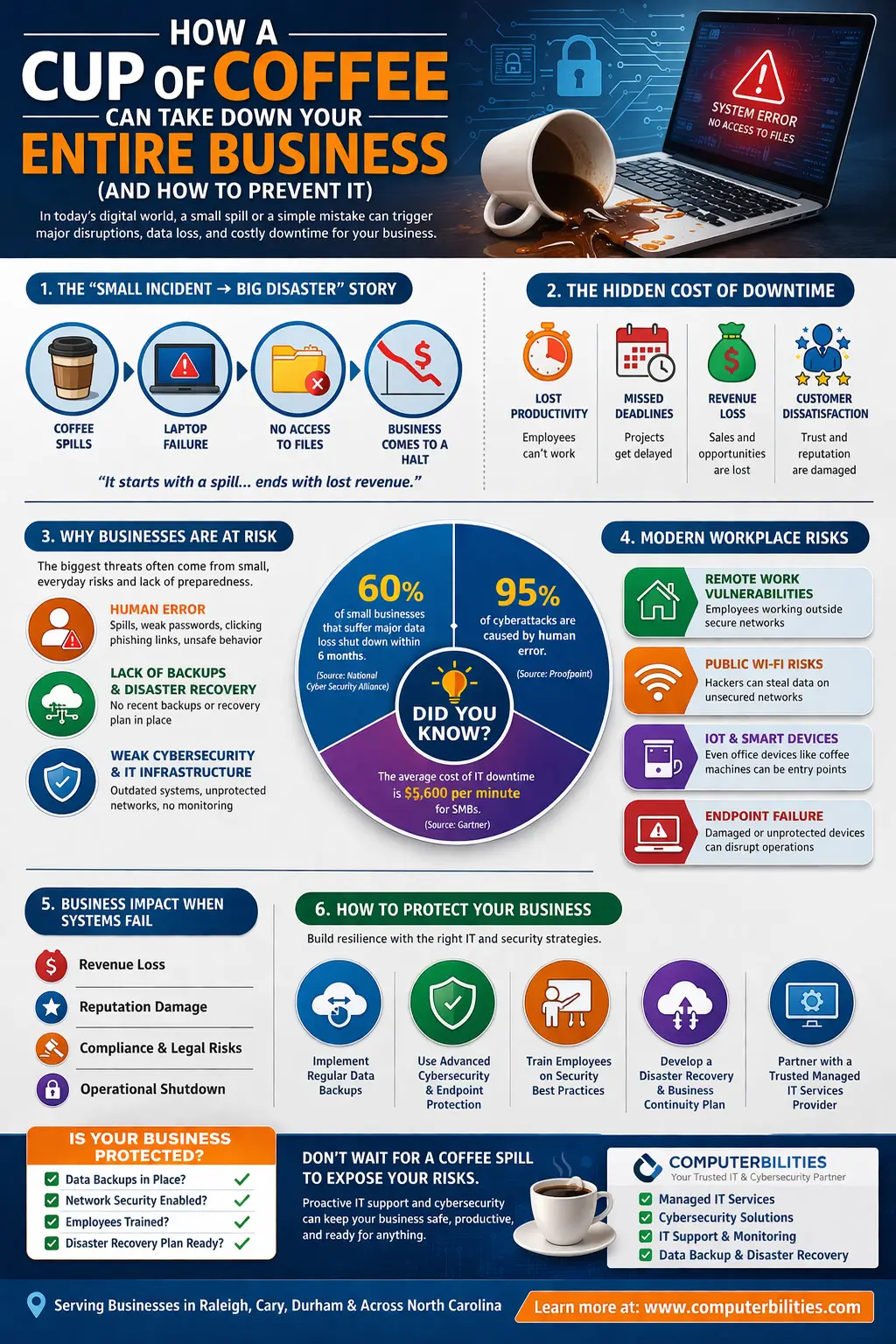
Why Businesses Fail Due to Technology Issues
Many SMBs fail not because of competition—but because of:
- Poor IT infrastructure
- Lack of cybersecurity measures
- No disaster recovery planning
- Ignoring early warning signs
Understanding why businesses fail due to technology issues is the first step toward prevention.
🛡️ How to Prevent Data Loss in Business
Here’s how you can protect your business:
- Implement Data Backup Solutions
Ensure regular and automated backups.
- Invest in Endpoint Security
Protect all devices connected to your network.
- Train Employees
Educate staff about phishing and cybersecurity risks.
- Use Zero Trust Security
Verify every access request—never assume trust.
- Develop an Incident Response Plan
Be prepared to act quickly during a crisis.
🔄 Business Continuity & Disaster Recovery
Your IT systems don’t need to be perfect.
They need to be recoverable.
Effective business continuity planning includes:
- Backup and restore strategies
- Cloud-based solutions
- Disaster recovery planning
- Redundant systems
This ensures your business can continue operating—even during disruptions.
✅ Is Your Business Protected? (Checklist)
Ask yourself:
- Do you have secure data backups? ✔
- Is your network protected? ✔
- Do employees receive cybersecurity training? ✔
- Do you have a disaster recovery plan? ✔
- Are your systems monitored 24/7? ✔
If you answered “no” to any of these, your business is at risk.
How Computerbilities Can Help
At Computerbilities, we understand that small mistakes shouldn’t lead to big disasters.
We provide:
Proactive monitoring and maintenance to prevent downtime.
Protect your business from evolving cyber threats.
🔹 Data Backup & Disaster Recovery
Ensure your data is always recoverable.
Fast, reliable support when you need it most.
Serving businesses across Raleigh, Cary, Durham, and North Carolina, we help you stay secure, productive, and prepared.
👉 Don’t wait for a coffee spill to expose your vulnerabilities.
FAQs
- How can a small incident cause major business downtime?
Even minor incidents like hardware damage or human error can disrupt systems if there’s no backup or recovery plan in place.
- What are the biggest cybersecurity risks for small businesses?
Human error, phishing attacks, weak passwords, and unsecured networks are among the top risks.
- How does IT downtime affect small businesses?
It leads to lost productivity, missed opportunities, revenue loss, and damage to customer trust.
- How can businesses prevent data loss?
By implementing regular backups, strong security measures, and disaster recovery planning.
- Why are managed IT services important?
They provide proactive monitoring, security, and support to prevent issues before they impact your business.
- Is public Wi-Fi safe for business use?
No. Public Wi-Fi exposes your data to cyber threats and should be avoided or secured with VPNs.
Final Thought
A cup of coffee may seem harmless.
But in today’s digital world, it represents something much bigger:
The reality that small, everyday risks can bring your entire business to a standstill.
The question isn’t whether something will go wrong.
It’s whether your business is prepared when it does.