
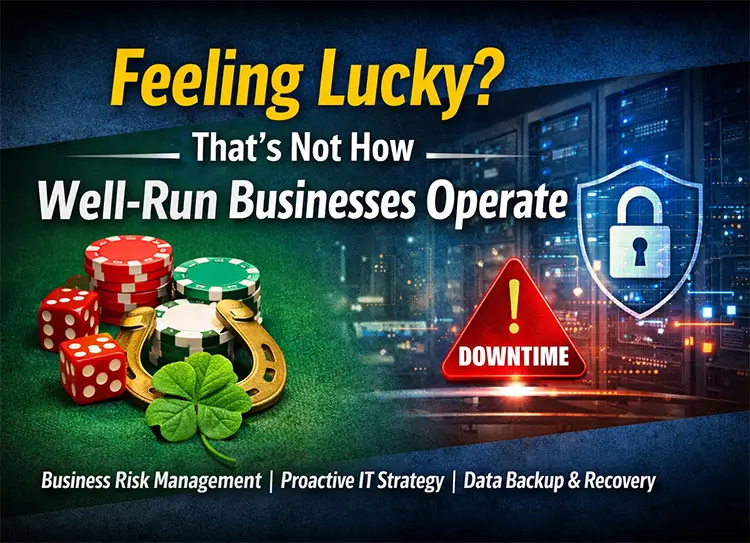
Feeling Lucky? That’s Not How Well-Run Businesses Operate
Walk into any successful business in Raleigh, Cary, or Durham and ask how they manage finances, hiring, or customer relationships—you’ll hear about systems, processes, and planning.
Now ask about their IT.
Too often, the answer sounds different:
“We’ve been fine so far.”
“Nothing bad has happened yet.”
“We’ll deal with it if something breaks.”
That’s not strategy. That’s luck.
And here’s the truth: luck is not a plan—it’s a gamble.
In today’s fast-moving digital environment, where cyber threats are increasing and downtime costs are rising, relying on luck is one of the biggest risks small and medium businesses (SMBs) can take.
This blog explores why business risk management, proactive IT strategy, and managed IT services are essential—and why well-run businesses in North Carolina are shifting from reactive thinking to structured planning.
Why Luck Is Not a Business Strategy
Every business relies on structure to succeed.
- Finance follows strict controls and audits
- Sales uses pipelines and forecasting
- Operations depend on processes and KPIs
No one says:
“Let’s just hope our accounting works out this quarter.”
Yet when it comes to IT infrastructure management, many businesses take that exact approach.
This creates a dangerous gap.
Because technology is no longer a support function—it’s the backbone of your operations. From communication and customer data to billing and compliance, everything runs through your systems.
When businesses ignore business continuity planning and data backup and recovery, they are essentially saying:
“We’re okay gambling with our operations.”
And that’s where problems begin.
👉 Hope is not a strategy.
👉 Luck = unmanaged risk.
The Dangerous “We’ve Been Fine So Far” Mindset
One of the most common phrases heard from SMBs is:
“We’ve never had a problem.”
It sounds reassuring—but it’s actually a warning sign.
This mindset ignores a fundamental truth:
Past success does not guarantee future security.
Cyber threats, hardware failures, and human errors don’t operate on your timeline. They strike when conditions are right—not when you’re ready.
Let’s consider a simple analogy:
A business owner doesn’t skip insurance because they’ve never had a fire.
So why skip a disaster recovery plan just because systems haven’t failed yet?
“Invisible risk is still risk.”
The absence of problems today often means:
- vulnerabilities haven’t been exposed yet
- systems haven’t been tested under stress
- backups haven’t been verified
And when something does go wrong, businesses with this mindset are the most vulnerable.
The Hidden Risks Businesses Ignore
Technology risks are often silent—until they’re not.
Unlike financial issues or operational delays, IT problems can remain hidden for months. That’s why many SMBs underestimate them.
Here are some of the most overlooked risks:
- Data Loss Without Backup Validation
Many businesses assume backups exist—but never test them.
Without proper data backup and recovery, those backups may:
- be outdated
- incomplete
- corrupted
- Cybersecurity Gaps
Small businesses are prime targets for cybercriminals because they often lack strong cybersecurity for small business measures.
Common issues include:
- weak passwords
- outdated software
- lack of employee training
- Downtime Without a Plan
Without downtime prevention strategies, even a small outage can halt operations.
- Compliance Risks
Industries like healthcare and legal services require strict IT compliance and security. Failure to comply can result in penalties.
- Reactive IT Approach
The break-fix model—waiting for something to fail—leads to:
- higher costs
- longer downtime
- increased stress
“Invisible risk is still risk.”
Why IT Gets a Free Pass (The Double Standard)
Here’s a question worth asking:
Would you accept this approach in finance?
Imagine your accountant saying:
“We don’t track everything—but we’ll figure it out if there’s a problem.”
Unacceptable, right?
Yet many businesses tolerate the same lack of structure in IT.
This double standard exists because:
- IT issues aren’t always visible
- problems don’t occur daily
- technology feels complex
But that doesn’t make it less important.
👉 Technology should follow the same standards as finance.
If your business demands accountability in:
- accounting
- hiring
- operations
…it should demand the same in IT support for businesses.
“If you wouldn’t accept it in finance, don’t accept it in IT.”
Prepared vs Lucky Businesses
Let’s draw a clear comparison.
Lucky Businesses
- No defined business continuity planning
- Unverified backups
- Reactive IT support
- No cybersecurity framework
- Depend on “hope”
Prepared Businesses
- Documented disaster recovery plan
- Regular backup testing
- Proactive IT monitoring
- Strong cybersecurity policies
- Clear risk mitigation strategies
The difference is simple:
Prepared businesses don’t panic—they respond.
And in a crisis, response time determines:
- revenue impact
- customer trust
- long-term stability
The Real Cost of Downtime and Data Loss
Downtime is not just an inconvenience—it’s a financial and operational threat.
For SMBs in North Carolina, even a few hours of downtime can result in:
💰 Financial Loss
- lost sales
- missed opportunities
- recovery expenses
📉 Productivity Loss
- employees unable to work
- disrupted workflows
😟 Reputation Damage
- lost customer trust
- delayed services
⚖️ Compliance Issues
- regulatory penalties
- legal complications
Studies consistently show that small businesses struggle to recover from major data loss incidents.
That’s why business resilience depends on:
- proactive planning
- secure systems
- reliable recovery processes
How Managed IT Services Eliminate Risk
This is where managed IT services transform the game.
Instead of reacting to problems, businesses adopt a proactive IT strategy.
What Managed IT Services Provide:
✅ Continuous Monitoring
Systems are monitored 24/7 to detect issues early.
✅ Data Protection Solutions
Includes:
- cloud backup solutions
- secure storage
- recovery testing
✅ Cybersecurity Protection
Advanced tools protect against:
- malware
- ransomware
- phishing attacks
✅ Strategic Planning
A long-term technology strategy for business aligned with growth goals.
✅ Reduced Downtime
With proactive maintenance, issues are resolved before they escalate.
Proactive vs Reactive IT
Reactive IT (Break-Fix) | Proactive IT (Managed Services) |
Fix after failure | Prevent failure |
Unpredictable costs | Predictable budgeting |
High downtime | Minimal downtime |
Stressful | Controlled & stable |
This shift improves:
- operational efficiency
- business process optimization
- digital transformation strategy
A Simple Business Reality Check
Ask yourself these questions:
- Do you have a tested disaster recovery plan?
- Are your backups regularly verified?
- Can your business operate during a system outage?
- Is your cybersecurity up to date?
- Do you rely on proactive or reactive IT support?
If you hesitate on any of these, you’re not alone.
But it also means:
You may be relying on luck more than you think.
And remember:
Luck is not a plan—it’s a gamble.
How Computerbilities Helps North Carolina Businesses
At Computerbilities, we understand the unique challenges faced by SMBs in Raleigh, Cary, Durham, and across North Carolina.
We don’t believe in luck—we believe in preparation.
Our Approach:
🔐 Comprehensive Cybersecurity
We protect your business with advanced cybersecurity for small business solutions.
💾 Reliable Backup & Recovery
Our data backup and recovery solutions ensure your data is always secure and accessible.
⚙️ Proactive IT Support
We eliminate surprises with continuous monitoring and maintenance.
📊 Strategic IT Planning
We align your IT infrastructure with your business goals.
🚀 Business Continuity Focus
We help you build true business resilience with tested recovery plans.
Why Choose Computerbilities?
- Local expertise in North Carolina
- Tailored solutions for SMBs
- Fast, responsive support
- Proven risk mitigation strategies
We don’t just fix problems—we prevent them.
Conclusion: Stop Relying on Luck—Start Building Resilience
Running a business is already challenging. The last thing you need is uncertainty in your technology.
The most successful businesses don’t rely on luck.
They rely on:
- planning
- systems
- proactive strategies
Because:
- Hope is not a strategy
- Luck = unmanaged risk
- Prepared businesses win
If your IT strategy still depends on “we’ve been fine so far,” it’s time to rethink your approach.
📞 Call to Action
Don’t wait for something to break.
👉 Get a FREE IT Risk Assessment from Computerbilities today and discover how to protect your business from downtime, data loss, and cyber threats.
FAQs
- Why is luck not a business strategy?
Luck is unpredictable and cannot be controlled. Businesses need structured risk mitigation strategies and proactive planning to ensure stability and growth.
- How can small businesses prevent IT downtime?
By implementing:
- proactive IT support
- regular system monitoring
- data backup and recovery
- disaster recovery planning
- What is the importance of data backup and disaster recovery?
It ensures business continuity by allowing quick recovery from data loss, cyberattacks, or system failures.
- What is the difference between proactive and reactive IT?
Proactive IT prevents issues before they occur, while reactive IT fixes problems after they happen—often at higher cost and downtime.
- How do managed IT services reduce business risk?
They provide continuous monitoring, cybersecurity protection, and strategic planning, reducing the likelihood of disruptions.
- Why is “we’ve been fine so far” dangerous in business?
It creates a false sense of security and ignores potential risks that haven’t yet surfaced.
- What industries benefit most from business continuity planning?
All industries benefit, but especially:
- healthcare
- legal firms
- finance
- retail
- How can Computerbilities help my business?
Computerbilities offers:
- managed IT services
- cybersecurity solutions
- data protection
- proactive IT support
…to help your business operate securely and efficiently.