
Iran-Linked Cyber Threats Are Escalating Globally: What Businesses Need to Know
“Iran is no longer just a regional cyber threat—it’s now global.”
That statement might sound dramatic, but in 2026, it’s simply reality. From ransomware attacks on U.S. infrastructure to sophisticated phishing campaigns targeting private companies, Iran cyber threats 2026 have evolved into a serious concern for businesses worldwide—including small and mid-sized organizations right here in North Carolina.
Thousands of phishing campaigns, ransomware attacks, and AI-driven operations are being launched at an unprecedented scale. And the most alarming part? Your business could be a target—even if you’re not in the Middle East.
In this blog, we’ll break down:
- Why Iran-linked cyber attacks are increasing
- How Iranian hackers operate
- What industries are at risk
- And most importantly, how your business can stay protected
What’s Driving the Surge in Iran Cyber Attacks?
To understand why Iranian hackers are becoming a global threat, we need to look beyond technology and into geopolitics.
Cyber as a Weapon of Asymmetric Warfare
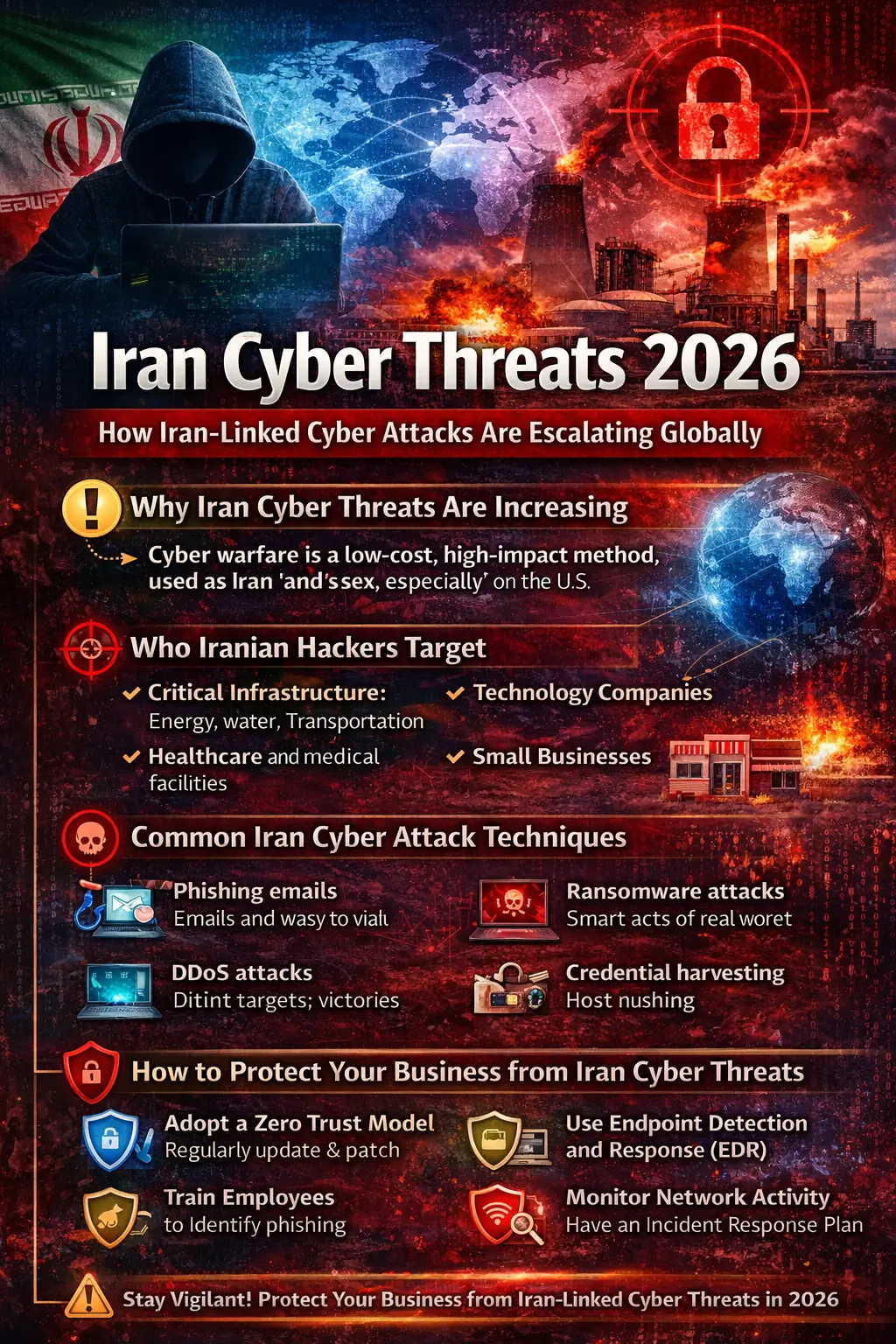
Iran doesn’t compete with global superpowers through conventional military strength. Instead, it uses cyber warfare as a low-cost, high-impact weapon.
Think of it like this:
Instead of deploying tanks, a nation can disrupt power grids, steal data, or shut down businesses—all remotely.
Geopolitical Triggers in 2026
Recent escalations involving the U.S., Israel, and Middle East tensions have intensified cyber operations. Cyberattacks are increasingly used as:
- Retaliation tools
- Strategic pressure tactics
- Intelligence-gathering mechanisms
👉 This is why Iran cyber warfare has accelerated dramatically in 2026.
Who Are the Key Iranian Cyber Threat Actors?
Iran’s cyber ecosystem is not a single entity—it’s a network of state-backed groups, intelligence agencies, and proxy hackers.
- IRGC (Islamic Revolutionary Guard Corps)
- Oversees many IRGC cyber operations
- Focus on infrastructure disruption and espionage
- MOIS (Ministry of Intelligence and Security)
- Conducts long-term cyber espionage operations
- Targets defense, tech, and political sectors
- Iranian APT Groups
- Advanced Persistent Threat (APT) groups like:
- APT33
- APT34
- APT35
- Known for stealthy, long-term infiltration
- Proxy Hacktivist Groups
- Groups like Handala operate as Iranian cyber proxies
- Provide plausible deniability
👉 This layered structure allows Iran to operate globally while avoiding direct attribution.
Top Cyberattack Techniques Used by Iranian Hackers in 2026
Understanding Iran cyber attack tactics and techniques is critical for defense.
🔐 Phishing Campaigns
- Thousands of malicious URLs detected
- Target employees through email impersonation
💣 Ransomware + Wiper Malware
- Ransomware used for financial gain
- Wiper malware used for destruction
🌐 DDoS Attacks
- Overwhelm servers and websites
- Disrupt business operations
🧾 Credential Harvesting
- Stealing login details via fake portals
🎭 Social Engineering
- Impersonation of executives or vendors
📢 Hack-and-Leak Campaigns
- Steal data → leak publicly to cause damage
📱 Spyware Distribution
- Delivered via SMS or fake apps
👉 These techniques show that Iran ransomware attacks are only one piece of a much larger strategy.
Industries Most at Risk in 2026
Iran cyber attacks on US / global infrastructure are expanding rapidly.
🏭 Critical Infrastructure
- Energy (oil, gas, electricity)
- Water systems
- Transportation
🏥 Healthcare
- Hospitals targeted due to weak defenses
💻 Technology & Defense
- Intellectual property theft
- Espionage
🏢 Small & Medium Businesses (SMBs)
- Often targeted as “easy entry points”
- Used in supply chain attacks
👉 No business is too small or too far anymore.
How Iran Uses AI and Proxy Hackers
AI is changing the cyber battlefield.
AI-Driven Cyber Attacks
Iran is increasingly using AI for:
- Disinformation campaigns
- Fake content generation
- Automated phishing
Blurring Lines Between Crime and Warfare
Iran is also leveraging:
- Ransomware-as-a-service
- Cybercriminal networks
👉 This creates a dangerous hybrid:
nation-state cyber threats + organized cybercrime
The Shift Toward Psychological and Destructive Attacks
Cyber warfare is no longer just about stealing data—it’s about creating fear and disruption.
From Espionage to Chaos
Modern attacks aim to:
- Disrupt operations
- Damage reputations
- Create uncertainty
Psychological Warfare
Examples include:
- Public data leaks
- Targeting individuals
- High-volume attack campaigns
👉 This combination of cyber + psychological tactics makes Iran a uniquely dangerous threat.
Why Global Businesses Should Be Concerned
Even if you’re a small business in Raleigh, Cary, or Durham, you’re not immune.
Opportunistic Targeting
Iranian hackers often:
- Scan for vulnerabilities
- Target weak systems
Common Entry Points
- Unpatched software
- Remote access tools
- Weak passwords
Supply Chain Risks
- Attack vendors → reach larger organizations
👉 This is why Iran cyber threats to businesses 2026 is a growing concern.
How to Protect Your Organization from Iran-Linked Cyber Threats
Now the most important part: defense
🛡️ 1. Adopt a Zero Trust Model
- Never trust, always verify
🔄 2. Regular Patch Management
- Close known vulnerabilities
👨💻 3. Employee Training
- Prevent phishing attacks
🖥️ 4. Endpoint Detection & Response (EDR)
- Monitor devices in real-time
🌐 5. Network Monitoring
- Detect unusual activity
📋 6. Incident Response Plan
- Be prepared before an attack happens
Final Thoughts: Why Cybersecurity Is No Longer Optional
Iran-linked cyber attacks are no longer isolated incidents—they are part of a global, evolving threat landscape.
For businesses in North Carolina, the message is clear:
- Cyber threats are becoming more advanced
- Attackers are becoming more strategic
- And defenses must evolve just as quickly
At Computerbilities, we help businesses stay ahead with:
Because in today’s world, cybersecurity isn’t just IT—it’s business survival.
FAQs
- Why are Iran cyber threats increasing in 2026?
Due to geopolitical tensions and the use of cyber warfare as a low-cost alternative to traditional military action.
- What industries are most targeted by Iranian hackers?
Critical infrastructure, healthcare, technology, and small businesses involved in supply chains.
- What are the most common Iran cyber attack techniques?
Phishing, ransomware, DDoS attacks, credential harvesting, and social engineering.
- Are small businesses at risk?
Yes. Many attacks target small businesses due to weaker security systems.
- How can businesses protect themselves?
Implement Zero Trust, train employees, use EDR tools, and maintain strong cybersecurity practices.
- What makes Iran cyber warfare unique?
Its combination of state-backed operations, proxy hackers, and cybercriminal tactics.