
Victoria (Australia) Schools Data Breach Affects Thousands: Critical Cybersecurity Lessons for North Carolina SMBs
In January 2026, news of a Victoria schools data breach sent shockwaves through the global cybersecurity community. Hackers infiltrated the Victorian government school network, exposing personal information belonging to thousands of students—both current and former. While the incident occurred in Australia, its implications extend far beyond national borders. For small and mid-sized businesses (SMBs) in North Carolina, particularly in Raleigh, Cary, Durham, Chapel Hill, Apex, and Wake Forest, this breach serves as a powerful reminder: no organization is too large—or too public—to be targeted, and no organization is too small to be affected.
As an experienced cybersecurity professional, I have seen a recurring pattern over two decades: organizations often assume cyberattacks are a “big enterprise problem.” The Victorian student data breach proves otherwise. Centralized systems, shared credentials, outdated controls, and limited visibility—these are not just education-sector challenges. They are the same weaknesses that place North Carolina SMBs at risk every day.
This article examines what happened in the Victorian government schools cyber attack, why it matters to U.S. businesses, and how proactive IT support, IT services, and managed IT services—delivered locally by experts like Computerbilities—can help prevent similar outcomes.
What Happened: Understanding the Victoria Schools Data Breach
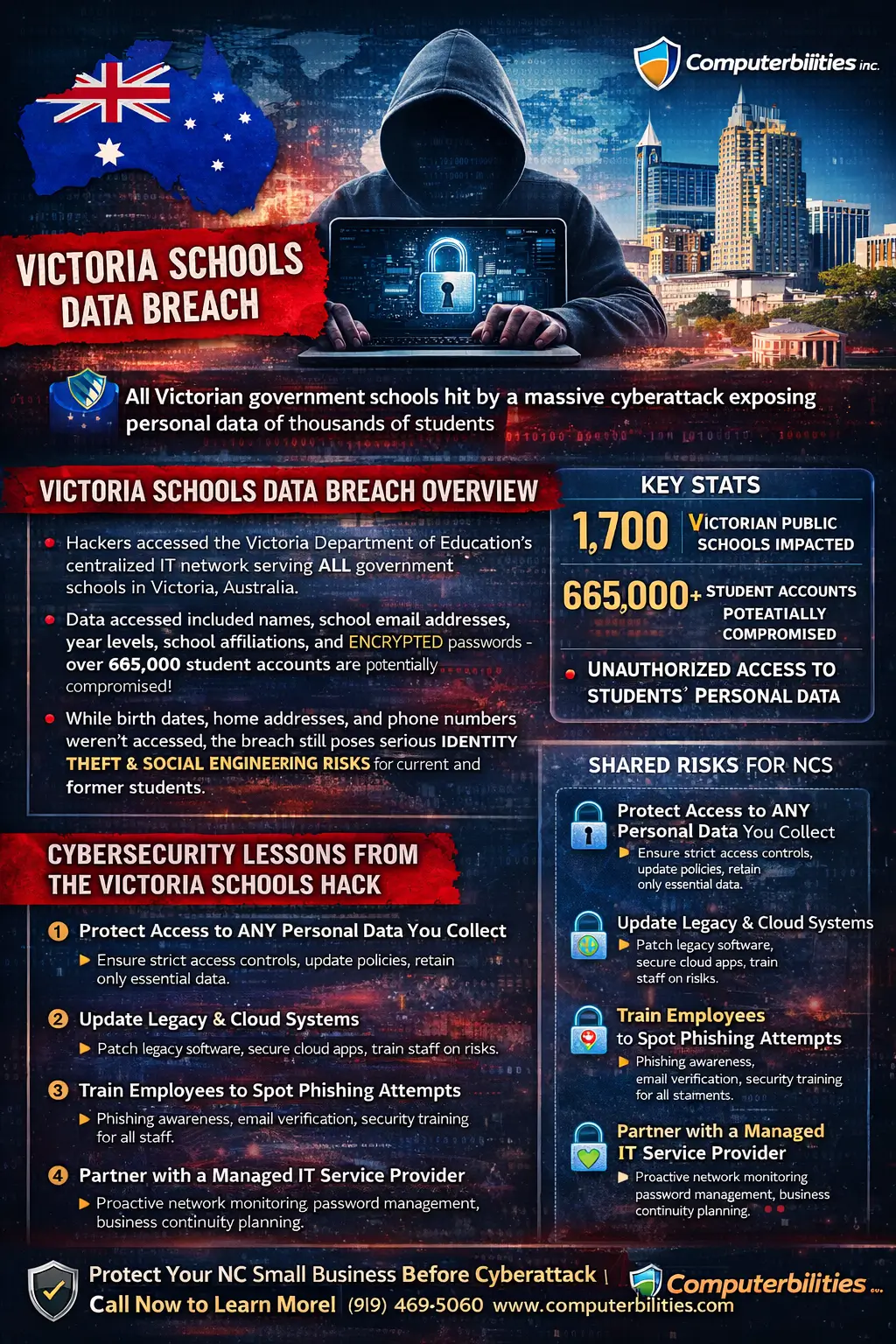
The Victorian education data breach stemmed from a successful cyber intrusion into the state’s government school network. Hackers gained unauthorized access to systems used across all public schools in Victoria, resulting in a Victorian public school data hack of unprecedented scale.
According to official disclosures, attackers accessed:
- Student names
- School-issued email addresses
- Year levels and school associations
- Encrypted passwords
Although more sensitive data such as home addresses and dates of birth were reportedly not exposed, cybersecurity experts quickly warned that the breach still created significant identity theft risk for Victorian students. Names and email addresses alone are powerful tools in the hands of cybercriminals, especially when used for phishing, credential stuffing, or long-term identity fraud.
This cybersecurity breach in Victorian schools affected thousands—and potentially hundreds of thousands—of individuals, including former students whose data remained stored in legacy systems.
Why This Matters to North Carolina SMBs
At first glance, a school cyberattack in Victoria, Australia may seem far removed from a law firm in Raleigh or a medical practice in Durham. In reality, the underlying risks are strikingly similar.
Shared Infrastructure and Centralized Access
Victorian schools relied on a shared network—much like many SMBs rely on:
- Shared Microsoft 365 or Google Workspace environments
- Centralized file servers or cloud platforms
- Remote access tools and VPNs
When a single access point is compromised, the entire organization can be exposed. For SMBs in Cary or Apex without dedicated cybersecurity staff, this risk is amplified.
Long-Term Data Retention
One of the most concerning aspects of the Victoria Department of Education data breach was the exposure of former students’ information. Many SMBs unknowingly mirror this risk by retaining:
- Old employee records
- Former customer databases
- Archived email accounts
Without proper data lifecycle management—an essential component of professional managed IT services—this information becomes a liability.
How the Attack Likely Happened: A Familiar SMB Scenario
While investigations into the Victorian school network breach continue, early reporting suggests attackers exploited vulnerabilities common in many SMB environments:
- Weak or reused credentials
- Insufficient multi-factor authentication (MFA)
- Limited network segmentation
- Delayed patching or outdated systems
These are the same gaps routinely discovered during cybersecurity assessments for North Carolina businesses. Without structured IT support and continuous monitoring, these vulnerabilities often go unnoticed—until it’s too late.
The Real Risk: What Hackers Do With “Basic” Data
Some organizations underestimate breaches that “only” expose names and email addresses. This is a dangerous misconception.
Phishing and Social Engineering
With verified email addresses, attackers can craft highly targeted phishing campaigns. For SMBs in Raleigh or Durham, this often leads to:
- Compromised employee credentials
- Fraudulent wire transfer requests
- Business email compromise (BEC) attacks
Credential Stuffing
Exposed encrypted passwords—especially if weak or reused—can be cracked over time and tested across other platforms.
Long-Term Identity Abuse
Just as experts warned of Victorian student privacy breach concerns, SMBs face prolonged exposure when stolen data resurfaces months or years later.
Lessons North Carolina Businesses Cannot Ignore
The education system cyber breach in Australia highlights several lessons directly applicable to SMBs across North Carolina:
- Cybersecurity Is Not Optional
Cyberattacks no longer target only large enterprises. SMBs are now the preferred targets because they often lack:
- Dedicated security teams
- Formal incident response plans
- Continuous monitoring
- Visibility Matters
Many organizations don’t know what data they store—or where it lives. Professional IT services provide visibility into:
- Network activity
- User behavior
- Data access patterns
- Incident Response Speed Is Critical
In the Victorian case, rapid password resets and system lockdowns helped limit further damage. SMBs without managed support often lose precious time responding to incidents.
How Managed IT Services Reduce Cyber Risk
This is where managed IT services play a decisive role for North Carolina SMBs.
A comprehensive managed IT approach includes:
- 24/7 network and endpoint monitoring
- Advanced email security and phishing protection
- Regular vulnerability assessments and patching
- Strong identity and access management (IAM)
- Secure data backups and disaster recovery planning
These controls directly address the weaknesses exposed in the Victorian government schools cyber attack.
Why Local IT Support Makes a Difference
Cybersecurity is not just a technical challenge—it’s a business one. Local context matters.
For businesses in Raleigh, Cary, Durham, Chapel Hill, and Wake Forest, working with a local IT provider means:
- Faster response times
- On-site support when needed
- Understanding of regional compliance and business environments
This is where Computerbilities stands apart.
How Computerbilities Helps North Carolina SMBs Stay Secure
Computerbilities has built its reputation by helping North Carolina businesses transition from reactive IT to proactive cybersecurity-focused IT support and managed IT services.
Proactive Cybersecurity-First IT Services
Computerbilities helps SMBs:
- Identify and remediate hidden vulnerabilities
- Implement MFA, endpoint protection, and email security
- Monitor networks continuously for suspicious activity
- Develop incident response and recovery plans
Tailored Solutions for SMBs
Unlike one-size-fits-all providers, Computerbilities understands the operational realities of SMBs in Raleigh, Cary, and Durham—balancing security, productivity, and cost.
Ongoing Partnership, Not Just IT Fixes
Cybersecurity is not a one-time project. Computerbilities provides ongoing managed IT services that evolve as threats change, ensuring your business stays protected long after initial setup.
Prevention Is Always Cheaper Than Recovery
The Victoria (Australia) schools data breach is a powerful reminder that cyber incidents rarely announce themselves in advance. They exploit gaps quietly, often over time, until the damage is unavoidable.
For North Carolina SMBs, the question is no longer if cyber threats will target your organization—but when.
Investing in professional IT support, IT services, and managed IT services is no longer optional. It is a business necessity.
If your organization wants to avoid becoming the next cautionary headline, Computerbilities can help you build a resilient, secure IT foundation—before a breach forces your hand.
Protect your data. Protect your people. Protect your business.