

Your Accountant Is Stressed. Hackers Know It.
It’s March.
Deadlines are closing in. Emails are piling up. Financial documents are being exchanged at lightning speed. Your accountant is juggling multiple clients, urgent filings, and last-minute requests.
And while your business is focused on staying compliant and meeting deadlines, hackers are watching closely.
Because they know something you might not realize:
Stress creates opportunity.
Every year, during tax season, cybercriminals launch highly targeted phishing attacks against accounting firms, finance teams, and small businesses. Why? Because when people are busy, they’re more likely to make mistakes—and in cybersecurity, one small mistake is all it takes.
For businesses across Raleigh, Cary, Durham, and throughout North Carolina, understanding these risks isn’t optional anymore—it’s essential.
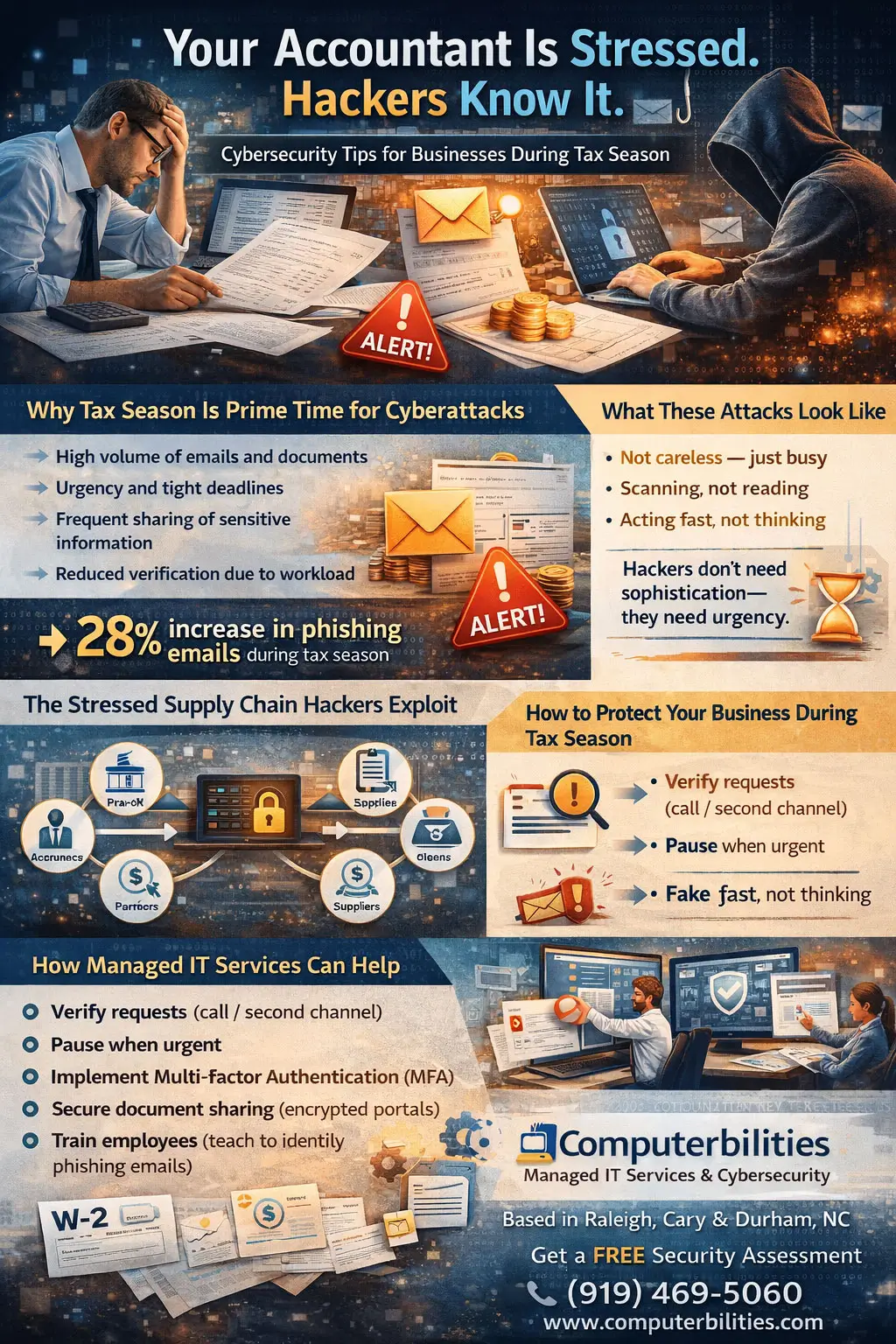
Why Tax Season Is Prime Time for Cyberattacks
Tax season isn’t just busy—it’s chaotic. And chaos is exactly what cybercriminals thrive on.
Recent data shows that phishing attacks during tax season increase by nearly 28%, targeting businesses handling sensitive financial data. This isn’t random—it’s strategic.
Why hackers target this period:
- High volume of emails and document exchanges
- Increased urgency and tight deadlines
- Frequent sharing of sensitive financial information
- Reduced verification due to workload
From a hacker’s perspective, this is the perfect storm.
They don’t need to hack your systems.
They just need you—or your accountant—to click.
The “Stressed Supply Chain” Hackers Exploit
Here’s something most businesses overlook:
Your risk doesn’t stop with your accountant.
It extends across your entire financial ecosystem.
The vulnerable chain includes:
- Your accounting firm
- Internal finance teams
- Payroll providers
- Vendors and suppliers
- Clients exchanging financial data
This is what we call the “stressed supply chain.”
If any link in this chain is compromised, the ripple effect can impact your entire business.
For example:
A hacker impersonates your accountant → sends a fake request → your employee responds → financial data is exposed.
No firewall can stop that.
Because it’s not a system failure—it’s a human moment.
What These Attacks Actually Look Like
One of the biggest misconceptions about cyber attacks on small businesses is that they’re obvious.
They’re not.
In fact, the most dangerous attacks look completely normal.
Common tax season phishing scams:
You receive an email from someone posing as your CEO or accountant:
“Can you send me all employee W-2s ASAP? Urgent.”
It looks legitimate. The timing feels right.
But it’s a trap.
- Vendor Email Compromise (Invoice Fraud)
A vendor emails you:
“We’ve updated our bank details. Please use this account for future payments.”
Everything looks correct—except the account number.
- Fake DocuSign Requests
You get a notification:
“You have a document waiting for signature.”
Clicking the link leads to a fake login page designed to steal your credentials.
- CEO Fraud Email Scam
An urgent message appears:
“I need you to process this wire transfer immediately. I’m in a meeting.”
No time to verify. Just act.
And that’s exactly what hackers want.
Why Smart (But Busy) People Still Get Caught
Let’s be clear:
People who fall for phishing scams aren’t careless.
They’re overwhelmed.
During tax season:
- People skim emails instead of reading carefully
- Urgent requests override normal procedures
- Verification steps are skipped
This is where social engineering attacks come into play.
Hackers don’t rely on technical complexity.
They rely on human psychology.
Hackers don’t need sophistication—they need urgency.
And urgency is everywhere during tax season.
The Real Risk: Financial Data & Business Reputation
The consequences of these attacks go far beyond a single mistake.
What’s at stake:
- Sensitive financial data exposure
- Employee personal information leaks
- Direct financial loss from fraudulent transfers
- Compliance violations
- Damage to client trust and reputation
For accounting firms and businesses in North Carolina, a breach can mean:
- Lost clients
- Legal consequences
- Long-term brand damage
Cybersecurity for accountants isn’t just about protection—it’s about trust.
How to Protect Your Business During Tax Season
The good news?
You don’t need complex systems to stay secure.
You need better habits and smarter processes.
- Verify Every Financial Request
If something involves money or sensitive data:
- Call the sender directly
- Use a second communication channel
Never rely solely on email.
- Slow Down Urgency
Train your team to recognize red flags:
- “Urgent” requests
- Pressure to act quickly
- Requests that bypass normal procedures
A simple pause can prevent a costly mistake.
- Implement Multi-Factor Authentication (MFA)
Even if credentials are stolen:
- MFA adds an extra layer of protection
This is one of the most effective defenses against business email compromise (BEC).
- Secure Document Sharing
Avoid sending sensitive financial data via:
- Unsecured email
- Public file-sharing links
Instead, use:
- Encrypted portals
- Secure document management systems
- Train Your Employees
Your employees are your first line of defense.
Regular training helps them:
- Identify phishing emails
- Understand cybercriminal tactics
- Respond correctly to suspicious requests
How Managed IT Services Can Help Accounting Firms Stay Secure
Let’s be honest—most small and medium businesses don’t have the time or resources to manage cybersecurity on their own.
That’s where managed IT services for accounting firms come in.
With the right IT partner, you get:
- 24/7 monitoring and threat detection
- Email security and phishing protection
- Data backup and recovery solutions
- Compliance support
- Employee cybersecurity training
For businesses in Raleigh, Cary, and Durham, working with a trusted IT provider like Computerbilities ensures that your systems—and your people—are protected year-round.
How Computerbilities Helps Protect Your Business
At Computerbilities, we understand that cybersecurity isn’t just about technology—it’s about people, processes, and prevention.
Our approach includes:
- Proactive cybersecurity strategies
- Advanced email threat protection
- Secure data handling solutions
- Ongoing employee training
- Tailored IT support for SMBs
Whether you’re an accounting firm or a growing business, we help you stay ahead of evolving cyber threats—especially during high-risk periods like tax season.
Final Thoughts: It’s Not About Fear—It’s About Awareness
Tax season will always be busy.
Deadlines will always create pressure.
But cyber attacks don’t have to be part of the equation.
By understanding how hackers think—and how they exploit stress—you can take simple, effective steps to protect your business.
Because at the end of the day:
Hackers don’t break systems.
They break routines.
And with the right awareness, you can stay one step ahead.
FAQs
- Why do hackers target accountants during tax season?
Hackers exploit increased workload, urgency, and frequent financial data exchanges, making it easier for employees to overlook suspicious emails.
- What is a business email compromise (BEC)?
BEC is a type of cyber attack where hackers impersonate trusted individuals (like executives or accountants) to trick employees into transferring money or sharing sensitive data.
- How can small businesses prevent phishing attacks?
By implementing employee training, using MFA, verifying requests, and adopting secure communication tools.
- What are the most common tax season scams?
W-2 phishing scams, fake DocuSign emails, vendor payment fraud, and CEO impersonation emails.
- Do accounting firms need managed IT services?
Yes. Managed IT services help protect sensitive financial data, ensure compliance, and provide continuous monitoring against cyber threats.
- How can Computerbilities help my business?
Computerbilities offers cybersecurity solutions, IT support, and proactive threat monitoring tailored for SMBs in North Carolina.