
Compliance Gaps Costing You Thousands: What Raleigh, Cary, Durham & NYC Businesses Miss
Compliance failures rarely begin with a breach. They begin with an assumption — the belief that because a policy exists, or a tool was purchased, or an audit was passed two years ago, the business is covered today.
That assumption holds up fine during normal operations. It falls apart the moment someone asks for proof: a client’s security questionnaire, a cyber insurance renewal, an auditor’s request, or the aftermath of an incident. By then, a gap that would have taken an afternoon to fix has turned into a five- or six-figure problem.
We work with small and midsize businesses across the Triangle — Raleigh, Cary, and Durham — as well as firms in the New York City market, and the pattern is remarkably consistent regardless of industry or ZIP code. The businesses that get hurt aren’t the ones with no security program. They’re the ones with a security program nobody has checked on in a while.
Why Compliance Gaps Surface at the Worst Possible Time
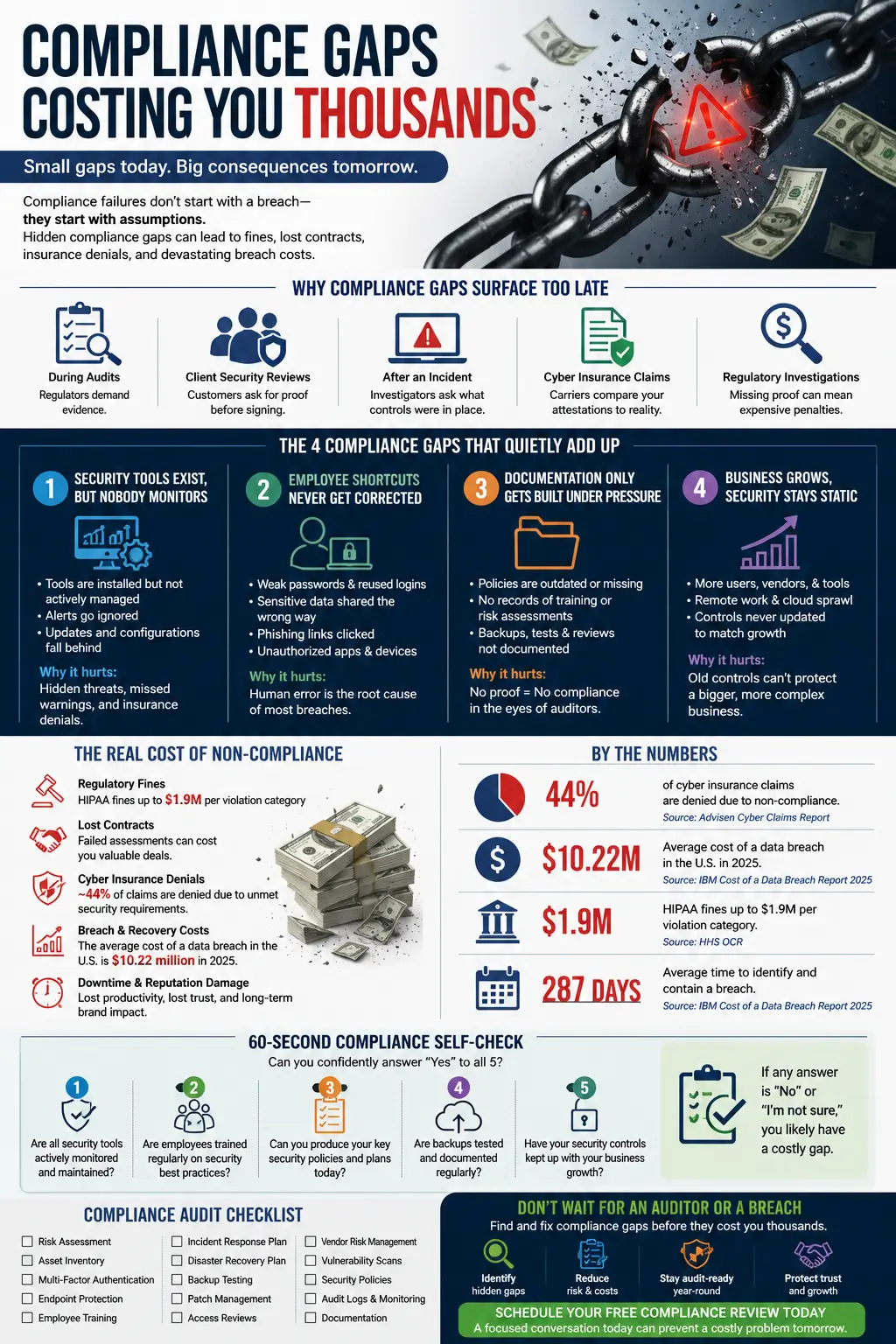
Compliance gaps almost never show up during a normal Tuesday. They surface under pressure — specifically:
- During a formal audit, when a regulator or industry body requests evidence
- In a client security review, when a prospective customer’s procurement team asks for documentation before signing
- After a cybersecurity incident, when an investigator starts asking what controls were actually in place
- When filing a cyber insurance claim, when the carrier compares what you attested to against what was actually running
Each of these moments has one thing in common: they demand proof, not intentions. A business that “meant to” enable multi-factor authentication everywhere, or “was planning to” formalize its incident response plan, is treated the same as a business that never considered it at all.
The 4 Compliance Gaps That Quietly Add Up
Across dozens of IT and security assessments, the same four gaps appear again and again — regardless of whether the business is a Raleigh law firm, a Durham healthcare practice, a Cary manufacturer, or a Manhattan financial services firm.
- Security Tools Nobody Is Actually Monitoring
Most businesses already pay for the basics: endpoint protection, multi-factor authentication (MFA), firewalls, email filtering, and some form of threat detection. On paper, that looks like solid coverage.
The problem isn’t the tools. It’s ownership. Nobody has clearly answered:
- Who confirms these tools are configured correctly on every device?
- Who reviews the alerts they generate?
- Who catches a failed update or a laptop that silently dropped off MFA enrollment?
This gap matters more than most business owners realize because insurers now underwrite around it directly. Industry claims data — including Advisen’s Cyber Claims Report — puts cyber insurance claim denial rates at roughly 44%, and a large share of those denials trace back to security controls that were promised on the application but not actually maintained, especially incomplete MFA coverage. Owning a tool and managing a tool are treated as two different things, and only one of them satisfies a carrier or an auditor.
- Employee Behavior No One Has Revisited
Most compliance risk isn’t malicious — it’s employees trying to move fast. Reused passwords, sensitive files sent through the wrong channel, a convincing phishing email clicked in a hurry, company systems accessed from a personal phone. None of these start as a crisis. They become one when nobody ever circles back to correct the habit.
This is a particularly common gap for growing NC businesses hiring quickly in a tight Triangle labor market, and for NYC firms managing hybrid or fully remote teams across boroughs and state lines. New hires inherit whatever habits go unaddressed.
- Documentation That Only Exists Once Someone Asks For It
A business can be doing genuinely good security work and still fail an audit — because doing the work and proving the work are not the same thing. Missing or inconsistent records, policies that were never formally reviewed, access logs that exist but were never checked, and vendor risk assessments that live only in someone’s memory all create the same outcome: scrambling under a deadline, in front of the person you least want to see you scrambling.
- The Business Changed, But Security Didn’t
This is the gap that’s easiest to miss because nothing “broke.” A company that started with 8 employees and one office now has 30 people, several remote workers, three new SaaS vendors, and a client contract with its own security requirements attached. The security stack, meanwhile, is still the one built for the smaller, simpler version of the business.
Access permissions become too broad. Backup coverage misses tools that didn’t exist a year ago. A control that made sense at one size quietly becomes inadequate at the next.
What This Actually Costs
The dollar figures here are not abstract. According to IBM’s 2025 Cost of a Data Breach Report, the average cost of a data breach for a U.S. organization reached an all-time high of $10.22 million in 2025 — up 9% year over year, driven largely by regulatory fines and longer detection timelines. Smaller businesses obviously don’t absorb breaches at that scale, but the direction is the same: the longer a gap goes unnoticed, the more expensive it becomes to resolve.
Regulatory exposure adds another layer. Businesses that qualify as “financial institutions” under the FTC Safeguards Rule — a definition that includes many mortgage brokers, accountants, tax preparers, auto dealers, and financial advisors, not just banks — face civil penalties that can now reach roughly $51,744 per violation, per day, under the FTC’s current inflation-adjusted enforcement guidance. Multiple violations, or violations that continue for weeks before they’re caught, compound quickly.
Then there’s the insurance layer. As noted above, close to half of all cyber insurance claims face denial, and control gaps — especially around MFA, documentation, and patching — are consistently cited as the leading cause. A business that assumed it had a safety net can discover, mid-crisis, that the net was never actually attached.
A brief, anonymized example: A Triangle-area professional services firm we assessed had every major security tool in place — MFA, endpoint protection, a modern firewall — and genuinely believed they were audit-ready. When a client’s procurement team requested documentation ahead of a contract renewal, the firm discovered their incident response plan hadn’t been updated in three years, their vendor risk assessments were incomplete, and MFA had silently lapsed on two administrative accounts during a platform migration eight months earlier. Nothing had gone wrong yet. But nothing about their actual environment matched what they would have attested to on a cyber insurance renewal. The fix took about three weeks. Finding out during an actual incident would have taken considerably longer, and cost considerably more.
A 60-Second Compliance Self-Check
Before scheduling a formal review, ask yourself these five questions. If you can’t answer “yes” to at least four, there’s a gap worth closing before someone else finds it first.
- Could you produce your current security policies and incident response plan within the hour, not the week?
- Is MFA enforced on every account — including admin, email, and remote access — not just the ones you remember to check?
- Has anyone reviewed employee security habits (password reuse, personal device use, data handling) in the last six months?
- Do your current security controls reflect your business today — headcount, vendors, remote work — rather than how it looked a year or two ago?
- If a client, auditor, or insurer asked for proof of compliance tomorrow, could you provide it without scrambling?
Compliance Isn’t a One-Time Project
Whether you’re a Raleigh accounting firm navigating the FTC Safeguards Rule, a Durham healthcare practice managing HIPAA obligations, a Cary manufacturer working toward CMMC requirements for defense contracts, or an NYC firm balancing New York’s SHIELD Act data security requirements alongside frameworks like SOC 2 or PCI DSS, the underlying lesson is the same: compliance is not a document you file once. It’s a posture you maintain.
The businesses that come through audits, insurance renewals, and client reviews without a scramble are the ones that treat compliance as ongoing — not the ones with the most expensive tools, but the ones with the clearest ownership over what those tools are actually doing.
Ready to find out where your gaps actually are? Schedule a free compliance and IT risk review with our team. We’ll walk through your current controls, documentation, and policies against what auditors, insurers, and clients are actually asking for — and give you a clear, prioritized punch list, not a sales pitch.
Schedule Your Free Compliance Review → Call us : (919)-469 5060
Frequently Asked Questions
What are the most common compliance gaps in small businesses?
The most common gaps fall into four categories: security tools that exist but aren’t actively monitored, employee security habits that are never revisited, documentation that only gets created under pressure instead of maintained continuously, and security controls that haven’t kept pace with business growth (new staff, vendors, remote work, or software).
How much can a compliance gap actually cost a small business?
Costs vary by severity and industry, but the exposure adds up fast. FTC Safeguards Rule violations can reach roughly $51,744 per violation per day under current inflation-adjusted penalties. Separately, close to 44% of cyber insurance claims face denial industry-wide, often because a security gap meant the policy’s conditions weren’t actually met — leaving the full cost of an incident uncovered.
What is a compliance risk assessment, and do I need one?
A compliance risk assessment is a structured review of your current security controls, documentation, and processes against the regulations and contractual requirements that actually apply to your business (such as HIPAA, PCI DSS, the FTC Safeguards Rule, SOC 2, or CMMC). If your business handles customer financial data, health information, card payments, or works with clients who require security attestations, a periodic risk assessment isn’t optional — it’s expected.
Can outdated documentation cause a compliance failure even if my security is actually good?
Yes. Auditors, insurers, and enterprise clients can only evaluate what you can prove, not what you assume is true. A business with strong technical controls but incomplete or outdated documentation can still fail a review, face a denied insurance claim, or lose a contract simply because it couldn’t produce evidence quickly enough.
How often should a business review its compliance and IT security posture?
At minimum, once a year — but any significant change (new hires, new vendors, a new office, expanded remote work, or a new client with its own security requirements) should trigger a review on its own. Waiting for the annual cycle to catch a gap created six months earlier is exactly how small issues turn into expensive ones.
Does managed IT support help with compliance, or is that a separate service?
The two are closely linked. Managed IT support typically covers monitoring, patching, and maintaining the tools themselves, while compliance support covers documentation, risk assessments, and mapping your controls to the specific regulations or frameworks (HIPAA, PCI, FTC Safeguards, CMMC, SOC 2, state privacy laws) that apply to your business. Many managed IT providers, including ours, offer both together, since a tool that isn’t documented or a policy that isn’t enforced technically both create the same audit risk.