
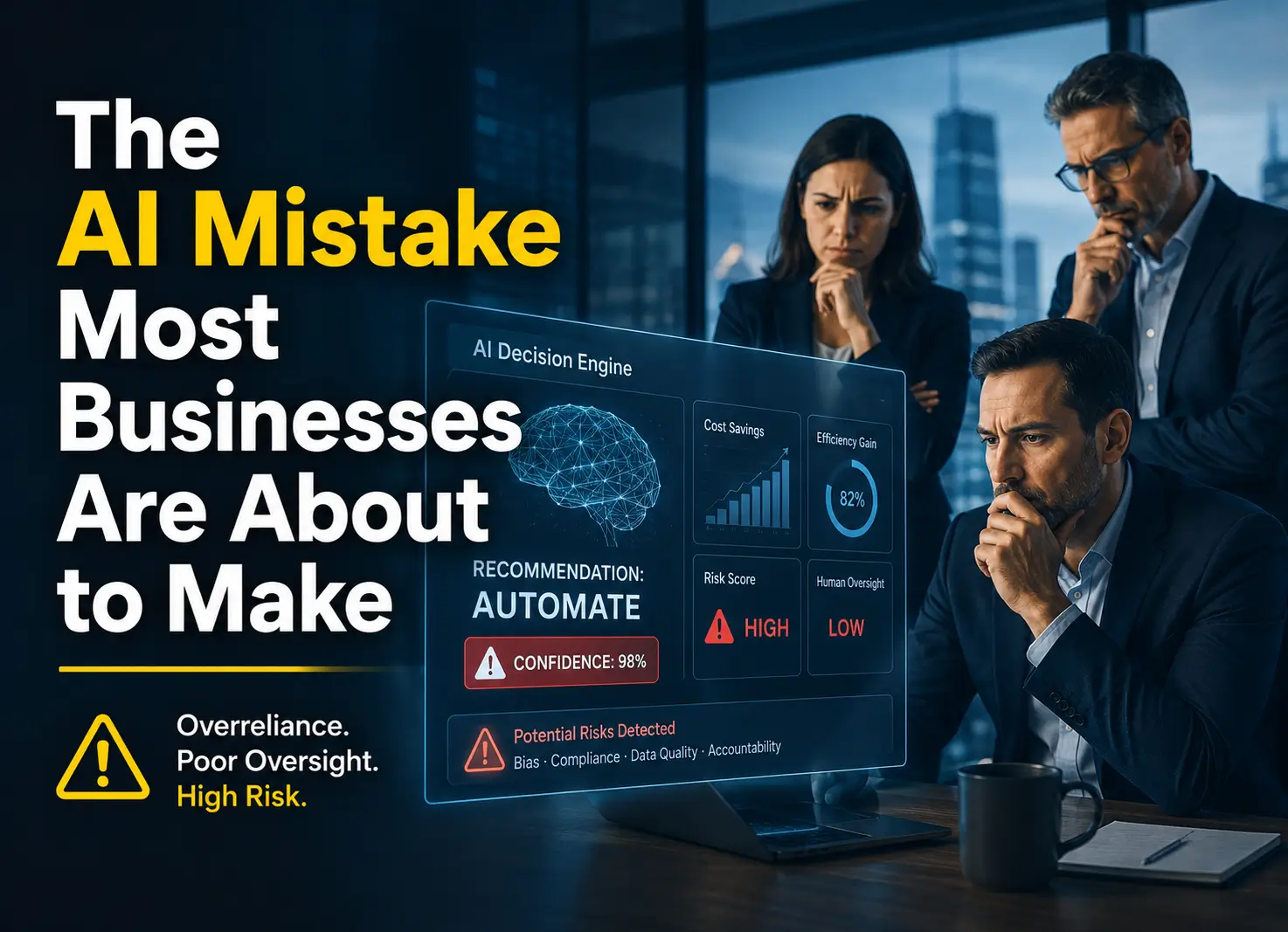
The AI Mistake Most Businesses Are About to Make
The AI Mistake Most Businesses Are About to Make
Artificial intelligence is becoming part of everyday business faster than most companies can update a policy, approve a vendor, or train a team. Employees are already using AI to summarize meetings, draft emails, analyze spreadsheets, write proposals, troubleshoot software, and organize customer information. Leaders are under pressure to move quickly because no one wants to fall behind.
But the biggest AI mistake most businesses are about to make is not choosing the wrong chatbot. It is treating AI like an ordinary software purchase instead of a managed business capability. A company buys licenses and encourages experimentation without defining which data the tool may access, who owns the results, when a person must review its output, or how the business will measure value.
Quick answer: Businesses should not scale AI until they have approved use cases, data rules, access controls, human review requirements, accountable ownership, and a way to measure business value. The goal is not to slow AI down. It is to make AI useful without making the organization fragile.
The Real Mistake: Implementation Before Strategy
AI adoption often begins with a tool demonstration. Someone shows how quickly it can write a sales email, summarize a contract, or generate a project plan. The output looks impressive, the monthly cost seems manageable, and the business begins rolling it out. That sequence feels efficient, but it starts with the product instead of the problem.
A sound AI initiative begins with a specific workflow and a defined outcome. Are you reducing time to prepare a first draft, helping technicians find documented answers, or turning meeting notes into assigned tasks? Each use case has different data, accuracy, security, and oversight requirements. Without that clarity, a business may automate the wrong work, buy overlapping tools, or create risk without producing a meaningful return.
This is why an AI policy alone is not enough. A policy can say what employees may or may not do, but a practical strategy connects rules to approved tools, technical controls, training, workflow design, and measurable goals. AI governance is not a document that sits in a folder. It is the way the business makes decisions about AI repeatedly.
What Unmanaged AI Looks Like Inside a Small Business
Unmanaged AI rarely arrives as one dramatic failure. It appears as dozens of reasonable shortcuts. A project manager pastes a client email into a free tool to make it clearer. An estimator uploads a document so an assistant can extract quantities. A recruiter asks AI to rank applicants. A finance employee uses an AI add-in to explain a spreadsheet. A field supervisor records a meeting with a transcription service that no one has reviewed.
Together, these actions create shadow AI: tools and workflows used without the visibility of the people responsible for IT, security, privacy, or records management. The company may not know which vendors hold its information, which accounts employees created, what integrations can access cloud files, or how long submitted data is retained.
Blocking every AI tool is usually not a lasting answer. Employees turn to convenient tools because they are trying to solve real problems. A better response is to give them an approved path: clear tools for approved tasks, simple rules for restricted data, and a fast process for requesting a new use case. Good governance makes the secure choice easier to follow.
Five Costs Businesses Often Discover Too Late
1. Sensitive data leaves the expected boundary
Prompts can contain far more than casual text. They may include customer records, employee information, pricing, contracts, source code, financial details, building plans, credentials, or intellectual property. Uploads, browser extensions, meeting assistants, and connected AI agents can expand that exposure. NIST identifies data privacy, information security, intellectual property, and third-party component risks among the concerns organizations should manage when using generative AI. The practical lesson is simple: do not rely on a warning in an employee handbook when access controls and approved configurations can enforce the rule.
2. Confident output is mistaken for correct output
AI can produce a polished answer that is incomplete, out of date, or wrong. NIST uses the term “confabulation” for confidently stated false content. In a low-risk brainstorming exercise, an error may be easy to catch. In a proposal, legal summary, financial analysis, customer response, or technical instruction, the same error can influence a decision. Businesses need review standards based on impact. The more consequential the output, the more qualified and independent the human review should be.
3. Tool sprawl creates cost and visibility problems
When every department chooses its own AI tools, subscriptions multiply and important controls vary. Some accounts use personal email addresses. Some tools have strong administrative controls; others do not. Similar features may already exist inside approved cloud platforms. A vendor inventory helps the business consolidate spending, confirm who owns each account, review settings, and remove tools that no longer serve an approved purpose.
4. Automation receives too much authority
The risk changes when AI moves from suggesting to acting. An assistant that drafts a customer email is different from one that sends it. A tool that identifies a late invoice is different from one that contacts the customer or changes a record. OWASP describes “excessive agency” as granting an AI-enabled system more functionality, permission, or autonomy than it needs. High-impact actions should require limited permissions, downstream authorization, reliable logging, and human approval.
5. The company cannot show what improved
AI activity is not the same as AI value. A dashboard showing thousands of prompts does not prove that employees saved useful time, reduced rework, improved response quality, or served customers better. Without a baseline, leaders cannot distinguish a productive workflow from a novelty. They also cannot tell whether faster output created more review work later.
A Seven-Step Framework for Safer, More Useful AI
Businesses do not need a large AI department to begin responsibly. They need a repeatable decision process. The following framework gives small and midsized organizations a practical starting point.
- Inventory current AI use. Ask employees which tools they use, what tasks they perform, which accounts or integrations are involved, and what information they submit. Make the exercise constructive. The purpose is to see the environment clearly, not punish people for trying to work more efficiently.
- Classify data before it reaches a prompt. Define categories such as public, internal, confidential, regulated, and prohibited. Give employees recognizable examples from their work. For a construction or engineering firm, restricted material may include customer agreements, bid details, credentials, project plans, personnel records, and controlled client documents. Map each class to permitted tools and actions.
- Approve tools for specific use cases. Review vendors for security controls, authentication options, administrative visibility, retention settings, integration permissions, contractual terms, and how submitted data is handled. Approval should answer both “Is this tool acceptable?” and “What may we use it for?” A tool approved for marketing brainstorming may not be approved for client documents.
- Start with a narrow pilot. Choose a frequent, reversible, low-impact workflow with a clear owner. Establish a baseline, test the process with a small group, and define success before rollout. Useful measures might include time to first draft, number of corrections, turnaround time, adoption rate, or employee satisfaction. Include the cost of review and error correction in the result.
- Keep people accountable for outcomes. Name the person responsible for the workflow, the person who approves the tool, and the person who reviews higher-risk outputs. Require human confirmation before external publication, customer communication, financial action, access change, hiring decision, or another consequential step. AI may assist the work; accountability remains with the business.
- Apply existing security fundamentals. Use business-managed accounts, multifactor authentication, least-privilege access, device management, patching, secure cloud configuration, logging, monitoring, backups, and an incident response process. These controls remain essential when AI is added. CISA’s small-business guidance emphasizes logging user and administrative activity, monitoring for unusual behavior, protecting logs, and assigning response roles.
- Review and improve on a schedule. AI tools, vendor terms, integrations, and business uses change quickly. Revisit the inventory, access permissions, approved-use list, incidents, and performance measures at a defined interval. Remove unused access, retire weak tools, update training, and expand only the pilots that demonstrate value without unacceptable risk.
What a Practical AI Policy Should Answer
The best AI policy is short enough to use and specific enough to guide a decision. Employees should be able to find direct answers to questions such as:
- Which AI tools and account types are approved?
- What information must never be entered, uploaded, recorded, or connected?
- Which outputs require fact-checking, expert review, or manager approval?
- May AI-generated content be sent to customers or published externally?
- Who evaluates new tools, plugins, browser extensions, and integrations?
- How should an employee report an accidental disclosure or suspicious AI behavior?
- How will the company preserve required records and document important decisions?
Training should turn those answers into examples employees recognize. They need to understand why AI output must be checked and where to go when an approved tool cannot complete the task. The U.S. Small Business Administration similarly advises small businesses to start small, avoid feeding sensitive or proprietary information into AI tools, and have a person review AI-generated work.
Why the Secure Foundation Matters
AI does not replace the need for well-managed technology. It increases the value of knowing who has access to what, where business data lives, how devices are protected, whether cloud permissions are appropriate, and how activity can be investigated. If identities, endpoints, cloud storage, backups, or vendor access are poorly managed, adding AI can make existing weaknesses harder to see and faster to exploit.
For businesses in Raleigh, Cary, Durham, the Triangle, and New York City, the right approach is not a race to adopt the most tools. It is a disciplined path from business need to approved workflow. That may begin with a technology and security assessment, followed by clearer data handling, stronger identity controls, a reviewed vendor list, employee training, and one useful pilot.
How Computerbilities Can Help
Computerbilities helps small and midsized businesses build the reliable, secure IT environment that responsible AI adoption depends on. That includes proactive managed IT services, cybersecurity solutions, cloud management, monitoring, employee security awareness, and strategic technology planning. The goal is to connect new technology to the way your business actually operates while reducing avoidable risk.
If employees are already experimenting with AI, that is not a reason to panic. It is a reason to gain visibility. Computerbilities can help your organization evaluate its current environment, identify gaps, and create a practical path for using AI more securely and intentionally.
Schedule a discovery call with Computerbilities to review your technology environment and discuss the security, cloud, and governance foundation your business needs before AI use expands.
Frequently Asked Questions
What is the biggest AI mistake businesses make?
The biggest mistake is adopting and scaling AI tools before defining approved use cases, data rules, ownership, human review, security controls, and success measures. The problem is not experimentation itself; it is experimentation that becomes an unmanaged business process.
Should a small business ban public AI tools?
A blanket ban may be appropriate for particular tools, data types, or regulated workflows, but it often fails as a complete strategy. A more workable approach is to provide approved tools, prohibit sensitive data where necessary, apply technical controls, train employees, and create a review process for new use cases.
What data should employees avoid entering into AI?
Unless a reviewed tool and approved workflow explicitly allow it, employees should avoid entering confidential customer information, employee records, financial data, credentials, contracts, proprietary files, regulated data, and other sensitive business information. The exact rule should reflect the company’s obligations and the vendor’s handling of data.
How can a company measure whether AI is useful?
Start with a baseline for one workflow, then measure an outcome such as turnaround time, correction rate, rework, customer response quality, or employee time saved. Count the time required to review and fix AI output. Expand the workflow only when the net result supports a real business goal.
Who should be responsible for AI governance?
Executive leadership should sponsor the program, while a named owner coordinates input from IT, cybersecurity, operations, legal or compliance, HR, and the teams using the tools. Responsibility should be explicit. High-impact use cases need qualified human owners who remain accountable for the final decision or action.
The Bottom Line
The winners in business AI will not be the companies that collect the most tools or automate the most steps. They will be the companies that know where AI creates value, where it creates risk, and where a person must remain firmly in control.
Treat AI as a managed capability. Give it a business purpose, an owner, secure boundaries, and a review process. Start small, measure honestly, and expand deliberately. That is how a business moves quickly without handing its data, decisions, and reputation to a system it has not learned to manage.