
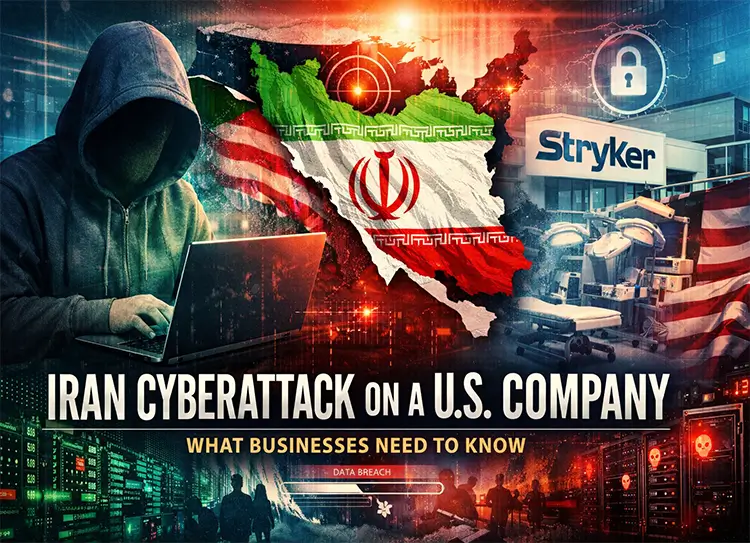
Iran Appears to Have Conducted a Major Cyberattack Against a U.S. Company
Cybersecurity experts have long warned that geopolitical tensions do not remain confined to physical battlefields. Increasingly, conflicts between nations are unfolding in the digital world—where corporate networks, healthcare systems, and critical infrastructure become targets.
Recently, reports surfaced that Iran-linked hackers may have launched a significant cyberattack against a U.S. company, marking one of the first notable cyber incidents tied to the ongoing geopolitical conflict. The target: Stryker, a major U.S.-based medical technology manufacturer with global operations.
The alleged Stryker cyberattack has sparked serious concern across the cybersecurity community. Analysts say the incident reflects a broader trend of nation-state cyber operations, where politically motivated hackers target organizations to disrupt operations, steal data, or send a geopolitical message.
For businesses in North Carolina—including Raleigh, Cary, and Durham—this event is more than international news. It highlights how modern cyber warfare increasingly impacts private companies, healthcare providers, and small and medium-sized businesses.
Understanding what happened—and what it means for cybersecurity—is critical for organizations looking to protect themselves in a rapidly evolving threat landscape.
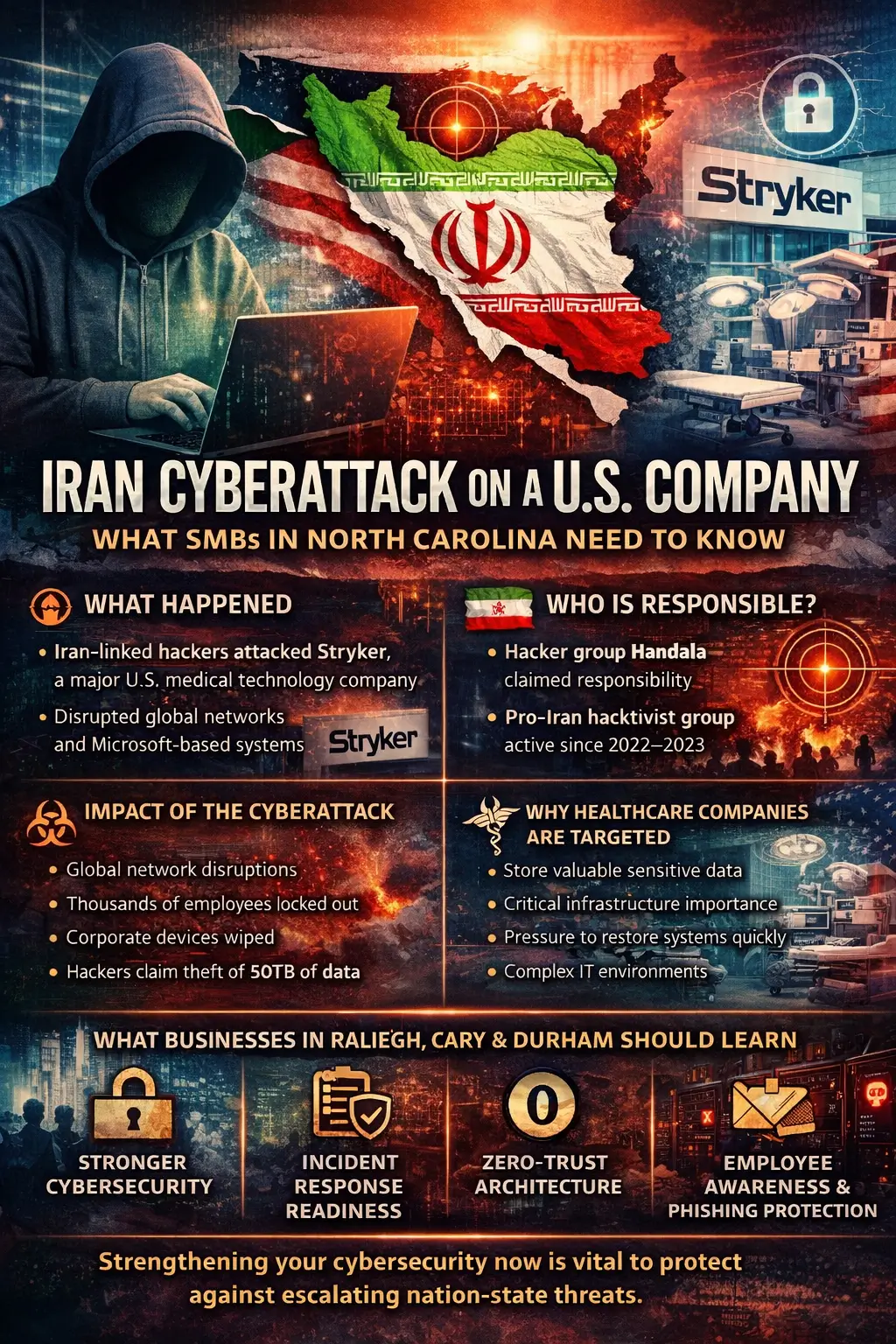
Iran-Linked Hackers Target U.S. Medical Technology Giant
Reports indicate that Iran-linked hackers carried out a cyberattack on Stryker, a globally recognized manufacturer of medical devices and healthcare technology.
The attack reportedly disrupted the company’s corporate networks and Microsoft-based systems worldwide, preventing employees from accessing internal resources and communication tools. Such disruptions can quickly ripple across international operations, especially for companies operating in highly interconnected environments.
While details continue to emerge, early analysis suggests the incident involved a global network disruption cyberattack, potentially impacting internal IT infrastructure and connected corporate systems.
Healthcare organizations are particularly sensitive to this type of attack because their operations depend heavily on digital infrastructure. Even temporary disruptions can interfere with supply chains, hospital technology integrations, and patient services.
For small and medium-sized businesses observing the situation, the incident highlights a key reality: cyberattacks today often target large companies but expose vulnerabilities across entire industries.
Who Is the Handala Hacker Group?
The Handala hacking group has claimed responsibility for the attack.
Handala is widely described as a pro-Iran hacktivist collective that emerged around 2022–2023 and has been linked to several cyber operations targeting Western organizations.
Unlike traditional cybercriminal groups motivated primarily by financial gain, hacktivist groups such as Handala often pursue political objectives. Their activities frequently align with broader geopolitical conflicts, making them part of what cybersecurity experts describe as state-linked cyber actors or proxy hacking groups.
These groups typically employ tactics associated with advanced persistent threats (APT), including:
- Data exfiltration cyberattacks
- Corporate network infiltration
- Digital espionage
- Public data leaks designed to embarrass organizations
Although the extent of direct state involvement is often difficult to prove, many cybersecurity analysts believe such groups operate in alignment with broader nation-state cyber operations.
In recent years, Iranian hacker groups have been linked to attacks targeting:
- Government agencies
- Energy infrastructure
- Healthcare systems
- Technology companies
This makes the Iran cyberattack on a U.S. company particularly concerning, as it signals the continued expansion of geopolitical cyber conflict into private industry.
How the Cyberattack Disrupted Global Operations
One of the most alarming aspects of the incident is the scale of disruption reportedly caused by the attack.
According to early reports, the cyberattack resulted in:
- Global corporate network disruptions
- Employees unable to access internal systems
- Corporate devices wiped or disabled
- Potential theft of large volumes of corporate data
Hackers allegedly claimed they stole up to 50 terabytes of data, though independent verification remains limited.
If confirmed, such a data exfiltration cyberattack could represent one of the larger corporate data theft incidents in recent months.
For companies that rely heavily on cloud platforms and enterprise software—especially Microsoft-based systems—an attack that disables access to internal tools can halt operations almost instantly.
To put this into perspective, imagine a company where employees suddenly cannot:
- Access internal email systems
- Use collaboration tools
- Retrieve critical business files
- Log into operational platforms
For organizations operating across multiple continents, the impact can escalate quickly.
While large corporations may have dedicated cybersecurity teams, smaller businesses often lack the same level of incident response resources, making them even more vulnerable to similar disruptions.
Why Healthcare Companies Are Increasingly Targeted
The healthcare sector has become one of the most frequently targeted industries for cyberattacks.
There are several reasons why hackers—particularly nation-state actors—focus on healthcare organizations.
- Valuable Data
Healthcare companies store extremely valuable information, including:
- Patient records
- Medical device data
- Insurance information
- Research and development data
This information can be used for identity theft, espionage, or political leverage.
- Critical Infrastructure Importance
Healthcare systems are considered part of critical infrastructure.
Disrupting medical technology companies can affect:
- Hospital equipment supply chains
- Medical device availability
- Healthcare delivery systems
This makes healthcare organizations highly strategic targets during geopolitical conflicts.
- Pressure to Restore Systems Quickly
Unlike many industries, healthcare organizations often face intense pressure to restore systems quickly because operational downtime can affect patient care.
Hackers understand this and may exploit the urgency to force organizations into rapid responses.
- Complex IT Environments
Healthcare companies often operate highly complex IT environments that include:
- Legacy systems
- Medical devices connected to networks
- Cloud platforms
- Third-party vendor integrations
This complexity creates additional opportunities for attackers to exploit vulnerabilities.
Motivation Behind the Attack
According to reports, the hackers framed the cyberattack as retaliation for military strikes linked to Iran.
This type of digital retaliation illustrates a growing trend: cyber warfare tied to geopolitical conflicts.
Instead of traditional military escalation, adversaries may use cyber operations to:
- Disrupt economic activity
- Send political messages
- Demonstrate technological capabilities
- Undermine public confidence
These tactics fall under the broader category of cyber warfare escalation in the Middle East, where digital operations increasingly accompany physical conflict.
The rise of cyber warfare means that private businesses are now part of geopolitical risk landscapes, even if they have no direct involvement in international politics.
Is This the Beginning of a New Cyber War?
Many cybersecurity experts believe incidents like the Stryker cyberattack may signal the beginning of a more aggressive phase of digital conflict.
Nation-state cyber campaigns are becoming more frequent and more sophisticated.
These campaigns often involve:
- Long-term cyber espionage
- Data theft operations
- Infrastructure disruption attacks
- Information warfare campaigns
For organizations across the United States, including SMBs in North Carolina, this trend raises important questions about cybersecurity preparedness.
While most nation-state attacks target larger organizations, smaller businesses often become secondary targets through supply chain attacks.
In other words, attackers may breach a large company by first compromising a smaller vendor or partner.
This makes cybersecurity readiness critical for organizations of every size.
What Businesses in Raleigh, Cary, and Durham Should Learn From the Attack
While the cyberattack targeted a large medical technology company, the lessons apply directly to small and medium-sized businesses in North Carolina.
Cyber threats are evolving quickly, and organizations must adapt their security strategies accordingly.
- Cybersecurity Is No Longer Optional
Businesses must view cybersecurity as a core operational priority, not just an IT issue.
Attackers increasingly target companies of all sizes, especially those with weak defenses.
- Incident Response Planning Is Essential
When a cyberattack occurs, the speed of response often determines the severity of damage.
Businesses should maintain a clear incident response strategy, including:
- Security monitoring systems
- Backup and recovery plans
- Communication protocols
- Zero Trust Security Models Are Becoming Standard
Traditional network security assumed users inside the network could be trusted.
Modern cybersecurity strategies use Zero Trust architecture, which verifies every user and device before granting access.
- Employee Awareness Is Critical
Human error remains one of the most common causes of cyber breaches.
Employees should receive regular training on:
- Phishing detection
- Password security
- Safe browsing practices
- Suspicious email identification
How Companies Can Protect Against Nation-State Cyberattacks
While no organization can completely eliminate cyber risk, several proactive strategies significantly reduce exposure.
Implement Continuous Network Monitoring
Real-time monitoring helps identify unusual network activity before attackers can escalate their access.
Strengthen Endpoint Protection
Advanced endpoint protection tools help prevent malware infections and unauthorized device access.
Secure Cloud Infrastructure
Many organizations rely heavily on cloud platforms such as Microsoft systems. Proper configuration and security monitoring are essential.
Conduct Regular Security Audits
Routine vulnerability assessments and penetration testing can identify weaknesses before attackers exploit them.
Partner With Managed IT Security Experts
For many SMBs, working with experienced cybersecurity providers ensures access to enterprise-level protection without the need for a full in-house security team.
Businesses across Raleigh, Cary, and Durham increasingly rely on Managed IT Services and cybersecurity monitoring to defend against evolving digital threats.
Final Thoughts
The alleged Iran cyberattack on a U.S. company serves as a stark reminder that cyber warfare is no longer a distant geopolitical issue—it is a real and growing risk for organizations everywhere.
As global tensions increasingly spill into cyberspace, businesses must recognize that digital security is now a critical part of operational resilience.
For companies across North Carolina, strengthening cybersecurity defenses today may be the difference between maintaining business continuity and experiencing a disruptive breach tomorrow.
The lessons from the Stryker cyberattack are clear: proactive cybersecurity planning, employee awareness, and modern security frameworks are essential for navigating the evolving threat landscape.
FAQs
What company was targeted in the Iran cyberattack?
Reports indicate that Stryker, a U.S.-based medical technology company, was targeted by Iran-linked hackers, resulting in disruptions to global corporate networks.
Who is the Handala hacker group?
The Handala hacking group is a pro-Iran hacktivist collective active since around 2022–2023 and associated with politically motivated cyber operations.
Why do hackers target healthcare companies?
Healthcare companies store highly sensitive data and operate critical infrastructure systems, making them attractive targets for cyber espionage and disruption attacks.
What is a nation-state cyberattack?
A nation-state cyberattack is a cyber operation carried out by a government or government-linked group targeting organizations for political, economic, or strategic purposes.
How can small businesses protect themselves from cyber warfare threats?
Small businesses can strengthen their cybersecurity by implementing network monitoring, employee security training, secure backups, and working with managed IT service providers.