
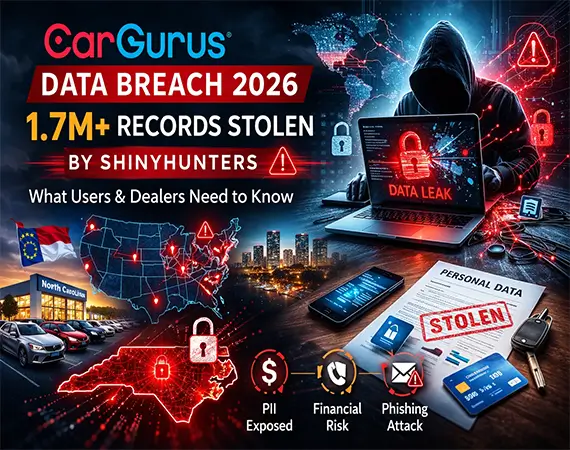
CarGurus Data Breach: 1.7M Records Stolen — What North Carolina Users and Dealers Need to Know
In February 2026, headlines began circulating about a major CarGurus data breach, with claims that 1.7 million records were stolen. Within days, those claims expanded, investigations deepened, and cybersecurity analysts uncovered evidence suggesting the breach may have been far larger than initially reported.
For North Carolina residents — from Raleigh and Durham car shoppers to Charlotte and Greensboro dealerships — the incident is more than a national tech story. It’s a reminder that even well-known platforms in the automotive marketplace are not immune to sophisticated cyberattacks.
In this detailed breakdown, we’ll explore what happened, who is behind the ShinyHunters CarGurus hack, how the attack unfolded, what data may have been exposed, and most importantly, what affected users should do next.
Introduction: What Happened at CarGurus?
CarGurus is one of the largest online automotive marketplaces in the United States. Millions of consumers use the platform to compare vehicle prices, research dealerships, check financing options, and communicate with sellers. For many North Carolina buyers — whether shopping in Cary, Chapel Hill, or Asheville — CarGurus has become part of the car-buying journey.
In mid-February 2026, however, CarGurus found itself in the spotlight for a very different reason: a cybersecurity incident.
The breach was claimed by the cybercrime group ShinyHunters, a prolific leak-and-extort organization known for targeting corporate platforms and selling or publishing stolen datasets. The group initially claimed that approximately 1.7 million corporate records had been stolen from CarGurus systems — sparking immediate concern among customers, dealers, and cybersecurity professionals.
This alleged CarGurus breach 2026 quickly escalated into a broader investigation as additional data surfaced online.
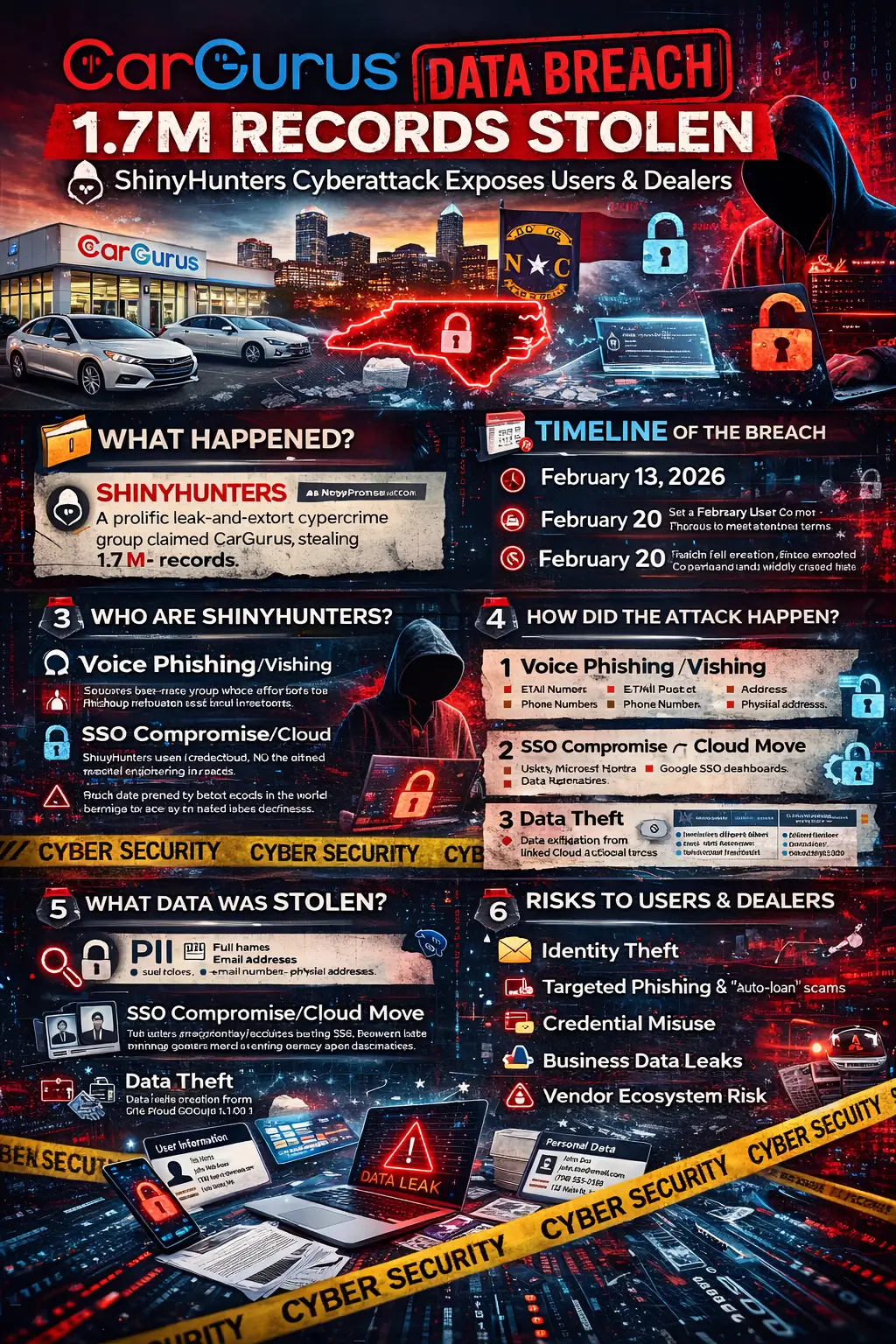
Timeline of the Breach
Understanding the sequence of events helps clarify how the CarGurus data breach investigation unfolded.
February 13, 2026 — Alleged Initial Compromise
Cyber threat intelligence sources suggest that the attackers gained access around February 13. The intrusion reportedly began with a targeted social engineering attack against internal employees.
February 20, 2026 — Public Claim and Ransom Deadline
ShinyHunters publicly claimed responsibility and set a February 20 deadline, demanding contact before releasing the stolen dataset. This tactic is characteristic of an extortion-style cyberattack, where attackers pressure organizations to negotiate before publishing data.
Post-Deadline — Data Released
When negotiations allegedly failed, the dataset was reportedly posted to a dark web leak site and indexed by threat intelligence platforms. Security researchers began analyzing the contents and discovered that the dataset may have included far more than the originally claimed 1.7 million records.
This progression — from initial claim to expanded exposure — is common in major breaches. Early numbers often reflect partial access, while forensic analysis reveals broader scope over time.
- Who Are ShinyHunters?
To understand the gravity of the ShinyHunters cyberattack, it’s important to know who they are.
ShinyHunters is a cybercrime collective notorious for breaching high-profile platforms and leaking stolen data to extort victims. Over the years, they have claimed responsibility for breaches involving global consumer brands, tech platforms, and corporate systems.
They are particularly known for:
- Targeting cloud-based infrastructure
- Exploiting single sign-on (SSO) systems
- Publishing datasets when ransom demands are not met
- Leveraging social engineering instead of purely technical exploits
Unlike traditional ransomware groups that encrypt systems, ShinyHunters often focuses on data exfiltration and public exposure — maximizing reputational damage.
Their track record includes breaches involving entertainment platforms, software companies, and enterprise databases. The ShinyHunters CarGurus hack fits a familiar pattern.
How the Attack Happened: The Voice Phishing SSO Breach
One of the most alarming aspects of the CarGurus hacked incident is the reported attack vector.
Vishing (Voice Phishing) Attack
Investigations indicate the breach began with a vishing (voice phishing) attack. Attackers allegedly impersonated internal IT or technical support staff and contacted employees directly.
Unlike email phishing — which many organizations now detect quickly — voice phishing is more personal and urgent. A convincing caller posing as IT support can persuade an employee to:
- Reset credentials
- Approve login prompts
- Provide verification codes
- Confirm multi-factor authentication requests
Once credentials were obtained, attackers reportedly accessed internal systems through SSO compromise (Okta / Microsoft / Google) platforms.
Multi-Factor Authentication Bypass
If an employee unknowingly approves a fraudulent authentication request, attackers can effectively bypass multi-factor authentication. This technique has become increasingly common in corporate breaches.
After gaining access, attackers reportedly moved laterally across connected cloud environments, including:
- Salesforce
- Microsoft 365
- Google Workspace
- Other linked enterprise systems
From there, credential harvesting and data exfiltration occurred.
This wasn’t a brute-force attack. It was a human attack — exploiting trust rather than code.
Scope and Size of the Data Leak
One of the most confusing aspects of the CarGurus leaked data story is the discrepancy in reported numbers.
Initial Claim: 1.7 Million Records
ShinyHunters initially claimed they had stolen approximately 1.7 million corporate/internal records.
This number was widely reported and became the basis for headlines referencing “CarGurus 1.7M records stolen.”
Expanded Dataset: 12.4 Million+ Records
However, subsequent analysis of the publicly circulating dataset suggested that the exposed data may have included over 12.4 million user records — significantly larger than the original claim.
This evolution highlights a key lesson: early breach numbers are often preliminary. Attackers may underestimate, overestimate, or selectively disclose data.
For North Carolina readers, this means that even if you don’t believe you fall within the “1.7 million,” your data could still be part of the broader exposure.
Types of Data Exposed
According to breach indexing sources and threat intelligence summaries, the exposed information may include:
Personally Identifiable Information (PII)
- Full names
- Email addresses
- Phone numbers
- Physical addresses
Account Metadata
- UUIDs
- Account creation dates
- Internal IDs
Technical and Financial Data
- IP addresses
- Auto finance pre-qualification data
- Dealer accounts and subscription records
Notably, there has been no confirmed evidence of plaintext passwords being included in the publicly analyzed dataset. However, the exposure of personally identifiable information (PII) alone can enable identity theft and targeted scams.
CarGurus’ Response
CarGurus acknowledged the cybersecurity incident and launched a third-party forensic investigation.
The company described the event as “limited in scope,” though independent analysis of the circulating dataset suggests broader exposure.
CarGurus stated that:
- Core dealer feeds were not compromised
- Primary operational systems were not disrupted
- The investigation remains ongoing
In major breaches, organizations must balance transparency with legal and forensic obligations. It’s not uncommon for official statements to evolve as more information becomes available.
Implications for North Carolina Users and Dealers
For North Carolina residents, the data breach impact on users can be significant.
Risks to Consumers
If your information was exposed, you could face:
- Identity theft
- Targeted phishing campaigns
- “Auto-loan” scams referencing vehicle inquiries
- Credential reuse attacks on other platforms
Imagine receiving an email referencing a specific car you viewed in Raleigh or Charlotte. That level of personalization makes scams more convincing.
Risks to Dealers and Partners
For dealerships in Durham, Greensboro, or Wilmington:
- Exposure of business contact data
- Risk of vendor ecosystem compromise
- Increased spear-phishing attempts
- Reputational risk
An automotive marketplace breach affects more than individual users — it impacts the entire ecosystem.
What Should Affected Users Do?
If you suspect you may be part of the CarGurus data breach, take these steps:
- Check Breach Monitoring Services
Use tools like Have I Been Pwned (data breach alert) to see if your email appears in exposed datasets.
- Change Your Password Immediately
Even if passwords were not confirmed exposed, change your CarGurus credentials and any reused passwords.
- Enable Phishing-Resistant MFA
Consider hardware security keys or app-based authentication rather than SMS codes.
- Monitor Financial Accounts
Watch for suspicious auto financing offers or loan inquiries.
- Stay Alert for Phishing
Be cautious of messages referencing:
- Vehicle purchases
- Financing approvals
- Dealership communications
When in doubt, contact companies directly using official channels.
Broader Cybersecurity Lessons from the CarGurus Attack
The cybersecurity lessons from CarGurus attack extend beyond one company.
The Rise of Vishing
Voice phishing is becoming a preferred tactic because it bypasses traditional email filters. Training employees to recognize high-pressure calls is essential.
Phishing-Resistant MFA Is Critical
SMS-based MFA is vulnerable. Push fatigue attacks and social engineering can compromise even multi-factor systems.
Employee Training Is Non-Negotiable
Technology alone cannot stop social engineering. Regular training and simulated phishing exercises reduce risk.
Threat Intelligence and Monitoring Matter
Organizations must monitor dark web leak sites and implement breach detection tools.
Final Thoughts
The CarGurus cybersecurity incident underscores a sobering truth: no platform is immune to modern cybercrime.
For North Carolina consumers and dealers, vigilance is essential. Cybersecurity is no longer just an IT issue — it’s a business and personal safety issue.
The CarGurus breach 2026 is a reminder that even a single successful voice phishing call can lead to millions of records exposed.
Stay informed. Stay cautious. And most importantly — treat every unexpected login request or urgent call with healthy skepticism.
Frequently Asked Questions (FAQs) About the CarGurus Data Breach
- What is the CarGurus data breach?
The CarGurus data breach refers to a cybersecurity incident disclosed in February 2026 in which hackers claimed to have stolen internal and user data from the online automotive marketplace CarGurus. The attack was attributed to the cybercrime group ShinyHunters, known for conducting extortion-style data theft operations.
- How many records were stolen in the CarGurus breach 2026?
Initially, hackers claimed that approximately 1.7 million corporate records were stolen. However, subsequent threat intelligence analysis suggested that the publicly circulating dataset may contain over 12.4 million user records. Investigations are ongoing, and figures may continue to evolve.
- Who is responsible for the ShinyHunters CarGurus hack?
The breach was claimed by ShinyHunters, a well-known cybercrime group that has previously targeted large companies and leaked stolen data on dark web platforms when ransom demands were not met.
- How did hackers breach CarGurus?
Reports indicate the attack began with a vishing (voice phishing) attack, where attackers impersonated IT personnel to trick employees into sharing login credentials. This led to a voice phishing SSO breach, allowing unauthorized access to cloud-based systems through single sign-on (SSO) platforms such as Okta, Microsoft Entra, or Google.
- What type of data was exposed in the CarGurus leaked data?
Based on available reports, exposed data may include:
- Personally identifiable information (PII) such as names, email addresses, phone numbers, and physical addresses
- Account metadata (UUIDs, account creation dates, internal IDs)
- Technical data like IP addresses
- Auto finance pre-qualification information
- Dealer account and subscription details
There has been no confirmed evidence of plaintext passwords being exposed.
- Was financial or credit card information stolen?
As of current reports, there is no verified confirmation that credit card numbers or payment details were included in the exposed dataset. However, users should remain cautious and monitor financial accounts for unusual activity.
- How does the CarGurus cybersecurity incident impact North Carolina users?
Residents in North Carolina — including Raleigh, Durham, Charlotte, and surrounding areas — who have used CarGurus may face risks such as:
- Identity theft
- Targeted phishing emails or phone scams referencing vehicle searches
- Fraudulent auto-loan offers
- Credential misuse if passwords were reused elsewhere
- How can I check if my information was part of the CarGurus data leak?
You can check your email address using reputable breach monitoring services like Have I Been Pwned (data breach alert platform). Additionally, monitor official communications from CarGurus regarding the breach investigation.
- What should I do if I believe my data was exposed?
If you suspect you were affected by the CarGurus hacked incident:
- Change your CarGurus password immediately.
- Enable phishing-resistant multi-factor authentication (MFA).
- Avoid clicking suspicious links referencing car purchases or financing.
- Monitor your credit reports and financial accounts.
- Be alert for targeted phishing or scam calls.
- What is vishing, and why is it dangerous?
Vishing (voice phishing) is a social engineering tactic where attackers use phone calls to impersonate trusted individuals or organizations. It is particularly dangerous because it creates urgency and trust, increasing the likelihood that employees will share login credentials or approve fraudulent authentication requests.
- Has CarGurus responded to the breach?
Yes. CarGurus acknowledged the cybersecurity incident and initiated a third-party forensic investigation. The company has described the breach as limited in scope, though independent analysis suggests the exposed dataset may be broader.
- Is CarGurus safe to use now?
While CarGurus has stated that core systems and dealer feeds were not compromised, users should always follow cybersecurity best practices. No online platform is entirely immune to cyber threats, so maintaining strong passwords and enabling MFA remains essential.
- What lessons can businesses learn from the CarGurus breach 2026?
The cybersecurity lessons from CarGurus attack include:
- The growing threat of social engineering and vishing attacks
- The importance of phishing-resistant MFA
- The need for ongoing employee cybersecurity awareness training
- The value of threat intelligence monitoring and rapid incident response
- Could this breach lead to more automotive marketplace attacks?
Possibly. High-profile breaches often encourage copycat attacks. Automotive platforms handle large volumes of consumer and dealer data, making them attractive targets for cybercriminals. Businesses in North Carolina and beyond should treat this incident as a reminder to strengthen cybersecurity defenses.