
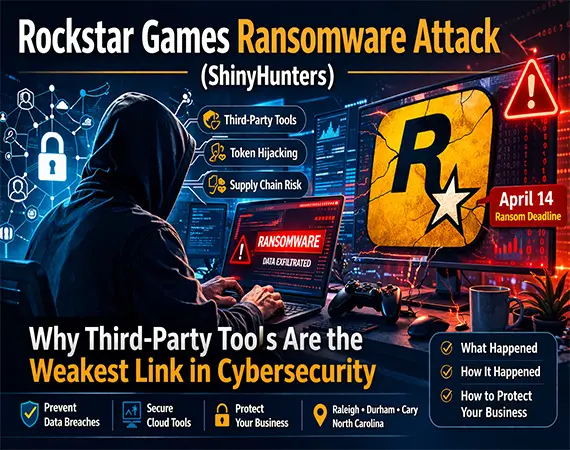
Rockstar Games Ransomware Attack (ShinyHunters): Why Third-Party Tools Are the Weakest Link in Cybersecurity
The Rockstar Games ransomware attack in April 2026, linked to the ShinyHunters group, highlights a critical shift in modern cyber threats: attackers are no longer breaking into systems—they’re exploiting trusted access. In many recent breaches, including this one, the attack cycle can unfold in less than 24 hours, with data exfiltration occurring before companies even detect suspicious activity. For businesses relying on multiple SaaS platforms and third-party tools, this creates a growing risk where a single compromised integration can expose thousands of sensitive files.
What Happened in the Rockstar Games Ransomware Attack?
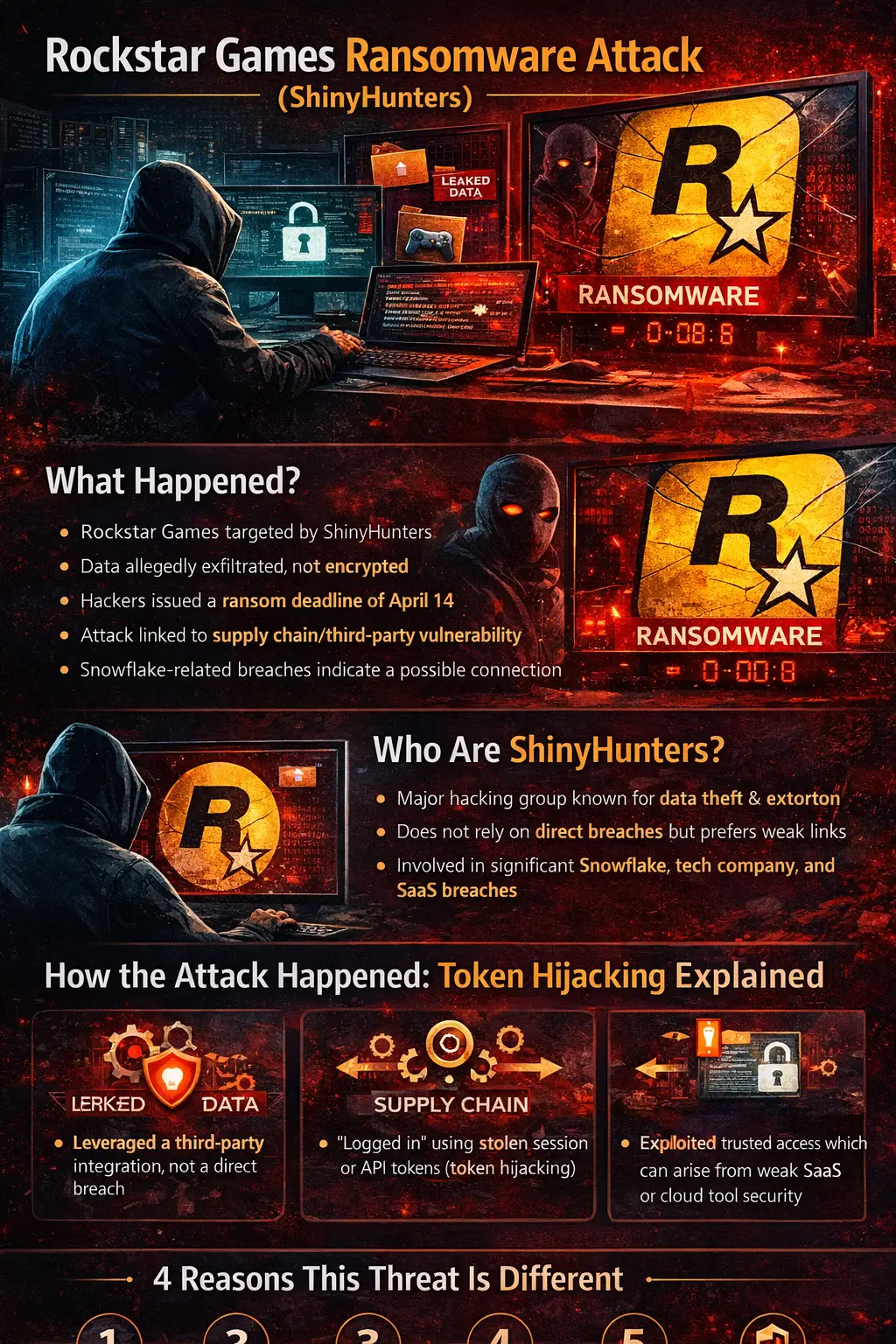
In April 2026, Rockstar Games became the target of a cyberattack attributed to the ShinyHunters hacking group.- Data was reportedly exfiltrated rather than encrypted
- Attackers issued a ransom deadline of April 14
- The breach was likely tied to a third-party tool or cloud integration
- There are indications of a possible Snowflake-related attack pattern
- Specializes in data theft and extortion
- Targets large organizations via indirect vulnerabilities
- Known for exploiting weak links like APIs and SaaS integrations
- This was not a direct network breach
- Likely involved token hijacking or session theft
- Attackers leveraged third-party tools or cloud services
- Represents a classic supply chain cyberattack
- Internal company data
- Operational or development-related information
- No confirmed large-scale customer data exposure (as of now)
- No immediate system shutdown
- Focus on data exfiltration first
- Uses double extortion tactics
- Entry point likely through third-party integrations
The Bigger Trend: Supply Chain & SaaS Attacks
The Rockstar breach is part of a growing pattern. What’s Changing:- Businesses rely on 10–50+ SaaS tools
- Each tool introduces a new attack surface
- Integrations create hidden security gaps
- One compromised tool → multiple companies affected
- Attackers target shared infrastructure
- Secure Third-Party Tools
- Audit all SaaS platforms
- Remove unused integrations
- Enforce Multi-Factor Authentication (MFA)
- Especially for admin and cloud accounts
- Monitor Token & Session Activity
- Detect unusual logins or session reuse
- Limit Access Permissions
- Apply least privilege access
- Continuous Monitoring (EDR + SOC)
- Identify threats before damage occurs
- Use MORE SaaS tools than enterprises
- Have LESS security visibility
- Often lack dedicated IT security teams
- Disrupt operations
- Expose sensitive client data
- Cost $10,000–$100,000+ in downtime and recovery
- Breach occurs (via third-party access)
- Data is exfiltrated
- Attackers claim responsibility
- Ransom demand issued
- Deadline set: April 14, 2026
FAQs
What is the Rockstar Games ransomware attack? A cyberattack in April 2026 where the ShinyHunters group allegedly stole data from Rockstar and issued a ransom demand. How was Rockstar Games hacked? The attack likely involved third-party tool exploitation or token hijacking, not a direct system breach. Was customer data exposed? There is no confirmed large-scale exposure of customer data, but internal data may have been compromised. What is token hijacking in cybersecurity? It’s when attackers steal authentication tokens to gain access without needing passwords. How can businesses prevent similar attacks? By securing third-party tools, using MFA, monitoring access, and implementing proactive cybersecurity strategies.
5/5 - (3 votes)