
Financial Services Firm Reports Customer Data Exposure: Risks, Impact, and Prevention Strategies
Introduction
- Increasing financial services data breach incidents
- Why cybercriminals target financial institutions
- Impact on customer trust
- Importance of financial services cybersecurity
- Relevance for North Carolina businesses in Raleigh, Durham, Cary, and surrounding areas
Understanding Customer Data Exposure in Financial Services
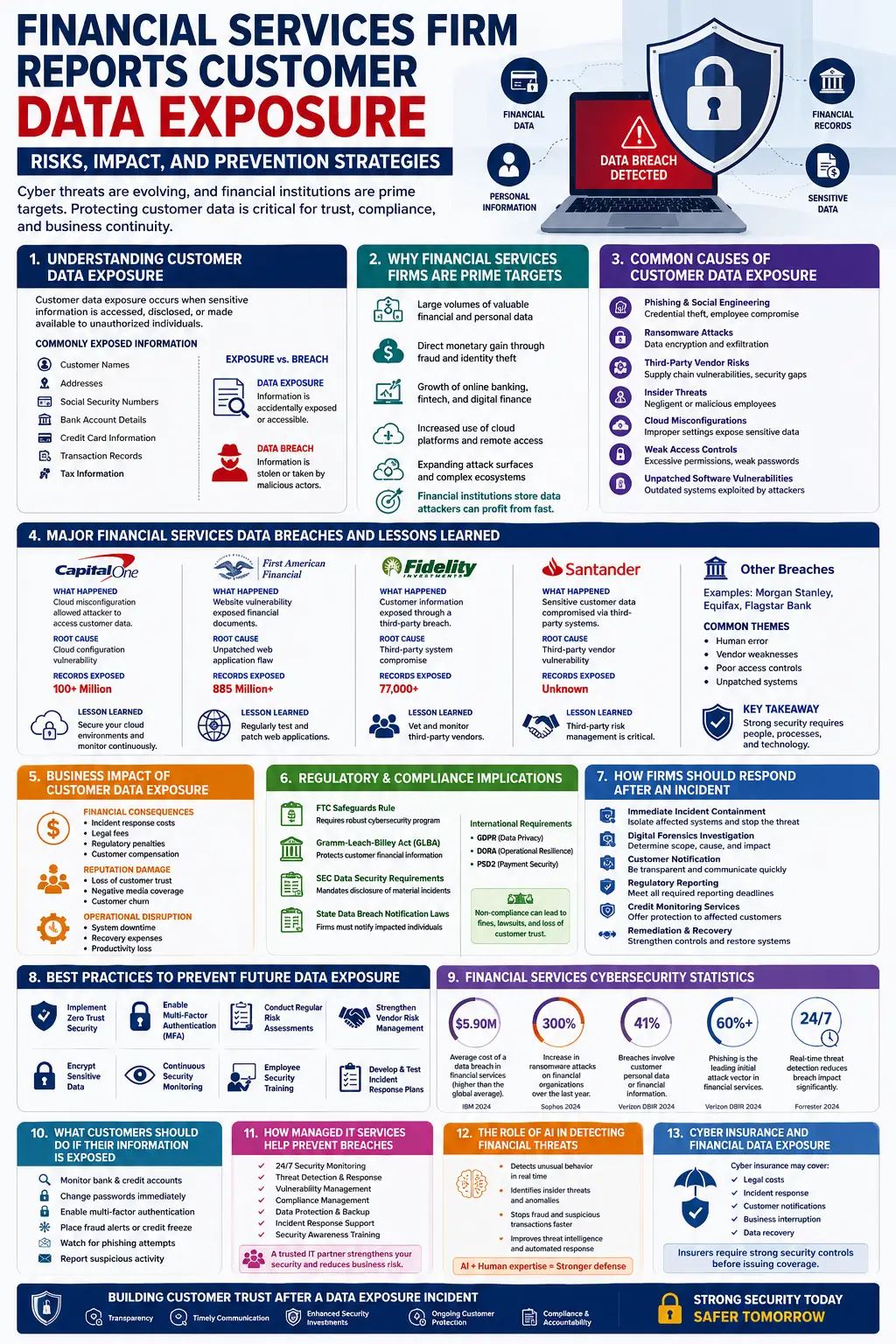
What Is Customer Data Exposure?
Customer data exposure occurs when sensitive customer information becomes accessible to unauthorized individuals due to cyberattacks, misconfigurations, insider actions, or accidental disclosure.
Data Exposure vs. Data Breach
Data Exposure | Data Breach |
Information is unintentionally accessible | Information is actively stolen |
May occur through misconfiguration | Usually involves malicious activity |
Can remain unnoticed | Often triggers investigations |
Information Commonly Exposed
- Customer names
- Addresses
- Social Security numbers
- Bank account information
- Credit card data
- Tax records
- Transaction histories
- Login credentials
Why Financial Services Firms Are Prime Targets for Cybercriminals
Financial institutions manage some of the world’s most valuable information.
High-Value Data
Unlike other industries, financial firms store:
- Banking credentials
- Investment portfolios
- Tax information
- Personally identifiable information (PII)
- Direct Financial Gain
Criminals can monetize stolen information through:
- Fraud
- Identity theft
- Account takeovers
- Dark web sales
- Digital Transformation Risks
The growth of:
- Online banking
- Mobile applications
- Fintech platforms
- Cloud computing
has expanded attack surfaces significantly.
Common Causes of Customer Data Exposure
Phishing and Social Engineering
One deceptive email can compromise an entire organization.
Key threats:
- Credential theft
- Business email compromise
- MFA fatigue attacks
- Ransomware Attacks
- Modern ransomware groups steal data before encryption.
Organizations face:
- Operational disruption
- Extortion demands
- Public data leaks
- Third-Party Vendor Risks
Many breaches originate through:
- Cloud providers
- Payment processors
- Software vendors
- Insider Threats
Not all threats come from outside.
Examples:
- Accidental disclosures
- Negligent employees
- Malicious insiders
- Cloud Misconfigurations
Improper permissions remain a leading cause of customer information exposure.
Weak Access Controls
Poor password policies and excessive privileges increase risks.
Unpatched Vulnerabilities
Attackers continuously exploit outdated systems.
Major Financial Services Data Breaches and What They Teach Us
Capital One
What Happened
A cloud configuration vulnerability exposed over 100 million customer records.
Lesson
Cloud security requires continuous monitoring.
First American Financial
What Happened
A website vulnerability exposed hundreds of millions of financial documents.
Lesson
Web application security must be continuously tested.
Fidelity Investments
What Happened
Customer information was exposed through a third-party-related security incident.
Lesson
Vendor risk management is critical.
Santander
What Happened
Sensitive customer information was compromised through third-party systems.
Lesson
Supply-chain cybersecurity is as important as internal security.
Other Notable Breaches
- Morgan Stanley
- Equifax
- Flagstar Bank
The Business Impact of Customer Data Exposure
Financial Consequences
Organizations often incur:
- Forensic investigation costs
- Legal fees
- Regulatory fines
- Customer compensation expenses
Reputation Damage
Trust takes years to build and minutes to lose.
Consequences include:
- Customer churn
- Negative media coverage
- Brand damage
Operational Disruption
Incident response activities can disrupt daily operations and productivity.
Regulatory and Compliance Implications
FTC Safeguards Rule
Requires financial institutions to implement robust cybersecurity programs.
Gramm-Leach-Bliley Act (GLBA)
Mandates protection of consumer financial information.
SEC Cybersecurity Requirements
Public companies face strict disclosure obligations.
State Data Breach Notification Laws
North Carolina businesses must comply with state notification requirements.
International Regulations
- GDPR
- DORA
- PSD2
Organizations serving global customers must address cross-border compliance.
How Financial Services Firms Should Respond After a Data Exposure Incident
Immediate Containment
- Isolate affected systems
- Disable compromised accounts
Digital Forensics Investigation
Determine:
- Attack vector
- Scope of exposure
- Impacted systems
Customer Notification
Provide transparent communication.
Regulatory Reporting
Meet reporting deadlines promptly.
Credit Monitoring Services
Offer protection for affected customers.
Recovery and Remediation
Strengthen controls and eliminate vulnerabilities.
Best Practices to Prevent Future Data Exposure
- Implement Zero Trust Security
- Trust nothing, verify everything.
- Enable Multi-Factor Authentication (MFA)
- MFA remains one of the most effective security controls.
- Conduct Regular Risk Assessments
- Identify vulnerabilities before attackers do.
- Strengthen Vendor Risk Management
- Assess suppliers continuously.
- Encrypt Sensitive Data
- Protect data both in transit and at rest.
- Continuous Security Monitoring
- Leverage advanced threat detection and response tools.
- Employee Security Awareness Training
- Employees remain the first line of defense.
- Develop Incident Response Plans
- Preparation reduces recovery time and costs.
Financial Services Cybersecurity Statistics Every Business Should Know
Include updated statistics such as:
- Financial services remain among the most expensive industries for data breaches.
- Phishing remains the leading initial attack vector.
- Ransomware attacks continue increasing year-over-year.
- Third-party breaches are becoming more common.
- Financial firms face significantly higher average breach costs than many other industries.
What Customers Should Do If Their Financial Information Is Exposed
- Monitor Accounts
- Check for unauthorized transactions.
- Freeze Credit
- Prevent fraudulent account openings.
- Change Passwords
- Update all financial accounts immediately.
- Enable MFA
- Add an extra security layer.
- Watch for Phishing Attempts
- Cybercriminals often exploit breach-related fear.
How Managed IT Services Help Prevent Financial Data Breaches
Managed IT Services provide:
- 24/7 monitoring
- Threat detection
- Vulnerability management
- Compliance management
- Incident response
- Security awareness training
For North Carolina businesses, partnering with a trusted Managed IT Services provider like Computerbilities can strengthen cybersecurity posture while reducing operational risk.
The Role of AI in Detecting Financial Services Cyber Threats
AI can identify:
- Unusual login behavior
- Insider threats
- Fraudulent transactions
- Phishing attempts
Machine learning enables earlier detection and faster response.
Cyber Insurance and Financial Data Exposure
Cyber insurance may help cover:
- Legal costs
- Incident response expenses
- Customer notifications
- Business interruption losses
However, insurers increasingly require strong cybersecurity controls before issuing coverage.
Building Customer Trust After a Data Exposure Incident
- Transparency
- Be honest and proactive.
- Timely Communication
- Provide regular updates.
- Enhanced Security Investments
- Demonstrate commitment to protection.
- Accountability
- Show customers corrective actions being taken.
- Ongoing Protection
- Offer monitoring and support services.
- Trust recovery is often more challenging than technical recovery.
FAQs
What happens when a financial services firm reports customer data exposure?
The organization investigates the incident, notifies affected customers, reports to regulators when required, and implements remediation measures to prevent future incidents.
What information is typically exposed during a financial services data breach?
Commonly exposed information includes names, addresses, Social Security numbers, account numbers, transaction histories, and other personally identifiable information (PII).
How can businesses protect customer financial data?
Businesses should implement MFA, encryption, Zero Trust security, employee training, continuous monitoring, and incident response planning.
Why are financial institutions frequent targets of cyberattacks?
Financial institutions store valuable financial and personal information that cybercriminals can use for fraud, identity theft, and extortion.
How do managed cybersecurity services reduce breach risks?
Managed cybersecurity services provide around-the-clock monitoring, threat detection, vulnerability management, and rapid incident response capabilities.
What should customers do if their financial information is exposed?
Monitor accounts, change passwords, enable MFA, freeze credit when necessary, and remain vigilant against phishing attacks.