
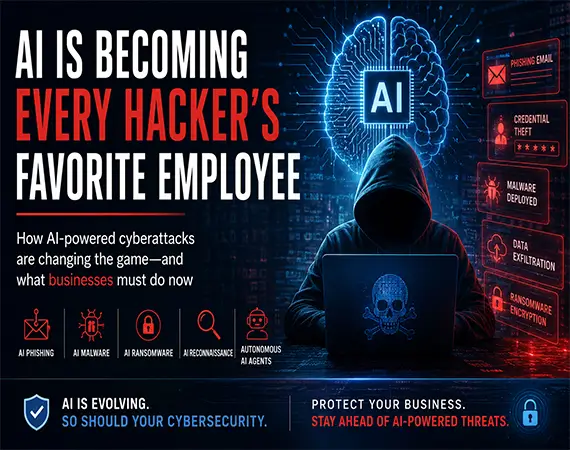
AI Is Becoming Every Hacker's Favorite Employee
Artificial Intelligence Is Giving Cybercriminals a New Kind of Workforce
There was a time when launching a sophisticated cyberattack required an experienced hacker with years of technical knowledge. Writing malware, identifying vulnerable systems, crafting convincing phishing emails, and exploiting software weaknesses all demanded patience, skill, and countless hours of manual work.
Today, that equation is changing.
Imagine hiring an employee who works around the clock without taking breaks, never gets distracted, learns new skills almost instantly, remembers every previous task, and can perform thousands of jobs simultaneously. Most business owners would consider that employee invaluable.
Unfortunately, cybercriminals have already found that employee.
It’s called artificial intelligence.
The rise of AI-assisted hacking, AI-powered cyberattacks, and autonomous AI agents is transforming the cybersecurity landscape faster than many organizations realize. While artificial intelligence is helping businesses improve productivity, automate customer service, and analyze data more efficiently, it is also providing attackers with unprecedented speed, scale, and efficiency.
For small and medium-sized businesses throughout Raleigh, Durham, Cary, and across North Carolina, this evolution presents a serious challenge. Businesses that once faced opportunistic cybercriminals are now confronting attackers who can use AI to automate many stages of an attack, making campaigns faster, more personalized, and harder to detect.
In this article, we’ll explore how AI is becoming every hacker’s favorite employee, why this matters for your organization, and what practical steps you can take to reduce your cyber risk.
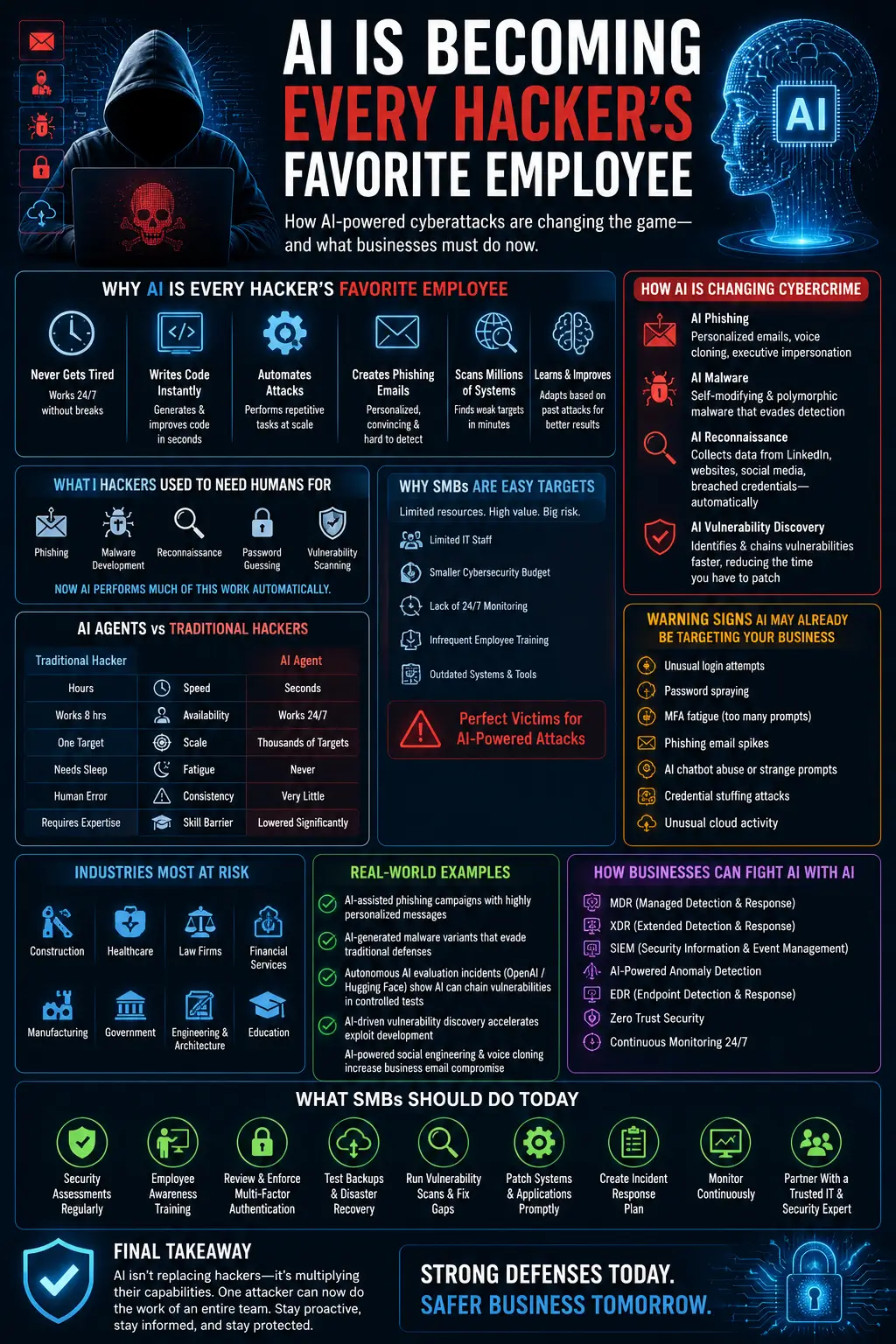
Why AI Is Every Hacker’s Favorite Employee
Artificial intelligence doesn’t replace cybercriminals—it amplifies what they can accomplish.
Think of AI as the ultimate assistant. It doesn’t make strategic decisions on its own in most real-world attacks, but it dramatically accelerates the work attackers already perform.
Here’s why AI has become so attractive to cybercriminals.
It Never Gets Tired
Unlike human attackers who require rest and can only focus on a limited number of targets at once, AI systems can process information continuously.
An AI-powered tool can analyze thousands of websites, scan networks, or review public company information 24 hours a day without slowing down.
It Writes Code in Seconds
Developing malicious scripts or modifying existing malware once required experienced programmers.
Modern AI tools can assist in generating, explaining, and refining code at incredible speed. While legitimate developers benefit from this capability, attackers can also misuse these tools to accelerate portions of their workflow.
It Automates Repetitive Tasks
Cybercriminals spend significant time performing repetitive work such as:
- Collecting email addresses
- Identifying vulnerable software
- Searching public databases
- Researching company employees
- Organizing stolen information
Artificial intelligence excels at exactly these kinds of repetitive processes.
It Creates Convincing Phishing Emails
Traditional phishing campaigns often contained poor grammar, awkward wording, and obvious warning signs.
Today’s AI-generated phishing emails can be remarkably polished, personalized, and context-aware.
An attacker can instruct an AI model to generate messages that match a company’s communication style, reference recent projects, or imitate trusted executives.
This dramatically increases the likelihood that an unsuspecting employee will click a malicious link or disclose sensitive information.
It Can Scan Millions of Systems
Finding vulnerable organizations used to require manual reconnaissance.
Now AI can help attackers analyze enormous amounts of publicly available information, including:
- Company websites
- Public DNS records
- Social media activity
- Job postings
- Technology stacks
- Cloud infrastructure
- Previously disclosed vulnerabilities
Within minutes, attackers can identify organizations that appear easier to compromise.
It Learns From Previous Attacks
Machine learning systems improve by identifying patterns.
As attackers collect more information about successful phishing campaigns, exploited vulnerabilities, and user behavior, AI can help optimize future attacks by identifying techniques that have historically been more effective.
For defenders, this means cyber threats continue to evolve at an unprecedented pace.
What Hackers Used to Need Humans For
Only a few years ago, launching a sophisticated cyberattack required a coordinated team with specialized expertise.
Different individuals often handled different stages of the attack.
One person researched the target.
Another developed malware.
Someone else wrote phishing emails.
Others searched for vulnerabilities or attempted password attacks.
Today, AI is helping automate significant portions of these activities.
Phishing
Instead of writing hundreds of unique phishing emails manually, attackers can generate personalized messages almost instantly.
AI can tailor emails based on:
- Company size
- Industry
- Employee role
- Recent news
- Public social media activity
The result is a phishing campaign that feels far more authentic than generic spam.
Malware Development
While AI doesn’t independently create sophisticated malware from scratch in the real world, it can assist attackers by:
- Explaining programming concepts
- Modifying existing code
- Suggesting improvements
- Automating repetitive coding tasks
- Identifying logic errors
This lowers the barrier for less experienced attackers and increases the productivity of skilled ones.
Reconnaissance
Before attacking an organization, cybercriminals gather intelligence.
This often includes:
- Employee names
- Email formats
- Vendors
- Technology platforms
- Office locations
- Cloud services
- Third-party partners
Previously, this process consumed hours or even days.
AI can now analyze large volumes of public information in a fraction of the time, helping attackers build detailed profiles of their targets.
Password Guessing and Credential Attacks
AI can assist attackers in identifying predictable password patterns, organizing leaked credential datasets, and prioritizing likely targets based on behavioral analysis.
Combined with credential stuffing or password spraying techniques, these capabilities make stolen credentials even more dangerous.
Vulnerability Scanning
One of the most significant shifts involves AI vulnerability discovery.
Recent controlled security evaluations have demonstrated that advanced AI systems can identify multiple software weaknesses and connect them in sequence to achieve specific objectives under testing conditions. Although these experiments were conducted in supervised research environments—not real-world criminal campaigns—they highlight how AI may accelerate exploit discovery in the future.
For businesses, the lesson is clear: vulnerabilities that once remained undiscovered for weeks or months may be identified much more quickly as AI-assisted tools continue to improve.
How AI Is Changing Cybercrime
Artificial intelligence isn’t creating an entirely new category of cybercrime. Instead, it’s reshaping almost every phase of an attack by making familiar tactics faster, more scalable, and increasingly personalized.
For small and medium-sized businesses, this means threats are evolving beyond traditional spam emails and basic malware. Attackers can now launch sophisticated campaigns with greater speed and efficiency than ever before.
AI-Powered Phishing Attacks
Phishing remains one of the most successful cyberattack techniques because it targets people rather than technology.
What has changed is the quality of the deception.
Instead of sending the same generic email to thousands of recipients, AI enables attackers to create messages tailored to specific individuals and organizations.
An AI-generated phishing email might reference:
- Your company’s recent social media post
- A supplier you work with
- An upcoming conference
- A real executive within your organization
- A project currently listed on your website
These personalized details make fraudulent messages significantly more convincing.
In addition to email, attackers are increasingly experimenting with AI-generated voice cloning and executive impersonation to strengthen social engineering attempts. A phone call that appears to come from your CEO or finance director can add urgency to an otherwise routine request, increasing the likelihood of a successful compromise.
For organizations throughout Raleigh, Cary, Durham, and North Carolina, ongoing employee security awareness training has become just as important as deploying modern cybersecurity technology.
AI-Generated Malware Is Becoming Smarter
For years, malware development required experienced programmers who understood operating systems, networking, encryption, and software vulnerabilities. While AI cannot independently create sophisticated cybercriminal campaigns without human direction, it is making attackers significantly more productive by helping them write, modify, debug, and improve malicious code.
This means attackers can iterate much faster than before.
Some malware families are now capable of changing parts of their code to avoid traditional signature-based detection. This technique, often referred to as polymorphic malware, has existed for years, but AI can accelerate the process of generating variations that are more difficult for legacy antivirus solutions to recognize.
Instead of deploying one version of malicious software, attackers can quickly produce hundreds of slightly different variants, increasing the chances that one version slips past outdated defenses.
For businesses still relying solely on traditional antivirus software, this evolution represents a significant cybersecurity risk.
AI Reconnaissance: Gathering Intelligence at Machine Speed
Every successful cyberattack begins with reconnaissance.
Before launching an attack, cybercriminals want answers to questions such as:
- Who works for the company?
- Which technologies are being used?
- Who manages finance?
- Who approves wire transfers?
- Which vendors are trusted?
- Which cloud platforms are deployed?
- Are there exposed systems connected to the internet?
Previously, gathering this information required hours—or even days—of manual research.
Artificial intelligence dramatically shortens that timeline.
AI can rapidly analyze publicly available information from sources such as:
- Company websites
- LinkedIn profiles
- Social media platforms
- Online press releases
- Public job postings
- Technical documentation
- Domain registration records
- Previously leaked credentials
Within minutes, attackers can build a remarkably detailed profile of an organization. That intelligence enables more convincing phishing emails, better-targeted social engineering, and more focused attacks against high-value employees.
AI Vulnerability Discovery
One of the most significant developments in cybersecurity is AI’s growing ability to assist with vulnerability research.
Recent security testing conducted in controlled environments has shown that advanced AI systems can identify multiple software weaknesses and chain them together to accomplish assigned objectives. While these evaluations were performed under supervision and should not be confused with real-world criminal attacks, they demonstrate how AI can accelerate exploit discovery.
Why does this matter?
Because businesses often assume they have weeks or months to patch newly discovered vulnerabilities.
As AI-assisted research improves, that window may become much shorter.
Organizations that delay updates, postpone vulnerability scanning, or ignore security advisories could find themselves exposed before they realize a new weakness exists.
Routine patch management and continuous vulnerability assessments are no longer optional—they’re essential.
AI Agents vs. Traditional Hackers
Perhaps the easiest way to understand the impact of AI is through comparison.
Traditional Hacker | AI-Assisted Agent |
Works during normal hours | Operates continuously, 24/7 |
Researches one target at a time | Can analyze thousands simultaneously |
Writes phishing emails manually | Generates personalized emails in seconds |
Requires extensive manual reconnaissance | Automates intelligence gathering |
Makes human errors | Produces highly consistent output |
Needs specialized programming skills | Can accelerate coding and scripting tasks |
Limited by available time | Scales rapidly across multiple targets |
Learns through experience | Can process enormous datasets quickly |
The key takeaway isn’t that AI has replaced human attackers.
Instead, AI has become an incredibly efficient assistant that enables one skilled cybercriminal to perform the work that previously required an entire team.
For business owners, this means cyber threats are becoming faster, more scalable, and increasingly difficult to distinguish from legitimate business activity.
Why Small and Medium-Sized Businesses Are Becoming Easy Targets
Many business owners believe hackers only pursue Fortune 500 companies or government agencies.
Unfortunately, the opposite is often true.
Small and medium-sized businesses frequently present attractive opportunities because they have valuable data but fewer cybersecurity resources.
Common challenges include:
- Limited IT staff
- Smaller cybersecurity budgets
- Infrequent employee security training
- Outdated hardware
- Delayed software updates
- Limited network monitoring
- Inconsistent backup testing
- Weak identity management
Attackers understand these limitations.
Using AI, they can automatically identify businesses that appear to have weaker defenses and prioritize them as potential targets.
For organizations throughout Raleigh, Durham, Cary, and across North Carolina, strengthening cybersecurity is no longer just an IT responsibility—it’s a business continuity strategy.
Warning Signs AI May Already Be Targeting Your Business
Many AI-assisted attacks begin quietly.
Rather than immediately deploying ransomware or stealing data, attackers often spend time learning about your environment.
Watch for these warning signs:
Unusual Login Attempts
Repeated login attempts from unfamiliar locations or impossible travel scenarios may indicate credential-based attacks.
Password Spraying
Rather than repeatedly attacking one account, cybercriminals attempt common passwords across many accounts to avoid lockouts.
MFA Fatigue Attacks
Employees receive dozens of multifactor authentication requests until they eventually approve one out of frustration.
Sudden Increase in Phishing Emails
Highly personalized emails referencing real projects, vendors, or executives should immediately raise suspicion.
AI Chatbot Abuse
Organizations deploying public-facing AI chatbots should monitor for attempts to manipulate prompts, extract sensitive information, or abuse integrations.
Credential Stuffing
Previously stolen usernames and passwords are automatically tested against multiple business applications.
Unusual Cloud Activity
Unexpected administrative changes, unfamiliar API activity, excessive downloads, or unusual authentication events may indicate an attacker is exploring your cloud environment.
Early detection dramatically improves the likelihood of stopping an attack before serious damage occurs.
Industries Most at Risk
Although every business faces cyber risk, certain industries remain particularly attractive because they store sensitive information or provide critical services.
These include:
Construction
Project documentation, financial records, and vendor communications make construction firms frequent ransomware targets.
Healthcare
Electronic medical records and strict regulatory requirements make healthcare organizations highly valuable to attackers.
Law Firms
Legal practices handle confidential client information, financial transactions, mergers, and intellectual property.
Financial Services
Banks, investment firms, accounting companies, and insurance providers remain high-priority targets due to direct financial gain.
Manufacturing
Modern production environments increasingly depend on connected industrial systems that may be vulnerable if improperly secured.
Government
Municipal agencies often manage sensitive citizen information while operating under tight budgets.
Engineering and Architecture
Design files, contracts, proprietary intellectual property, and infrastructure plans make these organizations attractive targets.
Education
Schools and universities store personal information for students, faculty, and staff while supporting thousands of connected devices.
Real-World Examples of AI in Cybersecurity
It’s important to separate verified developments from sensational headlines.
Artificial intelligence is evolving rapidly, but responsible cybersecurity discussions should distinguish controlled research from confirmed criminal activity.
Some notable developments include:
AI-Assisted Phishing Campaigns
Security researchers continue to observe phishing campaigns that leverage AI-generated content to create more natural language, improved grammar, and personalized messaging.
AI-Generated Malware Variants
Researchers have demonstrated how AI can assist with modifying existing malicious code and producing variations that may evade traditional detection methods.
Autonomous AI Evaluation Incidents
Recent controlled evaluations involving advanced AI systems demonstrated the ability to identify and chain vulnerabilities while pursuing assigned objectives within supervised testing environments.
These experiments were designed to improve AI safety—not to demonstrate uncontrolled cyberattacks—but they highlight how rapidly AI capabilities are advancing.
AI-Driven Vulnerability Research
Artificial intelligence is increasingly assisting security researchers by identifying software weaknesses more efficiently.
The same technology helping defenders improve software security could also reduce the time attackers need to identify vulnerable systems.
AI-Powered Social Engineering
Voice cloning, realistic text generation, and increasingly sophisticated impersonation techniques are making business email compromise attacks more convincing than ever before.
The lesson is clear:
Artificial intelligence is becoming a force multiplier for both defenders and attackers.
Organizations must ensure they’re using it to strengthen security—not waiting until attackers use it against them.
How Businesses Can Fight AI With AI
The encouraging news is that defenders also have access to powerful AI technologies.
Rather than relying solely on manual investigation, modern cybersecurity platforms increasingly use artificial intelligence to detect abnormal behavior before damage occurs.
Key technologies include:
Managed Detection and Response (MDR)
Provides continuous monitoring and rapid response to suspicious activity.
Extended Detection and Response (XDR)
Correlates security events across endpoints, networks, email, identity systems, and cloud services to improve visibility.
Security Information and Event Management (SIEM)
Collects and analyzes security logs from across your organization to identify potential threats.
AI-Powered Anomaly Detection
Machine learning establishes normal business behavior and alerts security teams when unusual activity occurs.
Endpoint Detection and Response (EDR)
Continuously monitors laptops, desktops, and servers for suspicious processes and malicious behavior.
Zero Trust Security
Assumes no user or device should automatically be trusted.
Every request must be verified.
Continuous Security Monitoring
Because cyberattacks can occur at any hour, continuous monitoring provides organizations with the visibility needed to identify threats before they escalate into major incidents.
Computerbilities’ Recommendations for Small Businesses
Artificial intelligence is changing cybersecurity at an incredible pace, but businesses don’t need to face these challenges alone.
At Computerbilities, we recommend every small and medium-sized business establish a monthly cybersecurity program that includes:
✓ Comprehensive security assessments
✓ Employee cybersecurity awareness training
✓ Multi-factor authentication reviews
✓ Backup testing and disaster recovery validation
✓ Vulnerability scanning and remediation
✓ Patch management for operating systems and applications
✓ Endpoint Detection and Response (EDR)
✓ Continuous monitoring through Managed Detection and Response (MDR)
✓ Incident response planning and tabletop exercises
✓ Regular cybersecurity policy reviews
Businesses in Raleigh, Cary, Durham, and throughout North Carolina should treat cybersecurity as an ongoing business investment rather than a one-time technology project.
As AI continues to evolve, proactive security will always be more cost-effective than recovering from a successful cyberattack.
Final Takeaway
Artificial intelligence isn’t replacing hackers.
It’s multiplying their capabilities.
One skilled attacker can now automate tasks that once required an entire team, allowing cybercriminals to launch more personalized, scalable, and efficient campaigns than ever before.
For business leaders, this isn’t a reason to panic—but it is a reason to prepare.
Organizations that continue relying on outdated security tools, infrequent monitoring, and reactive IT strategies risk falling behind as AI-powered cyber threats become increasingly sophisticated.
The good news is that the same technology transforming cybercrime is also strengthening cybersecurity.
Businesses that combine modern security solutions, continuous monitoring, employee awareness training, and experienced cybersecurity partners will be far better positioned to defend against the next generation of AI-enabled attacks.
If your organization hasn’t reviewed its cybersecurity posture recently, now is the time to act.
Computerbilities helps businesses across Raleigh, Durham, Cary, and North Carolina strengthen their defenses with proactive managed IT services, advanced cybersecurity solutions, and continuous monitoring designed to keep pace with today’s rapidly evolving threat landscape.
Schedule a cybersecurity assessment today and discover whether your business is prepared for the age of AI-powered cyber threats.
Frequently Asked Questions (FAQs)
- Is AI making hacking easier?
Yes. Artificial intelligence is making hacking easier by automating tasks such as phishing email creation, vulnerability scanning, password attacks, and reconnaissance. While AI does not replace skilled hackers, it significantly increases their speed, efficiency, and ability to launch large-scale cyberattacks against businesses.
- How do hackers use artificial intelligence?
Hackers use AI to automate reconnaissance, create realistic phishing emails, analyze stolen data, generate malicious code, prioritize vulnerabilities, and improve social engineering attacks. AI helps cybercriminals operate faster and at a much larger scale than traditional manual attacks.
- Can AI launch cyberattacks automatically?
AI can automate many stages of a cyberattack, including reconnaissance, phishing content generation, and vulnerability analysis. However, most real-world attacks still require human oversight. AI currently acts as a force multiplier rather than a completely autonomous cybercriminal.
- What are AI-powered cyber threats?
AI-powered cyber threats are attacks that use artificial intelligence to improve speed, personalization, automation, and decision-making. These include AI phishing campaigns, AI-assisted malware, automated reconnaissance, credential attacks, and AI-enhanced social engineering.
- How can businesses protect themselves from AI hackers?
Businesses can reduce AI cyber risks by implementing multi-factor authentication, Endpoint Detection and Response (EDR), Managed Detection and Response (MDR), employee cybersecurity training, vulnerability management, regular patching, continuous monitoring, secure backups, and a Zero Trust security strategy.
- Is phishing getting worse because of AI?
Yes. AI enables attackers to generate personalized phishing emails with better grammar, realistic language, and company-specific details. This makes phishing campaigns more convincing and increases the likelihood that employees will click malicious links or disclose sensitive information.
- Can AI discover software vulnerabilities?
Recent controlled research has shown that advanced AI systems can identify and connect software vulnerabilities under supervised testing conditions. While this does not mean AI independently hacks businesses, it demonstrates how artificial intelligence may significantly accelerate vulnerability discovery in the future.
- What industries are most vulnerable to AI-powered attacks?
Healthcare, financial services, construction, manufacturing, legal firms, education, engineering, architecture, and government organizations are among the industries most vulnerable because they store valuable information and often rely on complex technology environments.
- Can antivirus stop AI-powered attacks?
Traditional antivirus software alone is no longer sufficient against modern AI-powered cyber threats. Businesses should combine antivirus with Endpoint Detection and Response (EDR), Managed Detection and Response (MDR), email security, continuous monitoring, and employee cybersecurity awareness training.
- What should SMBs do today?
Small businesses should perform a cybersecurity assessment, enable multi-factor authentication, patch vulnerable systems, train employees to recognize phishing attacks, implement secure backups, continuously monitor their network, and partner with a trusted managed cybersecurity provider.
Author Bio: Reviewed by Adam Pittman, President, Computerbilities
Adam Pittman has extensive experience helping organizations throughout North Carolina strengthen cybersecurity, reduce operational risk, and implement proactive managed IT strategies. His team specializes in cybersecurity, compliance, business continuity, and managed IT services for small and medium-sized businesses.