
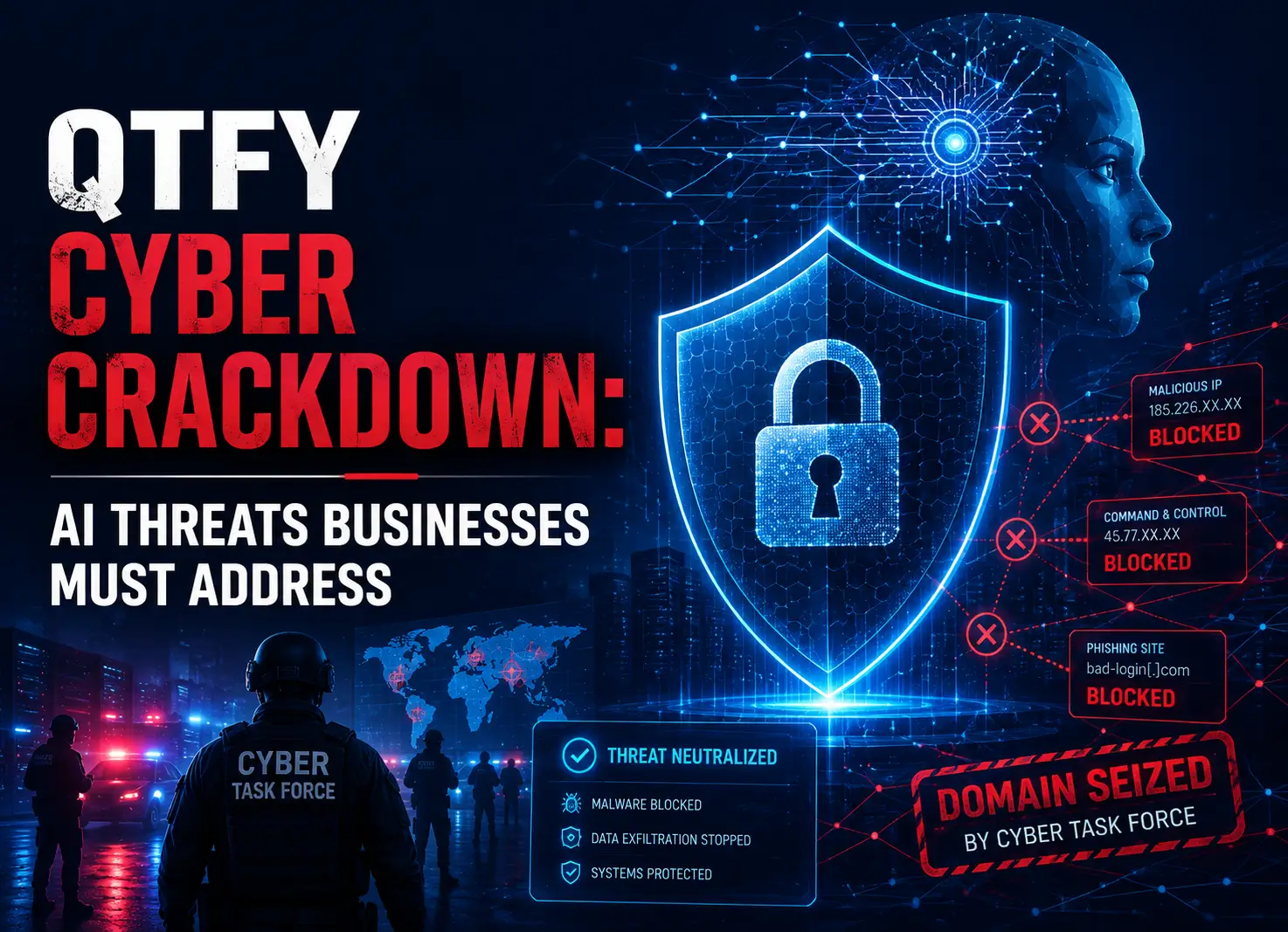
U.S. Seizes China-Linked QTFY Cyber Platforms: What Businesses Need to Know
On August 26, 2026, the U.S. Department of Justice and FBI announced a court-authorized operation that disabled two cyber platforms allegedly operated by a People’s Republic of China state-sponsored group known as QTFY. The action targeted QScan, a system used to identify and compromise exposed devices, and QTRouter, an obfuscation network that routed malicious activity through compromised Internet of Things devices, commercial proxy services, and leased virtual private servers.
According to the Justice Department, QTFY developed the platforms while working through China-based Nanjing Xinjiuwei Network Technology Company and offered hacking services to paying customers, including China’s Ministry of State Security and People’s Liberation Army. Court documents identify U.S. federal networks among the victims of QTFY intrusion activity, including NASA, the Federal Reserve, the departments of Energy, Justice, and Health and Human Services, the National Institutes of Health, and the U.S. Senate. Other targeted networks included hospitals, telecommunications providers, power companies, financial institutions, defense contractors, universities, and military systems.
The seizure is important because it attacked the infrastructure behind multiple cyber operations rather than blocking one malicious address at a time. Yet it should not be read as an all-clear. Disabling the platforms does not automatically patch vulnerable routers, remove persistence from previously accessed environments, or prove that every affected organization has found every intrusion. For business leaders, the event is a prompt to examine internet-facing systems, edge devices, supplier access, and the visibility needed to detect an attacker who appears to be connecting from nearby. Public reporting about the QTFY operation does not establish that the group used artificial intelligence; AI-driven threats matter here because they can accelerate and amplify the same reconnaissance, deception, and intrusion workflows defenders must already manage.
Key Takeaways
- DOJ and the FBI seized domains essential to QScan and QTRouter communication and authentication, rendering the platforms inoperable, according to the agencies.
- QTFY allegedly used compromised routers, cameras, other IoT devices, commercial proxy infrastructure, and virtual servers to disguise the origin of malicious traffic.
- The activity matters beyond government. Healthcare, energy, telecommunications, finance, higher education, technology, defense contractors, and critical-infrastructure suppliers were among the sectors targeted or profiled.
- Static IP blocking and country-based rules are not enough when hostile traffic exits through legitimate services or devices in the same country, region, or neighborhood as the target.
- Organizations should patch software and firmware, audit exposed applications, isolate critical systems from edge devices, and hunt for the official indicators of compromise, following the joint federal guidance.
- No public evidence currently ties AI directly to QTFY’s named platforms. Even so, AI can help threat actors scale reconnaissance, create convincing phishing and deepfake impersonation, and adapt lures faster, reducing the value of grammar mistakes or familiar voices as trust signals.
What Did the U.S. Government Seize?
Federal authorities seized multiple domains used by QTFY’s platforms for core functions, including communication and authentication. The Justice Department said the relevant domains were hard-coded into the QScan and QTRouter malware. Once the domains were taken under court authority, the platforms could no longer perform those essential functions and became inoperable.
This was more than a website takedown. A domain can act like a control point that software must contact to receive instructions, authenticate users, coordinate tasks, or return results. When a malicious platform depends on a small number of hard-coded domains, a seizure can create an operational choke point. The FBI described the result as the disruption of a global botnet and hacking platform used to target U.S. critical infrastructure.
The action also fits a broader pattern. DOJ cited previous operations against PlugX malware and botnets associated with Mustang Panda, Flax Typhoon, and Volt Typhoon. Each operation differed technically, but the strategic idea is similar: identify infrastructure that enables malicious activity at scale and use legal and technical measures to deny access to it.
How QScan and QTRouter Allegedly Worked Together
QTFY’s model combined automated discovery with a distributed layer for hiding the source of later activity. The result was an efficient pipeline from reconnaissance to attempted exploitation and covert access.
- Find exposed systems. QScan scanned internet-accessible infrastructure and collected information such as open ports, service banners, software versions, and configuration details. Lumen Technologies’ Black Lotus Labs observed both broad perimeter mapping and quieter, application-specific probing against high-value sectors.
- Exploit vulnerable devices. According to DOJ and the FBI, QScan automatically infected thousands of IoT devices. Home and small-office routers, security cameras, and similar equipment are attractive because they may be exposed to the internet, poorly inventoried, infrequently patched, or no longer supported.
- Build an obfuscation network. Compromised devices were added to QTRouter alongside commercial proxy devices and leased virtual private servers. This created a distributed network through which operators could route traffic.
- Make hostile traffic look local or ordinary. Because a connection could exit through a device outside China, malicious traffic might appear to come from a familiar country, a nearby network, or a legitimate commercial service. The FBI said devices in more than 130 countries were used, potentially placing an exit point close to the target.
- Move from mapping to intrusion activity. Black Lotus Labs reported that infrastructure profiled by QScan later appeared in communications through the related proxy environment. Its researchers observed patterns consistent with attempted exploitation, lateral movement, persistent backchannels, and data harvesting. Those findings describe observed infrastructure behavior; they do not establish the outcome of every attempted intrusion.
How AI-Driven Cyber Threats Raise the Stakes
AI is not required to make a platform such as QScan or QTRouter dangerous, and the cited QTFY materials do not document AI use. The broader risk is convergence: attackers can pair automated scanning and covert relay infrastructure with generative AI that drafts tailored messages, summarizes stolen data, translates lures, and supports faster target research. The result can be more attempts, more personalization, and less time for defenders to react.
The FBI has warned that criminals use AI to improve phishing and social engineering and to clone voices or video for impersonation scams. The U.K. National Cyber Security Centre assesses that AI will continue making parts of cyber intrusion more effective and efficient, particularly reconnaissance, social engineering, and coding. Those capabilities can turn technical access into business harm: a compromised account may be followed by a realistic executive voice message, a vendor-payment request that matches a real project, or a polished password-reset lure timed to a known event.
Businesses should therefore treat identity and process controls as part of QTFY-style infrastructure defense. Phishing-resistant multifactor authentication, independent verification of payment or credential requests, protected administrator accounts, email authentication, and rehearsed escalation procedures remain effective even when a message sounds fluent, looks familiar, or appears to come from a nearby IP address.
Why This Crackdown Matters to U.S. Businesses
It is tempting to see federal agencies and military networks in the headlines and conclude that the risk is limited to national-security targets. The operational model says otherwise. Critical services depend on a long chain of private companies: manufacturers, software vendors, logistics firms, engineering consultancies, healthcare providers, law firms, cloud partners, and managed service providers. A smaller organization may hold valuable credentials, proprietary research, regulated data, or trusted access to a larger customer.
For organizations in Raleigh, Cary, Durham, the wider North Carolina Triangle, and New York City, the lesson is especially practical. Construction, contracting, architecture, and engineering firms often connect offices, job sites, mobile devices, cloud platforms, and high-value project files. An exposed router, remote-access appliance, or supplier credential can create a path into scheduling systems, financial records, client data, CAD environments, and shared project repositories. Local relevance does not mean the attacker must be local; it means the infrastructure used to hide the attack may be.
The campaign also highlights the security importance of equipment that receives less attention than laptops and servers. An aging branch-office router, an exposed firewall management page, a building camera, or an unsupported remote-access appliance can provide a relay point or entry path. Even when the device contains little valuable data, its internet connection and geographic location can be useful to an attacker.
Finally, the reported use of shared proxy and relay infrastructure weakens simple assumptions about source location. A connection from a U.S. address is not automatically trustworthy. A blocked foreign geography is not proof that state-sponsored activity cannot reach the environment. Defenders need identity context, device health, application behavior, network segmentation, and historical telemetry in addition to source IP reputation.
What the Seizure Accomplishes—and What It Does Not
The operation appears to have imposed a meaningful immediate cost. It disabled two complementary platforms, interrupted an established service layer, exposed infrastructure and methods, and gave defenders new indicators and context. Taking down a shared enablement platform can also affect more than one downstream operator using the same service.
However, a successful disruption is not the same as complete eradication. Operators may rebuild with new domains, change tooling, buy access from another infrastructure provider, or use persistence already established inside a victim environment. Indicators can age quickly, and some infrastructure may carry both malicious and legitimate traffic. The federal advisory therefore recommends hunting and investigation, not indiscriminate blocking without context.
Computerbilities perspective: Treat the seizure as a window for defensive action. The best outcome is not simply that one platform stays offline; it is that organizations use the exposed tradecraft to remove vulnerable edge devices, improve segmentation, validate logs, and shorten the time between suspicious activity and a confident response.
Eight Actions Organizations Should Take Now
1. Inventory internet-facing assets and edge devices
Create or refresh an inventory of routers, firewalls, VPN gateways, remote-management interfaces, cameras, network appliances, cloud services, and public applications. Record the owner, model, firmware or software version, support status, exposure, and business purpose. Unknown assets and forgotten test systems deserve special attention.
2. Apply current software and firmware updates
Prioritize known-exploited vulnerabilities and devices exposed directly to the internet. Replace equipment that is end-of-life or cannot receive security updates. Confirm that patching changed the actual running version; a completed ticket is not the same as a verified update.
3. Reduce unnecessary exposure
Disable unused services and remote-management interfaces. Restrict administration to approved management networks, secure access paths, or allowlisted identities. Remove direct internet access where it is not required, and require strong authentication for remote administration.
4. Isolate critical systems from edge devices
Follow the NSA’s published mitigation by separating sensitive systems from internet-facing and edge equipment. Use network segmentation, firewall rules, and administrative boundaries to limit the paths available after a device is compromised. Operational technology and other high-impact systems should not share broad, implicit trust with general business networks.
5. Hunt the official indicators in historical telemetry
Review the FBI and NSA advisory and associated indicator files. Search DNS, proxy, firewall, NetFlow, endpoint, authentication, and cloud logs for relevant domains, addresses, hashes, and behaviors. Investigate matches before blocking because some indicators are historical or associated with shared services that may also carry legitimate traffic.
6. Look beyond indicators and prepare for AI-enabled deception
Search for repeated low-volume scanning, unusual outbound sessions from routers or IoT devices, unfamiliar administrative access, unexpected encrypted tunnels, new accounts, and long-lived bidirectional sessions. Pair technical monitoring with verification controls for urgent payment, password-reset, data-release, or access requests. A fluent email, familiar voice, recognizable face, or local-looking IP address should not substitute for verified identity and approved workflow.
7. Validate incident-response readiness
Confirm who can isolate an edge device, preserve evidence, reset credentials, contact legal counsel, notify an insurer, and communicate with customers. Run a tabletop exercise based on a compromised router or remote-access appliance that may have been used for persistence or lateral movement.
8. Review supplier and managed-access risk
Ask providers how they protect remote administration, monitor privileged access, patch edge devices, retain logs, and notify customers of suspicious activity. Defense contractors and regulated organizations should connect these answers to contractual, CMMC, NIST, insurance, and incident-reporting obligations.
Which Organizations Should Pay Closest Attention?
Every organization with internet-facing infrastructure should review the guidance, but urgency is higher for businesses that operate critical services, support government or defense customers, possess valuable research, or maintain trusted access into customer environments.
- Defense industrial base companies and subcontractors, including smaller suppliers that handle controlled information or connect to prime contractors.
- Healthcare organizations and service providers with connected devices, legacy systems, protected health information, or uptime-sensitive operations.
- Energy, water, telecommunications, transportation, and other critical-infrastructure operators with operational technology or distributed sites.
- Financial institutions and fintech providers that combine sensitive data, high-value transactions, remote access, and extensive third-party dependencies.
- Universities, research organizations, aerospace firms, software companies, and laboratories holding intellectual property or advanced research.
- MSPs, MSSPs, cloud providers, and technology vendors whose credentials or tools can create access across multiple customer environments.
Questions Business Leaders Should Ask Their IT or Security Team
- Do we have a current list of every internet-facing device and application, including branch offices, cloud deployments, cameras, and temporary systems?
- Which devices are end-of-life, missing firmware updates, or administered through an internet-exposed interface?
- Can critical systems be reached directly from edge devices or general user networks?
- How far back do our DNS, firewall, authentication, endpoint, and network-flow logs go, and can we search them quickly?
- Have we reviewed the QTFY advisory and investigated relevant indicators and behaviors rather than relying only on automatic blocklists?
- Do our finance, help desk, and privileged-access processes require an independent verification step when an urgent request arrives by email, chat, phone, or video—even if it appears to come from an executive or trusted vendor?
- If we found a compromised router today, who would contain it, preserve evidence, rotate credentials, assess lateral movement, and make required notifications?
Frequently Asked Questions
What is QTFY?
QTFY is the name U.S. agencies use for a China-linked, state-sponsored cyber group that allegedly developed and operated distributed hacking platforms including QScan and QTRouter. DOJ says the group worked through Nanjing Xinjiuwei Network Technology Company and provided services to customers including China’s Ministry of State Security and People’s Liberation Army.
What are QScan and QTRouter?
QScan was a scanning and exploitation platform used to identify vulnerable internet-facing systems and compromise devices. QTRouter was an obfuscation network made up of compromised IoT devices, commercial proxy infrastructure, and virtual servers. Together, they helped operators find targets and conceal the origin of later activity.
Which domains did the U.S. government seize?
The Justice Department action targeted domains essential to QScan and QTRouter. Public reporting and technical research identify qtproxy.xyz, qt-proxy.org, and qt-team.com among the core infrastructure. Security teams should use the complete, current indicator files published with the official advisory rather than relying on a short list in a blog post.
Does the domain seizure mean the threat is over?
No. The seizure disabled the named platforms as they were configured at the time, according to DOJ, but previously compromised environments may still require investigation and remediation. Operators can also change infrastructure or adopt different services and techniques.
Did QTFY use artificial intelligence in its attacks?
The public DOJ, FBI, NSA, and technical materials cited here do not establish that QTFY used AI in QScan, QTRouter, or related intrusions. AI belongs in the risk discussion because government assessments show that threat actors are using it to improve reconnaissance, phishing, social engineering, coding, and impersonation. Defenders should prepare for those capabilities without presenting them as a confirmed fact about QTFY.
Why are routers and IoT devices attractive to state-sponsored hackers?
These devices are widely distributed, often exposed to the internet, and may be poorly inventoried or infrequently patched. When compromised, they can provide a useful relay point that makes malicious traffic appear to originate close to a target or from an otherwise ordinary connection.
What should a small or midsize business do first?
Start with asset inventory and exposure: identify internet-facing devices, patch supported systems, replace end-of-life equipment, restrict remote management, and separate critical systems. Then review available logs and official indicators with a qualified security team. If suspicious activity appears, preserve evidence and follow the incident-response plan before making broad changes that could destroy useful forensic information.
Turn This Disruption Into a Defensive Advantage
The QTFY crackdown shows that modern cyber espionage is not only about sophisticated malware. It also depends on exposed devices, shared infrastructure, ordinary-looking traffic, and the gaps between asset ownership, patching, monitoring, and response. Federal action can remove an adversary’s tool, but each organization is still responsible for reducing its own attack surface and finding signs that an attacker may already have crossed it. AI raises the pressure by making familiar attack stages faster and deception harder to judge by appearance alone, which makes verified identity, disciplined access, and behavior-based monitoring even more important.
Book my free 15-minute IT Priorities Call. Discuss your main business IT concern and receive a brief emailed summary of priorities and recommended next steps. No cost, no obligation to purchase, and no system access required. Technical testing and detailed assessments are separately scoped.