
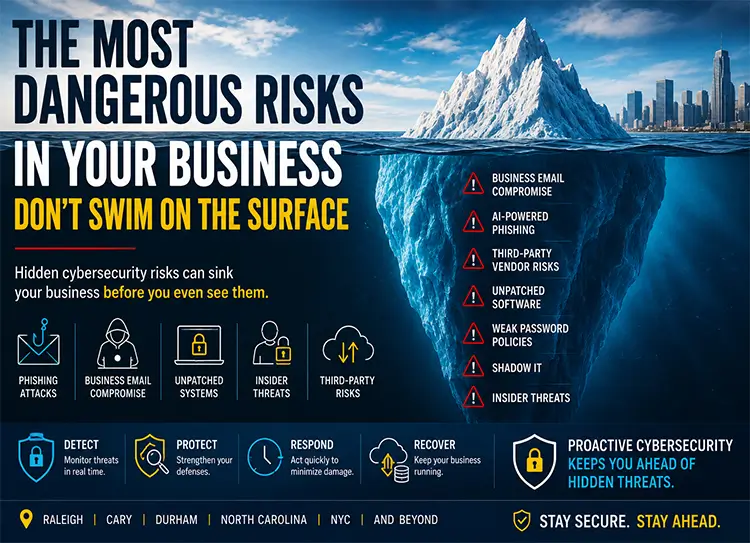
The Most Dangerous Risks in Your Business Don't Swim on the Surface
Sometimes the Biggest Threat Isn’t the One You Can See
Imagine standing on the shore of North Carolina’s beautiful Outer Banks. The ocean appears calm. Gentle waves roll in, families are enjoying the sunshine, and everything feels perfectly safe.
But beneath that peaceful surface, powerful currents move silently. Marine life travels unseen. Hidden dangers exist that most beachgoers never notice until they’re far too close.
Your business operates much the same way.
Many business owners worry about the obvious cybersecurity threats—ransomware splashed across the evening news, dramatic data breaches involving Fortune 500 companies, or movies depicting hackers breaking through digital firewalls in seconds. While these threats are real, they are rarely where the greatest risk begins.
The most damaging cyberattacks usually start quietly.
A convincing email that looks like it came from your bank.
A trusted vendor whose account has already been compromised.
An employee unknowingly installing an unauthorized application.
A former employee whose login credentials still work months after leaving.
These hidden cybersecurity risks don’t announce themselves with flashing warning lights. They blend into your everyday operations, patiently waiting for the right opportunity. By the time they’re discovered, sensitive information may already be stolen, customer trust damaged, and business operations disrupted.
For small and medium-sized businesses (SMBs), this reality is especially concerning. Many owners assume cybercriminals only target large corporations with massive budgets and valuable customer databases. In reality, attackers increasingly focus on smaller organizations because they often have fewer security controls, smaller IT teams, and limited cybersecurity resources.
According to cybersecurity researchers and federal agencies, cybercriminals have become remarkably patient. Instead of forcing their way into networks, they quietly gain access, observe employee behavior, study financial processes, and wait for the perfect opportunity to strike. Some attackers remain undetected for weeks or even months before launching ransomware, stealing funds, or exfiltrating confidential data.
This shift has fundamentally changed how businesses should think about cyber risk.
Instead of asking:
“Can someone hack us?”
Business leaders should begin asking:
“What hidden cybersecurity risks already exist inside our organization that we simply haven’t noticed yet?”
That question can make the difference between preventing a cyber incident and becoming tomorrow’s headline.
Whether your company is located in Raleigh, Cary, Durham, elsewhere in North Carolina, New York City, or anywhere across the United States, understanding these invisible threats is no longer optional. Every connected device, cloud application, employee account, and third-party vendor expands your digital attack surface.
The good news?
Most hidden cyber threats can be identified and significantly reduced through proactive planning, employee awareness, modern security technologies, and experienced IT professionals who continuously monitor your environment.
In this guide, we’ll explore the hidden cybersecurity risks every business should know, explain why attackers prefer these invisible entry points, and provide practical strategies to help protect your organization before a costly incident occurs.
Why the Biggest Cyber Threats Stay Hidden
When most people picture a cyberattack, they imagine dramatic scenes: flashing warning messages, encrypted files, or systems suddenly going offline.
The reality is far less obvious.
Modern cybercriminals have learned that stealth is often more profitable than speed. Rather than forcing their way into a network, they quietly blend in with normal business activity, making it difficult for organizations to recognize suspicious behavior until significant damage has already been done.
This evolution in attacker tactics is one of the biggest reasons hidden cybersecurity risks have become such a serious concern for businesses of every size.
Cybercriminals Don’t Want to Be Seen
Today’s attackers understand that the longer they remain unnoticed, the more opportunities they have to achieve their objectives.
Instead of immediately deploying ransomware, they often begin by:
- Stealing employee credentials through phishing emails.
- Monitoring financial workflows to identify payment approval processes.
- Collecting customer information.
- Mapping servers and cloud environments.
- Identifying administrator accounts.
- Disabling or bypassing security tools.
- Waiting for holidays, weekends, or staff shortages before acting.
This approach allows cybercriminals to maximize financial gain while minimizing the chances of early detection.
For business owners, the danger isn’t always the attack itself—it’s the time attackers spend inside the network before anyone realizes they’re there.
Everyday Business Activities Can Become Attack Vectors
One of the reasons hidden cyber threats are so effective is that they disguise themselves as routine business operations.
Consider how many digital interactions occur during a typical workday:
- Employees receive dozens of emails.
- Vendors send invoices.
- Customers upload documents.
- Teams collaborate through Microsoft 365.
- Staff members access cloud applications.
- Remote employees connect from home networks.
- Contractors log into shared systems.
Each interaction is legitimate—until one isn’t.
A single convincing email or compromised vendor account can provide attackers with the access they need to move throughout your environment unnoticed.
This is why cybersecurity risks for small businesses often begin with trusted relationships rather than sophisticated hacking techniques.
The Human Element Remains the Weakest Link
Technology has improved dramatically over the past decade, but cybercriminals continue targeting people because human behavior is often easier to exploit than software vulnerabilities.
Employees are busy.
Managers multitask.
Executives travel frequently.
Finance departments process hundreds of transactions.
Customer service representatives respond quickly to incoming requests.
Attackers know this.
They carefully craft emails, phone calls, fake login pages, and social engineering campaigns that exploit urgency, curiosity, or trust.
These attacks don’t rely on breaking encryption—they rely on convincing someone to unknowingly open the door.
That’s why security awareness training has become one of the most effective investments businesses can make.
Your Attack Surface Is Larger Than You Think
Many business owners believe their cybersecurity begins and ends with antivirus software and a firewall.
Unfortunately, today’s digital environments are far more complex.
Your organization’s attack surface may include:
- Microsoft 365 accounts.
- Cloud storage platforms.
- Mobile devices.
- Remote workers.
- Personal laptops.
- Third-party vendors.
- Business partners.
- Internet-connected devices.
- Backup systems.
- Password managers.
- Customer portals.
- Accounting software.
- Collaboration tools.
- Website hosting platforms.
- Wireless networks.
Every connected system represents another possible entry point.
Without continuous security monitoring, vulnerability assessments, and access control reviews, hidden cyber threats can remain undetected across multiple systems simultaneously.
Small Businesses Are Increasingly Targeted
A common misconception is that only enterprise organizations face sophisticated cyberattacks.
Unfortunately, that’s no longer true.
Small and medium-sized businesses have become attractive targets because attackers know they often lack:
- Dedicated security teams.
- Continuous monitoring.
- Formal cybersecurity strategies.
- Incident response plans.
- Security awareness programs.
- Multi-factor authentication across all systems.
- Regular vulnerability assessments.
Cybercriminals don’t necessarily look for the biggest company.
They look for the easiest opportunity.
For businesses throughout Raleigh, Cary, Durham, North Carolina, New York City, and across the U.S., strengthening cybersecurity isn’t simply about preventing a data breach—it’s about protecting operations, customer trust, regulatory compliance, and long-term business resilience.
What Makes Invisible Cyber Risks So Dangerous?
Not every cybersecurity threat announces itself with ransomware or system outages.
In fact, the most dangerous attacks are often the ones that quietly unfold in the background while your business continues operating as usual.
These invisible cyber threats are particularly damaging because they exploit blind spots rather than obvious weaknesses. By the time warning signs appear, attackers may have already accessed sensitive information, compromised user accounts, or positioned themselves to launch a much larger attack.
Understanding why these hidden cybersecurity risks are so dangerous is the first step toward building a stronger cyber risk management strategy.
They Blend Into Normal Business Activity
The most successful cyberattacks rarely look suspicious at first.
An employee receives an email from what appears to be a trusted supplier.
A finance manager approves what looks like a routine invoice.
A staff member logs into a fake Microsoft 365 page that perfectly mimics the real one.
Each action seems ordinary, making it difficult for employees—and sometimes even automated security tools—to distinguish legitimate business activity from malicious behavior.
This ability to hide in plain sight is what makes modern cyber threats so effective.
They Give Attackers Time to Plan
Unlike traditional attacks that aim for immediate disruption, today’s cybercriminals often play the long game.
Once inside a network, they may spend weeks quietly gathering information, identifying valuable systems, escalating privileges, and studying how your organization operates before making their move.
That patience allows attackers to:
- Maximize financial impact.
- Target critical business systems.
- Steal confidential customer data.
- Disable backups.
- Evade detection.
- Increase the likelihood of a successful ransomware deployment.
The longer attackers remain undetected, the greater the potential damage.
Hidden Risks Multiply Across Connected Systems
Modern businesses rely on interconnected technologies to stay productive—but every connection introduces additional risk.
Cloud applications, remote access tools, third-party integrations, mobile devices, and collaboration platforms all improve efficiency, yet they also expand your organization’s digital footprint.
Without proper oversight, a single compromised account or vulnerable application can provide attackers with a pathway to multiple critical systems.
This interconnected environment makes proactive cybersecurity, continuous monitoring, and layered security controls more important than ever.
Prevention Is Always Less Expensive Than Recovery
Recovering from a cyber incident often involves far more than restoring files. Businesses may face operational downtime, legal obligations, customer notifications, reputational damage, regulatory scrutiny, and significant financial costs.
By contrast, investing in proactive cybersecurity measures—such as regular vulnerability assessments, endpoint protection, security awareness training, and managed cybersecurity services—can substantially reduce both the likelihood and the impact of an attack.
For business owners, the lesson is clear: the threats you don’t see are often the ones that cost the most.
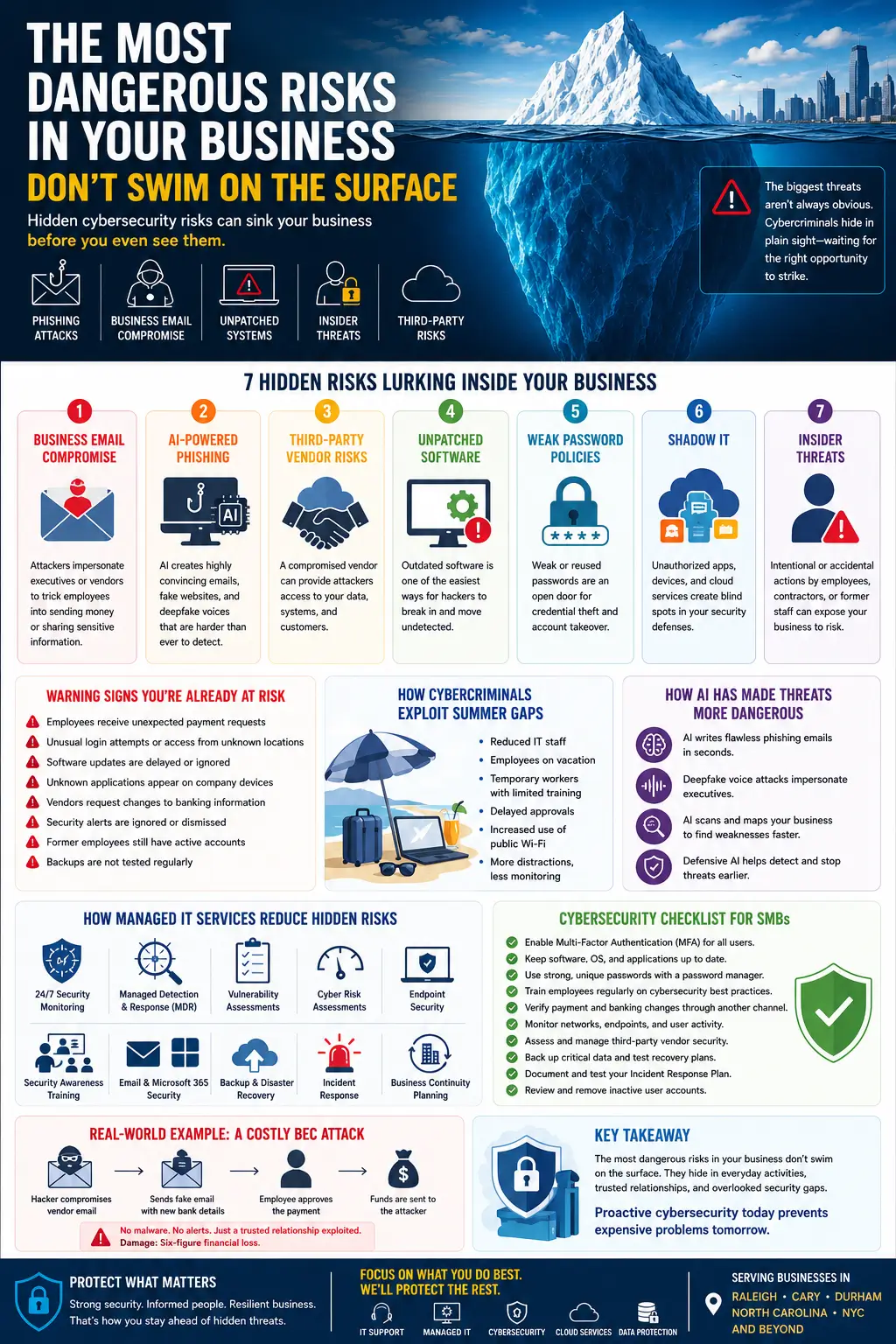
7 Hidden Risks Lurking Inside Your Business
Cybercriminals no longer rely solely on brute-force attacks or advanced malware. Instead, they focus on exploiting weaknesses that most organizations overlook. These hidden cybersecurity risks often exist within everyday business operations, making them difficult to detect until it’s too late.
Let’s examine the seven invisible threats that every business owner should understand.
- Business Email Compromise (BEC): When Trust Becomes a Weapon
Imagine receiving an email from your CEO requesting an urgent wire transfer to a new vendor account. The message includes the correct signature, company branding, and even references an ongoing project.
Everything appears legitimate.
The only problem?
It wasn’t sent by your CEO.
This is Business Email Compromise (BEC)—one of the fastest-growing and most financially damaging cyber threats facing businesses today.
Unlike ransomware, BEC attacks don’t rely on malicious software. Instead, they exploit trust, psychology, and business processes. Cybercriminals may impersonate executives, vendors, attorneys, or trusted partners to convince employees to transfer funds, change banking information, or share confidential data.
Why BEC Is So Dangerous
- No malware is required.
- Traditional antivirus solutions often can’t detect it.
- Emails frequently bypass spam filters.
- Financial losses can occur within minutes.
- Recovery is often difficult once funds are transferred.
Warning Signs
- Unexpected payment requests.
- Sudden changes to banking information.
- Urgent language demanding immediate action.
- Requests to bypass normal approval processes.
- Slight variations in email domains.
How to Reduce the Risk
- Require verbal verification for payment changes.
- Implement Multi-Factor Authentication (MFA).
- Use email authentication protocols such as SPF, DKIM, and DMARC.
- Conduct regular Security Awareness Training.
- Establish dual approval for financial transactions.
- AI-Powered Phishing: Smarter Attacks Than Ever Before
Traditional phishing emails were relatively easy to spot because they contained poor grammar, awkward formatting, or suspicious links.
Those days are largely gone.
Artificial intelligence now enables cybercriminals to create highly convincing phishing emails, fake websites, and even voice impersonations that closely mimic trusted individuals and organizations.
AI tools allow attackers to:
- Personalize messages using publicly available information.
- Write flawless emails.
- Translate messages into multiple languages.
- Mimic executives’ writing styles.
- Generate realistic fake invoices.
- Create convincing customer support conversations.
These sophisticated attacks significantly increase the success rate of phishing campaigns.
Why AI Makes Phishing More Dangerous
AI dramatically reduces the time required to launch convincing attacks while increasing their credibility.
Employees who previously recognized phishing attempts may now struggle to distinguish genuine communications from malicious ones.
Best Practices
- Deploy advanced email security solutions.
- Conduct phishing simulations.
- Encourage employees to verify unusual requests.
- Use conditional access policies.
- Continuously educate staff about evolving attack techniques.
- Third-Party Vendors: Your Weakest Link May Not Be Your Own
Your business likely depends on dozens of external organizations every day.
These may include:
- Payroll providers.
- Accounting firms.
- Managed software vendors.
- Cloud service providers.
- Marketing agencies.
- Law firms.
- Payment processors.
- IT consultants.
Each vendor may have access to sensitive information or systems.
Unfortunately, cybercriminals know that attacking one supplier can provide access to hundreds or even thousands of customers.
This is known as a supply chain cyber risk.
Instead of attacking your business directly, attackers compromise one of your trusted vendors first.
Questions Every Business Should Ask
- Does the vendor use MFA?
- How do they protect customer data?
- Have they experienced previous breaches?
- What security certifications do they maintain?
- How quickly will they notify customers after a security incident?
Vendor Security Best Practices
- Perform vendor security assessments.
- Limit third-party access.
- Review vendor contracts regularly.
- Monitor privileged accounts.
- Remove unused vendor accounts immediately.
- Unpatched Software: The Open Door Attackers Love
Every software application contains vulnerabilities.
Software vendors regularly release updates to fix these weaknesses.
Unfortunately, many organizations postpone updates because they’re busy, worried about downtime, or assume they’re unnecessary.
Attackers actively search for businesses running outdated software because known vulnerabilities are easy to exploit.
Common targets include:
- Windows operating systems.
- Microsoft 365 environments.
- Firewalls.
- VPN appliances.
- Web browsers.
- Business applications.
- Remote Desktop services.
- Network devices.
Why Delayed Updates Matter
A vulnerability may become public today.
Within hours, attackers begin scanning the internet for organizations that haven’t installed the security patch.
Every day without updating increases your exposure.
Best Practices
- Automate patch management whenever possible.
- Prioritize critical security updates.
- Maintain an asset inventory.
- Replace unsupported operating systems.
- Regularly perform vulnerability assessments.
- Weak Password Policies: Small Mistakes, Massive Consequences
Passwords remain one of the most common entry points for cybercriminals.
Many businesses still rely on:
- Shared passwords.
- Reused credentials.
- Simple passwords.
- Passwords stored in spreadsheets.
- Default administrator credentials.
Unfortunately, one compromised password can provide access to email, cloud services, financial systems, customer information, and administrative tools.
Strong Password Practices Include
- Unique passwords for every account.
- Password managers.
- Multi-Factor Authentication.
- Regular credential reviews.
- Disabling inactive accounts.
- Monitoring compromised credentials.
Remember
A password alone is no longer enough.
Modern cybersecurity strategies combine passwords with MFA, conditional access, identity monitoring, and Zero Trust security principles.
- Shadow IT: The Technology Your IT Team Doesn’t Know Exists
Shadow IT refers to hardware, software, or cloud applications that employees use without approval from the IT department.
Examples include:
- Personal Dropbox accounts.
- Free file-sharing platforms.
- AI writing tools.
- Unsanctioned messaging applications.
- Personal email accounts.
- Unauthorized SaaS subscriptions.
- Personal USB devices.
Employees usually adopt these tools with good intentions—to improve productivity or collaborate more effectively.
However, unauthorized technology creates serious security gaps.
Hidden Risks of Shadow IT
- Sensitive data stored outside company control.
- Weak authentication.
- Unknown security settings.
- Compliance violations.
- Data loss.
- Increased attack surface.
How to Reduce Shadow IT
- Provide approved alternatives.
- Educate employees.
- Monitor cloud application usage.
- Establish acceptable use policies.
- Regularly review software inventories.
- Insider Threats: Not Every Risk Comes From Outside
When people hear “cybercriminal,” they usually imagine anonymous hackers halfway around the world.
Sometimes, however, the greatest risk comes from within.
Insider threats may involve:
- Current employees.
- Former employees.
- Contractors.
- Temporary workers.
- Business partners.
Not every insider threat is malicious.
Many security incidents occur because someone accidentally:
- Sends confidential information to the wrong recipient.
- Clicks a phishing link.
- Uploads sensitive files to personal cloud storage.
- Uses unsecured Wi-Fi.
- Loses a company laptop.
- Misconfigures cloud storage.
Other insider threats are intentional, involving data theft, sabotage, or unauthorized access before an employee leaves the organization.
Reduce Insider Risk Through
- Role-based access control.
- Least privilege access.
- User behavior monitoring.
- Immediate account deactivation after termination.
- Security Awareness Training.
- Regular access reviews.
Warning Signs You’re Already at Risk
Many cyberattacks don’t begin with dramatic warning messages. Instead, they leave subtle clues that are often dismissed as routine technical issues or human error.
Recognizing these early indicators can help prevent a minor security issue from becoming a full-scale business crisis.
Here are some warning signs that hidden cybersecurity risks may already exist within your organization:
Employees Receive More Suspicious Emails Than Usual
A sudden increase in unexpected invoices, password reset requests, or emails requesting urgent payments could indicate attackers are actively targeting your organization with phishing or Business Email Compromise campaigns.
Employees Reuse Passwords Across Multiple Platforms
If staff members use the same credentials for Microsoft 365, cloud applications, and personal accounts, a breach on one platform could expose your business systems.
Unknown Applications Are Appearing on Company Devices
Unauthorized software installations, AI tools, browser extensions, or file-sharing applications may signal Shadow IT activity, increasing your organization’s attack surface.
Software Updates Are Frequently Delayed
Running outdated operating systems, browsers, or business applications leaves known vulnerabilities unpatched, providing attackers with easy entry points.
Employees Bypass Security Procedures
When team members ignore approval processes, disable security controls, or share login credentials for convenience, they unintentionally weaken your organization’s defenses.
Unusual Login Activity
Repeated failed login attempts, logins from unfamiliar locations, or access outside normal business hours may indicate compromised accounts or attempted credential theft.
Vendors Request Unexpected Banking Changes
Always verify any request to change payment instructions through a trusted communication channel. Vendor impersonation remains one of the most effective Business Email Compromise tactics.
Security Alerts Are Ignored
Alert fatigue is real, but repeatedly dismissing endpoint protection or monitoring alerts can allow attackers to remain hidden for weeks or months.
No One Knows Who Has Access to What
If your organization cannot quickly identify who has access to sensitive systems, cloud applications, or financial data, it’s a strong indicator that access controls need improvement.
The Common Thread
While these seven risks may seem different, they share one important characteristic:
They rarely announce themselves.
They operate quietly, blending into normal business activities until a seemingly harmless email, forgotten software update, or overlooked vendor relationship becomes the starting point of a costly cybersecurity incident.
The good news is that each of these risks can be significantly reduced with the right combination of technology, employee awareness, proactive monitoring, and a well-defined cybersecurity strategy.
How Cybercriminals Exploit Summer Staffing Gaps
Summer is a season most business owners look forward to. Employees take well-earned vacations, families travel, and work schedules become more flexible. Unfortunately, cybercriminals look forward to this season for an entirely different reason.
They know businesses are often operating with reduced staff, temporary employees, distracted managers, and slower approval processes. These temporary changes create ideal conditions for cyberattacks.
A cybercriminal doesn’t need to compromise an entire network overnight. They simply need one employee to make one mistake while everyone else is away.
This is why cybersecurity professionals often refer to vacation periods as “high-opportunity seasons” for attackers.
Why Summer Creates More Cybersecurity Risks
During the summer months, organizations commonly experience:
- Reduced IT staffing.
- Delayed software updates.
- Temporary employees with limited cybersecurity training.
- Managers approving requests remotely.
- Finance teams operating with fewer personnel.
- Increased use of personal devices while traveling.
- More remote work from hotels, airports, and public Wi-Fi networks.
Every one of these situations creates additional opportunities for hidden cyber threats.
Attackers carefully monitor these seasonal patterns because they know businesses may be slower to detect suspicious activity.
Vacation Auto-Replies Can Help Cybercriminals
An innocent out-of-office message may reveal more information than intended.
For example:
“I’m away until July 28. For urgent financial requests, please contact Susan.”
To a cybercriminal, this message provides valuable intelligence:
- The employee is unavailable.
- The organization has an alternate approver.
- The attack can now target Susan instead.
Attackers often use this information to launch highly targeted Business Email Compromise (BEC) campaigns against the remaining staff.
Best Practice
Keep automatic replies simple.
Avoid sharing:
- Internal reporting structures.
- Approval processes.
- Detailed travel schedules.
- Personal contact information.
Remote Work Increases the Attack Surface
Employees increasingly work from:
- Hotels.
- Coffee shops.
- Airports.
- Shared workspaces.
- Vacation homes.
While convenient, these environments often lack enterprise-grade security.
Public Wi-Fi networks can expose users to:
- Credential theft.
- Session hijacking.
- Fake wireless hotspots.
- Malware distribution.
Employees should always use:
- Company-approved VPNs.
- Multi-Factor Authentication (MFA).
- Secure business devices.
- Encrypted cloud services.
Temporary Employees Often Become Targets
Seasonal workers, interns, and contractors may not receive the same cybersecurity training as permanent employees.
Cybercriminals know this.
They frequently target newer staff because they may be unfamiliar with:
- Company payment procedures.
- Security policies.
- Vendor verification.
- Executive communication styles.
A single successful phishing email can provide attackers with valuable credentials.
This reinforces why Security Awareness Training should be ongoing—not just part of new employee orientation.
How AI Has Made Hidden Threats More Dangerous
Artificial intelligence has transformed the way businesses operate.
Unfortunately, it has also transformed the way cybercriminals attack.
AI allows attackers to automate, personalize, and scale cyberattacks faster than ever before.
The result is a new generation of hidden cybersecurity risks that are significantly more convincing than traditional attacks.
AI Can Write Better Phishing Emails Than Humans
Years ago, phishing emails were easy to identify because they contained:
- Poor grammar.
- Obvious spelling mistakes.
- Generic greetings.
- Awkward formatting.
Today’s AI-generated emails often look completely legitimate.
They can:
- Match your company’s writing style.
- Reference recent events.
- Mention colleagues by name.
- Include realistic branding.
- Adapt to regional language differences.
Employees can no longer rely on grammar mistakes as warning signs.
Deepfake Audio Is Becoming a Business Risk
Imagine receiving a phone call that sounds exactly like your CEO.
The voice requests an urgent payment.
Everything sounds authentic.
Except the voice was generated by artificial intelligence.
Deepfake technology is rapidly improving, making voice impersonation attacks increasingly believable.
Businesses should establish verification procedures that do not rely solely on voice recognition.
AI Helps Criminals Find Weaknesses Faster
Cybercriminals now use AI to:
- Scan networks.
- Identify exposed services.
- Generate malicious code.
- Test stolen passwords.
- Analyze publicly available business information.
- Personalize attacks against employees.
This dramatically reduces the amount of time needed to plan sophisticated attacks.
Defensive AI Matters Too
The good news is that businesses can also leverage AI-powered security technologies.
Modern security platforms can help detect:
- Unusual login behavior.
- Impossible travel logins.
- Suspicious email activity.
- Credential compromise.
- Endpoint anomalies.
- Ransomware behavior.
- Insider threats.
AI should be viewed as both a business productivity tool and a cybersecurity defense mechanism.
How Managed IT Services Reduce Hidden Risks
Cybersecurity is no longer just about installing antivirus software.
Modern businesses require continuous visibility into their technology environments.
This is where Managed IT Services provide significant value.
Rather than reacting after problems occur, managed service providers help identify hidden cybersecurity risks before they become costly incidents.
Continuous Security Monitoring
Many attacks occur outside normal business hours.
Professional Security Monitoring watches your environment 24/7, helping detect:
- Unauthorized access.
- Suspicious logins.
- Malware activity.
- Endpoint threats.
- Network anomalies.
- Data exfiltration attempts.
Early detection dramatically reduces recovery costs.
Managed Detection and Response (MDR)
Managed Detection and Response combines advanced security technology with experienced cybersecurity analysts.
Instead of simply generating alerts, MDR services investigate suspicious activity and help contain threats before they spread.
Regular Vulnerability Assessments
Technology changes constantly.
New software, devices, and cloud services introduce new vulnerabilities.
Routine Vulnerability Assessments help identify:
- Missing security patches.
- Weak configurations.
- Unsupported software.
- Exposed services.
- High-risk devices.
Addressing these issues proactively reduces the likelihood of successful attacks.
Cyber Risk Assessments
Technology alone doesn’t determine your cybersecurity posture.
A comprehensive Cyber Risk Assessment evaluates:
- Business processes.
- Employee behavior.
- Vendor relationships.
- Compliance requirements.
- Backup strategies.
- Incident response readiness.
This broader perspective helps organizations prioritize investments based on actual business risk.
Security Awareness Training
Employees remain one of the strongest—or weakest—components of your cybersecurity strategy.
Regular training helps employees recognize:
- Phishing attempts.
- Business Email Compromise.
- AI-generated scams.
- Social engineering.
- Password attacks.
- Insider threats.
An informed workforce is one of the most effective security controls available.
Business Continuity and Disaster Recovery
Even organizations with strong defenses should prepare for unexpected events.
A comprehensive Business Continuity and Disaster Recovery strategy helps ensure your organization can continue operating if systems become unavailable.
This includes:
- Secure backups.
- Recovery testing.
- Disaster recovery planning.
- Incident response procedures.
- Communication plans.
Preparation often determines how quickly a business can recover.
Cybersecurity Checklist for Small Businesses
If you’re wondering whether your business is prepared, use this practical checklist as a starting point.
Identity & Access Management
✔ Enable Multi-Factor Authentication (MFA) for all users.
✔ Remove accounts belonging to former employees.
✔ Review administrator privileges regularly.
✔ Use strong, unique passwords stored in a password manager.
Email Security
✔ Deploy advanced email filtering.
✔ Verify payment requests by phone.
✔ Configure SPF, DKIM, and DMARC.
✔ Train employees to recognize phishing attempts.
Endpoint Security
✔ Install Endpoint Detection and Response (EDR).
✔ Keep operating systems updated.
✔ Replace unsupported devices.
✔ Encrypt company laptops.
Cloud Security
✔ Secure Microsoft 365 with Conditional Access policies.
✔ Monitor cloud application usage.
✔ Restrict unauthorized file sharing.
✔ Back up cloud data regularly.
Network Security
✔ Segment critical systems.
✔ Secure Wi-Fi with modern encryption.
✔ Disable unused services.
✔ Monitor network activity continuously.
Vendor Management
✔ Assess third-party cybersecurity practices.
✔ Limit vendor access.
✔ Review contracts annually.
✔ Remove inactive vendor accounts.
Employee Awareness
✔ Conduct regular Security Awareness Training.
✔ Perform phishing simulations.
✔ Establish incident reporting procedures.
✔ Encourage employees to report suspicious activity immediately.
Incident Preparedness
✔ Maintain an Incident Response Plan.
✔ Test backups regularly.
✔ Review Business Continuity procedures.
✔ Perform annual Cyber Risk Assessments.
Quick Answer (Featured Snippet):
The best way to reduce hidden cybersecurity risks is to combine multi-factor authentication, employee security awareness training, regular vulnerability assessments, continuous security monitoring, secure backups, vendor risk management, and a documented incident response plan. Layered security significantly reduces the likelihood and impact of cyberattacks.
Real-World Example: When One Email Changed Everything
Consider a realistic scenario that mirrors incidents reported across thousands of small and mid-sized businesses.
A manufacturing company received what appeared to be a routine email from one of its long-time suppliers requesting an update to banking information before the next invoice payment.
The email contained:
- The supplier’s logo.
- Correct invoice references.
- Familiar language.
- A professional email signature.
Everything looked legitimate.
The finance department updated the banking information without making a verification phone call.
Several days later, a six-figure payment was transferred—not to the supplier, but to a cybercriminal’s account.
The supplier’s email account had been compromised weeks earlier.
The attacker patiently monitored conversations before sending the fraudulent request at exactly the right moment.
No ransomware.
No malware.
No obvious warning signs.
Just a carefully planned Business Email Compromise (BEC) attack that exploited trust instead of technology.
This example highlights an important lesson: the most damaging cyber incidents often begin with a routine business interaction rather than a dramatic technical failure.
What Computerbilities Does Differently
At Computerbilities, we believe cybersecurity should be proactive, practical, and aligned with the way your business operates—not just a collection of software tools.
Rather than waiting for something to go wrong, we help organizations uncover and reduce hidden cybersecurity risks before they impact operations.
Our approach includes:
- Managed IT Services designed to keep systems secure, stable, and up to date.
- 24/7 Security Monitoring to identify suspicious activity early.
- Managed Detection and Response (MDR) for rapid threat investigation and containment.
- Cyber Risk Assessments tailored to your business objectives.
- Vulnerability Assessments to uncover weaknesses before attackers do.
- Microsoft 365 Security configuration and monitoring.
- Endpoint Security for laptops, desktops, and mobile devices.
- Security Awareness Training that empowers employees to recognize evolving threats.
- Business Continuity and Disaster Recovery planning to minimize downtime during unexpected events.
Whether you’re a growing business in Raleigh, Cary, Durham, elsewhere in North Carolina, New York City, or beyond, our goal is to help you build a resilient technology environment that supports growth while reducing cyber risk.
We don’t just respond to incidents—we work alongside you to strengthen your overall cybersecurity strategy and improve your long-term resilience.
Don’t Wait Until Hidden Risks Become Visible
Cybercriminals rarely announce their presence. They exploit overlooked vulnerabilities, trusted relationships, and everyday business routines because they know those are the places where defenses are often weakest.
The organizations that recover fastest—and often avoid major incidents altogether—are the ones that take a proactive approach.
If you’re unsure whether hidden cybersecurity risks exist within your business, now is the right time to find out.
Computerbilities can help you identify vulnerabilities, strengthen your defenses, and develop a practical cybersecurity roadmap tailored to your organization.
Ready to Strengthen Your Cybersecurity?
Whether you need IT Support in Raleigh, Managed IT Services in Cary, Cybersecurity Services in Durham, or a comprehensive Cyber Risk Assessment anywhere in North Carolina or the New York City area, our experienced team is here to help.
Contact Computerbilities today to schedule a no-obligation cybersecurity consultation and discover how proactive security can protect your business, your employees, and your customers before hidden threats surface.
Frequently Asked Questions (FAQs)
- What is the biggest cybersecurity risk for small businesses?
The biggest cybersecurity risk for small businesses is human error combined with hidden cybersecurity risks, such as phishing emails, Business Email Compromise (BEC), weak passwords, and unpatched software. Cybercriminals often target employees rather than technology because people are easier to deceive. A layered cybersecurity strategy that includes Multi-Factor Authentication (MFA), employee training, endpoint security, and continuous monitoring significantly reduces these risks.
- What are hidden cyber threats?
Hidden cyber threats are cybersecurity risks that operate quietly without obvious warning signs. These include compromised user accounts, Business Email Compromise, malicious third-party vendors, insider threats, Shadow IT, unpatched systems, and AI-powered phishing attacks. Because these threats often blend into normal business activities, they can remain undetected for weeks or even months.
- What is Business Email Compromise (BEC)?
Business Email Compromise (BEC) is a type of cyberattack where criminals impersonate trusted executives, vendors, or business partners to trick employees into transferring money, sharing sensitive information, or changing payment details. Unlike ransomware, BEC attacks often don’t involve malware, making them difficult to detect using traditional antivirus software.
- How do hackers stay hidden inside a business network?
Cybercriminals stay hidden by using stolen credentials, compromised email accounts, legitimate remote access tools, and trusted third-party connections. Instead of immediately launching an attack, they often spend weeks observing business operations, identifying valuable data, escalating user privileges, and waiting for the right opportunity to strike.
- Why is phishing still so successful?
Phishing remains successful because attackers now use artificial intelligence to create highly personalized and convincing emails. AI-powered phishing campaigns mimic trusted brands, executives, and vendors with professional language and realistic formatting, making them much harder for employees to identify than traditional phishing attempts.
- What is supply chain cyber risk?
Supply chain cyber risk refers to cybersecurity threats introduced through third-party vendors, software providers, contractors, or service partners that have access to your business systems or sensitive information. If a trusted vendor is compromised, attackers may use that relationship to gain unauthorized access to your organization.
- How can businesses reduce hidden cybersecurity risks?
Businesses can reduce hidden cybersecurity risks by implementing Multi-Factor Authentication (MFA), regularly updating software, conducting vulnerability assessments, providing ongoing Security Awareness Training, monitoring networks 24/7, securing Microsoft 365 environments, performing Cyber Risk Assessments, and maintaining tested backup and disaster recovery plans.
- What are the early signs of a cyberattack?
Common early warning signs include:
- Unusual login attempts.
- Employees receiving unexpected payment requests.
- Increased phishing emails.
- Unknown software installations.
- Slower system performance.
- Unauthorized password changes.
- Suspicious network activity.
- Security alerts being ignored or repeatedly triggered.
Recognizing these indicators early can help prevent larger cybersecurity incidents.
- Why do businesses become ransomware victims?
Businesses often become ransomware victims because attackers exploit weak passwords, outdated software, stolen credentials, phishing emails, unsecured remote access, and inadequate security monitoring. Organizations without regular backups or an Incident Response Plan typically experience longer recovery times and greater financial losses.
- What should small businesses do to stay secure?
Small businesses should adopt a proactive cybersecurity strategy that includes:
- Multi-Factor Authentication (MFA)
- Managed IT Services
- Endpoint Detection and Response (EDR)
- Security Awareness Training
- Continuous Security Monitoring
- Regular Vulnerability Assessments
- Business Continuity and Disaster Recovery Planning
- Incident Response Planning
- Routine software updates
- Strong password policies
These measures create multiple layers of defense against today’s evolving cyber threats.
Key Takeaways
The greatest cybersecurity threats rarely announce themselves. Instead, they hide within everyday business activities—an email that looks genuine, a trusted vendor account that’s been compromised, an employee using an unauthorized cloud application, or software that hasn’t been updated in months.
For small and medium-sized businesses, these invisible risks are often more dangerous than highly publicized ransomware attacks because they remain undetected until the damage has already been done.
By understanding where hidden cyber threats exist and taking proactive steps to address them, organizations can significantly reduce their exposure while improving resilience against future attacks.
Whether you’re operating in Raleigh, Cary, Durham, elsewhere in North Carolina, New York City, or anywhere across the United States, investing in cybersecurity is no longer just an IT responsibility—it’s a critical business strategy.
Don’t Let Hidden Risks Become Costly Business Problems
Cybercriminals are constantly looking for organizations that rely on outdated security practices, weak passwords, unpatched systems, or employees who haven’t received proper cybersecurity training. They don’t need to force their way into your business if an unnoticed vulnerability is already waiting for them.
At Computerbilities, we help businesses uncover these hidden cybersecurity risks before attackers can exploit them. Our proactive approach combines advanced technology, experienced security professionals, and practical guidance tailored to the needs of small and medium-sized businesses.
Whether you’re looking for:
- Managed IT Services in Raleigh
- IT Support in Cary
- Cybersecurity Services in Durham
- Managed IT Services throughout North Carolina
- Comprehensive Cyber Risk Assessments
- Security Monitoring and Managed Detection & Response (MDR)
- Microsoft 365 Security
- Endpoint Protection
- Business Continuity and Disaster Recovery
our team is ready to help you strengthen your defenses and protect your business.
Book my free 15-minute IT Priorities Call. Discuss your main business IT concern and receive a brief emailed summary of priorities and recommended next steps. No cost, no obligation to purchase, and no system access required. Technical testing and detailed assessments are separately scoped.
If you’re unsure whether hidden cybersecurity risks are putting your organization at risk, now is the perfect time to act.
Protect your business before hidden threats surface.