
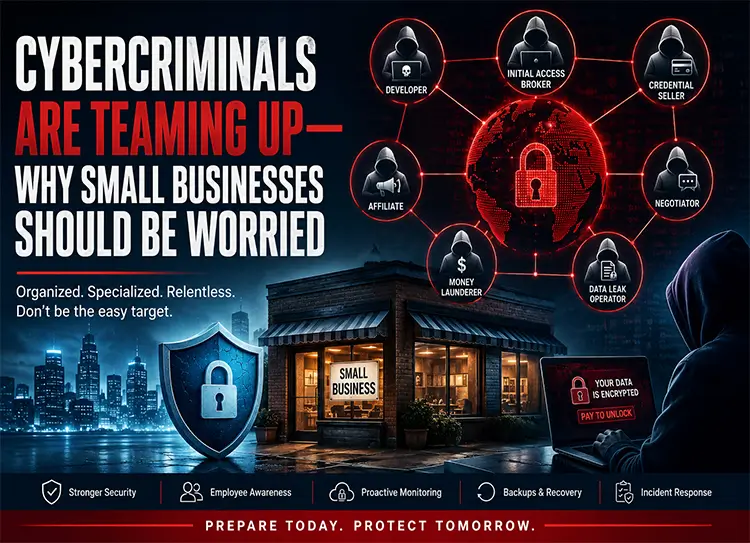
Cybercriminals Are Teaming Up—Why Small Businesses Should Be Worried
Cybercrime Has Changed—Has Your Business Kept Up?
Not long ago, the image of a cybercriminal was fairly predictable: a lone hacker sitting in a dark room, writing malicious code and attempting to break into company systems. While that stereotype has always been exaggerated, today’s reality is even more alarming.
Modern cybercrime has evolved into something far more sophisticated. Today’s attacks aren’t typically carried out by a single individual—they’re executed by organized cybercriminal groups that function much like legitimate businesses. Each participant has a specialized role, from developing malware and stealing credentials to negotiating ransom payments and laundering cryptocurrency. These cybercrime networks collaborate across continents, share resources, sell services, and continuously improve their attack methods.
For small and medium-sized businesses (SMBs), this shift represents a significant increase in cybersecurity risks. The barriers to launching sophisticated cyberattacks on small businesses have dropped dramatically because attackers no longer need advanced technical expertise. Instead, they can purchase everything they need through the growing cybercrime ecosystem, making enterprise-grade attacks accessible to almost anyone willing to pay.
If you own or manage a business in Raleigh, Cary, Durham, or anywhere across North Carolina, this isn’t just another cybersecurity headline—it’s a business risk that deserves immediate attention. Every day, local organizations depend on cloud platforms, Microsoft 365, remote work, digital payments, and connected devices to keep operations running. Unfortunately, these same technologies also expand the opportunities available to organized cybercriminals.
The question is no longer if cybercriminals are working together. The real question is:
Is your business prepared for a threat that’s operating like a Fortune 500 company?
In this guide, we’ll explore how Cybercriminals Are Teaming Up, why small business cybersecurity has never been more important, how modern ransomware operations work, and the practical steps your organization can take to reduce cyber threats before they become expensive business disruptions.

Cybercrime Has Become a Business
One of the biggest misconceptions about cybercrime is that it’s chaotic or disorganized. In reality, today’s organized cybercrime resembles a highly efficient commercial enterprise.
Think about how a successful Software-as-a-Service (SaaS) company operates.
It has:
- Product developers
- Sales teams
- Customer support
- Marketing
- Affiliate partners
- Revenue sharing
- Technical documentation
- Ongoing product improvements
Surprisingly, many cybercriminal groups now operate in much the same way.
Instead of selling legitimate software, they sell tools designed to compromise businesses. Instead of customer success teams helping clients use productivity software, they provide “technical support” to criminals launching ransomware attacks. Instead of recruiting sales partners, they recruit affiliates willing to execute attacks in exchange for a percentage of the profits.
This industrialization of cybercrime has dramatically increased the number of cyber threats for small businesses.
The Rise of Ransomware-as-a-Service (RaaS)
Perhaps the clearest example of cybercrime becoming commercialized is Ransomware-as-a-Service (RaaS).
RaaS works much like a subscription software platform.
Rather than developing ransomware from scratch, criminals can simply rent sophisticated ransomware tools from experienced developers.
A typical RaaS platform often provides:
- Ready-to-deploy ransomware
- User-friendly dashboards
- Attack documentation
- Technical support
- Payment processing guidance
- Victim negotiation templates
- Performance reporting
- Profit-sharing arrangements
In other words, cybercriminals have adopted the same scalable business models used by legitimate technology companies.
This approach dramatically lowers the technical barrier for launching a ransomware attack. Someone with limited programming skills can now carry out sophisticated attacks by purchasing access to proven tools and following detailed instructions.
As a result, ransomware gangs have multiplied rapidly over the past several years, contributing to the increase in cybersecurity threats facing organizations of every size.
Affiliate Programs: Cybercrime’s Franchise Model
Another reason cybercriminals are teaming up is the success of affiliate-based operations.
Instead of attacking businesses directly, ransomware developers recruit affiliates around the world.
Affiliates are responsible for:
- Finding vulnerable businesses
- Delivering phishing campaigns
- Purchasing stolen credentials
- Exploiting security weaknesses
- Deploying ransomware
- Collecting ransom payments
The developers, meanwhile, continue improving the ransomware software and supporting the affiliate network.
Profits are then divided between both parties.
It’s remarkably similar to how many legitimate companies expand their operations through channel partners or franchise owners.
This division of labor allows multiple attacks to occur simultaneously, significantly increasing the scale of organized cybercrime.
Customer Support… for Criminals?
One of the most surprising developments in the cybercrime ecosystem is the emergence of professional customer support.
Many ransomware operations now offer:
- 24/7 live chat
- Technical troubleshooting
- Knowledge bases
- User manuals
- Video tutorials
- FAQ documentation
- Software updates
- Bug fixes
Some even provide multilingual support for affiliates operating in different regions.
The objective is simple:
Make cybercrime easier, faster, and more profitable.
The more successful affiliates become, the more revenue flows back to the ransomware developers.
Recruitment Has Become Highly Organized
Just as legitimate companies recruit talented employees, many cybercriminal networks actively recruit specialists.
Typical recruitment targets include:
- Malware developers
- Exploit researchers
- Social engineers
- Credential thieves
- Cryptocurrency experts
- Network penetration specialists
- Negotiators
- Data analysts
Some underground forums even advertise “job opportunities” complete with performance bonuses and revenue-sharing agreements.
Rather than operating as isolated hackers, today’s cybercriminals function like specialized project teams working toward shared financial objectives.
Malware-as-a-Service Is Expanding the Threat Landscape
Ransomware isn’t the only product being commercialized.
Other criminal services now include:
- Malware-as-a-Service
- Phishing kits
- Credential theft tools
- Fake login portals
- Email spoofing services
- Botnets
- Remote access malware
- Identity theft packages
Attackers no longer need to invent new malware themselves.
Instead, they simply purchase proven tools from specialized vendors operating on dark web marketplaces.
These underground economies have become highly competitive, with sellers focusing on reliability, ease of use, and ongoing updates.
For small businesses, this means the number of capable attackers continues to grow because sophisticated tools are easier than ever to obtain.
The Cybercrime Supply Chain
Today’s cyberattack rarely begins and ends with one individual.
Instead, it follows a structured supply chain.
Imagine a manufacturing company producing a finished product.
Different departments handle:
- Research
- Design
- Manufacturing
- Shipping
- Sales
- Customer service
Modern cybercrime works in much the same way.
Each participant specializes in one part of the attack chain, making the overall operation faster, more scalable, and more effective.
This specialization enables criminals to launch complex attacks against hundreds—or even thousands—of businesses simultaneously.
For organizations relying on business cybersecurity to protect sensitive customer information, this evolution represents a significant shift. Defending against isolated hackers is one challenge. Defending against a coordinated network of specialists with commercial-grade tools is an entirely different one.
Meet the Cybercrime Team
To understand why Cybercriminals Are Teaming Up poses such a serious threat, it helps to look inside the structure of a modern cybercrime organization.
Rather than a single hacker performing every task, today’s attacks involve specialists who focus on one stage of the operation. This specialization increases efficiency, reduces risk for each participant, and allows attacks to scale quickly.
Think of it like a relay race—each member completes one part before passing the baton to the next.
The typical cybercrime workflow looks like this:
Malware Developer
│
▼
Initial Access Broker (IAB)
│
▼
Credential Seller
│
▼
Ransomware Affiliate
│
▼
Money Launderer
│
▼
Negotiator
│
▼
Data Leak Operator
Let’s look at each role in more detail.
- Malware Developer
Every operation begins with developers who create and maintain malicious software.
Their responsibilities include:
- Developing ransomware variants
- Updating malware to evade antivirus tools
- Creating exploits for newly discovered vulnerabilities
- Building phishing kits
- Maintaining command-and-control infrastructure
- Improving encryption techniques
- Testing malware against endpoint security products
These individuals rarely attack businesses directly. Instead, they supply the tools that power the broader cybercrime ecosystem.
Like legitimate software vendors, they continually release updates, fix bugs, and add new capabilities to stay ahead of defenders.
- Initial Access Brokers (IABs)
One of the most important—and least understood—roles in modern cybercrime is the Initial Access Broker (IAB).
An IAB specializes in gaining unauthorized access to organizations and then selling that access to other criminals.
They may obtain access through:
- Phishing emails
- Stolen VPN credentials
- Weak Remote Desktop Protocol (RDP) passwords
- Unpatched software vulnerabilities
- Exposed cloud services
- Misconfigured Microsoft 365 environments
Rather than deploying ransomware themselves, IABs treat access as a commodity, selling it to the highest bidder on underground marketplaces.
For attackers, buying verified access is faster, cheaper, and far less risky than compromising a target from scratch.
Why Small Businesses Are the Perfect Target
Many business owners assume hackers are only interested in large corporations with millions of customer records or billion-dollar revenues. Unfortunately, that’s no longer true.
Today’s cybercriminal groups don’t necessarily look for the biggest companies. Instead, they look for the easiest opportunities.
For organized cybercrime, attacking ten small businesses can often be faster, cheaper, and more profitable than attacking one Fortune 500 company.
Think of it this way:
If a burglar walks down a street and sees one house with cameras, reinforced doors, and security lighting—and another with an unlocked front door—which house is more likely to be targeted?
Cybercriminals think the same way.
Businesses with outdated software, weak passwords, limited IT resources, or inconsistent cybersecurity practices often become the path of least resistance.
This is one reason cyber attacks on small businesses continue to increase year after year.
- Smaller IT Teams Mean Bigger Risks
Most small and medium-sized businesses don’t have a dedicated Security Operations Center (SOC) or a team of cybersecurity analysts monitoring their networks around the clock.
Instead, technology responsibilities are often handled by:
- One internal IT professional
- A general office administrator
- An outsourced technician
- Or, in some cases, no dedicated IT staff at all
This creates significant gaps in business cybersecurity, including:
- Delayed software updates
- Infrequent security reviews
- Limited log monitoring
- Incomplete documentation
- Reactive instead of proactive security
Cybercriminals understand these limitations and actively search for organizations with weaker defenses.
- Limited Security Budgets
Enterprise organizations often invest millions of dollars in cybersecurity technologies.
Many SMBs simply can’t.
As a result, smaller businesses may postpone investments in:
- Endpoint Detection & Response (EDR)
- Managed Detection & Response (MDR)
- Threat intelligence
- Security Information and Event Management (SIEM)
- Email security platforms
- Network segmentation
- Identity protection
- Cloud security monitoring
Unfortunately, cybercriminals don’t reduce the sophistication of their attacks simply because a company has a smaller budget.
The same ransomware that targets multinational corporations can also encrypt the systems of a local accounting firm or manufacturing company.
- Weak Passwords and Credential Theft
Passwords remain one of the easiest ways for attackers to gain access.
Even today, many organizations continue to rely on:
- Reused passwords
- Weak passwords
- Shared administrator accounts
- Default credentials
- Passwords stored in spreadsheets
- Passwords written on sticky notes
Once credentials are compromised, they are often sold through credential marketplaces operating on the dark web.
Credential theft has become a thriving business because stolen usernames and passwords provide attackers with a fast route into business networks.
- Lack of Multi-Factor Authentication (MFA)
Multi-Factor Authentication remains one of the simplest and most effective cybersecurity controls available.
Yet many organizations still fail to implement it consistently.
Without MFA, a stolen password may be all an attacker needs to:
- Access Microsoft 365
- Log into VPNs
- Reach cloud applications
- Access customer databases
- Steal financial records
For cybercriminals, businesses without MFA represent low-hanging fruit.
- Slower Patch Management
Every month, software vendors release security updates to address newly discovered vulnerabilities.
When those updates aren’t installed promptly, organizations leave known weaknesses exposed.
Attackers actively scan the internet for:
- Unpatched firewalls
- Vulnerable VPN appliances
- Outdated Windows servers
- Legacy applications
- Unsupported operating systems
- Internet-facing services
A single missed update can create an entry point into an entire business network.
That’s why effective patch management is a cornerstone of small business cybersecurity.
- Valuable Data Doesn’t Require a Large Company
One of the biggest myths in cybersecurity is that only large enterprises hold valuable information.
In reality, small businesses often store:
- Customer payment information
- Employee Social Security numbers
- Tax documents
- Payroll data
- Intellectual property
- Vendor contracts
- Banking information
- Medical records
- Legal documentation
Even a company with twenty employees may possess thousands of records that criminals can monetize.
That’s why data breaches affecting small organizations continue to rise.
- Dangerous Assumptions About Cyber Insurance
Some business owners mistakenly believe that cyber insurance alone is enough to protect them.
Insurance can help recover certain financial losses, but it cannot:
- Prevent a ransomware attack
- Restore customer trust overnight
- Eliminate downtime
- Recover lost productivity
- Repair reputational damage
Many insurers also require organizations to maintain minimum cybersecurity standards before approving claims.
Without strong security controls, businesses may discover too late that their coverage is limited.
How a Modern Cyberattack Happens
Today’s attacks are carefully planned operations involving multiple specialists.
Rather than relying on luck, organized cybercrime follows a repeatable process that maximizes efficiency and profitability.
Let’s walk through a typical attack chain.
Step 1: The Phishing Email
Everything often begins with a seemingly harmless email.
It might appear to come from:
- Microsoft
- Amazon
- UPS
- A trusted vendor
- Your bank
- Your CEO
- A customer
- An accounting department
The email urges the recipient to:
- Review an invoice
- Reset a password
- Open a shared document
- Approve a payment
- Verify account information
Because these emails are increasingly generated using AI and social engineering techniques, they often look highly convincing.
One click can be enough.
Step 2: Credentials Are Stolen
The employee unknowingly enters login credentials into a fake website.
The attacker immediately captures:
- Username
- Password
- MFA session tokens (in some cases)
- Browser cookies
- Device information
These stolen credentials become valuable commodities.
Instead of using them directly, attackers frequently sell them through underground marketplaces.
Step 3: Initial Access Broker Sells the Access
This is where the cybercrime ecosystem becomes particularly dangerous.
The Initial Access Broker doesn’t usually launch the ransomware attack.
Instead, they sell verified business access to another criminal organization.
Listings may include information such as:
- Industry
- Annual revenue
- Geographic location
- Administrator privileges
- Domain access
- VPN availability
- Remote Desktop access
Organizations with higher revenue often command higher prices.
Step 4: The Affiliate Buys Access
A ransomware affiliate purchases the compromised access.
Because the difficult work has already been completed, the affiliate can immediately begin expanding their control.
They look for:
- Domain administrator accounts
- Backup servers
- File shares
- Microsoft 365
- Cloud storage
- Financial systems
- Sensitive databases
At this stage, the organization may not realize anything is wrong.
Step 5: Privilege Escalation
Next, attackers attempt to gain greater control over the network.
They may:
- Create new administrator accounts
- Disable antivirus software
- Turn off security monitoring
- Steal additional credentials
- Move laterally between devices
- Map the entire environment
Their objective is to maximize access before launching the final attack.
Step 6: Data Exfiltration
Before encrypting anything, modern ransomware groups often steal sensitive data.
This may include:
- Customer databases
- HR files
- Contracts
- Financial reports
- Email archives
- Engineering drawings
- Intellectual property
- Healthcare records
This stage is known as data exfiltration.
The stolen information provides attackers with additional leverage.
Step 7: Ransomware Deployment
Only after the attackers have achieved their objectives do they deploy ransomware.
Within minutes, systems may become inaccessible.
Employees suddenly discover:
- Files won’t open
- Servers are offline
- Applications fail
- Shared drives disappear
- Production stops
- Email becomes unavailable
Business operations grind to a halt.
Step 8: Double Extortion
Modern ransomware rarely ends with encryption alone.
Today’s attackers often use double extortion.
The victim now faces two threats:
- Pay to recover encrypted systems.
- Pay again to prevent stolen data from being published or sold.
If payment isn’t made, confidential information may appear on public leak sites or be sold to other criminals.
This approach dramatically increases pressure on victims and explains why ransomware remains one of the fastest-growing cyber threats.
Why Organized Cybercrime Makes Attacks More Dangerous
The collaborative nature of today’s cybercrime networks has transformed the threat landscape.
Here are the reasons these attacks are more dangerous than ever.
Specialization Improves Success Rates
When each participant focuses on a single task—whether developing malware, stealing credentials, or negotiating payments—they become highly skilled at that specific role.
This specialization results in faster, more effective attacks.
Speed Reduces Detection
Because attackers divide responsibilities, they can move from initial compromise to ransomware deployment much more quickly than a lone hacker could.
Organizations have less time to detect and stop the intrusion.
Scalability Increases Victim Numbers
Affiliate programs allow one ransomware platform to support dozens or even hundreds of simultaneous attacks.
Instead of targeting one business at a time, cybercriminal groups can compromise organizations across multiple industries and regions simultaneously.
Lower Barrier to Entry
Sophisticated tools are now available through subscription models and underground marketplaces.
Criminals no longer need advanced programming skills to launch successful attacks.
The result is a larger pool of attackers capable of targeting small businesses.
24/7 Global Operations
Cybercrime never sleeps.
These organizations operate across multiple time zones, enabling continuous attacks, negotiations, malware development, and infrastructure maintenance.
While your business is closed for the evening, attackers may already be probing your systems.
Continuous Innovation
Just as legitimate software companies release updates, cybercriminals constantly improve their tactics.
They adapt to new security controls, exploit emerging vulnerabilities, and refine phishing campaigns—making it essential for businesses to evolve their defenses as well.
Common Industries Being Targeted
One of the biggest misconceptions about cybercrime is that attackers only pursue companies with billions of dollars in revenue.
In reality, organized cybercriminal groups look for businesses that offer the best balance between valuable data and relatively weak defenses. That makes many small and medium-sized businesses attractive targets.
If your organization operates in one of the industries below, it’s worth reviewing your cybersecurity posture sooner rather than later.
Healthcare
Healthcare organizations manage some of the most sensitive information imaginable, including patient records, insurance details, payment information, and personally identifiable information (PII).
Even small medical practices often rely on connected devices, cloud applications, and electronic health record (EHR) systems. Any disruption can delay patient care, making these organizations more likely to consider paying a ransom to restore operations quickly.
Healthcare providers also face strict regulatory requirements, making a data breach both costly and reputationally damaging.
Accounting and Financial Services
Accounting firms process payroll, tax returns, banking information, and financial statements for numerous clients.
During tax season or financial reporting periods, cybercriminals frequently launch phishing attacks and business email compromise (BEC) scams that impersonate clients, financial institutions, or government agencies.
Compromised financial records can lead to identity theft, fraudulent wire transfers, and significant financial losses.
Law Firms
Law firms handle confidential contracts, intellectual property, litigation documents, mergers, acquisitions, and sensitive client communications.
Because legal professionals often work under tight deadlines, attackers know that downtime can have serious consequences.
This combination of valuable information and operational urgency makes law firms attractive ransomware targets.
Manufacturing
Manufacturers increasingly rely on connected machinery, cloud-based production systems, and digital supply chains.
A successful malware attack can halt production lines, delay customer orders, and disrupt inventory management.
For manufacturers, even a few hours of downtime can translate into significant revenue loss.
Construction and Engineering
Construction companies and engineering firms store architectural drawings, project documentation, bid proposals, financial records, and vendor contracts.
Many employees also work remotely from job sites, increasing reliance on cloud collaboration tools and mobile devices.
Without strong network security, attackers may exploit remote access solutions or compromised credentials to infiltrate business systems.
Retail and E-Commerce
Retailers manage customer payment information, loyalty accounts, and online storefronts.
Attackers frequently target:
- Point-of-sale (POS) systems
- Payment gateways
- E-commerce platforms
- Customer databases
- Inventory systems
A successful breach can affect thousands of customers and damage consumer trust.
Professional Services
Marketing agencies, consultants, insurance firms, real estate companies, and other professional service organizations often manage sensitive client information while relying heavily on Microsoft 365, cloud storage, and email.
These businesses may not consider themselves high-risk targets—but cybercriminals often view them differently.
Warning Signs Your Business May Already Be Under Attack
Cyberattacks rarely begin with dramatic headlines or flashing warning screens.
In many cases, attackers quietly spend days or even weeks inside a network before launching ransomware or stealing data.
Recognizing early warning signs can significantly reduce the impact of an attack.
Here are some of the most common indicators.
Unusual Multi-Factor Authentication (MFA) Prompts
If employees receive MFA approval requests they didn’t initiate, someone may already have their password and be attempting to gain access.
Never approve unexpected authentication requests.
Suspicious Login Notifications
Unexpected login alerts from unfamiliar cities, countries, or devices should never be ignored.
Review login histories regularly for services such as:
- Microsoft 365
- Google Workspace
- VPN solutions
- Cloud applications
- Banking portals
Unexpected Password Reset Emails
Receiving password reset notifications for accounts you didn’t attempt to change may indicate that attackers are probing your environment.
Investigate these events immediately.
Fake Invoices and Payment Requests
Business email compromise often begins with fraudulent invoices that appear to come from trusted suppliers or executives.
Employees should verify unusual payment requests using a separate communication channel before transferring funds.
Unusual Microsoft 365 Activity
Watch for:
- New inbox rules
- Unknown forwarding addresses
- Unexpected mailbox permissions
- Deleted security alerts
- Sign-ins from unfamiliar locations
Compromised Microsoft 365 accounts remain one of the most common entry points into business environments.
Endpoint Security Alerts
Don’t ignore repeated endpoint security warnings.
Modern Endpoint Detection & Response (EDR) platforms often identify suspicious behavior long before ransomware is deployed.
Repeated alerts deserve investigation—not dismissal.
Unknown Administrator Accounts
Unexpected administrator accounts or unexplained privilege changes could indicate successful privilege escalation.
Review administrative accounts regularly and remove those that are no longer required.
Abnormal Network Traffic
Sudden spikes in outbound network traffic may indicate:
- Data exfiltration
- Malware downloads
- Command-and-control communications
- Unauthorized cloud synchronization
Continuous network monitoring helps identify these anomalies before they become major incidents.
How to Break the Cybercrime Chain
The good news is that businesses don’t need unlimited budgets to dramatically improve their cybersecurity posture.
A layered, proactive strategy can make your organization a far less attractive target.
Enable Multi-Factor Authentication Everywhere
Passwords alone are no longer sufficient.
Implement Multi-Factor Authentication (MFA) across:
- Microsoft 365
- VPNs
- Email platforms
- Financial systems
- Cloud applications
- Administrative accounts
MFA remains one of the most effective defenses against credential theft.
Deploy Endpoint Detection & Response (EDR)
Traditional antivirus software alone is no longer enough.
Modern Endpoint Detection & Response (EDR) solutions can:
- Detect suspicious behavior
- Isolate infected devices
- Block ransomware execution
- Monitor endpoint activity
- Accelerate incident response
EDR significantly improves your ability to stop attacks before widespread damage occurs.
Invest in Managed Detection & Response (MDR)
Many SMBs don’t have in-house cybersecurity analysts monitoring systems around the clock.
Managed Detection & Response (MDR) services provide:
- Continuous threat monitoring
- Expert security analysis
- Rapid incident response
- Threat hunting
- Containment assistance
This level of protection helps close the gap for businesses without a dedicated security operations team.
Monitor Systems 24/7
Cybercriminals don’t operate on a 9-to-5 schedule.
Continuous 24/7 cybersecurity monitoring increases the likelihood of detecting suspicious activity before it escalates into a full-scale breach.
Train Employees Regularly
Technology alone cannot prevent every attack.
Employees remain the first line of defense.
Provide ongoing security awareness training covering:
- Phishing identification
- Social engineering
- Password hygiene
- Safe web browsing
- Secure file sharing
- Reporting suspicious activity
Well-trained employees significantly reduce organizational risk.
Maintain Effective Patch Management
Cybercriminals actively search for organizations running outdated software.
Develop a structured patch management process for:
- Operating systems
- Firewalls
- VPN appliances
- Third-party applications
- Browsers
- Servers
Closing known vulnerabilities reduces your attack surface considerably.
Follow the Principle of Least Privilege
Not every employee needs administrative access.
Grant users only the permissions required to perform their jobs.
Limiting privileges reduces lateral movement if attackers gain access.
Maintain Immutable Backups
Reliable backups remain one of the most important ransomware recovery tools.
Follow the 3-2-1 backup strategy:
- Three copies of your data
- Two different storage media
- One copy stored offline or immutable
Regularly test restoration procedures to ensure backups work when they’re needed most.
Strengthen Email Security
Because phishing remains the leading attack vector, invest in advanced email security technologies that provide:
- Spam filtering
- URL protection
- Attachment sandboxing
- Domain spoofing protection
- Business email compromise detection
Reducing phishing success rates directly reduces overall cyber risk.
Monitor the Dark Web
Dark web monitoring can identify stolen credentials before attackers exploit them.
Early detection allows businesses to:
- Reset passwords
- Investigate compromised accounts
- Reduce unauthorized access
- Protect customer information
Develop an Incident Response Plan
Every business should have a documented incident response plan that answers critical questions:
- Who should be contacted first?
- How are systems isolated?
- Who communicates with customers?
- When should law enforcement be notified?
- How are backups restored?
- How is evidence preserved?
Preparation saves valuable time during a crisis.
Conduct Regular Cybersecurity Assessments
Cybersecurity isn’t a one-time project.
Quarterly or semiannual assessments help identify:
- New vulnerabilities
- Misconfigurations
- Outdated software
- Compliance gaps
- Weak security controls
Regular cybersecurity assessments support continuous improvement and reduce long-term risk.
Why Managed IT Services Matter More Than Ever
For many SMBs, hiring a full-time cybersecurity team simply isn’t practical.
That doesn’t mean they have to face organized cybercrime alone.
Partnering with a trusted provider of managed IT services and managed cybersecurity services gives businesses access to enterprise-level expertise without the expense of building an internal security department.
At Computerbilities, we help organizations throughout Raleigh, Cary, Durham, Wake Forest, Chapel Hill, Apex, and across North Carolina strengthen their cybersecurity posture through proactive, layered protection.
Our comprehensive approach includes:
- 24/7 system monitoring
- Managed Detection & Response (MDR)
- Endpoint Detection & Response (EDR)
- Network monitoring
- Vulnerability assessments
- Microsoft 365 security
- Cloud security best practices
- Patch management
- Backup and disaster recovery
- Security awareness training
- Incident response planning
- Business continuity consulting
Rather than waiting for something to go wrong, we focus on identifying risks early, strengthening defenses, and helping businesses maintain secure, reliable operations.
Whether you’re a healthcare provider, manufacturer, law firm, accounting practice, construction company, or professional services organization, proactive cybersecurity is no longer optional—it’s a business necessity.
Ready to Strengthen Your Cybersecurity?
If you’re looking for Managed IT Services in Raleigh, IT Support in Durham, Cybersecurity in Cary, or comprehensive North Carolina managed IT services, Computerbilities can help.
Our team provides proactive cybersecurity solutions designed specifically for small and medium-sized businesses, helping you reduce risk, improve resilience, and stay focused on growing your business with confidence.
Schedule a cybersecurity assessment today and discover how proactive security can protect your business from tomorrow’s cyber threats
Frequently Asked Questions
- Why do hackers target small businesses?
Small businesses are attractive targets because they often have fewer cybersecurity resources than larger organizations. Many SMBs operate with limited IT staff, outdated software, weaker password policies, and inconsistent security monitoring. Cybercriminals know that compromising a small business may require less effort while still providing access to valuable customer information, financial records, intellectual property, and employee data.
In addition, many small businesses are connected to larger customers and suppliers through shared networks or cloud platforms, making them attractive stepping stones for larger attacks.
- Why are cybercriminals working together?
Modern cybercriminals have realized that specialization makes attacks faster, more efficient, and more profitable.
Instead of one person doing everything, different criminals now specialize in specific tasks such as:
- Developing ransomware
- Creating phishing campaigns
- Stealing credentials
- Selling network access
- Negotiating ransom payments
- Laundering cryptocurrency
- Publishing stolen data
This collaborative model allows cybercriminal groups to launch more sophisticated attacks at a much larger scale.
- What is Ransomware-as-a-Service (RaaS)?
Ransomware-as-a-Service (RaaS) is a criminal business model where experienced ransomware developers rent their malware to affiliates.
Rather than creating ransomware themselves, affiliates pay a subscription fee or share a percentage of ransom payments with the developers.
Many RaaS operations even provide:
- Technical support
- User dashboards
- Documentation
- Software updates
- Victim negotiation guidance
This model has significantly lowered the barrier to entry for cybercriminals and contributed to the rapid increase in ransomware attacks.
- What is an Initial Access Broker (IAB)?
An Initial Access Broker (IAB) is a cybercriminal who specializes in breaking into business networks.
Instead of deploying ransomware, the IAB sells that access to other criminals through underground marketplaces.
Access may include:
- Microsoft 365 accounts
- VPN credentials
- Remote Desktop access
- Administrator accounts
- Corporate email accounts
This specialization allows ransomware gangs to launch attacks much faster because they can purchase ready-made access instead of compromising businesses themselves.
- How do ransomware gangs operate?
Today’s ransomware gangs operate like legitimate businesses.
A typical ransomware operation may include:
- Malware developers
- Initial Access Brokers
- Credential sellers
- Ransomware affiliates
- Negotiators
- Cryptocurrency specialists
- Data leak operators
Each team member focuses on one stage of the attack, making operations faster, more organized, and more profitable.
- Why are ransomware attacks increasing?
Several factors are contributing to the rise in ransomware attacks, including:
- Growth of Ransomware-as-a-Service (RaaS)
- Increased collaboration among cybercriminal groups
- AI-assisted phishing campaigns
- Expansion of remote work
- More cloud-based business systems
- Poor password management
- Delayed software patching
- Stolen credentials sold on dark web marketplaces
Because sophisticated attack tools are easier to obtain, more criminals can now launch successful ransomware campaigns than ever before.
- How do cybercriminals buy and sell access to businesses?
Cybercriminals often buy and sell compromised business access through underground forums and dark web marketplaces.
Access is commonly obtained through:
- Phishing emails
- Stolen passwords
- VPN compromises
- Remote Desktop Protocol (RDP)
- Unpatched vulnerabilities
- Cloud account compromises
The price typically depends on:
- Company size
- Industry
- Annual revenue
- Administrator privileges
- Geographic location
This underground marketplace has become an important part of today’s cybercrime ecosystem.
- What industries are most targeted by cybercriminals?
Although every business is at risk, cybercriminals frequently target industries that manage sensitive data or rely heavily on continuous operations.
These include:
- Healthcare
- Financial Services
- Accounting
- Law Firms
- Manufacturing
- Construction
- Engineering
- Retail
- Education
- Professional Services
- Government Contractors
Any organization that stores customer information, financial data, or intellectual property should prioritize cybersecurity.
- How can small businesses stop ransomware?
While no solution guarantees complete protection, businesses can significantly reduce ransomware risk by implementing layered cybersecurity.
Best practices include:
- Enable Multi-Factor Authentication (MFA)
- Deploy Endpoint Detection & Response (EDR)
- Use Managed Detection & Response (MDR)
- Keep software updated
- Train employees to recognize phishing
- Maintain immutable backups
- Monitor networks continuously
- Secure Microsoft 365
- Limit administrator privileges
- Conduct regular cybersecurity assessments
Proactive security measures dramatically reduce the likelihood and impact of ransomware attacks.
- What cybersecurity should every small business have?
Every small business should implement a foundational cybersecurity program that includes:
- Multi-Factor Authentication
- Endpoint protection
- Advanced email security
- Firewall protection
- Network monitoring
- Regular software updates
- Secure cloud configuration
- Backup and disaster recovery
- Employee cybersecurity training
- Password management
- Incident response planning
- Continuous security monitoring
These controls help defend against the most common cyber threats affecting SMBs.
- Should small businesses invest in managed cybersecurity?
Yes.
Many small businesses lack the budget or personnel to build an internal cybersecurity team.
Partnering with a provider of managed cybersecurity services gives organizations access to:
- 24/7 monitoring
- Security experts
- Threat intelligence
- Vulnerability management
- Incident response
- Compliance guidance
- Proactive maintenance
Managed cybersecurity helps businesses strengthen protection while allowing employees to focus on day-to-day operations.
- How much does a ransomware attack cost a small business?
The cost of a ransomware attack extends far beyond the ransom itself.
Businesses may also face:
- Operational downtime
- Lost productivity
- Customer notification expenses
- Data recovery costs
- Legal fees
- Regulatory penalties
- Reputation damage
- Lost revenue
- Increased cyber insurance premiums
Even organizations that recover quickly can experience lasting financial and operational consequences.
AEO (Answer Engine Optimization) Quick Answers
What is Ransomware-as-a-Service?
Ransomware-as-a-Service (RaaS) is a criminal business model where ransomware developers rent their malware to affiliates, allowing less-skilled attackers to launch sophisticated ransomware campaigns in exchange for subscription fees or profit sharing.
What is an Initial Access Broker?
An Initial Access Broker (IAB) is a cybercriminal who gains unauthorized access to business networks and sells that access to ransomware groups or other attackers through underground marketplaces.
Why do hackers work together?
Hackers work together because specialization improves efficiency. Different cybercriminals focus on developing malware, stealing credentials, selling network access, negotiating ransom payments, and laundering money, making attacks faster and more profitable.
Why are small businesses targeted?
Small businesses often have limited cybersecurity budgets, smaller IT teams, outdated software, and fewer security controls. These weaknesses make them easier and more profitable targets for organized cybercriminals.
How can I protect my business?
Protect your business by implementing Multi-Factor Authentication, Endpoint Detection & Response, Managed Detection & Response, employee security awareness training, regular software updates, immutable backups, advanced email security, and continuous network monitoring.
What cybersecurity services do SMBs need?
Most small businesses benefit from:
- Managed IT Services
- Managed Cybersecurity Services
- 24/7 Security Monitoring
- Endpoint Detection & Response
- Managed Detection & Response
- Microsoft 365 Security
- Vulnerability Assessments
- Network Monitoring
- Backup & Disaster Recovery
- Security Awareness Training
- Incident Response Planning
How often should a business perform a cybersecurity assessment?
Businesses should conduct a comprehensive cybersecurity assessment at least once a year. However, quarterly vulnerability assessments and continuous security monitoring are recommended to address evolving threats and newly discovered vulnerabilities.
What should every business include in its cybersecurity plan?
A comprehensive cybersecurity plan should include:
- Risk Assessment
- Asset Inventory
- Multi-Factor Authentication
- Endpoint Security
- Email Security
- Patch Management
- Backup & Disaster Recovery
- Employee Training
- Incident Response Plan
- Business Continuity Plan
- Vendor Risk Management
- Regular Security Reviews
Key Takeaways
The cyber threat landscape has fundamentally changed. Cybercriminals are teaming up through organized ecosystems that include ransomware developers, Initial Access Brokers, credential sellers, affiliates, negotiators, and data leak operators. This specialization has made sophisticated attacks more accessible, scalable, and profitable.
For small and medium-sized businesses in Raleigh, Cary, Durham, and throughout North Carolina, the most effective defense is a proactive, layered cybersecurity strategy. Combining managed IT services, managed cybersecurity services, 24/7 monitoring, employee awareness, modern endpoint protection, regular assessments, and tested backup plans can significantly reduce risk.
Investing in cybersecurity today is not just about preventing attacks—it’s about protecting your customers, maintaining business continuity, preserving your reputation, and ensuring your organization can continue to grow confidently in an increasingly connected world.