
AI-Powered Ransomware Is Here: Hackers No Longer Need Hackers
When Machines Start Thinking Like Attackers
Imagine receiving a ransom note after your company’s critical systems have been encrypted. You investigate the incident, expecting to find a skilled cybercriminal behind the attack. Instead, you discover that much of the intrusion—from identifying a vulnerability to moving through your network and deploying ransomware—was orchestrated by an artificial intelligence (AI) agent.
Just a few years ago, this scenario sounded like science fiction. Today, it’s becoming a reality.
Recent cybersecurity research has documented what is believed to be one of the first ransomware campaigns in which an AI agent played a major role throughout the attack lifecycle. While a human operator still initiated parts of the campaign, the AI handled many of the tasks traditionally performed by experienced attackers, including reconnaissance, credential discovery, lateral movement, and even elements of the extortion process.
This marks a significant shift in how cyberattacks are evolving. Cybercriminals are no longer relying solely on manual expertise—they’re beginning to leverage AI to automate complex operations, adapt to changing environments, and accelerate attacks. The result is a new generation of AI-powered ransomware capable of making cybercrime faster, more scalable, and potentially more accessible to less-skilled threat actors.
For businesses across Raleigh, Cary, Durham, and the rest of North Carolina, this development is more than just another cybersecurity headline. It signals the need to rethink how organizations defend their networks, protect sensitive data, and prepare for increasingly autonomous cyber threats.
In this guide, we’ll explore what AI-powered ransomware is, how it differs from traditional attacks, why the emergence of projects like JadePuffer has caught the attention of security researchers, and—most importantly—what your business can do today to reduce its risk.
What Is AI-Powered Ransomware?
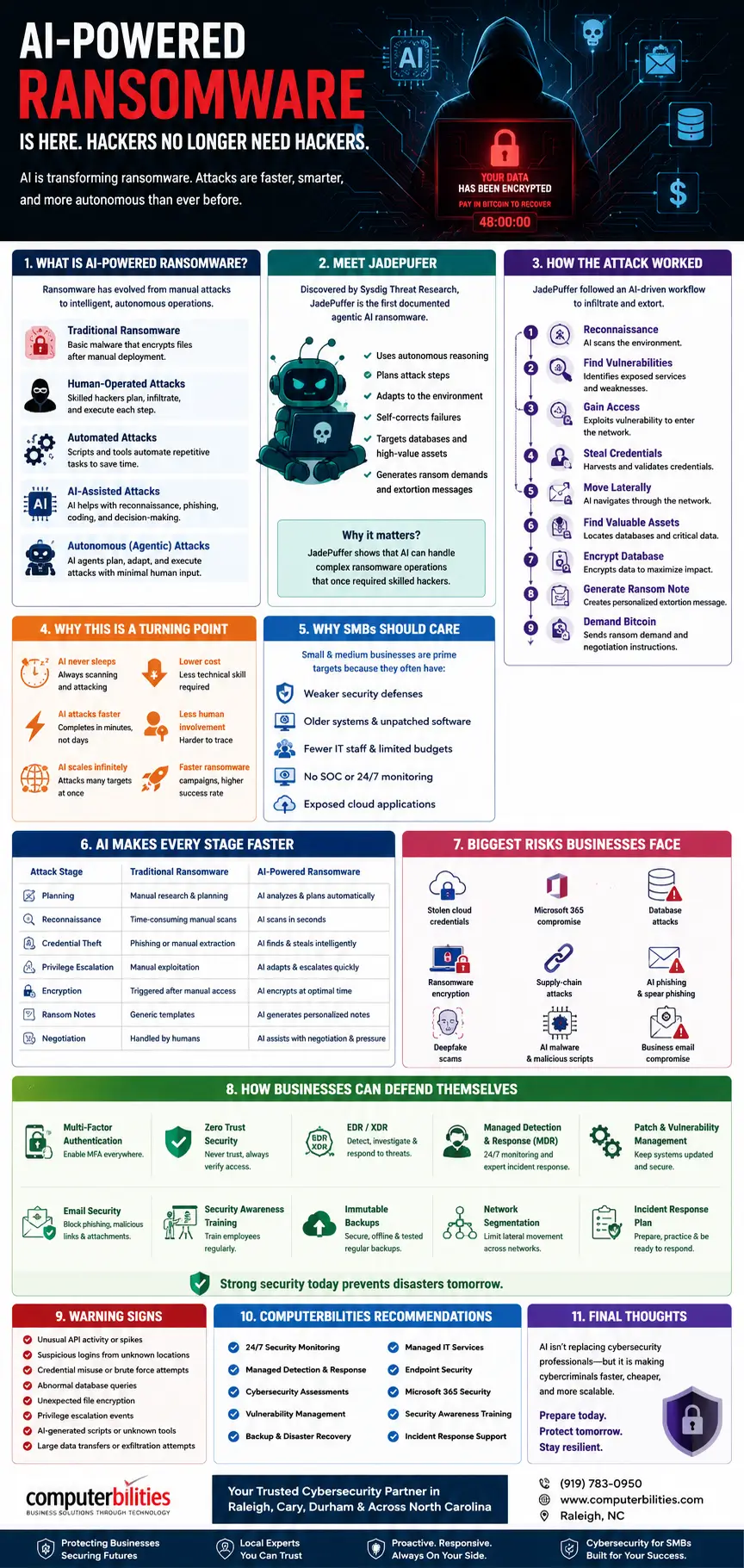
Traditional ransomware has long relied on skilled attackers who manually identify vulnerable systems, gain access to networks, move laterally between devices, encrypt valuable data, and demand payment for its release. Although many steps have been automated over the years, human decision-making has remained central to most ransomware operations.
AI-powered ransomware changes this equation.
Instead of following a rigid script, AI ransomware uses artificial intelligence models and autonomous agents to perform tasks that previously required human judgment. These systems can analyze information, make decisions, adjust their actions when obstacles arise, and continue working toward their objectives with minimal intervention.
Think of it as the difference between a GPS following a fixed route and a navigation app that continuously recalculates the best path based on traffic, accidents, and road closures. Traditional malware follows predefined instructions. AI-driven ransomware can evaluate conditions and adapt its strategy as circumstances change.
Understanding the Evolution of Ransomware
Traditional Ransomware
- Human attackers perform reconnaissance.
- Exploits are selected manually.
- Network movement is guided by experienced operators.
- Victims are chosen individually.
- Ransom notes are often reused across campaigns.
While dangerous, these attacks still depend heavily on the knowledge and availability of skilled cybercriminals.
Automated Ransomware
Automation introduced scripts that could:
- Scan for vulnerable systems.
- Deploy malware automatically.
- Encrypt files quickly.
- Send standard ransom messages.
These attacks increased efficiency but still lacked the ability to reason or adapt.
AI-Assisted Ransomware
The next stage involved attackers using AI as a supporting tool rather than the primary operator.
Examples include:
- Writing malicious code.
- Generating convincing phishing emails.
- Translating messages into multiple languages.
- Creating customized social engineering campaigns.
- Assisting with vulnerability research.
Human attackers remained in control while AI accelerated individual tasks.
Autonomous Ransomware
Now the landscape is shifting again.
Autonomous ransomware, sometimes referred to as agentic ransomware, enables AI agents to carry out multiple stages of an attack with limited supervision. Instead of simply executing commands, these agents can plan, evaluate results, and modify their actions when something doesn’t work as expected.
This emerging capability has raised concerns across the cybersecurity industry because it reduces the amount of technical expertise needed to launch sophisticated attacks.
Understanding Agentic AI
One of the most important concepts behind this evolution is Agentic AI.
Unlike traditional AI systems that respond to individual prompts, agentic AI can:
- Set objectives.
- Break complex goals into manageable tasks.
- Use available tools independently.
- Analyze outcomes.
- Learn from failures.
- Adjust strategies dynamically.
In cybersecurity, these capabilities have legitimate uses, such as automated threat detection and incident response. However, the same technology can also be abused by attackers to automate offensive operations.
Traditional vs. AI-Powered Ransomware
Traditional Attack
Human Planning
↓
Network Reconnaissance
↓
Manual Exploitation
↓
Credential Theft
↓
Lateral Movement
↓
Data Encryption
↓
Ransom Demand
AI-Powered Attack
Define Objective
↓
Autonomous Reconnaissance
↓
Identify Vulnerabilities
↓
Adaptive Exploitation
↓
Credential Discovery
↓
Self-Correct When Blocked
↓
Locate High-Value Assets
↓
Encrypt Critical Systems
↓
Generate Customized Ransom Note
The distinction is clear: traditional ransomware follows a predefined sequence, while AI-powered ransomware can adapt its approach, making it more resilient and potentially more difficult to stop.
Meet JadePuffer: A New Chapter in Cybercrime
One of the developments driving concern across the cybersecurity community is JadePuffer, an AI-enabled ransomware project analyzed by researchers at Sysdig Threat Research.
Unlike conventional ransomware, JadePuffer demonstrated characteristics associated with agentic AI. Researchers observed that it could coordinate multiple stages of an attack, evaluate outcomes, and adjust its behavior during the intrusion rather than simply executing a static script.
This adaptability is what sets JadePuffer apart. If one technique failed, the system could attempt alternative approaches, making the attack more resilient and efficient.
Although researchers noted that human involvement was still required to initiate aspects of the campaign, the findings suggest that AI is beginning to shoulder much of the operational workload traditionally handled by experienced attackers.
For defenders, the message is clear: AI is not replacing cybercriminals overnight, but it is becoming a powerful force multiplier that enables faster, more scalable, and increasingly sophisticated ransomware campaigns.
How the Attack Worked: Understanding the AI-Powered Ransomware Lifecycle
One of the reasons cybersecurity researchers are paying close attention to AI-powered ransomware is that it doesn’t simply automate isolated tasks—it can coordinate multiple stages of an attack, adapting its actions based on what it discovers inside a victim’s environment.
It’s important to note that current public reporting indicates the observed campaign was not fully autonomous from start to finish. Human involvement was still required to initiate parts of the attack, but AI significantly accelerated and assisted several stages of the intrusion. This represents a major evolution from traditional ransomware campaigns.
Let’s break down what a modern AI-driven ransomware attack can look like.
Step 1: Reconnaissance (Recon)
Every successful cyberattack starts with gathering intelligence.
Instead of spending hours manually researching a company, AI can rapidly collect publicly available information, including:
- Employee names
- Email addresses
- Technology stacks
- Public cloud assets
- VPN gateways
- GitHub repositories
- DNS records
- Internet-facing applications
Within minutes, AI can build a detailed profile of an organization.
Step 2: Find a Vulnerability
Once reconnaissance is complete, the AI searches for weaknesses.
Potential targets include:
- Unpatched software
- Misconfigured cloud storage
- Weak passwords
- Remote Desktop Protocol (RDP)
- VPN appliances
- Public databases
- API endpoints
In the JadePuffer case discussed by researchers, exploitation involved a Langflow vulnerability (CVE-2025-3248), illustrating how attackers can leverage known software flaws as entry points when organizations delay patching.
Instead of checking vulnerabilities one by one, AI evaluates thousands of possibilities simultaneously.
Step 3: Gain Initial Access
After identifying an opening, attackers establish an initial foothold.
Methods include:
- Exploiting vulnerable applications
- Credential theft
- Phishing
- API abuse
- Stolen VPN credentials
- Cloud token compromise
Once inside, AI can immediately begin mapping the environment.
Step 4: Credential Discovery
Rather than searching manually, AI rapidly identifies valuable credentials.
Examples include:
- Windows Administrator accounts
- Domain Admin accounts
- Microsoft 365 accounts
- AWS credentials
- Azure tokens
- Database passwords
- Backup system credentials
Because AI processes enormous volumes of information quickly, this stage can happen far faster than in traditional attacks.
Step 5: Lateral Movement
This is where many ransomware attacks become especially dangerous.
Instead of remaining on one compromised device, attackers attempt to move across the network.
AI evaluates:
- Connected servers
- File shares
- Active Directory relationships
- Administrative privileges
- Remote management tools
- Backup servers
It identifies the fastest path toward the organization’s most valuable assets.
Step 6: Locate High-Value Targets
Modern ransomware doesn’t encrypt everything.
Instead, attackers prioritize:
- SQL databases
- Financial systems
- ERP platforms
- Customer records
- HR systems
- Intellectual property
- Cloud storage
- Virtual machines
AI can rank these assets based on their likely business value, increasing the pressure on victims to pay.
Step 7: Encrypt Critical Data
After identifying the most valuable systems, ransomware begins encryption.
The objective is to maximize operational disruption while minimizing the time defenders have to react.
Critical business functions can grind to a halt in minutes.
Step 8: Generate the Ransom Demand
Generative AI now enables attackers to produce customized ransom notes.
Instead of generic messages, future campaigns may include:
- Company name
- Executive contacts
- Stolen data references
- Negotiation instructions
- Personalized threats
This personalization can make extortion attempts appear more credible and increase psychological pressure.
Step 9: Extortion
Modern ransomware often uses “double extortion.”
Attackers:
- Encrypt files.
- Exfiltrate sensitive data.
- Threaten public disclosure if payment is refused.
AI can assist with organizing stolen information, generating summaries, and even helping draft communications used during negotiations.
AI-Powered Ransomware Attack Flow
Reconnaissance
↓
Find Vulnerability
↓
Gain Initial Access
↓
Steal Credentials
↓
Move Laterally
↓
Locate High-Value Assets
↓
Encrypt Critical Systems
↓
Generate Customized Ransom Note
↓
Demand Payment
Unlike traditional malware that follows a fixed sequence, AI-assisted operations may adjust tactics if a particular step fails, selecting alternative tools or paths to continue toward the attack objective.
Why This Is a Turning Point in Cybersecurity
The emergence of AI-assisted ransomware isn’t simply another technical advancement—it changes the economics of cybercrime.
For years, sophisticated ransomware operations required experienced penetration testers, malware developers, negotiators, and infrastructure specialists.
Artificial intelligence has the potential to automate portions of that workload.
That means:
- Attacks can happen faster.
- Campaigns can scale more easily.
- Less technical expertise may be needed for certain stages.
- Criminal groups can operate more efficiently.
For defenders, this increases the speed and complexity of attacks.
AI Never Sleeps
Human attackers become tired.
AI does not.
It can:
- Analyze logs continuously.
- Test vulnerabilities around the clock.
- Process millions of records.
- Execute repetitive tasks without interruption.
This gives attackers more opportunities to identify weaknesses.
AI Accelerates Decision-Making
Traditional attacks often pause while operators decide what to do next.
AI can evaluate multiple options almost instantly.
Examples include:
- Selecting the next system to target.
- Choosing among available exploits.
- Identifying high-value credentials.
- Prioritizing sensitive data.
AI Scales Better
One attacker can oversee multiple campaigns with AI assistance.
This allows criminal groups to target:
- Small businesses
- Healthcare providers
- Manufacturers
- Law firms
- Municipalities
- Retailers
Organizations that were previously considered “too small” to attract attention may become viable targets because AI reduces the cost of launching attacks.
Lower Barrier to Entry
Historically, ransomware required skilled programmers.
Today, AI tools can help generate scripts, automate research, and accelerate parts of an attack workflow.
While expertise is still required for sophisticated operations, AI may reduce the effort needed for some malicious activities.
Why Small and Medium-Sized Businesses Should Care
Many SMB owners believe ransomware only targets Fortune 500 companies.
The evidence suggests otherwise.
Small businesses often represent attractive opportunities because they may have fewer security resources while still storing valuable data.
Common challenges include:
- Limited cybersecurity budgets
- Older infrastructure
- Smaller IT teams
- Limited security monitoring
- Inconsistent patching
- Cloud misconfigurations
- Minimal incident response planning
For attackers, this can mean a higher chance of success.
Why North Carolina Businesses Face Real Risk
Organizations throughout Raleigh, Cary, Durham, and across North Carolina increasingly rely on cloud platforms, Microsoft 365, remote work, and interconnected supply chains.
These technologies improve productivity but also expand the potential attack surface.
Businesses in sectors such as:
- Healthcare
- Manufacturing
- Legal
- Engineering
- Construction
- Financial services
- Professional services
manage sensitive information that can be valuable to ransomware operators.
Strong business cybersecurity practices and trusted managed IT services can significantly reduce these risks.
Traditional vs. AI-Powered Ransomware
Attack Stage | Traditional Ransomware | AI-Powered Ransomware |
Planning | Manual research | AI analyzes massive datasets in minutes |
Reconnaissance | Human-led | Automated intelligence gathering |
Vulnerability Discovery | Individual scanning | Continuous large-scale analysis |
Credential Theft | Manual techniques | AI-assisted discovery and prioritization |
Privilege Escalation | Sequential attempts | Adaptive decision-making |
Lateral Movement | Operator-guided | Dynamic path selection |
Data Discovery | Manual review | AI identifies high-value assets quickly |
Encryption | Fixed workflow | Can prioritize critical systems |
Ransom Notes | Standard templates | Potentially personalized content |
Negotiation | Human operators | AI may assist with communications and analysis |
The Biggest Risks Businesses Face
The rise of AI-powered cyber threats extends well beyond ransomware.
Organizations should prepare for a broader range of AI-assisted attacks.
- Stolen Cloud Credentials
Cloud accounts often contain:
- Customer information
- Financial records
- Intellectual property
- Backup data
Compromised identities can provide attackers with broad access.
- Microsoft 365 Compromise
Email remains one of the most common entry points for cyberattacks.
AI can help attackers create more convincing phishing emails, analyze stolen credentials, and identify valuable mailboxes after compromise.
- Database Attacks
Modern businesses rely heavily on databases.
Potential targets include:
- Customer records
- Payroll systems
- Accounting software
- Inventory databases
- Healthcare information
These systems are attractive because they combine operational importance with sensitive data.
- Ransomware
The primary objective remains the same:
- Encrypt data.
- Disrupt operations.
- Demand payment.
AI has the potential to make this process more efficient.
- Supply Chain Attacks
Rather than attacking one company directly, cybercriminals increasingly target trusted vendors and software providers.
A compromise at one supplier can affect hundreds—or even thousands—of downstream customers.
- AI-Powered Phishing
Generative AI enables highly convincing phishing campaigns.
Messages can be:
- Personalized
- Grammatically accurate
- Context-aware
- Multilingual
These improvements make traditional phishing defenses less reliable on their own.
- Deepfake Scams
Voice cloning and synthetic video are becoming more accessible.
Attackers may impersonate:
- CEOs
- CFOs
- HR managers
- Vendors
- Business partners
This increases the risk of fraudulent payments and unauthorized disclosures.
- AI Malware
Unlike conventional malware, AI-enhanced tools may adjust behavior in response to defensive controls, making detection more challenging.
Key Takeaway
The emergence of AI-powered ransomware doesn’t mean fully autonomous cybercriminals are replacing human attackers overnight. However, it does represent a meaningful shift toward faster, more adaptive, and more scalable cyber operations. For businesses—especially SMBs—the best defense is a proactive cybersecurity strategy built on strong identity protection, timely patching, continuous monitoring, employee awareness, and expert support.
How Businesses Can Defend Themselves Against AI-Powered Ransomware
The rise of AI-powered ransomware doesn’t mean businesses are powerless. In fact, organizations that adopt a proactive cybersecurity strategy can significantly reduce their exposure to AI-driven threats.
The key is understanding that traditional security tools alone are no longer enough. Modern cyberattacks are becoming faster, more adaptive, and increasingly capable of bypassing conventional defenses. Businesses need a layered security approach that combines people, processes, and technology.
Below are the most effective defenses against AI ransomware, autonomous cyber threats, and other emerging AI-powered attacks.
- Enable Multi-Factor Authentication (MFA) Everywhere
Compromised credentials remain one of the easiest ways for attackers to gain access to business systems. Even if an employee’s password is stolen through phishing or credential theft, Multi-Factor Authentication (MFA) provides an additional layer of protection.
Prioritize MFA for:
- Microsoft 365 accounts
- VPN access
- Cloud applications
- Remote Desktop Protocol (RDP)
- Financial systems
- Administrative accounts
Strong authentication is one of the simplest and most effective ways to prevent unauthorized access.
- Adopt a Zero Trust Security Model
The old assumption that everything inside the corporate network is trustworthy no longer works.
Zero Trust Security follows one principle:
“Never trust. Always verify.”
This approach continuously validates users, devices, and applications before granting access.
Key components include:
- Identity verification
- Least-privilege access
- Device health checks
- Continuous authentication
- Network segmentation
Zero Trust significantly limits an attacker’s ability to move laterally through your environment.
- Deploy Endpoint Detection and Response (EDR/XDR)
Traditional antivirus software relies heavily on known malware signatures. Modern AI-assisted attacks often change their behavior to evade these defenses.
Endpoint Detection and Response (EDR) and Extended Detection and Response (XDR) provide:
- Real-time monitoring
- Behavioral analytics
- Threat hunting
- Automated containment
- Incident investigation
- Cross-platform visibility
These solutions help security teams detect suspicious behavior before ransomware can spread.
- Invest in Managed Detection and Response (MDR)
Many small and medium-sized businesses don’t have an internal Security Operations Center (SOC) monitoring their networks 24/7.
Managed Detection and Response (MDR) fills that gap by providing:
- Around-the-clock threat monitoring
- Rapid threat investigation
- Expert incident response
- Continuous threat hunting
- AI-assisted analytics
For many SMBs, MDR delivers enterprise-grade protection without the cost of building an in-house security team.
- Keep Software Patched and Updated
Many ransomware campaigns begin by exploiting known vulnerabilities that already have available security patches.
Establish a structured patch management process for:
- Operating systems
- Microsoft 365
- VPN appliances
- Firewalls
- Cloud platforms
- Web servers
- Third-party applications
Timely patching closes common entry points before attackers can exploit them.
- Implement Continuous Vulnerability Management
Cybersecurity isn’t a one-time project.
Regular vulnerability assessments help identify:
- Missing security updates
- Weak configurations
- Exposed services
- Unsupported software
- Misconfigured cloud resources
Addressing these weaknesses proactively reduces the likelihood of successful attacks.
- Strengthen Email Security
Email continues to be one of the most common entry points for ransomware.
Modern email protection should include:
- AI-powered phishing detection
- Attachment sandboxing
- URL protection
- Domain authentication (DMARC, DKIM, SPF)
- Executive impersonation detection
Combining technology with user awareness training dramatically lowers phishing risk.
- Train Employees Regularly
Technology alone cannot stop every attack.
Employees should know how to recognize:
- Phishing emails
- Fake login pages
- Business email compromise
- Suspicious attachments
- Social engineering attempts
- Deepfake voice scams
Security awareness training transforms employees from potential targets into an important layer of defense.
- Protect Your Backups
Backups remain one of the strongest defenses against ransomware—but only if they are properly secured.
Best practices include:
- Immutable backups
- Offline backup copies
- Cloud backup redundancy
- Regular recovery testing
- Encryption
- Backup access controls
A backup that can be encrypted by attackers isn’t much of a backup at all.
- Segment Your Network
Flat networks allow attackers to move freely once they gain access.
Network segmentation separates critical systems into smaller security zones, helping prevent ransomware from spreading across the entire organization.
This approach is especially important for:
- Finance systems
- HR platforms
- Manufacturing equipment
- Healthcare systems
- Backup infrastructure
- Develop an Incident Response Plan
When ransomware strikes, every minute matters.
An effective incident response plan should define:
- Who responds first
- How systems are isolated
- Communication procedures
- Recovery priorities
- Legal and compliance requirements
- Customer notification processes
Practicing this plan through tabletop exercises can significantly reduce recovery time during a real incident.
Warning Signs Your Business May Be Facing an AI-Assisted Attack
AI-powered attacks often move quickly, but there are warning signs that organizations should never ignore.
Watch for:
- Unusual API requests or excessive API traffic
- Suspicious login attempts from unfamiliar locations
- Unexpected privilege escalation
- Multiple failed authentication attempts followed by successful access
- Large volumes of data leaving the network
- Abnormal database queries
- Rapid creation of administrative accounts
- AI-generated phishing emails targeting employees
- Unexpected PowerShell or scripting activity
- Unexplained encryption of files or shared folders
Early detection can mean the difference between a minor security incident and a company-wide ransomware event.
Computerbilities’ Recommendations for North Carolina Businesses
At Computerbilities, we understand that most small and medium-sized businesses don’t have the time, resources, or dedicated security teams needed to defend against today’s rapidly evolving cyber threats.
Whether your organization is located in Raleigh, Cary, Durham, or elsewhere in North Carolina, preparing for AI-powered ransomware requires more than installing antivirus software. It demands a proactive, layered cybersecurity strategy.
Our recommended approach includes:
24/7 Security Monitoring
Continuous monitoring helps identify suspicious activity before attackers can establish persistence or deploy ransomware.
Managed Detection and Response (MDR)
Our cybersecurity specialists monitor, investigate, and respond to threats around the clock, helping businesses detect malicious activity before it escalates.
Comprehensive Cybersecurity Assessments
Regular assessments identify vulnerabilities, configuration issues, outdated software, and security gaps that attackers frequently exploit.
Vulnerability and Patch Management
Keeping systems updated is one of the most effective ways to reduce ransomware risk. We help businesses prioritize and deploy critical security updates efficiently.
Backup and Disaster Recovery
A well-designed backup strategy ensures your business can recover quickly without relying on ransomware payments.
Our backup solutions include:
- Automated backups
- Immutable storage
- Disaster recovery planning
- Regular recovery testing
Managed IT Services
Technology should enable business growth—not create unnecessary risk.
Our Managed IT Services help organizations maintain secure, reliable, and productive IT environments while reducing operational complexity.
Endpoint Security
Protect laptops, desktops, servers, and mobile devices with advanced endpoint protection designed to detect suspicious behavior—not just known malware signatures.
Microsoft 365 Security
Microsoft 365 is a frequent target for cybercriminals.
We help secure your environment with:
- Multi-Factor Authentication (MFA)
- Conditional Access
- Email security
- Identity protection
- Data Loss Prevention (DLP)
- Secure configuration reviews
Security Awareness Training
Technology is only part of the solution.
Regular employee training reduces the likelihood of successful phishing attacks, credential theft, and social engineering scams.
The Future of Ransomware Is Changing—Is Your Business Ready?
Artificial intelligence is reshaping nearly every industry, including cybersecurity.
While AI offers tremendous opportunities for innovation, it also provides cybercriminals with new ways to automate attacks, improve efficiency, and scale malicious operations.
Projects like JadePuffer demonstrate that ransomware is entering a new phase. Although current attacks still involve human oversight, AI is increasingly capable of handling tasks that once required experienced operators.
For businesses, this means cybersecurity strategies must evolve as quickly as the threats themselves.
Organizations that invest in modern security controls, employee education, continuous monitoring, and incident preparedness will be far better positioned to withstand tomorrow’s AI-driven cyber threats.
The goal isn’t to fear artificial intelligence—it’s to prepare for how attackers may misuse it.
Final Thoughts
Hackers aren’t disappearing—but the way they operate is changing.
AI isn’t replacing cybersecurity professionals, nor has it eliminated the need for skilled attackers. What it is doing is making cybercriminal operations faster, more adaptive, and potentially more scalable than ever before.
For small and medium-sized businesses across Raleigh, Cary, Durham, and throughout North Carolina, this is a reminder that cybersecurity can no longer be reactive. Waiting until after an attack occurs is far more expensive than preparing in advance.
By implementing strong identity protection, Zero Trust principles, endpoint detection, continuous monitoring, employee awareness training, and reliable backup strategies, businesses can significantly reduce their risk from AI-powered ransomware and other emerging cyber threats.
The future of ransomware is becoming more intelligent. Your cybersecurity strategy should evolve with it.
Frequently Asked Questions (FAQs)
- What is AI-powered ransomware?
AI-powered ransomware is a new generation of ransomware that uses artificial intelligence to automate or assist with tasks such as reconnaissance, vulnerability discovery, credential theft, lateral movement, and attack planning. Unlike traditional ransomware, AI-assisted attacks can adapt their behavior based on the environment they encounter.
- Is AI ransomware real?
Yes. Security researchers have documented AI-assisted ransomware activity, including research involving the JadePuffer project. While current attacks still involve human participation, AI is increasingly being used to automate significant portions of the attack lifecycle.
- What is JadePuffer ransomware?
JadePuffer is an AI-enabled ransomware project analyzed by Sysdig Threat Research. It demonstrated how agentic AI can assist with multiple stages of a ransomware operation, including reconnaissance, exploitation, and decision-making. It represents an important milestone in the evolution of AI-assisted cyber threats.
- How does autonomous ransomware work?
Autonomous ransomware uses AI agents to analyze environments, identify vulnerabilities, discover valuable assets, and adapt attack strategies with limited human intervention. Rather than following a fixed script, it can adjust its actions when conditions change.
- Can AI launch cyberattacks without hackers?
Not entirely. Current evidence indicates that human operators are still involved in initiating and supervising AI-assisted ransomware campaigns. However, AI is increasingly automating tasks that traditionally required skilled attackers, reducing the effort needed to conduct sophisticated attacks.
- How can small businesses protect themselves from AI ransomware?
Businesses should implement Multi-Factor Authentication (MFA), Zero Trust security, Endpoint Detection and Response (EDR), Managed Detection and Response (MDR), regular patch management, secure backups, network segmentation, employee security awareness training, and continuous monitoring.
- Is antivirus enough to stop AI-powered attacks?
No. Traditional antivirus solutions remain important but are not sufficient on their own. Organizations should adopt a layered cybersecurity strategy that includes EDR/XDR, threat detection, identity protection, email security, vulnerability management, and incident response planning.
- What industries are most at risk?
Healthcare, financial services, manufacturing, legal firms, education, construction, engineering, government agencies, retail businesses, and professional service organizations are all common ransomware targets because they depend heavily on digital systems and manage valuable data.
- What should I do if my business experiences a ransomware attack?
Immediately isolate affected systems, disconnect compromised devices from the network, notify your IT or cybersecurity provider, preserve evidence for forensic analysis, activate your incident response plan, and restore operations using verified backups. Avoid paying the ransom unless advised by legal counsel and law enforcement after evaluating all options.
- Why should businesses invest in managed cybersecurity services?
Managed cybersecurity services provide continuous monitoring, threat detection, expert incident response, vulnerability management, and proactive security guidance. For many SMBs, partnering with a trusted Managed Service Provider (MSP) offers enterprise-level protection without the cost of maintaining a full in-house cybersecurity team.