
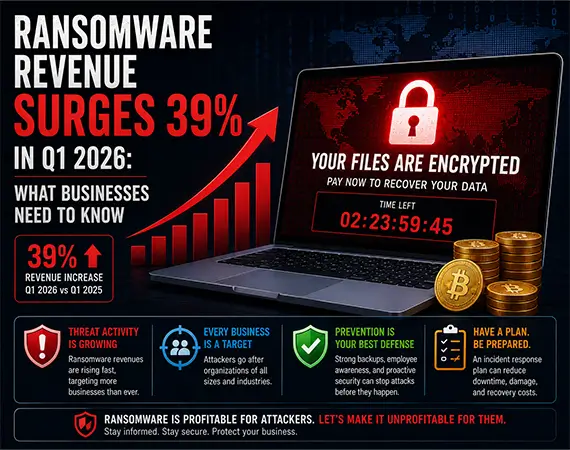
Ransomware Revenue Surges 39% in Q1 2026: What Businesses Need to Know
Cybercriminals are becoming more organized, more sophisticated, and more profitable than ever before. According to recent cybersecurity reports, ransomware groups generated approximately $529.2 million in revenue during the first quarter of 2026, representing a staggering 39% increase compared to the same period in 2025. This dramatic surge underscores a troubling reality: ransomware remains one of the most lucrative forms of cybercrime, and businesses of all sizes continue to be prime targets.
For organizations across North Carolina and beyond, these numbers are more than just statistics—they represent a growing threat capable of disrupting operations, compromising sensitive data, damaging reputations, and costing businesses millions in recovery expenses. As ransomware attacks evolve, understanding the factors driving this growth is essential for building effective cybersecurity strategies.
In this article, we’ll examine why ransomware revenue is rising, the tactics cybercriminals are using, the industries most at risk, and the proactive steps businesses can take to protect themselves in 2026 and beyond.
Ransomware Earnings Reach $529 Million in Q1 2026
The ransomware landscape experienced significant growth during the first quarter of 2026. Threat intelligence reports indicate that ransomware operators generated approximately $529.2 million in illicit revenue, making it one of the most profitable quarters on record.
Several key statistics reveal the scale of the problem:
- Ransomware revenue increased by nearly 40% year-over-year.
- More than 2,100 victims were publicly listed on ransomware leak sites.
- Q1 2026 became the second-highest first quarter ever recorded for ransomware activity.
- The average sophistication of attacks continued to increase.
- Large enterprises, government agencies, healthcare providers, and small businesses all remained active targets.
What makes these findings particularly concerning is that ransomware attacks are no longer limited to large corporations. Small and midsized businesses are increasingly being targeted because attackers recognize that these organizations often lack the cybersecurity resources necessary to defend against sophisticated threats.
As cybercriminal organizations continue to mature, ransomware operations are beginning to resemble legitimate businesses. Many groups now employ structured teams responsible for network infiltration, malware development, victim negotiations, customer support for affiliates, and even public relations efforts within underground cybercrime communities.
The result is a highly efficient criminal ecosystem capable of generating hundreds of millions of dollars in revenue each quarter.
Why Cybercriminals Are Making More Money Than Ever
The 39% increase in ransomware revenue is not occurring by chance. Several major developments within the cybercrime ecosystem have made ransomware more accessible, scalable, and profitable.
The Rise of Initial Access Brokers (IABs)
One of the most significant contributors to ransomware growth is the rise of Initial Access Brokers (IABs).
Traditionally, ransomware operators needed to perform their own network intrusions before deploying ransomware. Today, specialized cybercriminals focus solely on gaining access to corporate networks and selling that access to ransomware groups.
These Initial Access Brokers:
- Identify vulnerable organizations.
- Exploit unpatched systems.
- Harvest stolen credentials.
- Gain administrative access.
- Sell network access on underground marketplaces.
This specialization allows ransomware operators to focus exclusively on monetization rather than spending time conducting reconnaissance and penetration activities.
For businesses, this means that a single exposed vulnerability or compromised credential can quickly become the gateway to a ransomware attack. Because access can be purchased instantly, attackers no longer need advanced technical expertise to launch successful campaigns.
The growing popularity of IABs has lowered the barrier to entry for cybercriminals and significantly accelerated the speed at which ransomware attacks can be executed.
Ransomware-as-a-Service (RaaS) Continues to Expand
Another major factor driving ransomware revenue growth is the continued evolution of Ransomware-as-a-Service (RaaS).
Much like legitimate Software-as-a-Service (SaaS) platforms, RaaS allows affiliates to rent ransomware tools and infrastructure from established ransomware groups.
Under this model:
- Developers create ransomware software.
- Affiliates deploy attacks.
- Profits are shared between operators and affiliates.
- Technical support is often provided.
- Marketing and recruitment efforts attract new affiliates.
This business model has transformed ransomware into a scalable enterprise.
Individuals with limited technical expertise can purchase access to sophisticated ransomware tools and immediately begin targeting organizations. As a result, the number of active ransomware operators continues to increase while the quality and effectiveness of attacks improve.
Many ransomware groups now offer dashboards, reporting tools, negotiation assistance, and customer service-like support systems, further demonstrating how organized these criminal enterprises have become.
Artificial Intelligence Is Empowering Attackers
Artificial intelligence is rapidly becoming a powerful tool for cybercriminals.
While AI offers significant benefits for businesses, it is also being leveraged by threat actors to improve attack efficiency and success rates.
Attackers are using AI to:
- Generate highly convincing phishing emails.
- Automate reconnaissance activities.
- Analyze target organizations.
- Identify vulnerabilities faster.
- Create personalized social engineering campaigns.
- Scale attacks against multiple organizations simultaneously.
AI-powered phishing campaigns are particularly dangerous because they can mimic legitimate communications with remarkable accuracy. Employees who might have previously recognized suspicious emails may now encounter messages that appear authentic and relevant to their roles.
Smaller ransomware groups are also benefiting from AI because it enables them to operate with capabilities previously available only to larger criminal organizations.
The combination of AI, automation, and ransomware-as-a-service is creating an increasingly dangerous threat landscape for businesses worldwide.
The Evolution of Ransomware: From Encryption to Extortion
Modern ransomware attacks have evolved far beyond simple file encryption.
In the early days of ransomware, attackers encrypted data and demanded payment for decryption keys. Today, many groups employ multi-layered extortion tactics designed to maximize pressure on victims.
Double Extortion
Double extortion has become the standard approach for many ransomware groups.
Attackers now:
- Steal sensitive data.
- Encrypt business systems.
- Threaten to publish stolen information if payment is not made.
This approach significantly increases the likelihood that organizations will pay because even if backups allow systems to be restored, sensitive data may still be exposed.
Triple Extortion
Some ransomware groups have adopted even more aggressive tactics known as triple extortion.
In addition to encrypting and stealing data, attackers may:
- Contact customers directly.
- Pressure vendors and business partners.
- Launch distributed denial-of-service (DDoS) attacks.
- Publicly shame organizations through leak sites.
These tactics increase reputational damage and create additional operational disruptions that can extend far beyond the initial ransomware incident.
As ransomware continues to evolve, organizations must prepare for attacks that target not only their technology infrastructure but also their customers, partners, and brand reputation.
Top Ransomware Groups Driving the Surge
While hundreds of ransomware groups operate worldwide, a handful of dominant players are responsible for a significant portion of attacks and illicit revenue. These groups have built sophisticated infrastructures, affiliate networks, and extortion mechanisms that allow them to target organizations at scale.
Qilin: The Dominant Force
Qilin emerged as one of the most profitable ransomware operations during the reporting period, generating an estimated $193 million between July 2025 and March 2026.
The group’s success can be attributed to several factors:
- Aggressive affiliate recruitment programs
- Advanced ransomware capabilities
- Effective double-extortion tactics
- Broad targeting across multiple industries
- Reliable payment collection mechanisms
Qilin’s growth demonstrates how ransomware groups continue to evolve into highly organized criminal enterprises capable of generating revenue comparable to legitimate technology companies.
Gentleman Ransomware’s Rapid Growth
Another notable player is Gentleman Ransomware, which reportedly generated approximately $52 million during the same period.
The group’s rapid expansion reflects the increasing popularity of ransomware affiliate models, where operators provide tools and infrastructure while affiliates execute attacks.
This structure allows ransomware groups to expand globally without maintaining large internal teams, increasing both attack volume and profitability.
The Return of LockBit
Despite facing major disruptions from international law enforcement agencies, LockBit remains a significant threat within the ransomware ecosystem.
Its continued presence highlights an important reality about cybercrime: even when authorities successfully disrupt ransomware operations, new infrastructure, affiliates, and successor groups often emerge.
The resilience of LockBit and similar organizations demonstrates why businesses cannot rely solely on law enforcement efforts for protection. Strong internal cybersecurity defenses remain essential.
Ransomware Groups Are Consolidating
One of the most important trends emerging in 2026 is the consolidation of ransomware activity.
While the number of active ransomware groups remains high, a smaller number of organizations are responsible for a growing percentage of attacks.
Research indicates that the top 10 ransomware groups account for approximately 71% of publicly disclosed victims.
At first glance, this may appear to be positive news. However, consolidation often results in more dangerous threats.
Large ransomware organizations benefit from:
- Greater financial resources
- More experienced operators
- Better infrastructure
- Advanced malware development
- Dedicated research teams
- Sophisticated affiliate networks
As these groups grow, they become more efficient and more capable of targeting larger organizations.
Rather than reducing risk, consolidation often means businesses face fewer but far more dangerous adversaries.
How Attackers Are Breaching Business Networks
Understanding how ransomware attacks begin is essential for developing effective defense strategies.
Vulnerability Exploitation
One of the most significant findings from recent threat reports is that vulnerability exploitation has surpassed social engineering as a primary initial access vector.
Cybercriminals actively scan the internet for:
- Unpatched software
- Misconfigured systems
- Remote access services
- Internet-facing applications
- Legacy infrastructure
Once a vulnerability is discovered, attackers often move quickly to exploit it before organizations have an opportunity to apply security updates.
Unpatched Systems
Many successful ransomware attacks stem from organizations delaying software updates.
Common causes include:
- Resource limitations
- Operational concerns
- Lack of visibility into assets
- Poor patch management processes
Unfortunately, cybercriminals frequently target known vulnerabilities with publicly available exploits, making delayed patching a significant risk.
Exposed Internet-Facing Services
Remote Desktop Protocol (RDP), VPN gateways, cloud services, and other internet-accessible systems remain attractive targets.
Weak configurations, outdated software, and poor authentication practices can provide attackers with direct access to business networks.
Phishing Attacks
Although vulnerability exploitation has increased, phishing remains one of the most common attack methods.
Modern phishing campaigns leverage:
- AI-generated content
- Personalized messaging
- Spoofed domains
- Business email compromise tactics
These attacks are designed to trick employees into revealing credentials or downloading malicious files.
Stolen Credentials
Credentials obtained through phishing, credential stuffing, malware infections, and data breaches continue to fuel ransomware attacks.
Once attackers obtain valid usernames and passwords, they can often bypass perimeter security controls and move laterally throughout a network.
Third-Party and Supply Chain Compromises
Businesses are increasingly interconnected through vendors, software providers, cloud services, and managed service providers.
As a result, attackers frequently target trusted third parties to gain access to multiple organizations simultaneously.
Supply chain attacks can have devastating consequences because a single compromise may affect hundreds or thousands of businesses.
Why Small and Mid-Sized Businesses Are Prime Targets
Many business owners assume cybercriminals only target large enterprises. Unfortunately, the opposite is often true.
Small and midsized businesses (SMBs) have become attractive targets because they frequently possess valuable data while lacking enterprise-level security resources.
Attackers view SMBs as ideal victims because:
- Security budgets are often limited.
- Internal IT teams may be understaffed.
- Security monitoring capabilities are restricted.
- Vulnerability management processes may be inconsistent.
- Employee cybersecurity training is often minimal.
Cybercriminals understand that even a relatively modest ransom payment can be profitable when attacks are automated and scaled across thousands of organizations.
For many SMBs, a ransomware incident can threaten business continuity, making them more likely to pay ransom demands in an effort to resume operations quickly.
Industries Most Vulnerable to Ransomware Attacks
Although every organization faces ransomware risk, certain industries remain particularly attractive to attackers.
Healthcare
Healthcare organizations continue to be major targets due to:
- Sensitive patient data
- Critical operational requirements
- Limited tolerance for downtime
- Regulatory pressures
Hospitals and healthcare providers often face difficult decisions when ransomware attacks threaten patient care and operational continuity.
Manufacturing
Manufacturers are increasingly targeted because disruptions can halt production lines and create significant financial losses.
Attackers recognize that downtime directly impacts revenue, increasing pressure on organizations to pay quickly.
Financial Services
Financial institutions manage valuable customer information and critical financial systems, making them attractive targets for extortion and data theft.
Professional Services
Law firms, consulting organizations, and accounting firms frequently store confidential client information that can be leveraged during extortion attempts.
Government Agencies
Local governments, municipalities, and public sector organizations often face budget constraints that limit cybersecurity investments while managing highly sensitive data.
Education
Educational institutions remain vulnerable due to large user populations, complex networks, and limited cybersecurity resources.
Universities and school systems continue to experience ransomware attacks that disrupt operations and expose sensitive information.
Critical Infrastructure
Utilities, transportation providers, and industrial organizations are increasingly targeted because disruptions can have widespread societal and economic consequences.
As ransomware groups become more sophisticated, attacks against critical infrastructure are expected to remain a significant concern throughout 2026 and beyond.
The Role of Cyber Insurance in the Ransomware Economy
As ransomware attacks continue to increase in frequency and severity, cyber insurance has become a critical component of many organizations’ risk management strategies. However, the relationship between ransomware and cyber insurance has become increasingly complex.
Several years ago, many organizations viewed cyber insurance as a safety net that would help cover ransom payments and recovery costs. Today, insurers are taking a much more proactive approach to cybersecurity requirements.
Many cyber insurance providers now require organizations to implement:
- Multi-factor authentication (MFA)
- Endpoint Detection and Response (EDR)
- Regular vulnerability assessments
- Security awareness training
- Data backup validation
- Incident response planning
Organizations that fail to meet these requirements often face higher premiums or reduced coverage options.
Cyber insurers have recognized that preventing attacks is far less costly than covering ransomware-related losses. As a result, businesses that invest in strong cybersecurity controls often benefit from both improved protection and more favorable insurance terms.
The Real Cost of a Ransomware Incident
When discussing ransomware, many organizations focus exclusively on the ransom payment itself. However, the actual financial impact of an attack often extends far beyond the initial demand.
Operational Downtime
For many businesses, downtime is the most immediate and costly consequence.
A ransomware attack can disrupt:
- Customer service operations
- Manufacturing processes
- Financial transactions
- Employee productivity
- Supply chain activities
Even a few days of downtime can result in significant revenue losses.
Recovery Costs
Restoring systems after a ransomware attack requires substantial resources.
Organizations often incur expenses related to:
- Incident response teams
- Digital forensics investigations
- System restoration
- Hardware replacement
- Legal services
- Public relations support
In many cases, recovery costs exceed the ransom demand itself.
Regulatory Penalties
Organizations that experience data breaches may face regulatory consequences, particularly if sensitive customer information is exposed.
Industries subject to compliance requirements may encounter:
- Fines
- Reporting obligations
- Legal liabilities
- Increased audit scrutiny
Reputational Damage
Customer trust can take years to build and only moments to lose.
A ransomware incident may lead to:
- Negative publicity
- Customer attrition
- Brand damage
- Lost business opportunities
For many organizations, reputational harm becomes one of the longest-lasting effects of an attack.
Customer Trust Erosion
Customers expect businesses to protect their information. When sensitive data is compromised, confidence in the organization may decline significantly.
Rebuilding trust often requires substantial investments in communication, transparency, and security improvements.
Future Ransomware Trends to Watch in 2026
The ransomware landscape continues to evolve rapidly. Businesses should prepare for several emerging trends that are likely to shape the threat environment throughout the remainder of 2026.
AI-Powered Attack Automation
Artificial intelligence will continue to improve attackers’ capabilities.
Expect to see:
- More convincing phishing campaigns
- Faster vulnerability discovery
- Automated reconnaissance
- Improved malware customization
- Increased attack scalability
Organizations must recognize that AI is changing both cybersecurity defense and cybercrime.
Growth of Supply Chain Attacks
Cybercriminals increasingly target trusted vendors and service providers because compromising one organization can provide access to many others.
Businesses should strengthen third-party risk management processes and regularly evaluate vendor security practices.
Increased Critical Infrastructure Targeting
Healthcare systems, utilities, transportation providers, and government agencies will remain attractive targets due to their operational importance.
Threat actors understand that organizations delivering essential services often face greater pressure to restore operations quickly.
Faster Exploitation of Vulnerabilities
The window between vulnerability disclosure and active exploitation continues to shrink.
Businesses must prioritize:
- Continuous vulnerability monitoring
- Rapid patch deployment
- Attack surface management
- Security testing
Organizations that delay remediation significantly increase their risk exposure.
Essential Steps to Protect Your Business in 2026
While ransomware threats continue to evolve, organizations can significantly reduce their risk by implementing proven cybersecurity best practices.
Deploy Multi-Factor Authentication (MFA)
MFA remains one of the most effective defenses against credential-based attacks.
By requiring multiple forms of verification, organizations can prevent attackers from gaining access even if passwords are compromised.
Invest in Security Awareness Training
Employees remain a critical line of defense.
Regular training helps staff recognize:
- Phishing attempts
- Social engineering attacks
- Suspicious links
- Malicious attachments
Security-conscious employees can stop many attacks before they begin.
Strengthen Vulnerability Management
Organizations should maintain visibility into all systems and promptly address identified vulnerabilities.
Regular vulnerability scanning and remediation programs can significantly reduce attack opportunities.
Implement Robust Patch Management
Timely software updates help eliminate known security weaknesses before attackers can exploit them.
Patch management should include:
- Operating systems
- Applications
- Network devices
- Cloud platforms
- Third-party software
Maintain Immutable Backups
Backups remain one of the most important ransomware recovery tools.
Organizations should maintain:
- Offline backups
- Immutable backups
- Regular backup testing
- Disaster recovery procedures
Reliable backups can dramatically reduce recovery time and eliminate the need to pay ransom demands.
Deploy Endpoint Detection and Response (EDR)
EDR solutions provide continuous visibility into endpoint activity and help identify suspicious behavior before ransomware can spread throughout the network.
Utilize 24/7 Security Monitoring
Cyberattacks do not occur only during business hours.
Continuous monitoring enables organizations to detect and respond to threats before significant damage occurs.
Adopt a Zero Trust Security Model
Zero Trust assumes that no user, device, or connection should be trusted by default.
This approach helps limit lateral movement and reduces the impact of successful compromises.
Develop an Incident Response Plan
Preparation is critical.
Organizations should establish:
- Defined response procedures
- Communication plans
- Recovery processes
- Escalation paths
- Testing exercises
A well-prepared organization can respond faster and minimize business disruption.
What This Means for North Carolina Businesses
The ransomware threat is not limited to large enterprises or global organizations. Businesses throughout North Carolina face growing cybersecurity risks as attackers increasingly automate their operations and target organizations of all sizes.
Small and midsized businesses are particularly vulnerable because they often lack dedicated cybersecurity personnel and advanced security technologies.
Organizations across Raleigh, Cary, Durham, Chapel Hill, Apex, Holly Springs, Wake Forest, and throughout North Carolina should evaluate whether their current security posture can withstand today’s ransomware threats.
Key questions every business should ask include:
- Are our systems fully patched?
- Do we have multi-factor authentication enabled?
- Are backups tested regularly?
- Can we detect ransomware activity before it spreads?
- Do employees receive cybersecurity awareness training?
- Do we have a documented incident response plan?
If the answer to any of these questions is no, your organization may face increased risk.
Frequently Asked Questions (FAQs)
- Why did ransomware revenue surge by 39% in Q1 2026?
Ransomware revenue surged by 39% in Q1 2026 due to the growing use of Ransomware-as-a-Service (RaaS), the rise of Initial Access Brokers (IABs), and the increasing adoption of artificial intelligence by cybercriminals. These developments have made ransomware attacks more scalable, efficient, and profitable, enabling attackers to target more organizations than ever before.
- How much revenue did ransomware groups generate in Q1 2026?
According to recent cybersecurity reports, ransomware groups generated approximately $529.2 million in revenue during the first quarter of 2026. This makes Q1 2026 one of the most profitable quarters on record for cybercriminal organizations.
- What is Ransomware-as-a-Service (RaaS)?
Ransomware-as-a-Service (RaaS) is a cybercrime business model where ransomware developers provide malware, infrastructure, and support to affiliates who conduct attacks. In return, affiliates share a percentage of the ransom payments with the ransomware operators. This model allows even inexperienced attackers to launch sophisticated ransomware campaigns.
- What are Initial Access Brokers (IABs)?
Initial Access Brokers (IABs) are cybercriminals who specialize in gaining unauthorized access to business networks. They then sell that access to ransomware groups and other threat actors. By purchasing access from IABs, ransomware operators can launch attacks more quickly and efficiently.
- Which industries are most vulnerable to ransomware attacks?
Industries commonly targeted by ransomware groups include:
- Healthcare
- Manufacturing
- Financial Services
- Professional Services
- Government Agencies
- Education
- Critical Infrastructure
These sectors often handle sensitive data or provide essential services, making them attractive targets for cybercriminals.
- How are ransomware attackers gaining access to business networks?
Attackers commonly gain access through:
- Unpatched software vulnerabilities
- Phishing emails
- Stolen credentials
- Remote Desktop Protocol (RDP) exploits
- Exposed internet-facing systems
- Supply chain and third-party compromises
Implementing strong cybersecurity controls can significantly reduce these risks.
- What is double extortion ransomware?
Double extortion ransomware involves two stages of attack. First, cybercriminals steal sensitive data from an organization. Then they encrypt systems and demand payment not only for decryption but also to prevent the stolen data from being publicly released.
- Are small businesses at risk of ransomware attacks?
Yes. Small and midsized businesses (SMBs) are increasingly targeted because they often have fewer cybersecurity resources than larger organizations. Cybercriminals view SMBs as attractive targets because they may lack advanced security measures while still possessing valuable data and financial resources.
- What is the average cost of a ransomware attack for businesses?
The cost of a ransomware attack extends far beyond the ransom payment. Organizations may face expenses related to operational downtime, incident response, legal fees, regulatory fines, system restoration, lost productivity, and reputational damage. In many cases, recovery costs exceed the actual ransom demand.
- Should businesses pay ransomware demands?
Most cybersecurity experts and law enforcement agencies advise against paying ransom demands. Payment does not guarantee data recovery and may encourage further criminal activity. Instead, organizations should focus on prevention, incident response planning, and maintaining secure backups.
- What are the best ways to protect a business from ransomware?
Organizations can reduce ransomware risk by implementing:
- Multi-Factor Authentication (MFA)
- Endpoint Detection and Response (EDR)
- Regular vulnerability assessments
- Timely patch management
- Security awareness training
- Immutable backups
- 24/7 network monitoring
- Zero Trust security frameworks
- Incident response planning
A layered cybersecurity strategy provides the strongest protection.
- How can managed IT services help prevent ransomware attacks?
Managed IT service providers help businesses strengthen their cybersecurity posture through proactive monitoring, vulnerability management, patch deployment, endpoint protection, backup management, employee security training, and incident response support. Partnering with a trusted cybersecurity provider can help organizations detect threats early and reduce their exposure to ransomware attacks.