

Critical Palo Alto VPN Vulnerability Being Actively Exploited: What North Carolina Businesses Need to Know
Introduction
Cybercriminals are constantly searching for the easiest path into a business network. Sometimes that path is a phishing email. Sometimes it is an employee using a weak password. And increasingly, it is a vulnerability in the very systems organizations rely on to secure remote access.
That is exactly why cybersecurity experts worldwide are paying close attention to CVE-2026-0257, a newly disclosed Palo Alto VPN vulnerability affecting the GlobalProtect platform. Security researchers have confirmed active exploitation in the wild, government agencies have issued urgent warnings, and organizations are being urged to patch affected systems immediately.
For small and medium-sized businesses across Raleigh, Durham, Cary, and throughout North Carolina, this isn’t just another technical security advisory. It represents a real-world threat that could potentially lead to unauthorized access, data theft, operational disruption, and even ransomware attacks.
In this article, we’ll break down what happened, why it matters, who is affected, and what steps businesses should take immediately to protect themselves.
What Happened?
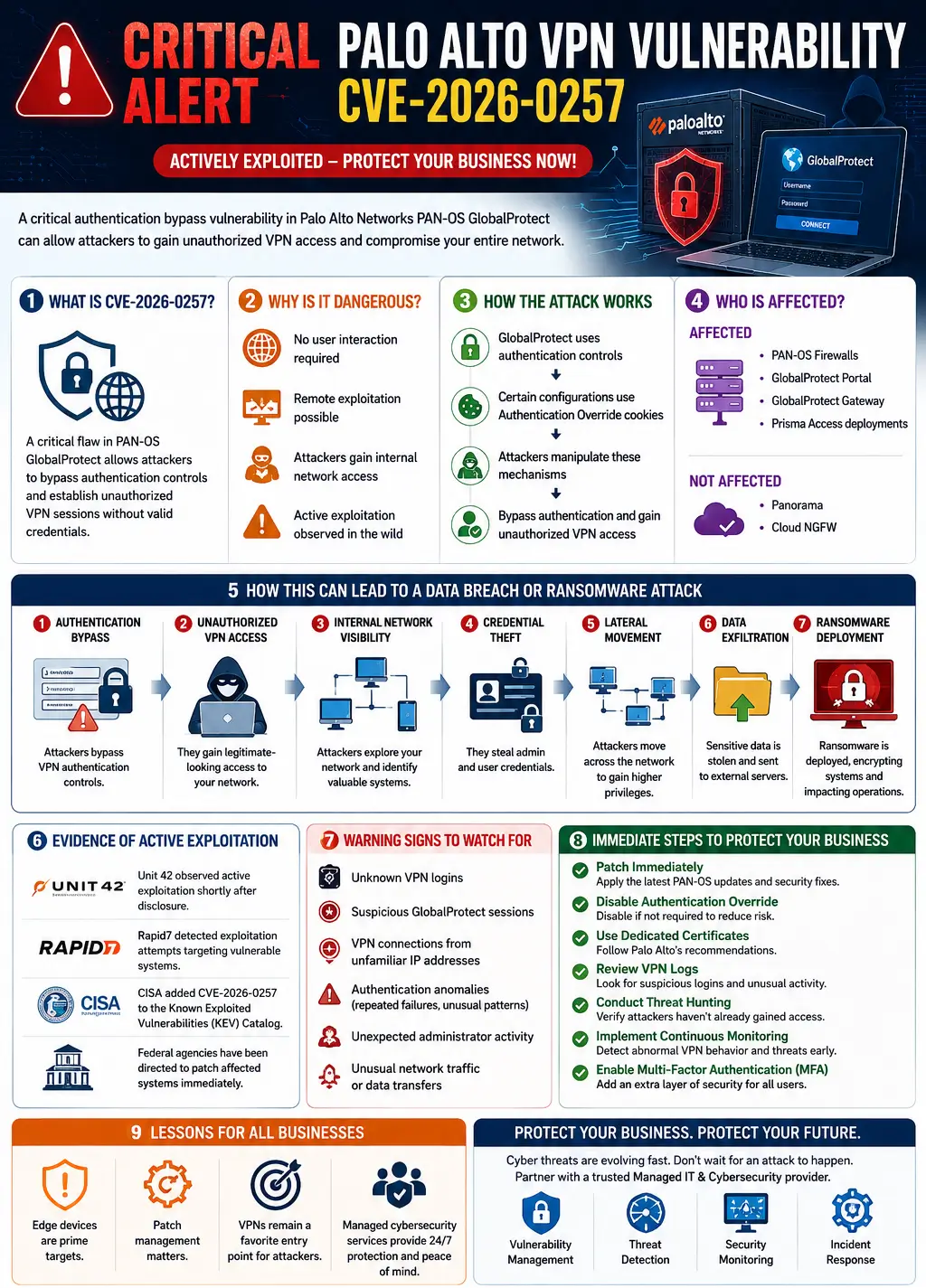
Palo Alto Networks recently disclosed CVE-2026-0257, a critical PAN-OS vulnerability affecting GlobalProtect VPN implementations.
The issue centers around authentication mechanisms used by GlobalProtect. Under specific conditions, attackers can exploit the vulnerability to bypass authentication controls and gain access to VPN resources without possessing valid credentials.
In simple terms, an attacker may be able to establish unauthorized VPN sessions that appear legitimate to the system.
This is particularly concerning because VPNs are designed to serve as secure gateways into corporate networks. If that gateway becomes compromised, attackers can potentially gain access to internal systems that were never intended to be exposed to the internet.
Unlike many cyber threats that require user interaction, this GlobalProtect authentication bypass can potentially be exploited remotely, making it especially attractive to threat actors.
What Is CVE-2026-0257?
Every publicly disclosed software vulnerability receives a unique identifier called a CVE (Common Vulnerabilities and Exposures) number.
CVE-2026-0257 identifies a critical authentication bypass flaw affecting certain Palo Alto GlobalProtect implementations.
The vulnerability allows threat actors to circumvent authentication protections under specific configurations, effectively granting unauthorized access to VPN resources.
Security researchers quickly classified the issue as a serious threat because:
- Remote exploitation is possible.
- Authentication controls can be bypassed.
- VPN infrastructure is frequently exposed to the internet.
- Active exploitation has already been observed.
- Compromised VPN access can become a launching point for larger attacks.
For businesses relying on GlobalProtect for remote workforce access, this vulnerability demands immediate attention.
Why This Vulnerability Is So Dangerous
Not every software flaw becomes a major cybersecurity event.
This one has.
Several factors make this critical VPN security flaw especially dangerous.
No User Interaction Required
Many cyberattacks depend on convincing an employee to click a malicious link or download a dangerous attachment.
This vulnerability does not.
Attackers can target exposed systems directly.
Remote Exploitation
Threat actors can attempt exploitation over the internet.
That significantly increases risk because VPN appliances are often publicly accessible by design.
Internal Network Access
Once attackers achieve unauthorized VPN access, they may gain visibility into internal systems, applications, and resources.
This creates opportunities for further compromise.
Active Exploitation Confirmed
One of the most alarming aspects of CVE-2026-0257 is that exploitation isn’t theoretical.
Researchers have already observed attackers actively targeting vulnerable systems.
When vulnerabilities move from “possible” to “actively exploited,” the urgency level changes dramatically.
How Attackers Exploit Palo Alto GlobalProtect
Understanding how attacks work helps organizations appreciate the importance of mitigation.
Fortunately, the attack mechanism can be explained without diving too deeply into technical details.
GlobalProtect uses authentication controls to verify that users are legitimate before granting VPN access.
Some deployments utilize a feature called Authentication Override.
This feature can improve user experience by reducing repeated authentication requests.
However, researchers discovered that attackers may be able to manipulate certain authentication mechanisms associated with these processes.
The result?
A threat actor could potentially bypass authentication checks and gain unauthorized VPN access.
Think of it like a security guard checking visitor badges at the entrance of an office building.
Normally, every visitor must present proper identification.
But if someone discovers a way to bypass that checkpoint entirely, they can enter the building without verification.
That is effectively what makes authentication bypass vulnerabilities so dangerous.
Is Your Palo Alto Firewall Vulnerable?
Organizations should immediately review their environment to determine exposure.
Potentially Affected
- PAN-OS firewalls
- GlobalProtect Portal deployments
- GlobalProtect Gateway deployments
- Prisma Access environments utilizing affected configurations
Not Reported as Affected
- Panorama
- Cloud NGFW
Even if your organization believes it is unaffected, verification remains essential.
Cybersecurity incidents often occur because businesses assume they are protected without validating their environment.
A comprehensive vulnerability assessment can help confirm exposure levels.
Evidence of Active Exploitation
Several respected cybersecurity organizations have confirmed exploitation activity.
Unit 42 Findings
Palo Alto’s Unit 42 threat intelligence team observed attackers actively exploiting vulnerable systems shortly after disclosure.
Rapid7 Research
Rapid7 reported exploitation attempts targeting exposed GlobalProtect infrastructure.
CISA Action
The Cybersecurity and Infrastructure Security Agency (CISA) added CVE-2026-0257 to its Known Exploited Vulnerabilities (KEV) Catalog.
This is a significant development because inclusion in the KEV catalog signals that exploitation has been verified.
Federal Government Response
Federal agencies were directed to remediate affected systems within mandated timeframes.
When government agencies issue urgent patch directives, private-sector organizations should pay close attention.
The same vulnerabilities affecting government networks can just as easily impact businesses.
Why VPN Vulnerabilities Are a Ransomware Gateway
Many ransomware attacks begin long before encryption occurs.
The attack chain often looks like this:
Step 1: Authentication Bypass
Attackers exploit a VPN authentication flaw.
Step 2: Unauthorized VPN Access
They gain entry into the corporate environment.
Step 3: Internal Reconnaissance
The attackers map systems and identify valuable assets.
Step 4: Credential Theft
Administrative credentials are harvested.
Step 5: Lateral Movement
The attackers spread throughout the network.
Step 6: Data Exfiltration
Sensitive business data is stolen.
Step 7: Ransomware Deployment
Systems are encrypted and ransom demands follow.
This progression explains why VPN vulnerabilities receive so much attention from ransomware groups.
A compromised VPN can provide the initial foothold needed to execute a full-scale attack.
How Unauthorized VPN Access Leads to Data Breaches
Many business owners assume that a successful cyberattack immediately results in ransomware.
In reality, attackers often spend days or weeks inside networks before taking action.
Once unauthorized VPN access is established, attackers may gain access to:
- Customer records
- Financial information
- Employee data
- Internal communications
- Intellectual property
- Business applications
The longer attackers remain undetected, the greater the potential damage.
For North Carolina businesses operating in healthcare, legal services, manufacturing, finance, and professional services, the consequences can include regulatory penalties, reputational damage, and revenue loss.
Warning Signs Your Organization May Be Under Attack
Organizations should remain vigilant for indicators of compromise.
Key warning signs include:
Unknown VPN Logins
Review access logs regularly.
Suspicious GlobalProtect Sessions
Investigate unusual connection patterns.
New Geographic Login Locations
Unexpected login locations may indicate compromise.
Authentication Anomalies
Repeated failures followed by successful access attempts can be suspicious.
Privilege Escalation Activity
Unexpected administrative account activity should be investigated immediately.
Unusual Network Traffic
Monitor for abnormal data transfers.
The sooner suspicious behavior is identified, the greater the chance of preventing a major incident.
Immediate Steps to Protect Your Business
The most effective response combines patching, monitoring, and proactive cybersecurity practices.
Patch Immediately
Apply vendor-recommended security updates as soon as possible.
Delaying patches increases exposure.
Disable Authentication Override Where Appropriate
Evaluate whether Authentication Override is necessary within your environment.
Reducing attack surface lowers risk.
Use Dedicated Certificates
Follow Palo Alto recommendations regarding certificate management and authentication controls.
Review VPN Logs
Search for suspicious access attempts and unusual activity.
Conduct Threat Hunting
Verify that attackers have not already established persistence.
Perform Vulnerability Scanning
Regular vulnerability assessments help identify weaknesses before attackers do.
Strengthen Security Monitoring
Continuous monitoring enables faster detection and response.
Implement Multi-Factor Authentication
Even when vulnerabilities emerge, MFA can provide an additional layer of protection.
Work With Cybersecurity Experts
Many SMBs lack the resources to monitor threats around the clock.
Partnering with a Managed IT Services provider can improve resilience while reducing operational burden.
Lessons Every Business Should Learn From CVE-2026-0257
This incident offers valuable lessons for organizations of all sizes.
Edge Devices Are Prime Targets
VPNs, firewalls, and internet-facing systems are constantly targeted.
Patch Management Matters
Delayed updates remain one of the most common causes of successful cyberattacks.
Cybercriminals Move Quickly
Attackers often begin exploiting vulnerabilities within hours of public disclosure.
Visibility Is Critical
You cannot defend what you cannot see.
Managed Cybersecurity Services Add Value
Continuous monitoring, threat detection, vulnerability management, and incident response capabilities help organizations stay ahead of evolving threats.
Conclusion
The active exploitation of CVE-2026-0257 serves as another reminder that cybersecurity threats continue to evolve at an alarming pace. The Palo Alto VPN vulnerability, GlobalProtect authentication bypass, and associated PAN-OS vulnerability demonstrate how a single weakness can become an entry point for data breaches, ransomware attacks, and significant business disruption.
For organizations throughout Raleigh, Durham, Cary, and across North Carolina, now is the time to review VPN security, strengthen vulnerability management practices, and ensure that critical security updates are applied without delay.
Cybersecurity is no longer just an IT issue—it is a business continuity issue. The organizations that proactively address vulnerabilities today are far more likely to avoid becoming tomorrow’s headline.
FAQs:
- What is CVE-2026-0257?
CVE-2026-0257 is a critical security vulnerability affecting certain Palo Alto Networks PAN-OS GlobalProtect VPN configurations. The flaw allows attackers to bypass authentication controls and potentially gain unauthorized access to VPN resources without valid credentials. Because it has been actively exploited in the wild, organizations are urged to apply security updates immediately.
- Why is the Palo Alto VPN vulnerability considered so dangerous?
This vulnerability is particularly dangerous because it can be exploited remotely and does not require user interaction. Successful exploitation can allow attackers to gain unauthorized VPN access, move laterally within a network, steal sensitive information, and potentially deploy ransomware or other malicious payloads.
- Which Palo Alto products are affected by CVE-2026-0257?
According to Palo Alto Networks, the vulnerability primarily affects:
- PAN-OS firewalls
- GlobalProtect Portal deployments
- GlobalProtect Gateway deployments
- Certain Prisma Access environments
Organizations should review Palo Alto’s official security advisories to determine whether their specific versions and configurations are affected.
- Are Panorama and Cloud NGFW affected by this vulnerability?
At the time of disclosure, Palo Alto Networks indicated that Panorama and Cloud NGFW products were not impacted by CVE-2026-0257. However, organizations should always verify the latest vendor guidance and security advisories for updates.
- How do attackers exploit the GlobalProtect authentication bypass vulnerability?
Attackers exploit weaknesses in specific authentication mechanisms associated with GlobalProtect. Under certain conditions, they can manipulate authentication processes to bypass login requirements and establish unauthorized VPN sessions, potentially gaining access to internal network resources.
- Has this vulnerability been actively exploited?
Yes. Security researchers from Palo Alto Networks’ Unit 42 and Rapid7 have reported active exploitation attempts targeting vulnerable systems. Additionally, the Cybersecurity and Infrastructure Security Agency (CISA) added CVE-2026-0257 to its Known Exploited Vulnerabilities (KEV) Catalog, confirming real-world exploitation.
- How can unauthorized VPN access lead to a data breach?
Once attackers gain unauthorized VPN access, they may be able to:
- View internal systems and applications
- Steal credentials
- Access sensitive customer and employee data
- Move laterally through the network
- Exfiltrate confidential information
This unauthorized access can ultimately result in a costly data breach or ransomware attack.
- What are the warning signs that my organization may have been compromised?
Common indicators of compromise include:
- Unrecognized VPN logins
- Suspicious GlobalProtect sessions
- VPN connections from unfamiliar geographic locations
- Authentication anomalies
- Unexpected administrator activity
- Unusual network traffic patterns
- Unexpected changes to firewall configurations
Organizations noticing these signs should investigate immediately.
- How do I know if my Palo Alto firewall is vulnerable?
The best way to determine exposure is to:
- Review Palo Alto’s official security advisory.
- Verify your PAN-OS version.
- Assess GlobalProtect configurations.
- Conduct a vulnerability scan.
- Consult with cybersecurity professionals if needed.
A thorough security assessment can help identify vulnerable systems before attackers do.
- What should businesses do immediately to protect themselves?
Organizations should take the following actions as soon as possible:
- Apply all recommended security patches.
- Review GlobalProtect configurations.
- Disable Authentication Override if feasible.
- Use dedicated certificates as recommended by Palo Alto.
- Monitor VPN logs for suspicious activity.
- Conduct threat hunting activities.
- Enable Multi-Factor Authentication (MFA).
- Strengthen continuous security monitoring.
Prompt action can significantly reduce the risk of exploitation.
- Can this vulnerability lead to ransomware attacks?
Yes. VPN vulnerabilities are frequently used as initial access points by ransomware groups. Attackers can exploit the vulnerability to gain access, steal credentials, move laterally through the network, exfiltrate data, and ultimately deploy ransomware to encrypt systems and disrupt operations.
- Why are VPNs such a common target for cybercriminals?
VPNs provide remote access to internal business networks and are often exposed to the internet. Because they act as gateways to critical systems and sensitive data, cybercriminals actively search for VPN vulnerabilities that can provide easy access without requiring stolen credentials.
- What role does patch management play in preventing attacks like this?
Effective patch management is one of the most important cybersecurity practices. Applying security updates promptly helps close known vulnerabilities before attackers can exploit them. Organizations that delay patching often become prime targets for cybercriminals and ransomware groups.
- How can small and medium-sized businesses improve their VPN security?
SMBs can strengthen VPN security by:
- Enforcing Multi-Factor Authentication (MFA)
- Regularly updating VPN and firewall software
- Conducting vulnerability assessments
- Monitoring access logs
- Restricting unnecessary remote access
- Implementing endpoint security solutions
- Partnering with a Managed IT Services provider for ongoing monitoring and protection
These measures significantly reduce the likelihood of a successful cyberattack.
- How can Managed IT Services help protect against vulnerabilities like CVE-2026-0257?
Managed IT Services providers help businesses stay ahead of emerging threats by offering:
- Proactive vulnerability management
- Security monitoring and threat detection
- Patch management
- Incident response support
- Endpoint security
- Security awareness training
- Cybersecurity risk assessments
For many small and medium-sized businesses, partnering with a trusted cybersecurity provider offers access to enterprise-level protection without the cost of maintaining a large in-house security team.
- Where can businesses get help assessing their cybersecurity risks?
Businesses should work with experienced cybersecurity professionals who can perform vulnerability assessments, security audits, firewall reviews, and threat monitoring. A proactive cybersecurity strategy helps identify risks before they become costly security incidents, data breaches, or ransomware attacks.