
Ransomware Disrupts U.S. Municipal Services: What Businesses and Cities Must Know
Across the United States, ransomware attacks on local governments are becoming more frequent and disruptive. From payment portals to public safety systems, cybercriminals are targeting municipal infrastructure that millions of citizens depend on daily.
When a ransomware attack on city government systems occurs, the consequences extend far beyond IT departments. Residents may lose access to utility payments, courts, licensing portals, and public safety systems. In some cases, cities are forced to operate manually while cybersecurity teams race to restore compromised networks.
In recent years, cyber attacks on U.S. municipalities have surged, highlighting serious municipal cybersecurity threats across the public sector. As city governments increasingly rely on digital platforms to manage services, the risk of ransomware disrupting public infrastructure has grown significantly.
For businesses in North Carolina cities like Raleigh, Durham, and Cary, these incidents carry an important lesson: cybercriminals don’t just target corporations. They exploit weaknesses in public systems, third-party vendors, and interconnected networks that support everyday economic activity.
This article explores why ransomware attacks on local government systems are rising, the real-world impact on communities, and how organizations can strengthen their cybersecurity defenses.
Rising Cyber Threats to U.S. Municipalities
The digital transformation of government services has improved efficiency and accessibility. Citizens can now pay taxes online, renew licenses through portals, and access public services digitally.
However, this transformation has also created new vulnerabilities.
Municipal governments oversee critical infrastructure such as:
- Water utilities
- Emergency services
- Property tax systems
- Court and licensing platforms
- Public transportation
- Digital payment systems
Because of this, ransomware targeting local government agencies has become extremely profitable for cybercriminal groups.
A successful attack can disrupt services for thousands—or even millions—of residents. For attackers, the strategy is simple: if essential services are shut down long enough, governments may feel pressure to pay the ransom.
Today, ransomware attacks on local government systems represent one of the most serious cybersecurity challenges facing the public sector.
Recent Examples of Ransomware Disrupting Municipal Services
Several recent incidents demonstrate how ransomware disrupts municipal services across the United States.
The BridgePay Payment System Attack (2026)
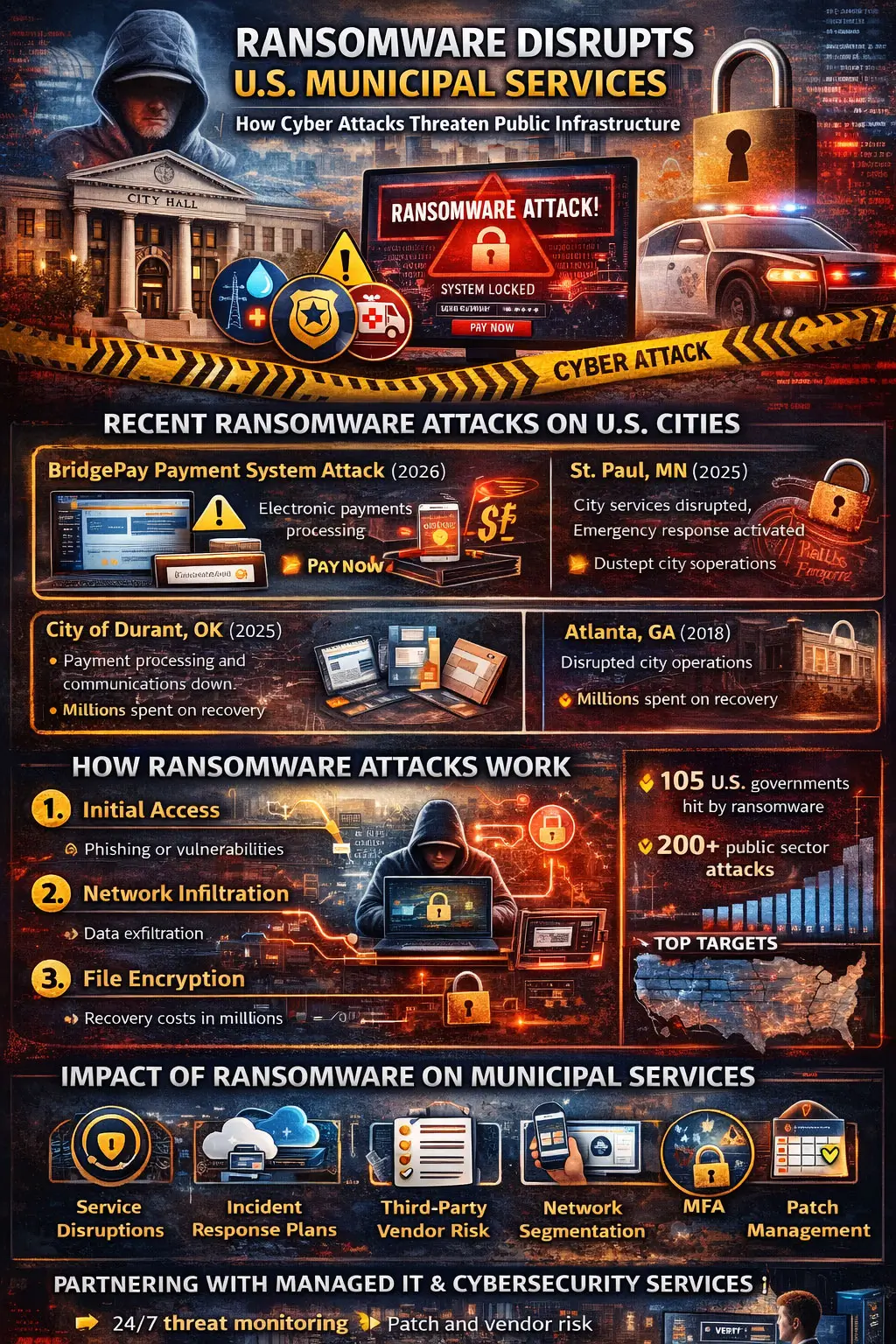
In early 2026, a ransomware attack struck BridgePay Network Solutions, a payment gateway used by municipalities and utilities across multiple states.
The attack caused widespread disruptions in electronic payment systems used by local governments. Several cities reported outages affecting their billing platforms and municipal payment portals.
As a result:
- Utility customers were unable to pay water bills online
- Credit card payment systems went offline
- Some municipalities temporarily switched to in-person payments
In certain jurisdictions, residents had to rely on drop boxes or kiosks while systems were restored.
This incident highlights a growing risk: third-party vendors can become single points of failure for public infrastructure.
St. Paul Cyberattack (2025)
In July 2025, the city of St. Paul, Minnesota, experienced a major city government cyberattack that forced officials to shut down internal networks and online services.
The incident was severe enough that the state activated the Minnesota National Guard’s cyber defense units to assist with response and containment.
Key impacts included:
- Payment portals disabled
- Public Wi-Fi systems shut down
- Internal government networks taken offline
City officials ultimately confirmed the attack was ransomware and chose not to pay the ransom, prioritizing system restoration and long-term security improvements.
City of Durant Cyber Incident (2025)
Another example occurred in Durant, Oklahoma, where a cyberattack disrupted municipal services including payment processing and internal communications.
Local law enforcement and city departments experienced operational challenges while systems were investigated and restored.
This event demonstrates how ransomware affecting utilities and payment portals can disrupt both administrative and public safety functions.
Historical Incidents: Atlanta and Baltimore
Some of the most notable ransomware attacks on city governments occurred in the late 2010s.
Atlanta (2018)
In 2018, the city of Atlanta suffered a ransomware attack that shut down numerous municipal services, including courts, utility payments, and internal systems.
Recovery costs ultimately reached $2.7 million.
Residents were forced to complete forms manually while digital systems remained offline.
Baltimore (2019)
The Baltimore ransomware attack disrupted city services for months and cost the city approximately $18 million in recovery expenses.
Critical services such as property transactions, email systems, and municipal payments were severely affected.
Why Local Governments Are Prime Targets for Ransomware
Understanding why ransomware targets local governments helps explain why these incidents are increasing.
Limited Cybersecurity Budgets
Many municipal governments operate with tight financial constraints. While cybersecurity is a priority, funding limitations often result in:
- Outdated security infrastructure
- Limited monitoring capabilities
- Reduced cybersecurity staffing
Compared to large enterprises, many city governments lack the resources needed to defend against sophisticated attacks.
Critical Public Services Create Pressure
Municipal governments manage services that citizens rely on daily, including:
- Utility billing
- Emergency response systems
- Public transportation
- Licensing and permits
- Tax collection
When these services are disrupted, pressure quickly builds to restore them.
Attackers know this—and exploit it.
Legacy Technology Infrastructure
Many municipal systems still rely on older software platforms that were not designed to withstand modern cyber threats.
Legacy systems often suffer from:
- Unpatched vulnerabilities
- Limited encryption
- Outdated authentication methods
These weaknesses increase the likelihood of data encryption attacks that lock entire systems.
Large Attack Surfaces
Municipal networks connect multiple departments including:
- Police
- Fire services
- schools
- utilities
- administrative offices
This interconnected environment creates a broad attack surface, making it easier for attackers to move laterally within networks once access is gained.
How Ransomware Attacks Work in Municipal Systems
Most ransomware attacks on local government systems follow a similar pattern.
- Initial Access
Attackers gain entry through:
- phishing emails
- compromised credentials
- vulnerable software
- third-party vendor breaches
Phishing remains one of the most common entry points.
- Network Infiltration
Once inside a network, attackers attempt to expand their access by:
- escalating privileges
- moving laterally between systems
- identifying critical infrastructure
- Data Exfiltration
Modern ransomware groups often steal sensitive data before encrypting systems.
This tactic allows them to threaten public data leaks if ransom demands are not met.
- File Encryption
The attackers deploy ransomware that encrypts files across the network, rendering systems unusable.
Essential services may suddenly stop working.
- Ransom Demand
Finally, attackers demand payment—usually in cryptocurrency—in exchange for decryption keys.
Cities must decide whether to pay or attempt recovery without the attackers’ assistance.
Impact of Ransomware on Municipal Services
The impact of ransomware on municipal services can be widespread and disruptive.
Service Disruptions
Ransomware incidents can disable critical systems such as:
- online payment platforms
- court databases
- water billing systems
- business licensing portals
Citizens may suddenly lose access to services they rely on every day.
Financial Losses
Recovering from ransomware attacks is expensive.
Costs may include:
- forensic investigations
- system restoration
- hardware replacements
- cybersecurity upgrades
Cities often spend millions of dollars recovering from major attacks.
Public Safety Risks
In extreme cases, ransomware impact on public safety services can become a concern.
Police systems, dispatch centers, and emergency communications platforms can be affected if attackers gain access to critical infrastructure networks.
The Scale of the Problem
Cybersecurity experts have observed a dramatic increase in cyber attacks on municipal infrastructure.
Recent reports indicate:
- Over 100 U.S. state and municipal governments experienced ransomware incidents in a single year.
- The public sector remains one of the top targets for ransomware groups.
These statistics highlight the urgent need for public sector cyber resilience.
Lessons from Ransomware Attacks on U.S. Cities
There are important lessons from ransomware attacks on U.S. cities that organizations can apply.
Backup Strategies Are Essential
Reliable backups allow systems to be restored without paying ransom.
Incident Response Plans Must Exist
Cities must develop structured incident response for municipalities, including:
- threat detection
- containment procedures
- communication plans
Third-Party Vendor Risk Is Real
The BridgePay attack demonstrates how vendor compromises can disrupt municipal services nationwide.
Vendor security assessments should be part of any cybersecurity strategy.
Network Segmentation Reduces Damage
Segmented networks prevent attackers from moving freely across systems.
Cybersecurity Training Matters
Employees remain the first line of defense.
Regular training helps reduce risks associated with phishing and social engineering attacks.
Protecting Municipal Systems from Ransomware
Strengthening government IT security requires a multi-layered approach.
Technical Controls
Municipalities should implement:
- endpoint detection and response (EDR)
- advanced network monitoring
- automated patch management
Security Strategies
Modern security frameworks include:
- multi-factor authentication
- zero trust architecture
- secure data backups
- disaster recovery planning
These strategies significantly reduce the ransomware recovery costs associated with attacks.
Organizational Measures
Effective cybersecurity also requires cultural change.
Key practices include:
- employee phishing training
- vendor risk management programs
- regular cybersecurity audits
The Role of Managed IT and Cybersecurity Services
For many municipalities and businesses, managing cybersecurity internally can be difficult.
This is where managed IT services providers like Computerbilities can play a critical role.
Professional cybersecurity services provide:
- 24/7 threat monitoring
- ransomware detection and prevention
- backup and disaster recovery
- managed IT security infrastructure
- compliance and governance support
For businesses in Raleigh, Durham, Cary, and across North Carolina, partnering with a cybersecurity provider helps ensure systems remain protected against emerging threats.
As cyber threats evolve, proactive defense is essential.
FAQs
What are ransomware attacks on local governments?
These attacks occur when cybercriminals infiltrate municipal systems and encrypt critical data, demanding payment to restore access.
Why do ransomware groups target cities?
Cities operate essential services and often rely on legacy systems, making them attractive targets for cybercriminals seeking quick ransom payments.
How does ransomware disrupt municipal services?
Ransomware can shut down payment portals, utilities, licensing systems, and other digital infrastructure used by residents.
What are the biggest risks of ransomware for municipalities?
Major risks include financial losses, service disruptions, data breaches, and threats to public safety infrastructure.
How can cities protect themselves from ransomware?
Municipalities should adopt cybersecurity best practices such as network monitoring, multi-factor authentication, regular backups, and employee training.
Conclusion
Ransomware has become one of the most disruptive cybersecurity threats facing modern cities.
As digital services expand, ransomware attacks on local government systems will likely continue to increase. These incidents not only disrupt municipal operations but also affect residents and businesses that rely on city infrastructure.
For communities across the United States—including North Carolina cities like Raleigh, Durham, and Cary—strengthening cybersecurity defenses is no longer optional.
By investing in public sector cyber resilience, modern security technologies, and managed IT services, municipalities and businesses alike can reduce the risks posed by ransomware and ensure critical services remain operational.