
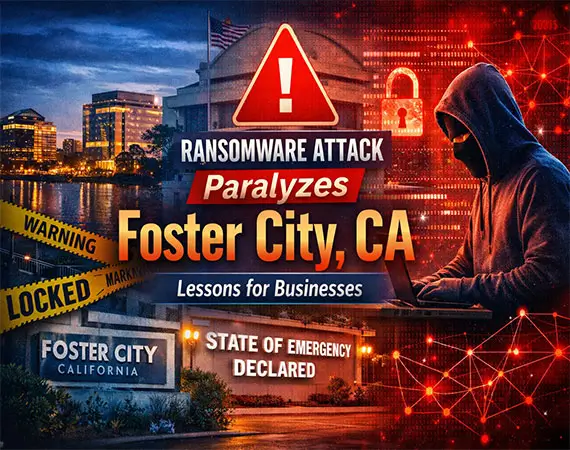
Ransomware Attack Paralyzes Foster City, CA: What Businesses Must Learn
🧩 Introduction: When a City Goes Dark
In March 2026, a ransomware attack in Foster City, California sent shockwaves far beyond the Bay Area. What began as a cybersecurity incident quickly escalated into a full-blown operational crisis—forcing city officials to shut down systems, disrupt public services, and ultimately declare a state of emergency.
This wasn’t just another headline. It was a stark reminder of how fragile digital infrastructure can be—even at the municipal level.
If a well-funded U.S. city can be paralyzed by a cyberattack, what does that mean for small and medium-sized businesses in Raleigh, Durham, or Cary?
The answer is simple—and uncomfortable:
No organization is too small to be targeted.
What Happened: Breaking Down the Foster City Cyberattack
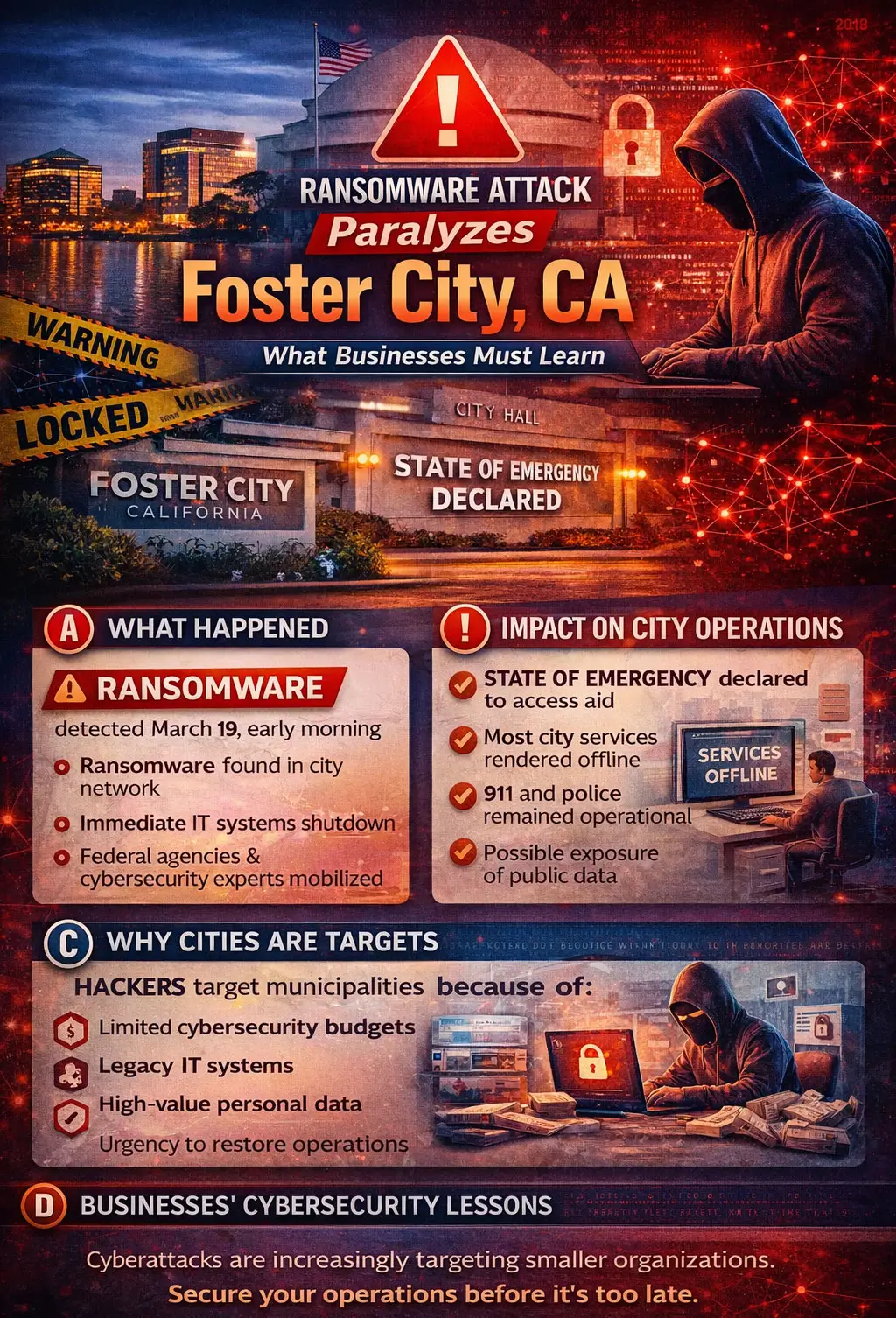
The Foster City cyberattack was detected in the early hours of March 19. IT teams identified suspicious activity within the city’s network—later confirmed to be ransomware embedded deep within critical systems.
Key Developments:
- Ransomware infiltrated internal systems
- Immediate IT systems shutdown to contain spread
- Emergency protocols activated
- External cybersecurity experts engaged
This wasn’t a slow-moving breach—it was a rapid, high-impact cyberattack on city infrastructure.
And like many modern attacks, it likely exploited:
- Phishing vulnerabilities
- Weak endpoints
- Legacy systems
Impact on City Operations: When Systems Go Offline
The effects were immediate and severe.
What Was Disrupted:
- Online city services
- Internal communication systems (email, phones)
- Administrative operations
- Public-facing portals
City Hall remained open—but only in a limited capacity.
This is a textbook example of “city services offline ransomware”—where digital paralysis translates into real-world disruption.
Imagine:
- A business unable to process invoices
- A healthcare provider losing access to patient data
- A law firm locked out of case files
That’s exactly what happens during a municipal cyberattack in the USA—just at a larger scale.
Emergency Services: A Critical Lifeline
Despite the chaos, 911 services and law enforcement remained operational.
This is a crucial point.
Most municipalities maintain segmented systems for emergency response, ensuring that critical services remain active even during cyber incidents.
However:
- Initial disruptions were reported
- Backup protocols had to be activated
This highlights a key lesson:
👉 Cyber resilience planning is not optional—it’s essential.
State of Emergency: Why It Matters
Faced with escalating disruption, Foster City declared a state of emergency due to the cyberattack.
This decision wasn’t symbolic—it was strategic.
What It Enabled:
- Access to emergency funding
- Faster procurement of cybersecurity services
- Coordination with federal agencies
In essence, it accelerated recovery.
For businesses, this translates to a similar concept:
👉 Having an incident response plan before disaster strikes
Data Breach Concerns: What’s at Risk?
One of the most concerning aspects of the Foster City data breach is the potential exposure of sensitive information.
While full details are still under investigation, risks include:
- Resident personal data
- Payment information
- Internal administrative records
Residents were advised to:
- Change passwords
- Monitor financial accounts
This underscores a critical truth:
👉 A ransomware attack isn’t just about downtime—it’s about data exposure risk in city breaches.
Response & Recovery: The Long Road Back
Recovery from a ransomware attack on local government is neither quick nor simple.
Foster City’s Response Included:
- Taking systems offline
- Engaging cybersecurity specialists
- Coordinating with federal authorities
- Conducting forensic investigations
Expected Timeline:
Recovery could take weeks—or even longer.
Why?
Because restoring systems safely requires:
- Verifying clean backups
- Eliminating all malicious code
- Rebuilding infrastructure securely
This is where many organizations fail—not in prevention, but in recovery.
Why Cities Are Prime Targets for Ransomware
You might assume hackers go after large corporations. Increasingly, that’s not the case.
Why Municipalities Are Targeted:
- Limited cybersecurity budgets
- Legacy IT systems
- High-value data (residents, taxes, utilities)
- Operational urgency (pressure to pay ransom quickly)
This makes cities—and SMBs—ideal targets.
Let’s be clear:
👉 If your business has data, you are a target.
A Growing Trend: Cyberattacks on US Cities
The US city cyberattack trend in 2026 is part of a broader pattern.
Recent examples include:
- Oakland ransomware attack (2023)
- Multiple municipal breaches across the U.S.
- Increased DHS funding for cybersecurity defense
Cybercriminals are shifting focus toward:
- Public sector organizations
- Small and mid-sized enterprises
Because they often lack:
- Advanced threat detection
- Dedicated security teams
Lessons for Businesses in Raleigh, Durham & Cary
Here’s where this story becomes personal.
The Foster City ransomware attack isn’t just a news event—it’s a blueprint of what could happen to your business.
🔑 1. Proactive Cybersecurity Is Non-Negotiable
Waiting until after an attack is too late.
You need:
- Continuous monitoring
- Threat detection systems
- Regular vulnerability assessments
🛡️ 2. Endpoint Protection Is Your First Line of Defense
Every device is a potential entry point.
Protect:
- Laptops
- Mobile devices
- Remote workstations
💾 3. Backup & Disaster Recovery Saves Businesses
The difference between survival and shutdown?
Clean, accessible backups.
Best practices:
- Daily automated backups
- Offsite/cloud storage
- Regular recovery testing
👨🏫 4. Employee Training Prevents Most Attacks
Most ransomware attacks begin with a simple email.
Train your team to:
- Identify phishing attempts
- Avoid suspicious links
- Report anomalies immediately
📋 5. Incident Response Planning Is Critical
Ask yourself:
👉 If your systems went down today, what would you do?
A proper plan includes:
- Defined roles
- Communication protocols
- Recovery procedures
Conclusion: A Wake-Up Call for Every Business
The California city ransomware attack in Foster City is more than a local incident—it’s a warning.
Cyberattacks are:
- Increasing in frequency
- Growing in sophistication
- Targeting organizations of all sizes
If a city can be brought to a standstill, so can a business.
The question is no longer:
👉 “Will this happen to us?”
But rather:
👉 “Are we prepared when it does?”
FAQs: Ransomware & Business Cybersecurity
- What is a ransomware attack?
A ransomware attack is a type of cyberattack where hackers encrypt your data and demand payment to restore access.
- How did the Foster City cyberattack happen?
While investigations are ongoing, it likely involved vulnerabilities such as phishing, outdated systems, or weak security controls.
- Can small businesses be targeted by ransomware?
Yes. In fact, SMBs are often targeted because they typically have weaker cybersecurity defenses.
- What should I do if my business is hit by ransomware?
- Disconnect affected systems
- Contact cybersecurity experts
- Avoid paying ransom immediately
- Restore from backups if available
- How can businesses prevent ransomware attacks?
- Implement endpoint security
- Train employees on phishing
- Maintain regular backups
- Use firewalls and monitoring tools
- Why are municipal cyberattacks increasing in the USA?
Because cities often operate with limited cybersecurity resources and hold valuable data, making them attractive targets.
Final Thought
Cybersecurity isn’t just an IT issue—it’s a business survival strategy.
For businesses across **North Carolina—from Raleigh to Durham and Cary—**the time to act is now.
Because the next headline…
could be about a business just like yours.