
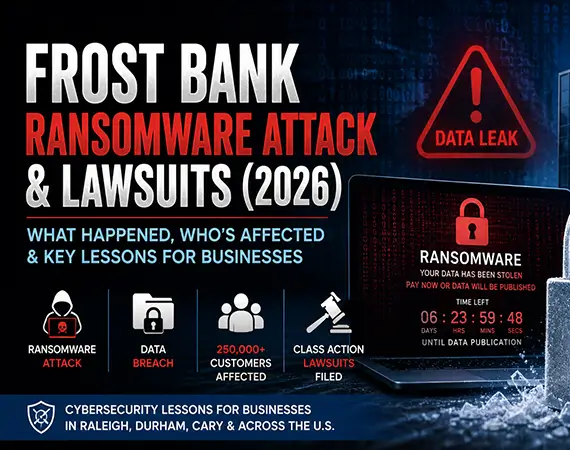
Frost Bank Ransomware Attack & Lawsuits (2026): What Happened, Who’s Affected & Key Lessons
In April 2026, the Frost Bank ransomware attack quickly became one of the most discussed cybersecurity incidents in the financial sector. What initially appeared to be a routine banking data breach 2026 soon escalated into something far more complex—a third-party vendor breach, a massive data leak, and multiple class-action lawsuits.
For businesses across Raleigh, Durham, Cary, and the broader U.S., this incident serves as a stark reminder:
Cybersecurity risks are no longer confined to your own systems.
Let’s break down exactly what happened, what data was exposed, and what it means for businesses today.
Overview of the Frost Bank Data Breach
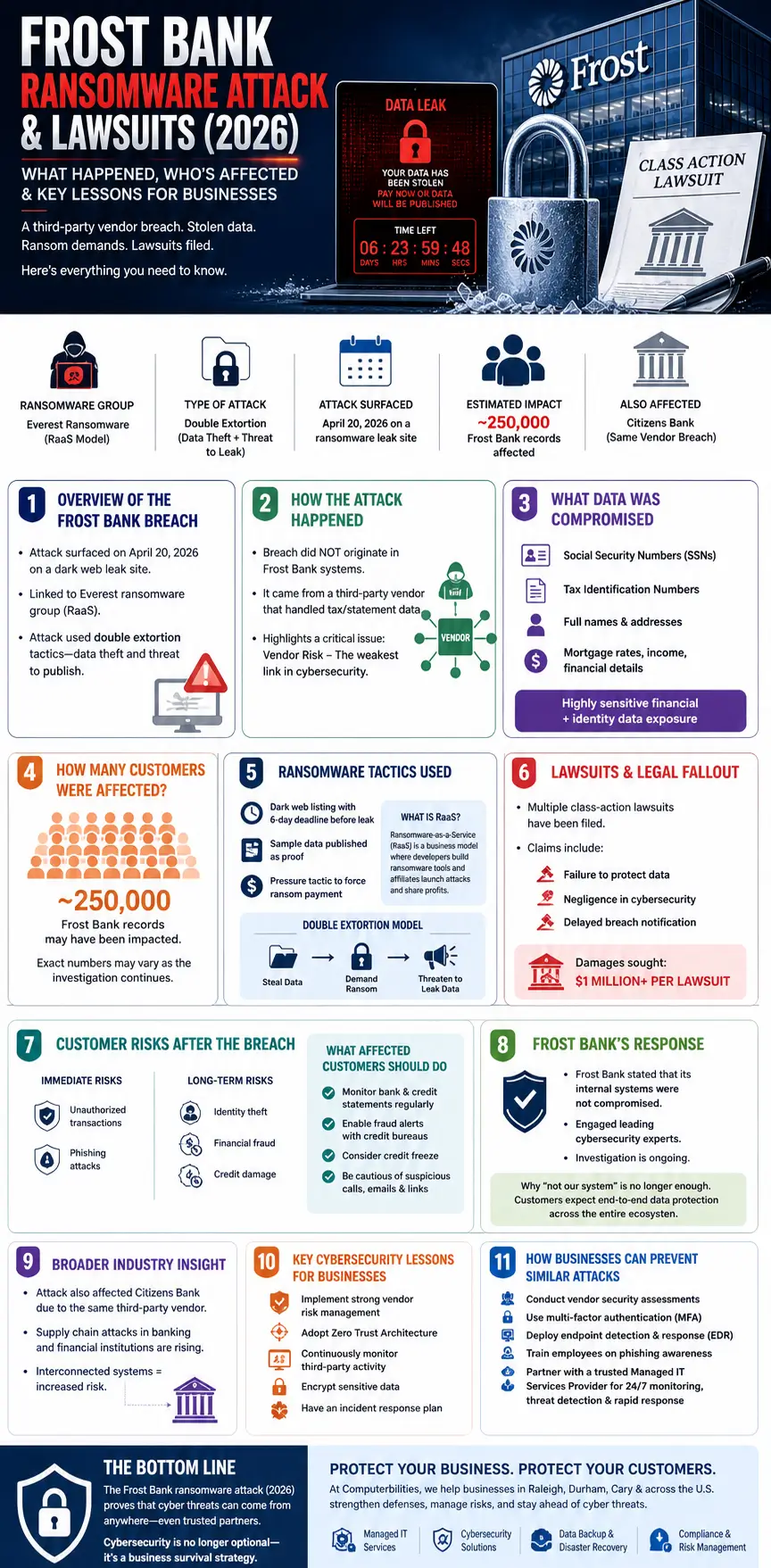
The Frost Bank cybersecurity incident surfaced on April 20, 2026, when the Everest ransomware group listed the bank on its dark web leak site.
Unlike traditional ransomware attacks, this one followed a double extortion model:
- Data was stolen
- A ransom demand was issued
- Threat of public exposure was used as leverage
This approach has become increasingly common with ransomware-as-a-service (RaaS) groups, where cybercriminals operate like businesses—offering tools and infrastructure to affiliates.
How the Attack Happened: A Third-Party Vendor Breach
One of the most critical aspects of the Frost Bank third-party data breach is this:
Frost Bank itself was not directly hacked.
Instead, the breach originated from a third-party vendor responsible for handling sensitive financial documents, including tax and statement data.
This type of attack is known as a supply chain attack, and it highlights a dangerous reality:
👉 Vendor Risk Is the Weakest Link
Think of your business security like a chain.
It doesn’t matter how strong your defenses are—
if one vendor is weak, the entire system is vulnerable.
This is why the Citizens Bank Frost Bank breach is being discussed as a broader industry issue.
What Data Was Compromised
The Frost Bank customer data leak reportedly exposed highly sensitive personal and financial information, including:
- Social Security Numbers (SSNs)
- Tax Identification Numbers
- Full names and addresses
- Mortgage rates and income details
- Financial account-related data
This level of personally identifiable information (PII) exposure is particularly concerning because:
- It enables identity theft
- It allows financial fraud
- It can be exploited for years
How Many Customers Were Affected
Estimates suggest that up to 250,000 records may have been impacted.
However, like many ransomware incidents:
- Exact numbers remain uncertain
- Data may still be circulating on dark web forums
For affected individuals, the risk is not immediate alone—it’s long-term exposure.
Lawsuits Filed Against Frost Bank
Following the breach, multiple Frost Bank class action lawsuits were filed.
Key Allegations Include:
- Failure to protect customer data
- Negligence in cybersecurity practices
- Delayed notification of the breach
Damages Sought:
- Over $1 million per lawsuit
These Frost Bank data breach lawsuits represent a growing trend:
Businesses are no longer judged only on whether they were hacked—
but on how well they prepared and responded.
Ransomware Tactics Used
The Everest ransomware Frost Bank attack followed modern cyber extortion tactics:
- Dark web listing with a 6-day countdown
- Publication of sample stolen data
- Pressure to force ransom payment
Understanding Ransomware-as-a-Service (RaaS)
RaaS works like a subscription model:
- Developers create ransomware tools
- Affiliates execute attacks
- Profits are shared
This makes cybercrime scalable and more dangerous.
Customer Risks After the Breach
If you’re wondering about risks after Frost Bank data breach, here’s what stands out:
Immediate Risks:
- Unauthorized transactions
- Phishing attacks
Long-Term Risks:
- Identity theft
- Loan fraud
- Credit damage
What Affected Customers Should Do:
- Monitor bank and credit statements
- Enable fraud alerts
- Freeze credit if necessary
- Avoid suspicious emails or calls
- Frost Bank’s Response
Frost Bank has stated:
- Internal systems were not compromised
- External cybersecurity experts were engaged
- Investigation is ongoing
However, this raises a critical question:
Is “not our system” still a valid defense?
In today’s threat landscape, customers expect:
- End-to-end data protection
- Vendor accountability
Broader Industry Insight: A Systemic Risk
This incident is not isolated.
The ransomware attack on financial institutions is increasing due to:
- interconnected systems
- reliance on third-party vendors
- cloud-based operations
The involvement of Citizens Bank reinforces this point:
Financial institutions are only as secure as their ecosystem.
Key Cybersecurity Lessons for Businesses
For SMBs in Raleigh, Durham, Cary, this breach offers critical lessons:
- Vendor Risk Management Is Essential
- Audit vendors regularly
- Require security compliance
- Adopt Zero Trust Architecture
- Never assume trust
- Verify every access point
- Monitor Third-Party Activity
- Use continuous monitoring tools
- Encrypt Sensitive Data
- Even if stolen, it remains unusable
How Businesses Can Prevent Similar Attacks
Step-by-Step Protection Strategy:
- Conduct vendor security assessments
- Implement multi-factor authentication (MFA)
- Deploy endpoint detection tools
- Train employees on phishing threats
- Use managed IT services for continuous monitoring
For many SMBs, partnering with a managed IT services provider is the most effective approach.
Why This Matters for North Carolina Businesses
If you run a business in Raleigh, Durham, or Cary, this incident is highly relevant.
Even local businesses:
- Use cloud tools
- Share data with vendors
- Handle sensitive customer information
The Frost Bank ransomware attack 2026 proves:
Cyber threats are no longer limited to large corporations.
Conclusion
The Frost Bank data breach lawsuit is more than just another cybersecurity headline.
It’s a wake-up call.
From third-party vendor risk in banking to cyber extortion tactics, this incident highlights how modern cyber threats operate—and how devastating their impact can be.
For businesses, the message is clear:
Cybersecurity is no longer optional—it’s a business survival strategy.
FAQs
What happened in the Frost Bank data breach 2026?
The breach was linked to a third-party vendor and exposed sensitive customer data through a ransomware attack.
Was Frost Bank hacked directly?
No, the breach originated from a vendor, not Frost Bank’s internal systems.
What data was stolen?
SSNs, tax IDs, financial details, and personal information.
How many customers were affected?
Approximately 250,000 records are believed to be impacted.
What lawsuits have been filed?
Multiple class-action lawsuits alleging negligence and failure to protect data.