
Utility Giant Itron Cyberattack: What Happened and Why It Matters
In April 2026, utility technology giant Itron confirmed that it had suffered a cyberattack involving unauthorized access to parts of its internal IT environment. While the company stated that customer-hosted systems remained unaffected, the incident immediately raised alarms across the cybersecurity and critical infrastructure sectors.
Why? Because Itron is not just another software company.
The organization provides smart utility infrastructure solutions to energy, gas, and water providers worldwide. Its technologies help power connected cities, smart meters, energy grids, and water management systems used by thousands of utility providers globally. When a company operating in such a sensitive sector becomes the victim of a cyberattack, businesses, governments, and cybersecurity professionals pay attention.
The Itron cyberattack has become one of the most discussed critical infrastructure cybersecurity incidents of 2026. It highlights the growing risks facing utility providers, connected infrastructure, and organizations that depend on operational technology (OT) systems to deliver essential services.
For small and medium-sized businesses across Raleigh, Durham, Cary, and throughout North Carolina, the incident offers valuable lessons about cybersecurity preparedness, infrastructure protection, and incident response planning.
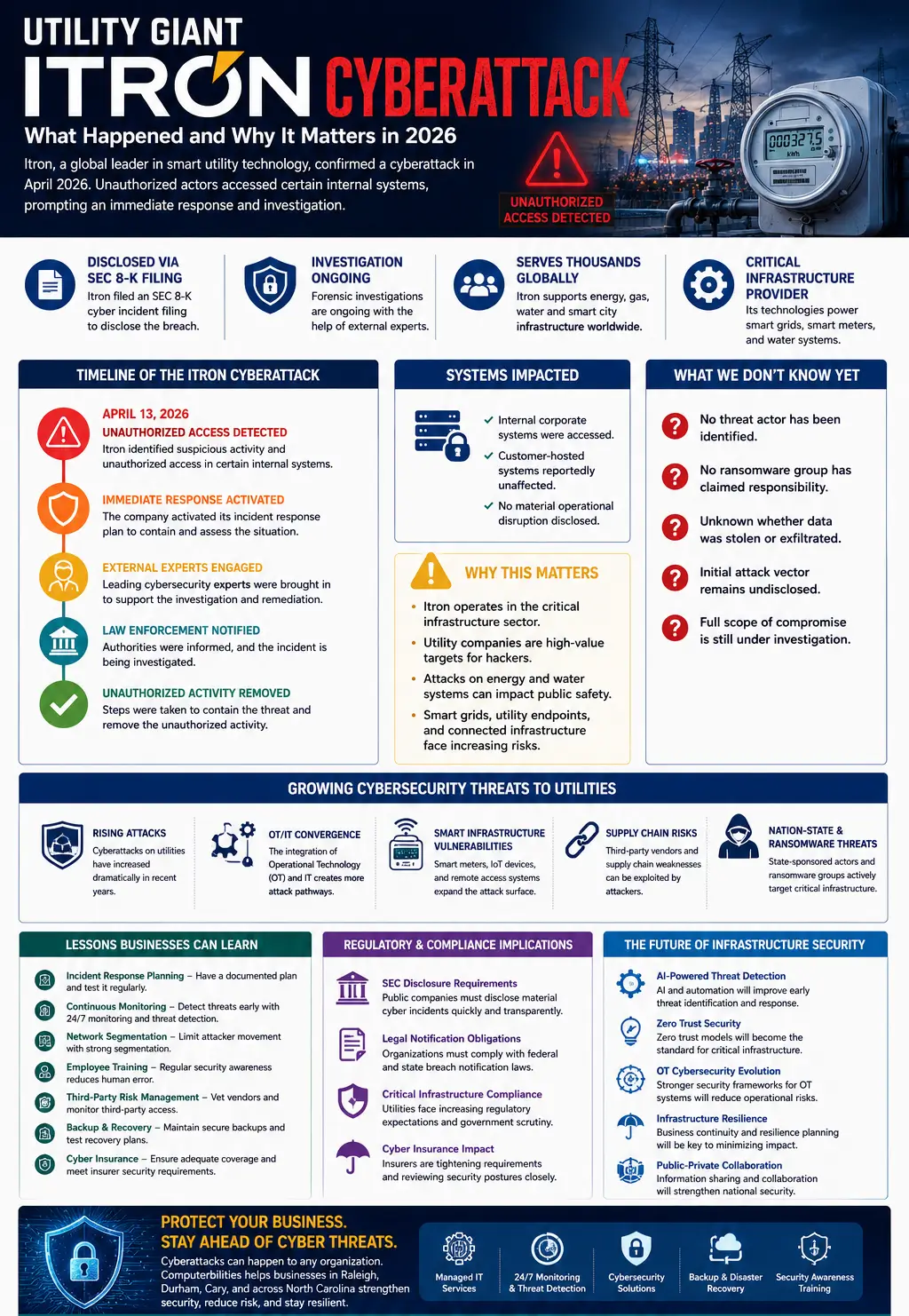
What Happened in the Itron Cyberattack?
According to public reports and the company’s SEC cyber incident filing, Itron discovered unauthorized activity within certain internal systems in April 2026. The company stated that threat actors gained access to portions of its corporate IT network, prompting an immediate cybersecurity response.
After detecting suspicious activity, Itron:
- Activated its incident response plan
- Engaged external cybersecurity advisors
- Began forensic investigations
- Notified law enforcement agencies
- Took steps to contain unauthorized activity
At the time of disclosure, the company noted that the investigation remained ongoing. Importantly, Itron stated that customer-hosted systems and operational environments were not believed to be impacted.
Still, the breach triggered significant concern because of the company’s role in critical infrastructure operations.
Itron’s technologies support:
- Smart utility meters
- Connected energy grids
- Water infrastructure systems
- Gas distribution monitoring
- Smart city infrastructure
- Utility endpoint communications
When cybercriminals gain access to systems connected to critical infrastructure providers, the potential risks extend beyond financial losses. Public safety, operational continuity, and essential services can all be affected.
Why Critical Infrastructure Companies Are Prime Cybersecurity Targets
The Rising Threat to Utility Providers
The Itron cyberattack reflects a broader and increasingly dangerous trend: cybercriminals and nation-state threat actors are aggressively targeting critical infrastructure organizations.
Utility companies are particularly attractive targets because they operate systems that communities depend on every day, including:
- Electricity distribution
- Water treatment facilities
- Natural gas infrastructure
- Energy transmission networks
- Smart grid technologies
Unlike many traditional cyberattacks that focus solely on stealing data, attacks against utility infrastructure can create real-world disruptions affecting millions of people.
This is one reason why the energy sector has become a top target for ransomware groups and advanced persistent threat (APT) actors.
Why Smart Infrastructure Creates New Risks
Modern utility infrastructure relies heavily on interconnected systems, including:
- Smart meters
- Cloud-connected monitoring tools
- Internet-enabled utility endpoints
- Industrial control systems (ICS)
- Supervisory Control and Data Acquisition (SCADA) environments
While these technologies improve operational efficiency, they also expand the attack surface available to cybercriminals.
The convergence of IT and OT systems has introduced new cybersecurity challenges for utility companies worldwide. Many operational systems were originally designed for functionality and reliability — not modern cybersecurity resilience.
As a result, even a breach involving internal corporate systems can raise concerns about lateral movement, supply chain compromise, and operational exposure.
Timeline of the Itron Security Breach
Understanding the timeline helps illustrate how organizations should respond during a cyber incident.
April 13, 2026 – Unauthorized Access Detected
Itron reportedly identified suspicious activity involving unauthorized access to internal systems.
Immediate Incident Response Activation
Following detection:
- Internal security teams initiated containment measures
- External cybersecurity experts were engaged
- Systems were analyzed for evidence of compromise
Regulatory Notifications Filed
The company disclosed the incident through an SEC 8-K filing, complying with cybersecurity disclosure requirements for public companies.
Law Enforcement Engagement
Authorities were notified as part of the investigation process.
Ongoing Forensic Investigation
As of the latest reports:
- The attack vector remains undisclosed
- No threat actor has been officially identified
- Investigations continue into the full scope of the compromise
This response timeline demonstrates the importance of having a well-defined incident response plan before a cyberattack occurs.
Were Customer Systems Affected?
One of the most important questions surrounding the Itron data breach is whether customer systems or utility operations were impacted.
According to public statements:
- Internal corporate systems were accessed
- Customer-hosted environments were reportedly unaffected
- No material operational disruption was disclosed
This distinction matters significantly.
A breach involving customer utility operations could potentially affect:
- Energy distribution
- Water management systems
- Smart grid communications
- Utility billing systems
- Public infrastructure monitoring
At this stage, no evidence has been publicly disclosed indicating that operational utility systems were compromised.
However, cybersecurity experts caution that investigations involving critical infrastructure attacks often take months to fully understand.
What We Still Don’t Know About the Attack
Although the incident has received widespread attention, several critical questions remain unanswered.
No Threat Actor Identified
At the time of writing:
- No ransomware group has claimed responsibility
- No nation-state attribution has been announced
- No official attacker profile has been disclosed
Unknown Initial Attack Vector
Investigators have not publicly confirmed how attackers gained access.
Potential possibilities could include:
- Phishing campaigns
- Credential compromise
- Third-party vendor exposure
- Vulnerable internet-facing systems
- Supply chain compromise
Unknown Data Exposure
It remains unclear whether:
- Sensitive data was exfiltrated
- Proprietary information was accessed
- Internal communications were compromised
Ongoing Scope Assessment
Cybersecurity investigations involving large enterprises often uncover additional details over time. Initial reports frequently evolve as forensic analysis continues.
This uncertainty is one reason why cybersecurity incidents involving utility providers generate such significant industry attention.
The Growing Cybersecurity Threat to Utilities
Cyberattacks Against Critical Infrastructure Are Increasing
The Itron cyberattack is not an isolated event.
Over the past several years, cyberattacks targeting:
- energy providers,
- water facilities,
- transportation systems,
- healthcare organizations,
- and telecommunications infrastructure
have increased dramatically.
Critical infrastructure operators are now dealing with:
- ransomware threats,
- state-sponsored attacks,
- insider risks,
- supply chain vulnerabilities,
- and advanced malware campaigns.
OT and IT Convergence Risks
One of the biggest cybersecurity challenges in the utility sector is the growing overlap between:
- Operational Technology (OT)
- Information Technology (IT)
Historically, these environments operated separately. Today, connected infrastructure increasingly bridges both worlds.
Unfortunately, attackers understand this convergence.
A compromise in an internal IT network can sometimes become a pathway toward more sensitive operational environments if segmentation controls are weak.
This is why cybersecurity experts emphasize:
- network segmentation,
- zero trust architecture,
- continuous monitoring,
- and endpoint visibility.
Smart Meter and Smart Grid Vulnerabilities
Smart utility infrastructure introduces convenience and operational efficiency, but it also creates additional attack surfaces.
Potential risks include:
- Remote device exploitation
- Weak authentication mechanisms
- Firmware vulnerabilities
- Utility endpoint compromise
- IoT security weaknesses
As utilities continue expanding digital transformation initiatives, cybersecurity resilience must evolve alongside infrastructure modernization.
Lessons Businesses Can Learn From the Itron Cyberattack
Although the incident involves a major infrastructure provider, the lessons apply to businesses of all sizes.
Small and medium-sized businesses across North Carolina often assume they are “too small” to become cyberattack targets. In reality, SMBs are increasingly targeted because attackers know many organizations lack advanced cybersecurity defenses.
- Incident Response Planning Is Essential
Every organization should have a documented incident response plan that includes:
- escalation procedures,
- communication protocols,
- containment strategies,
- recovery workflows,
- and legal notification processes.
The speed of response often determines the severity of impact.
- Continuous Monitoring Matters
Cyberattacks frequently remain undetected for weeks or months.
Businesses should implement:
- 24/7 monitoring,
- managed detection and response (MDR),
- SIEM solutions,
- endpoint detection tools,
- and threat intelligence services.
Early detection significantly reduces risk exposure.
- Network Segmentation Reduces Damage
Strong segmentation helps prevent attackers from moving laterally between systems.
Critical systems should be isolated from:
- user endpoints,
- guest networks,
- and less secure environments.
- Employee Security Training Remains Critical
Many breaches begin with:
- phishing emails,
- credential theft,
- or social engineering.
Regular cybersecurity awareness training helps employees identify suspicious activity before it becomes a major incident.
- Third-Party Risk Management Cannot Be Ignored
Supply chain attacks continue rising.
Organizations should evaluate:
- vendor security practices,
- access permissions,
- compliance standards,
- and external integration risks.
- Backup and Recovery Planning Is Vital
Businesses must ensure:
- secure offline backups,
- disaster recovery planning,
- and business continuity procedures
are regularly tested and updated.
Regulatory and Compliance Implications
The Itron cyberattack also highlights the growing regulatory pressure surrounding cybersecurity disclosure and infrastructure protection.
SEC Cybersecurity Disclosure Requirements
Public companies are now expected to disclose material cybersecurity incidents within strict timelines.
These regulations aim to:
- improve transparency,
- protect investors,
- and strengthen cybersecurity accountability.
Critical Infrastructure Compliance Expectations
Utility providers and infrastructure operators face increasing scrutiny from:
- federal agencies,
- industry regulators,
- and cybersecurity oversight bodies.
Organizations handling critical infrastructure are expected to demonstrate:
- cyber resilience,
- incident preparedness,
- risk assessments,
- and security governance.
Cyber Insurance Considerations
Cyber insurers are also tightening requirements.
Businesses may now need:
- MFA enforcement,
- endpoint protection,
- employee training,
- backup validation,
- and incident response documentation
to qualify for coverage.
How Organizations Can Strengthen Cybersecurity Defenses
The Itron incident reinforces the importance of proactive cybersecurity strategies.
Recommended Security Measures
Businesses should consider implementing:
Zero Trust Security
Trust no device or user automatically. Verify continuously.
Multi-Factor Authentication (MFA)
Protect accounts from credential-based attacks.
Endpoint Detection & Response (EDR)
Improve visibility across user devices and servers.
Managed IT & Cybersecurity Services
Partnering with cybersecurity professionals helps organizations maintain stronger defenses without overwhelming internal teams.
Regular Vulnerability Assessments
Identify weaknesses before attackers exploit them.
Security Awareness Training
Human error remains one of the biggest cybersecurity risks.
Backup and Disaster Recovery Planning
Ensure operational continuity after an incident.
For businesses in Raleigh, Durham, Cary, and throughout North Carolina, proactive cybersecurity investments are no longer optional — they are operational necessities.
The Future of Critical Infrastructure Security
Cybersecurity threats targeting utilities and infrastructure providers are expected to continue evolving.
Future defense strategies will likely focus on:
- AI-powered threat detection
- Zero trust frameworks
- OT cybersecurity modernization
- Infrastructure resilience
- Public-private cybersecurity collaboration
- Advanced behavioral analytics
- Real-time threat intelligence sharing
As infrastructure becomes more connected, cybersecurity must become more adaptive.
Organizations that prioritize resilience today will be far better positioned to handle tomorrow’s threats.
Final Thoughts
The Itron cyberattack serves as a powerful reminder that no organization — regardless of size or industry — is immune from cyber threats.
While the full scope of the incident remains under investigation, the attack underscores the growing risks facing critical infrastructure providers, utility companies, and organizations operating connected environments.
For businesses across North Carolina, the lessons are clear:
- cybersecurity preparedness matters,
- incident response planning is essential,
- and proactive defense strategies can significantly reduce operational risk.
Cybercriminals are becoming more sophisticated every year. Businesses that invest in cybersecurity resilience today will be better prepared to protect their operations, customers, and long-term reputation tomorrow.
Computerbilities helps businesses across Raleigh, Durham, Cary, and surrounding areas strengthen cybersecurity through managed IT services, proactive monitoring, threat detection, employee training, and incident response support.
FAQs
What happened in the Itron cyberattack?
Itron confirmed that unauthorized actors accessed portions of its internal IT systems in April 2026. The company launched an investigation and engaged external cybersecurity experts.
Was customer data affected in the Itron breach?
Based on current public statements, customer-hosted systems were reportedly not impacted. However, investigations remain ongoing.
Why are utility companies targeted by hackers?
Utility providers operate critical infrastructure systems such as energy grids and water management networks. Disrupting these services can create major operational and public safety consequences.
What are the biggest cybersecurity risks for utilities?
Common risks include:
- ransomware attacks,
- OT vulnerabilities,
- phishing campaigns,
- smart meter exploitation,
- supply chain compromise,
- and insider threats.
How can businesses reduce cybersecurity risks?
Organizations can improve cybersecurity by implementing:
- MFA,
- network segmentation,
- employee security training,
- continuous monitoring,
- endpoint protection,
- and incident response planning.
Did ransomware groups claim responsibility for the Itron attack?
At the time of writing, no ransomware group has publicly claimed responsibility for the incident.