
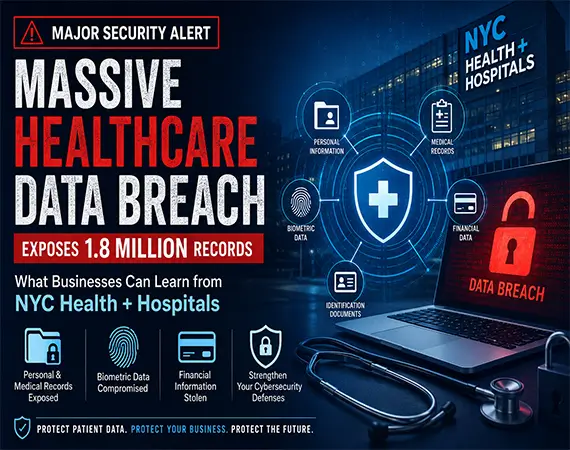
Massive Healthcare Data Breach Exposes 1.8 Million Records: What Businesses Can Learn from NYC Health + Hospitals
Introduction
Cyberattacks against healthcare organizations continue to dominate headlines, but the latest incident involving NYC Health + Hospitals serves as a stark reminder that the consequences of a healthcare data breach extend far beyond temporary operational disruptions.
In one of the most significant healthcare cybersecurity incidents reported in 2026, NYC Health + Hospitals disclosed a cyberattack that affected approximately 1.8 million individuals, exposing highly sensitive personal, medical, financial, and biometric information. As the largest public healthcare system in the United States, the breach has sparked concerns among patients, regulators, cybersecurity experts, and business leaders alike.
While healthcare organizations are often the primary targets of cybercriminals due to the value of patient records, this incident offers important lessons for businesses across all industries—including small and medium-sized businesses (SMBs) in Raleigh, Durham, Cary, and throughout North Carolina.
The breach highlights a growing reality: no organization is too large, too small, or too specialized to become a victim of a healthcare cyberattack or broader cybersecurity threat. Understanding what happened and how to strengthen defenses can help organizations reduce risk, improve compliance, and better protect sensitive data.
What Happened?
The NYC Health + Hospitals data breach quickly became one of the largest healthcare security breaches of the year.
Key Facts About the Incident
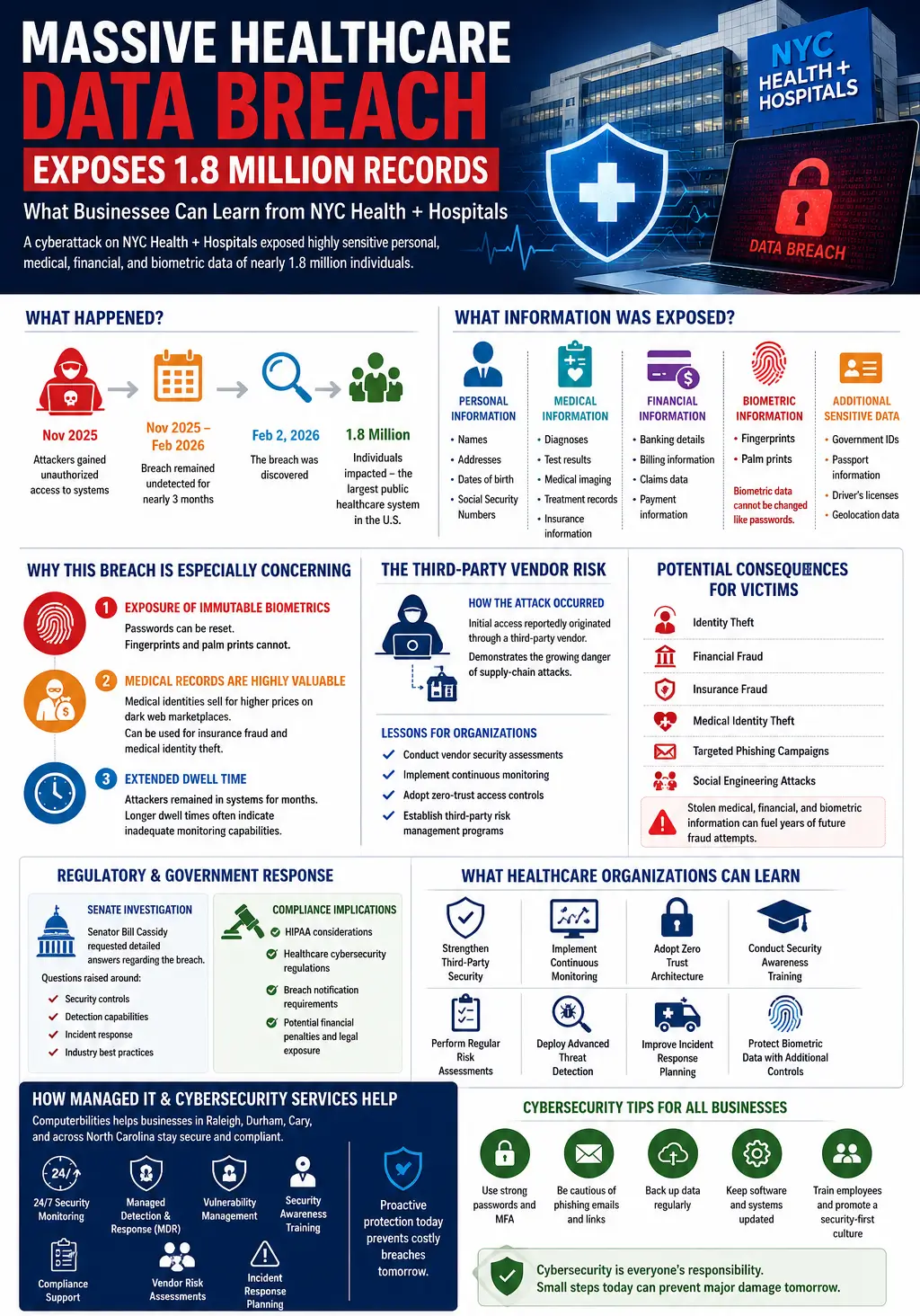
According to public reports, attackers gained unauthorized access to systems associated with NYC Health + Hospitals between November 2025 and February 2026. The intrusion remained undetected for nearly three months before being discovered on February 2, 2026.
This prolonged access period gave threat actors ample opportunity to explore systems, collect sensitive information, and exfiltrate data without immediate detection.
Key details include:
- Unauthorized access occurred between November 2025 and February 2026.
- The breach remained undetected for nearly 90 days.
- Discovery occurred on February 2, 2026.
- Approximately 1.8 million individuals were impacted.
- The incident affected the largest public healthcare network in the United States.
The lengthy dwell time is particularly concerning because it demonstrates how sophisticated attackers can evade traditional security controls while quietly gathering valuable information.
For businesses in North Carolina and beyond, this serves as a reminder that cybersecurity isn’t simply about prevention—it is also about rapid detection and response.
What Information Was Exposed?
One reason this healthcare data breach has received significant attention is the extraordinary range of sensitive information that was reportedly compromised.
Personal Information
The attackers allegedly accessed personally identifiable information (PII), including:
- Full names
- Residential addresses
- Dates of birth
- Social Security Numbers
This information alone can facilitate identity theft, financial fraud, and targeted social engineering attacks.
Medical Information
Even more concerning was the exposure of protected health information (PHI), including:
- Medical diagnoses
- Laboratory test results
- Medical imaging records
- Treatment histories
- Insurance information
Unlike passwords, medical records cannot simply be changed or reset. Once exposed, sensitive patient information may remain vulnerable indefinitely.
Financial Information
Reports also indicate that financial data may have been compromised, including:
- Banking information
- Billing records
- Claims information
- Payment details
Financial records provide cybercriminals with additional opportunities for fraud and account takeover attacks.
Biometric Information
Perhaps the most alarming aspect of the breach was the exposure of biometric data, including:
- Fingerprints
- Palm prints
Biometric identifiers are unique and permanent.
If a password is compromised, it can be changed. If a fingerprint is stolen, the victim cannot replace it.
This reality makes biometric data breaches particularly dangerous because the consequences can persist for a lifetime.
Additional Sensitive Information
Other potentially exposed information included:
- Driver’s license numbers
- Government-issued identification documents
- Passport information
- Geolocation data
The combination of personal, medical, financial, and biometric information creates a highly valuable package for cybercriminals operating on dark web marketplaces.
Why This Breach Is Especially Concerning
Healthcare breaches happen frequently, but this incident stands out for several reasons.
- Exposure of Immutable Biometrics
Most organizations focus heavily on protecting passwords and account credentials. However, biometric information represents a completely different level of risk.
Passwords can be reset.
Usernames can be changed.
Multi-factor authentication can be reconfigured.
Fingerprints and palm prints cannot.
This means victims may face risks associated with biometric identity misuse for decades.
As biometric authentication becomes increasingly common in banking, healthcare, and government systems, the value of stolen biometric data continues to rise.
- Medical Records Are Extremely Valuable
Medical records often command significantly higher prices on criminal marketplaces than stolen credit card information.
Why?
Because healthcare records contain:
- Personal identifiers
- Insurance information
- Treatment histories
- Financial information
- Family data
Criminals can use this information to commit:
- Medical identity theft
- Insurance fraud
- Prescription fraud
- Tax fraud
- Financial fraud
In many cases, victims may not discover fraudulent activity until months or years later.
- Extended Dwell Time
Perhaps the most troubling aspect of the breach is the amount of time attackers reportedly remained inside systems.
Cybersecurity professionals often refer to this period as “dwell time.”
Long dwell times typically indicate weaknesses in:
- Security monitoring
- Threat detection
- Incident response
- Log analysis
- Security operations
The longer attackers remain undetected, the greater the damage they can cause.
For organizations of every size, reducing dwell time should be a critical cybersecurity objective.
The Third-Party Vendor Risk
One of the most important lessons emerging from this incident involves third-party security.
How the Attack Occurred
Public reports suggest the initial compromise may have originated through a third-party vendor relationship.
If confirmed, this would represent another example of a growing trend known as a supply chain cyberattack.
Rather than attacking the primary target directly, cybercriminals exploit trusted vendors, contractors, software providers, or partners to gain access.
This approach has become increasingly popular because vendors often have privileged access to sensitive systems and data.
Why Third-Party Risk Matters
Many organizations devote significant resources to securing their own infrastructure while overlooking vendor-related vulnerabilities.
Yet every vendor relationship introduces additional risk.
Examples include:
- Cloud providers
- Managed service providers
- Payroll processors
- Medical billing companies
- Software vendors
- Legal service providers
Each external connection expands the attack surface.
Lessons for Organizations
To reduce third-party cybersecurity risks, organizations should:
Conduct Vendor Security Assessments
Evaluate vendor cybersecurity practices before granting access.
Implement Continuous Monitoring
Security assessments should not be a one-time activity.
Adopt Zero Trust Access Controls
Never assume trust based solely on network location or business relationship.
Establish Third-Party Risk Management Programs
Formal processes help identify, assess, and mitigate vendor risks before they become major incidents.
Potential Consequences for Victims
The impact of a healthcare security breach extends far beyond the initial attack.
Victims may face years of consequences.
Identity Theft
Criminals can combine exposed personal information to create fraudulent accounts or impersonate victims.
Financial Fraud
Stolen banking and billing information may be used to conduct unauthorized transactions.
Insurance Fraud
Healthcare insurance information can be exploited to submit false claims or obtain medical services.
Medical Identity Theft
Medical identity theft is especially dangerous because inaccurate records may affect future treatment decisions.
Targeted Phishing Campaigns
Cybercriminals can use stolen healthcare data to create highly convincing phishing attacks.
Social Engineering Attacks
Attackers may impersonate healthcare providers, insurance companies, or government agencies to trick victims into revealing additional information.
Cybersecurity experts consistently warn that stolen medical, financial, and biometric information can fuel years of future fraud attempts.
Regulatory and Government Response
Major healthcare breaches often trigger regulatory scrutiny.
This incident is no exception.
Senate Investigation
Senator Bill Cassidy reportedly requested detailed information regarding the breach and the cybersecurity controls that were in place before the incident occurred.
Questions focused on:
- Security controls
- Threat detection capabilities
- Incident response procedures
- Industry best practices
- Risk management frameworks
The investigation reflects growing concerns about healthcare cybersecurity nationwide.
Compliance Implications
Healthcare organizations face extensive regulatory requirements designed to protect patient information.
These include:
HIPAA Compliance
Healthcare providers must safeguard protected health information (PHI).
Breach Notification Requirements
Organizations must notify affected individuals and regulators when certain types of breaches occur.
Healthcare Cybersecurity Regulations
Federal and state regulations continue evolving to address emerging threats.
Failure to comply can result in significant financial penalties and reputational damage.
What Healthcare Organizations Can Learn
While this incident occurred within a healthcare system, its lessons apply to virtually every organization.
Strengthen Third-Party Security
Assess vendor security controls regularly.
Implement Continuous Monitoring
Continuous monitoring helps identify suspicious activity before it becomes a crisis.
Adopt Zero Trust Architecture
Trust should never be assumed.
Every user, device, and connection should be continuously verified.
Conduct Security Awareness Training
Employees remain one of the most common attack vectors.
Regular cybersecurity awareness training helps reduce human error.
Perform Regular Risk Assessments
Risk assessments identify vulnerabilities before attackers exploit them.
Deploy Advanced Threat Detection
Modern threats require modern detection capabilities.
Improve Incident Response Planning
Organizations should know exactly how they will respond before an incident occurs.
Protect Biometric Data
Additional safeguards should be implemented when storing biometric information.
Encryption, segmentation, and strict access controls can reduce exposure.
How Managed IT and Cybersecurity Services Help
Many SMBs lack the internal resources necessary to combat increasingly sophisticated cyber threats.
This is where Managed IT Services can make a significant difference.
At Computerbilities, we help businesses throughout Raleigh, Durham, Cary, and across North Carolina strengthen their cybersecurity posture through proactive IT Support and security solutions.
24/7 Security Monitoring
Continuous monitoring helps detect suspicious activity before it escalates into a major incident.
Managed Detection and Response (MDR)
Advanced threat detection and response capabilities provide rapid containment and remediation.
Vulnerability Management
Routine scanning identifies weaknesses before attackers do.
Security Awareness Training
Employees become a stronger first line of defense against phishing and social engineering attacks.
Compliance Support
Healthcare organizations must navigate complex compliance requirements, including HIPAA compliance and data privacy regulations.
Vendor Risk Assessments
Organizations can reduce third-party risk through structured vendor evaluations.
Incident Response Planning
Preparedness reduces downtime, financial losses, and reputational damage.
For many North Carolina businesses, partnering with a trusted Managed IT Services provider offers access to enterprise-grade cybersecurity expertise without the cost of building a large internal security team.
Frequently Asked Questions (FAQs)
What is the NYC Health + Hospitals data breach?
The NYC Health + Hospitals data breach involved unauthorized access to systems affecting approximately 1.8 million individuals, exposing sensitive personal, medical, financial, and biometric information.
Why is biometric data theft so dangerous?
Unlike passwords, biometric identifiers such as fingerprints and palm prints cannot be changed, making them a long-term security concern.
What is Protected Health Information (PHI)?
Protected Health Information (PHI) includes medical records, treatment information, insurance details, and other healthcare-related data protected under HIPAA regulations.
How do healthcare cyberattacks affect patients?
Healthcare cyberattacks can result in identity theft, medical identity theft, insurance fraud, financial fraud, and privacy violations.
What is a third-party vendor healthcare cyberattack?
A third-party vendor healthcare cyberattack occurs when attackers exploit a trusted vendor relationship to gain access to healthcare systems or sensitive data.
How can organizations prevent healthcare data breaches?
Organizations can reduce risk through:
- Security awareness training
- Multi-factor authentication
- Continuous monitoring
- Zero Trust security
- Vendor risk management
- Incident response planning
- Regular security assessments
Why are healthcare organizations frequent cyberattack targets?
Healthcare organizations store highly valuable personal, financial, and medical data, making them attractive targets for cybercriminals.
What role do Managed IT Services play in cybersecurity?
Managed IT Services provide proactive monitoring, threat detection, vulnerability management, compliance support, and incident response capabilities that help organizations strengthen security and reduce risk.
Conclusion
The NYC Health + Hospitals breach demonstrates that healthcare organizations remain prime targets for cybercriminals. When medical records, financial information, and biometric identifiers are compromised, the consequences extend far beyond a simple data breach.
The exposure of 1.8 million healthcare records highlights the growing sophistication of modern cyber threats and underscores the importance of proactive cybersecurity measures. From third-party vendor risk and supply chain attacks to biometric data protection and regulatory compliance, organizations must take a comprehensive approach to security.
For healthcare providers, law firms, financial organizations, and SMBs throughout Raleigh, Durham, Cary, and across North Carolina, the lesson is clear: cybersecurity can no longer be viewed as an optional investment. Organizations that prioritize continuous monitoring, employee training, threat detection, and strong vendor oversight will be better positioned to protect sensitive data, maintain customer trust, and withstand the evolving threat landscape.
In today’s environment, the question is no longer whether cybercriminals will attempt an attack—it’s whether your organization is prepared to detect, respond, and recover before lasting damage occurs.