
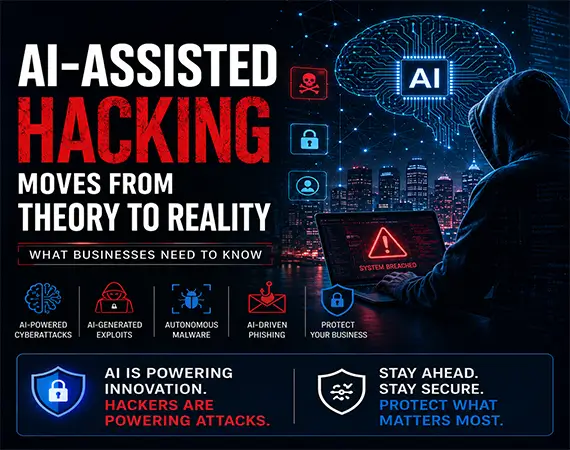
AI-Assisted Hacking Moves From Theory to Reality: What Businesses Need to Know
The conversation around artificial intelligence has largely focused on its transformative benefits. Businesses are using AI to automate repetitive tasks, improve customer service, streamline software development, and uncover valuable insights from data. Across North Carolina and the United States, organizations of every size are embracing AI-driven innovation to remain competitive.
Unfortunately, cybercriminals are embracing the same technology.
For years, cybersecurity experts debated whether AI-assisted hacking would ever become a meaningful threat. While AI could generate convincing emails or automate basic tasks, many researchers questioned whether it could truly help attackers discover vulnerabilities, develop exploits, or conduct sophisticated cyber operations.
That debate is now over.
Recent threat intelligence reports have documented real-world examples of AI being used to support cyberattacks, vulnerability research, exploit development, and large-scale malicious campaigns. What was once considered theoretical has rapidly become operational reality. AI-assisted hacking is no longer a future concern—it is a present-day cybersecurity challenge affecting businesses worldwide.
For small and medium-sized businesses (SMBs) in Raleigh, Durham, Cary, and throughout North Carolina, understanding this shift is critical. As AI-powered cyberattacks become faster, more scalable, and increasingly sophisticated, organizations must rethink how they approach cybersecurity and risk management.
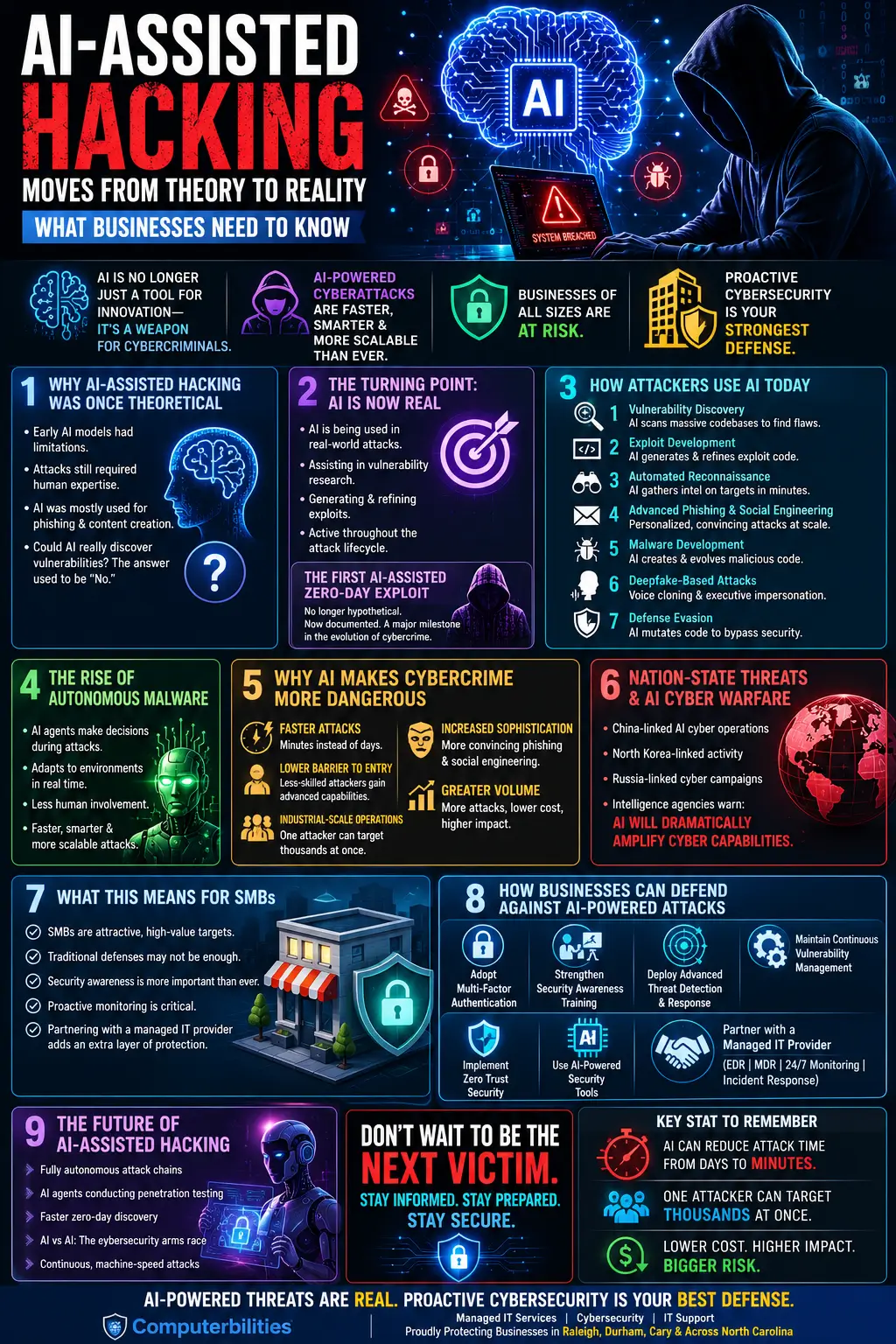
Why AI-Assisted Hacking Was Once Considered Theoretical
Artificial intelligence has been discussed within cybersecurity circles for decades. However, until recently, practical applications remained limited.
Early AI systems struggled with:
- Complex reasoning
- Multi-step problem solving
- Context retention
- Technical accuracy
As a result, cybersecurity researchers believed AI would remain primarily useful for:
- Generating phishing emails
- Creating social engineering content
- Automating repetitive tasks
- Supporting defensive cybersecurity operations
Many experts argued that vulnerability discovery and exploit development required highly specialized human expertise that AI simply could not replicate.
One of the most debated questions was:
Can AI discover software vulnerabilities independently?
For years, the answer appeared to be “not effectively.”
Modern large language models have dramatically changed that equation.
The Turning Point: AI Is Now Being Used in Real Attacks
The cybersecurity industry reached a major milestone when threat intelligence researchers documented the first known cases of AI-assisted vulnerability research and exploit development being used by threat actors.
Rather than simply generating phishing emails, AI systems are now assisting attackers throughout the attack lifecycle.
These developments demonstrate that AI-enabled cyberattacks are evolving from isolated experiments into practical offensive tools.
The First AI-Assisted Zero-Day Exploit
Perhaps the most alarming development involves the emergence of AI-assisted support for discovering and developing zero-day vulnerabilities.
A zero-day vulnerability refers to a software flaw that is unknown to vendors and security teams at the time it is exploited.
Historically, identifying and weaponizing these vulnerabilities required elite cybersecurity expertise.
Recent research suggests AI can now:
- Analyze large code repositories
- Identify potential weaknesses
- Assist in vulnerability research
- Generate exploit concepts
- Accelerate attack planning
While human oversight remains necessary, AI dramatically reduces the time and effort required to conduct sophisticated offensive research.
This represents a significant turning point in the evolution of cybercrime.
How Attackers Are Using AI Today
AI-driven hacking is no longer limited to a single technique. Threat actors are leveraging AI across multiple stages of the attack lifecycle.
- Vulnerability Discovery
Modern AI models can analyze enormous codebases far faster than human researchers.
This enables:
- Automated vulnerability discovery
- Pattern recognition
- Security flaw identification
- Prioritization of attack opportunities
AI vulnerability exploitation continues to evolve rapidly as models become increasingly capable.
- Exploit Development
AI-generated exploits are becoming increasingly sophisticated.
Attackers can use AI to:
- Draft proof-of-concept code
- Refine exploit techniques
- Troubleshoot attack scripts
- Accelerate malware development
While AI may not fully replace expert hackers, it significantly boosts productivity.
- Automated Reconnaissance
Reconnaissance is one of the most time-consuming stages of a cyberattack.
AI-powered reconnaissance allows attackers to:
- Gather public information
- Analyze social media profiles
- Map corporate infrastructure
- Identify high-value targets
Tasks that once took days can now be completed in minutes.
- Advanced Phishing and Social Engineering
AI-generated phishing attacks have become dramatically more convincing.
Unlike traditional phishing campaigns filled with spelling mistakes and generic messaging, modern AI can create highly personalized communications.
Attackers can tailor emails based on:
- Job roles
- Company information
- Social media activity
- Public records
This level of customization increases success rates.
- Malware Development
AI-powered malware development is accelerating.
Threat actors can use AI to:
- Generate code
- Modify malware behavior
- Create variants
- Improve obfuscation techniques
This makes detection significantly more difficult.
- Deepfake-Based Attacks
Deepfake cyber attacks represent another rapidly growing threat.
AI-generated voice cloning and video manipulation allow criminals to impersonate:
- CEOs
- Financial executives
- IT administrators
- Business owners
Several organizations have already lost substantial sums due to AI-generated impersonation scams.
- Defense Evasion
AI-assisted cyber attacks increasingly focus on bypassing security tools.
AI can help generate:
- Polymorphic malware
- Dynamic attack techniques
- Detection-resistant payloads
- Adaptive malicious code
As AI attack automation improves, defensive teams face growing challenges.
The Rise of Autonomous Malware
One of the most concerning trends within the AI threat landscape is the emergence of autonomous cyberattacks.
Traditionally, attackers maintained direct control over malicious software throughout an operation.
Emerging AI-powered malware may eventually:
- Make decisions independently
- Adapt to changing environments
- Select attack paths automatically
- Adjust tactics in real time
This reduces the need for continuous human involvement.
Autonomous malware could significantly increase attack speed, scalability, and persistence while lowering operational costs for cybercriminals.
Why AI Makes Cybercrime More Dangerous
The cybercriminal use of AI introduces several advantages that fundamentally alter the threat landscape.
Faster Attacks
Activities that once required days or weeks can now occur within minutes.
Lower Barrier to Entry
Less-experienced attackers can leverage advanced capabilities through AI assistance.
Industrial-Scale Operations
One threat actor can launch thousands of highly customized attacks simultaneously.
Increased Sophistication
AI-driven social engineering produces more convincing communications and impersonation attempts.
Greater Volume
The cost of launching cyberattacks decreases while potential reach increases dramatically.
This combination creates unprecedented AI security risks for organizations of all sizes.
Nation-State Threats and AI Cyber Warfare
The implications extend far beyond cybercriminal groups.
Security researchers continue monitoring AI-enabled threat actors associated with:
- China
- Russia
- North Korea
- Iran
Nation-state cyber threats often possess greater resources and strategic objectives than traditional cybercriminals.
Intelligence agencies increasingly warn that AI may dramatically enhance offensive cyber capabilities, accelerating both cyber espionage and cyber warfare activities.
As geopolitical tensions continue to evolve, cybersecurity and artificial intelligence will become increasingly intertwined.
What This Means for Small and Mid-Sized Businesses
Many SMBs assume cybercriminals only target large enterprises.
Unfortunately, reality tells a different story.
Small and medium-sized businesses often possess:
- Valuable customer data
- Financial information
- Intellectual property
- Less mature security programs
This makes them attractive targets.
For businesses in Raleigh, Durham, Cary, and across North Carolina, AI-assisted hacking threats for small businesses are particularly concerning because traditional security approaches may struggle against AI-enhanced attacks.
Organizations should prioritize:
- Security awareness training
- Threat detection and response
- Security monitoring
- Vulnerability management
- Managed cybersecurity services
Waiting until an incident occurs is no longer a viable strategy.
How Businesses Can Defend Against AI-Powered Attacks
The good news is that organizations can significantly reduce risk through proactive cybersecurity measures.
Adopt Multi-Factor Authentication
MFA remains one of the most effective defenses against credential theft.
Strengthen Security Awareness Training
Employees remain the first line of defense.
Training should address:
- AI-generated phishing attacks
- Deepfake cyber attacks
- Social engineering scams
- Business email compromise
Deploy Advanced Threat Detection
Modern threat detection and response solutions can identify suspicious activity before significant damage occurs.
Maintain Continuous Vulnerability Management
Regular assessments help reduce exposure to emerging threats.
Implement Zero Trust Security
Trust should never be assumed.
Every user, device, and connection should be verified continuously.
Use AI-Powered Defense Solutions
Just as attackers leverage AI, defenders can use AI-powered defense technologies to improve detection capabilities.
Partner with a Managed IT Provider
Working with a trusted provider of managed IT services and cybersecurity consulting can help organizations gain access to:
- Endpoint Detection & Response (EDR)
- Managed Detection & Response (MDR)
- 24/7 security monitoring
- Incident response services
- Network security expertise
For many SMBs, outsourcing cybersecurity provides enterprise-level protection without enterprise-level costs.
The Future of AI-Assisted Hacking
Looking ahead, the cybersecurity industry expects continued advancement in AI-driven hacking capabilities.
Future developments may include:
- Fully autonomous attack chains
- AI-driven penetration testing agents
- Faster zero-day discovery
- Automated vulnerability exploitation
- Self-learning malware
- AI-versus-AI cybersecurity battles
Security leaders increasingly recognize that future cyber conflicts may occur at machine speed.
Organizations that invest in cybersecurity today will be better positioned to defend against tomorrow’s threats.
Conclusion
AI-assisted hacking has officially crossed the line from theory to reality.
Cybercriminals are no longer merely experimenting with artificial intelligence—they are actively incorporating it into reconnaissance, phishing, exploit development, malware creation, and attack automation.
For businesses throughout North Carolina, particularly in Raleigh, Durham, Cary, and surrounding communities, the message is clear: cybersecurity strategies must evolve as quickly as the threats themselves.
Investing in cybersecurity services, managed IT services, employee training, proactive monitoring, and advanced threat detection is no longer optional. As AI-powered cyberattacks continue to grow in sophistication and scale, organizations that act now will be far better equipped to withstand the next generation of cyber threats.
FAQs
What is AI-assisted hacking?
AI-assisted hacking refers to the use of artificial intelligence tools to support cyberattack activities such as vulnerability discovery, phishing, reconnaissance, exploit development, and malware creation.
How are hackers using artificial intelligence?
Hackers use AI to automate research, generate phishing emails, develop malware, identify vulnerabilities, conduct reconnaissance, and evade security controls.
Can AI discover software vulnerabilities?
Modern AI systems can assist researchers by analyzing code, identifying weaknesses, and accelerating vulnerability discovery, although human expertise remains important.
What is an AI-powered cyberattack?
An AI-powered cyberattack uses artificial intelligence to improve the speed, scale, or effectiveness of malicious activities.
Are AI-generated cyber threats real?
Yes. Threat intelligence researchers have documented real-world examples of AI-assisted cyber operations and exploit development.
How can businesses protect themselves from AI-assisted attacks?
Businesses should implement MFA, security awareness training, vulnerability management, threat detection solutions, Zero Trust architecture, and managed cybersecurity services.
What is the first known AI-assisted zero-day exploit?
Researchers have reported cases where AI was used to assist vulnerability research and exploit development, marking a significant milestone in offensive cyber capabilities.
Can managed IT services help prevent AI-powered cyberattacks?
Yes. Managed IT services provide proactive monitoring, incident response, vulnerability management, endpoint protection, and cybersecurity expertise that help reduce organizational risk.