
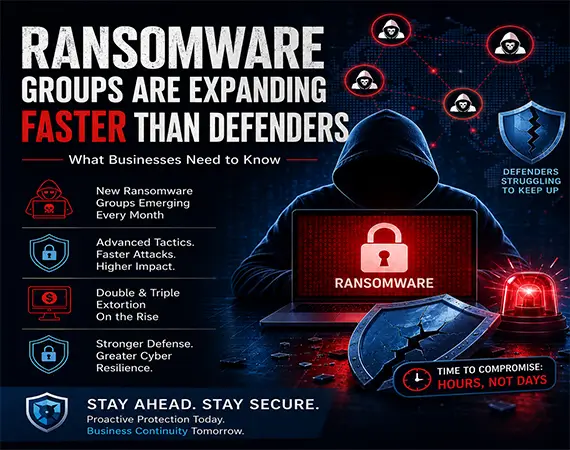
Ransomware Groups Are Expanding Faster Than Defenders: What Businesses Need to Know
Introduction
A decade ago, ransomware attacks were largely viewed as opportunistic cybercrimes. Attackers would send mass phishing emails, infect a few systems, and hope someone paid the ransom. Today, ransomware has evolved into a sophisticated, multi-billion-dollar criminal industry that operates with the efficiency of a legitimate business.
Modern ransomware gangs recruit affiliates, maintain customer support portals, negotiate payments, conduct marketing campaigns on dark web forums, and continuously refine their attack methods. Meanwhile, businesses across North Carolina and throughout the United States are struggling to keep pace with rapidly evolving cybersecurity threats.
The numbers tell a concerning story. New ransomware groups continue to emerge every month. Existing ransomware operators are becoming more efficient. Attacks that once took weeks to execute can now occur within hours. Security teams, already stretched thin by staffing shortages and increasing workloads, are often forced into a reactive posture.
The challenge is not simply that ransomware attacks are increasing. The more pressing concern is that ransomware groups are expanding faster than defenders can adapt.
For small and medium-sized businesses in Raleigh, Durham, Cary, and across North Carolina, this trend presents a significant risk. Organizations that once believed they were too small to attract cybercriminals are increasingly finding themselves in the crosshairs of sophisticated ransomware operators.
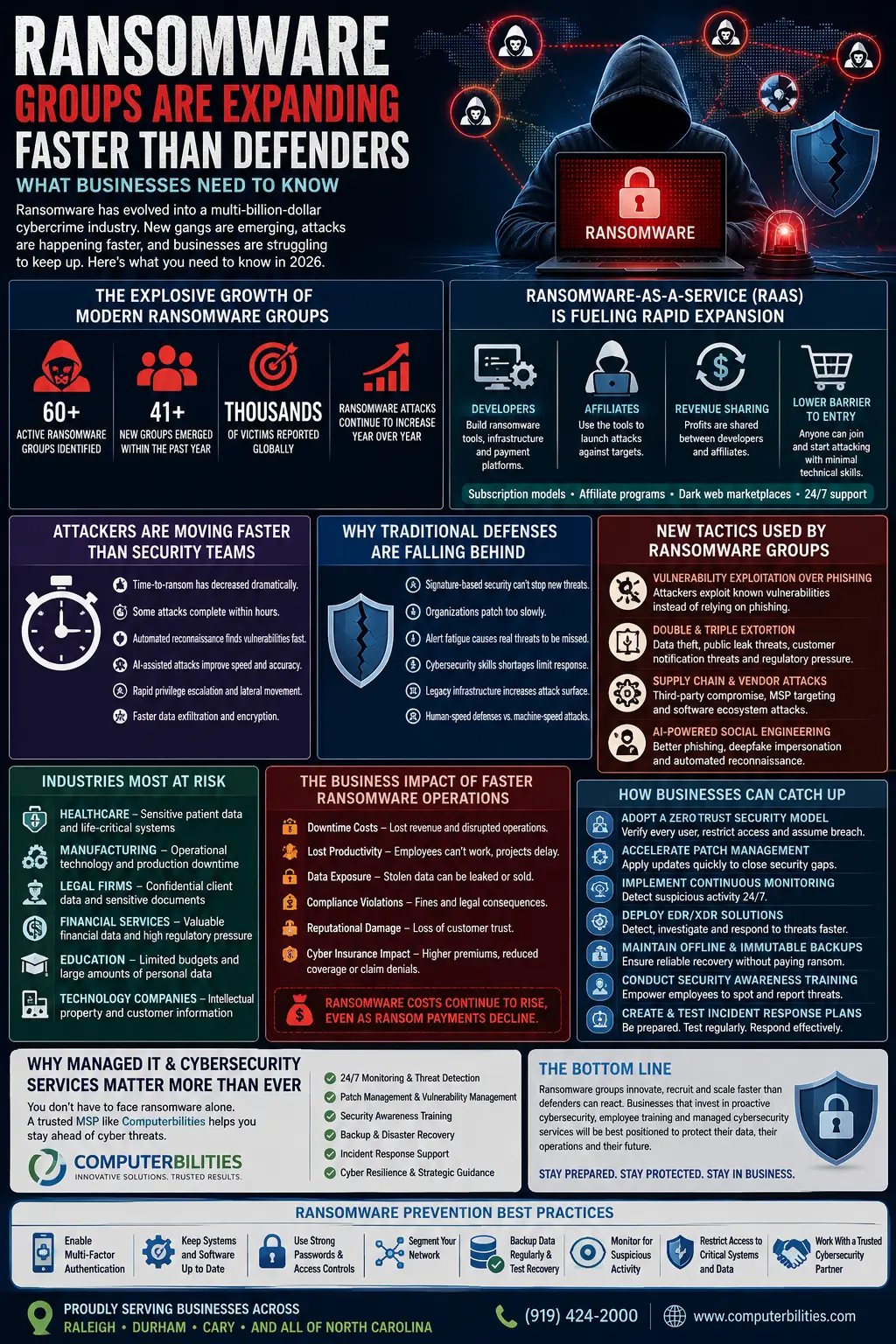
The Explosive Growth of Modern Ransomware Groups
The ransomware landscape has changed dramatically over the last few years. What was once dominated by a handful of major threat actors has evolved into a crowded ecosystem of cybercriminal organizations operating around the globe.
Security researchers have identified more than 60 active ransomware groups, with dozens of new groups emerging annually. In some threat intelligence reports, more than 40 new ransomware gangs appeared within a single year.
At first glance, this may seem surprising. Governments and international law enforcement agencies have successfully disrupted several major ransomware operations. Yet every time one group disappears, multiple new groups emerge to fill the gap.
This phenomenon resembles a game of cybersecurity whack-a-mole. Eliminating one threat actor rarely eliminates the underlying ecosystem that supports ransomware operations.
Why New Ransomware Groups Keep Emerging
Several factors contribute to this rapid growth:
Low Startup Costs
Unlike traditional businesses, ransomware groups require very little infrastructure to begin operations. Cybercriminals can purchase tools, stolen credentials, malware kits, and access services through underground marketplaces.
High Profit Potential
Ransomware remains one of the most profitable forms of cybercrime. Successful attacks can generate hundreds of thousands or even millions of dollars in ransom payments.
Easy Access to Criminal Resources
The dark web provides access to:
- Malware developers
- Initial access brokers
- Data brokers
- Cryptocurrency laundering services
- Stolen credentials
As a result, aspiring cybercriminals can enter the ransomware ecosystem with relatively little technical expertise.
Global Recruitment
Many ransomware organizations actively recruit affiliates from around the world. These affiliates execute attacks while sharing profits with ransomware developers.
This decentralized structure enables rapid expansion and makes disruption more difficult.
Why This Matters for Businesses
For businesses in North Carolina, the growing number of ransomware groups increases the likelihood of becoming a target.
More attackers mean:
- More attack campaigns
- More vulnerability scanning
- More phishing attempts
- More supply chain compromises
- More opportunities for systems to be breached
The threat landscape is no longer limited to a few well-known ransomware gangs. Organizations must now defend against a constantly evolving network of emerging ransomware groups.
Ransomware-as-a-Service (RaaS) Is Fueling Rapid Expansion
One of the primary reasons ransomware groups are expanding faster than defenders is the rise of Ransomware-as-a-Service (RaaS).
The RaaS model has transformed ransomware from a specialized cybercrime into a scalable business operation.
Think of it as the criminal equivalent of a software subscription service.
Instead of building ransomware from scratch, attackers can simply subscribe to an existing platform and begin launching attacks almost immediately.
How Ransomware-as-a-Service Works
A typical RaaS operation consists of two groups:
Developers
Developers create:
- Encryption tools
- Payment portals
- Negotiation systems
- Malware infrastructure
They maintain and improve the ransomware platform over time.
Affiliates
Affiliates conduct attacks using the developer’s tools.
Their responsibilities include:
- Finding targets
- Gaining initial access
- Deploying ransomware
- Negotiating payments
Revenue is shared between developers and affiliates, often through profit-sharing arrangements.
Why RaaS Is So Dangerous
The RaaS model dramatically lowers the barrier to entry.
In the past, launching a ransomware campaign required extensive technical expertise.
Today, cybercriminals can:
- Purchase access to ransomware platforms
- Receive technical support
- Access training materials
- Utilize established attack infrastructure
As a result, ransomware operators can scale much faster than traditional cybersecurity teams.
The Business Model Behind Modern Ransomware
Many ransomware gangs now operate with structures that resemble legitimate companies.
They offer:
- Affiliate programs
- Revenue-sharing agreements
- Customer support
- Product updates
- Technical documentation
Some groups even maintain performance metrics and recruitment initiatives.
This business-oriented approach allows ransomware groups to grow rapidly while continuously improving operational efficiency.
For defenders, this means they are no longer facing isolated hackers. They are competing against organized cybercriminal enterprises that invest heavily in innovation and expansion.
Attackers Are Moving Faster Than Security Teams
Perhaps the most alarming ransomware trend in 2026 is speed.
The time between initial compromise and ransomware deployment has shrunk dramatically.
In many incidents, attackers can move from infiltration to encryption within hours.
For businesses, this leaves little room for error.
The Rise of Automated Reconnaissance
Modern ransomware operators use automation to identify vulnerable targets.
Automated tools can:
- Scan internet-facing systems
- Identify software vulnerabilities
- Locate exposed credentials
- Detect misconfigured cloud environments
These tools allow attackers to evaluate thousands of potential targets simultaneously.
Security teams, by contrast, often rely on manual processes that cannot operate at the same speed.
AI-Assisted Attacks
Artificial intelligence is becoming a force multiplier for cybercriminals.
Attackers are using AI to:
- Generate convincing phishing emails
- Create realistic social engineering campaigns
- Analyze stolen data
- Identify high-value targets
AI helps ransomware gangs scale operations while reducing the resources required to conduct attacks.
Faster Privilege Escalation
Once attackers gain initial access, they move quickly to expand their control.
Modern ransomware campaigns often include:
- Credential theft
- Privilege escalation
- Lateral movement
- Network discovery
Automation enables these activities to occur far more rapidly than in previous years.
Data Theft Before Encryption
Today’s ransomware attacks rarely focus solely on encryption.
Instead, attackers frequently:
- Gain access.
- Steal sensitive data.
- Establish persistence.
- Deploy ransomware.
This strategy increases pressure on victims because the threat extends beyond operational disruption.
Even organizations with strong backup strategies may face extortion if confidential data is exposed.
For many businesses, the consequences of public data disclosure can be more damaging than system downtime itself.
Why Traditional Defenses Are Falling Behind
Many organizations still rely on cybersecurity strategies that were effective five or ten years ago. Unfortunately, ransomware gangs have evolved far beyond those traditional defenses.
While businesses continue to depend on antivirus software, periodic vulnerability scans, and manual monitoring, ransomware operators are leveraging automation, artificial intelligence, and sophisticated attack frameworks. The result is an increasingly uneven playing field.
Signature-Based Security Is No Longer Enough
Traditional antivirus solutions primarily rely on known malware signatures. This approach works well against previously identified threats but struggles against modern ransomware variants that are constantly modified to evade detection.
Many ransomware groups now use:
- Polymorphic malware that changes its code
- Fileless attack techniques
- Living-off-the-land tactics that abuse legitimate system tools
- Customized ransomware payloads for individual targets
Because these attacks often look different from known threats, signature-based detection alone is no longer sufficient.
Organizations Patch Too Slowly
Cybercriminals often exploit vulnerabilities within days—or even hours—of public disclosure. Meanwhile, businesses may take weeks or months to deploy critical updates.
Several factors contribute to patching delays:
- Legacy systems that cannot be updated easily
- Limited IT resources
- Fear of operational disruption
- Complex software dependencies
Unfortunately, ransomware operators understand this reality and actively scan for unpatched systems.
Alert Fatigue Is a Growing Problem
Security teams receive thousands of alerts daily. Many are false positives, causing analysts to spend valuable time investigating benign activity.
Over time, this creates alert fatigue, making it easier for genuine threats to slip through unnoticed.
Cybersecurity Skills Shortages Continue to Grow
The cybersecurity workforce gap remains a major challenge across the United States. Small and medium-sized businesses in Raleigh, Durham, Cary, and throughout North Carolina often lack dedicated cybersecurity personnel.
Without specialized expertise, organizations struggle with:
- Threat detection and response
- Vulnerability management
- Incident response planning
- Security monitoring
This skills shortage creates opportunities for ransomware gangs to exploit weaknesses before they are identified.
Human-Speed Defenses vs. Machine-Speed Attacks
The core issue is simple: attackers increasingly operate at machine speed, while defenders often operate at human speed.
Automated ransomware campaigns can:
- Discover vulnerabilities instantly
- Launch attacks automatically
- Move laterally across networks rapidly
Defenders who rely solely on manual processes cannot realistically keep pace.
The New Tactics Used by Ransomware Groups
Modern ransomware operators are constantly refining their methods. Understanding these evolving tactics is essential for developing effective ransomware defense strategies.
Vulnerability Exploitation Over Phishing
Phishing remains a common attack vector, but many ransomware gangs are increasingly prioritizing vulnerability exploitation.
Rather than convincing users to click malicious links, attackers often:
- Exploit internet-facing applications
- Target VPN vulnerabilities
- Abuse remote desktop services
- Exploit unpatched software
This approach allows cybercriminals to bypass user awareness defenses entirely.
For businesses, this highlights the importance of proactive vulnerability management and timely patching.
Double and Triple Extortion
Ransomware extortion has evolved significantly.
In the past, attackers encrypted data and demanded payment for decryption keys.
Today, many ransomware operators employ double extortion tactics:
Data Theft
Before encrypting systems, attackers steal sensitive information.
Public Leak Threats
If victims refuse to pay, attackers threaten to publish stolen data.
Customer Notification Threats
Some ransomware gangs directly contact customers, partners, or stakeholders to increase pressure.
Regulatory Pressure
Organizations subject to compliance regulations may face fines and reporting obligations if sensitive data is exposed.
Triple extortion significantly increases the leverage attackers have over victims.
Supply Chain and Vendor Attacks
Cybercriminals increasingly recognize that attacking one organization can provide access to many others.
Common targets include:
- Managed service providers (MSPs)
- Software vendors
- Cloud service providers
- Third-party suppliers
By compromising trusted partners, ransomware groups can gain access to numerous organizations simultaneously.
For North Carolina businesses, evaluating vendor security practices has become a critical component of cyber resilience.
AI-Powered Social Engineering
Artificial intelligence is transforming cybercrime.
Attackers now use AI to create:
- Highly personalized phishing emails
- Deepfake voice messages
- Fraudulent video communications
- Automated reconnaissance reports
These techniques make attacks more convincing and difficult to detect.
Employees who could previously identify obvious phishing attempts may struggle against AI-generated communications that appear authentic.
Industries Most at Risk
While no organization is immune from ransomware attacks, certain industries face elevated risk due to the nature of their operations and data.
Healthcare
Healthcare organizations store highly sensitive patient information and rely on uninterrupted access to critical systems.
Ransomware can directly impact patient care, creating pressure to restore operations quickly.
Manufacturing
Manufacturers increasingly depend on connected technologies and operational systems.
Even a few hours of downtime can result in:
- Production delays
- Revenue losses
- Supply chain disruptions
This operational urgency makes manufacturing organizations attractive targets.
Legal Firms
Law firms manage confidential client information, contracts, intellectual property, and litigation records.
The sensitivity of this data makes legal organizations appealing ransomware targets.
Financial Services
Banks, credit unions, and financial institutions possess valuable financial data and often face strict regulatory requirements.
Attackers understand that disruptions can have significant consequences.
Education
Schools, colleges, and universities frequently operate with limited cybersecurity budgets while maintaining large amounts of personal information.
These factors make educational institutions vulnerable.
Technology Companies
Technology firms often possess intellectual property, proprietary code, and customer information that cybercriminals can monetize.
Why These Industries Are Targeted
Common factors include:
- Sensitive data
- High operational urgency
- Greater likelihood of ransom payment
- Regulatory compliance obligations
- Complex digital environments
Organizations within these sectors must prioritize cybersecurity strategies against ransomware threats.
The Business Impact of Faster Ransomware Operations
Many organizations focus on the ransom itself, but the broader business impact often exceeds the ransom payment.
Downtime Costs
Operational downtime remains one of the most expensive consequences of ransomware attacks.
Every hour of disruption can affect:
- Revenue generation
- Customer service
- Employee productivity
- Supply chain operations
Lost Productivity
Employees cannot perform their responsibilities when systems become unavailable.
Even after recovery, organizations often spend weeks restoring normal operations.
Data Exposure
Data theft can expose:
- Customer information
- Financial records
- Employee data
- Proprietary business information
The resulting damage can persist long after systems are restored.
Compliance Violations
Organizations subject to regulations may face:
- Investigation costs
- Reporting obligations
- Legal expenses
- Regulatory penalties
Reputational Damage
Trust is difficult to earn and easy to lose.
Customers may hesitate to do business with organizations that experience highly publicized ransomware incidents.
Cyber Insurance Challenges
Insurance providers are increasingly scrutinizing cybersecurity controls before issuing policies.
Organizations with weak security practices may face:
- Higher premiums
- Reduced coverage
- Coverage exclusions
Even as ransom payments decline in some sectors, overall ransomware-related losses continue to rise.
How Businesses Can Catch Up
The good news is that organizations are not powerless against ransomware. By implementing modern cybersecurity practices, businesses can significantly reduce risk.
Adopt a Zero Trust Security Model
Zero Trust Security assumes no user or device should be trusted automatically.
Key principles include:
- Verify every access request
- Enforce least-privilege access
- Continuously validate identities
- Monitor network activity
Accelerate Patch Management
Timely patching remains one of the most effective ransomware prevention strategies.
Organizations should:
- Prioritize critical vulnerabilities
- Automate patch deployment where possible
- Maintain accurate asset inventories
Implement Continuous Monitoring
Cyber threats do not operate on business hours.
Continuous monitoring enables organizations to identify suspicious activity before attackers achieve their objectives.
Deploy EDR and XDR Solutions
Endpoint Detection and Response (EDR) and Extended Detection and Response (XDR) provide visibility into malicious behavior across environments.
These tools improve:
- Threat detection and response
- Incident investigation
- Attack containment
Maintain Offline and Immutable Backups
Backups remain a critical defense against ransomware.
Organizations should:
- Store backups offline
- Test recovery procedures regularly
- Implement immutable backup solutions
Conduct Security Awareness Training
Employees remain an important layer of defense.
Regular security awareness training helps staff identify:
- Phishing attempts
- Social engineering tactics
- Suspicious communications
Create and Test Incident Response Plans
An incident response plan can dramatically reduce recovery times.
Organizations should regularly test:
- Communication procedures
- Recovery workflows
- Escalation processes
Preparation often determines whether an attack becomes a manageable disruption or a business crisis.
Why Managed IT and Cybersecurity Services Matter More Than Ever
As ransomware groups continue expanding faster than defenders, many organizations recognize they cannot address these threats alone.
For small and medium-sized businesses across Raleigh, Durham, Cary, and the broader North Carolina region, partnering with an experienced cybersecurity provider can significantly strengthen defenses.
At Computerbilities, we help businesses improve cyber resilience through proactive security measures designed to identify threats before they become costly incidents.
Our cybersecurity services include:
24/7 Monitoring
Continuous monitoring enables rapid detection of suspicious activity and emerging threats.
Threat Detection and Response
Advanced threat detection technologies help identify ransomware activity before it spreads throughout the network.
Patch Management
Keeping systems updated reduces exposure to known ransomware vulnerabilities.
Security Awareness Training
Employees receive practical guidance on identifying phishing attempts, social engineering attacks, and other cybersecurity threats.
Backup and Disaster Recovery
Comprehensive backup strategies help organizations recover quickly if an incident occurs.
Incident Response Support
When cybersecurity events happen, rapid response can significantly reduce business impact.
Managed cybersecurity services provide businesses with access to specialized expertise, advanced technologies, and proactive protection that would otherwise be difficult and costly to maintain internally.
Frequently Asked Questions
What is ransomware-as-a-service (RaaS)?
Ransomware-as-a-Service is a business model in which ransomware developers create attack platforms that affiliates use to conduct attacks. Profits are shared between developers and affiliates, allowing ransomware operations to scale rapidly.
Why are ransomware groups growing faster than defenders?
Ransomware groups leverage automation, artificial intelligence, affiliate networks, and ransomware-as-a-service platforms, enabling them to expand more quickly than many organizations can strengthen their cybersecurity defenses.
How can small businesses protect themselves from ransomware attacks?
Small businesses should implement multi-factor authentication, regular patching, endpoint detection and response solutions, employee security awareness training, offline backups, and continuous monitoring.
What industries face the highest ransomware risk?
Healthcare, manufacturing, legal services, financial services, education, and technology companies are among the industries most frequently targeted by ransomware operators.
Does cyber insurance protect against ransomware?
Cyber insurance may help cover certain costs associated with ransomware incidents, but coverage varies by policy and often requires organizations to maintain strong cybersecurity controls.
What is the most effective ransomware prevention strategy?
There is no single solution. The most effective approach combines Zero Trust Security, vulnerability management, threat detection and response, security awareness training, backup protection, and incident response planning.
Conclusion
Ransomware groups are no longer operating like isolated hackers working from the shadows. They function as highly organized criminal enterprises that innovate, recruit affiliates, refine attack techniques, and scale operations with remarkable speed.
Unfortunately, many organizations continue relying on outdated cybersecurity strategies that cannot keep pace with modern ransomware threats. As ransomware-as-a-service platforms expand, attack automation increases, and AI-powered social engineering becomes more sophisticated, the gap between attackers and defenders continues to widen.
For businesses throughout North Carolina—including Raleigh, Durham, Cary, and surrounding communities—the stakes have never been higher. The organizations that succeed will be those that move beyond reactive security and embrace proactive cyber resilience.
By investing in layered security controls, continuous monitoring, vulnerability management, employee training, incident response planning, and managed cybersecurity services, businesses can significantly reduce ransomware risk and strengthen their ability to withstand the next generation of cyber threats.
The question is no longer whether ransomware groups will continue expanding. They will.
The real question is whether your organization will be prepared when they come looking for their next target.