
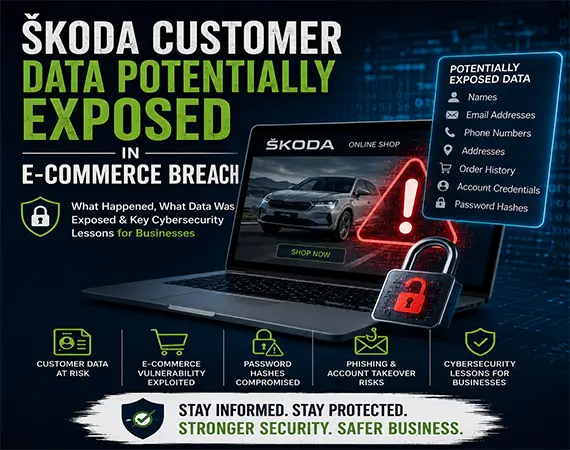
Škoda Customer Data Potentially Exposed in E-Commerce Breach: What Businesses Need to Learn
Cybersecurity incidents continue to make headlines across industries, and the automotive sector is no exception. Recently, Škoda Auto disclosed a security incident involving its online shop that may have exposed customer information after attackers exploited a vulnerability in its e-commerce platform. While the investigation is ongoing, the incident serves as another reminder that even globally recognized brands remain vulnerable to cyber threats targeting online retail environments.
The Škoda customer data breach has attracted significant attention because it highlights a growing cybersecurity risk in e-commerce: vulnerabilities within third-party software and online store infrastructure. As businesses increasingly rely on digital platforms to sell products and engage customers, cybercriminals are finding new opportunities to exploit weaknesses that may lead to unauthorized access to customer data.
For organizations across Raleigh, Durham, Cary, and throughout North Carolina, the incident offers valuable lessons about cybersecurity monitoring, vendor risk management, incident response planning, and protecting customer information. Whether your business operates an online store or simply manages customer data, understanding what happened and why it matters can help strengthen your cybersecurity strategy.
What Happened in the Škoda Data Breach?
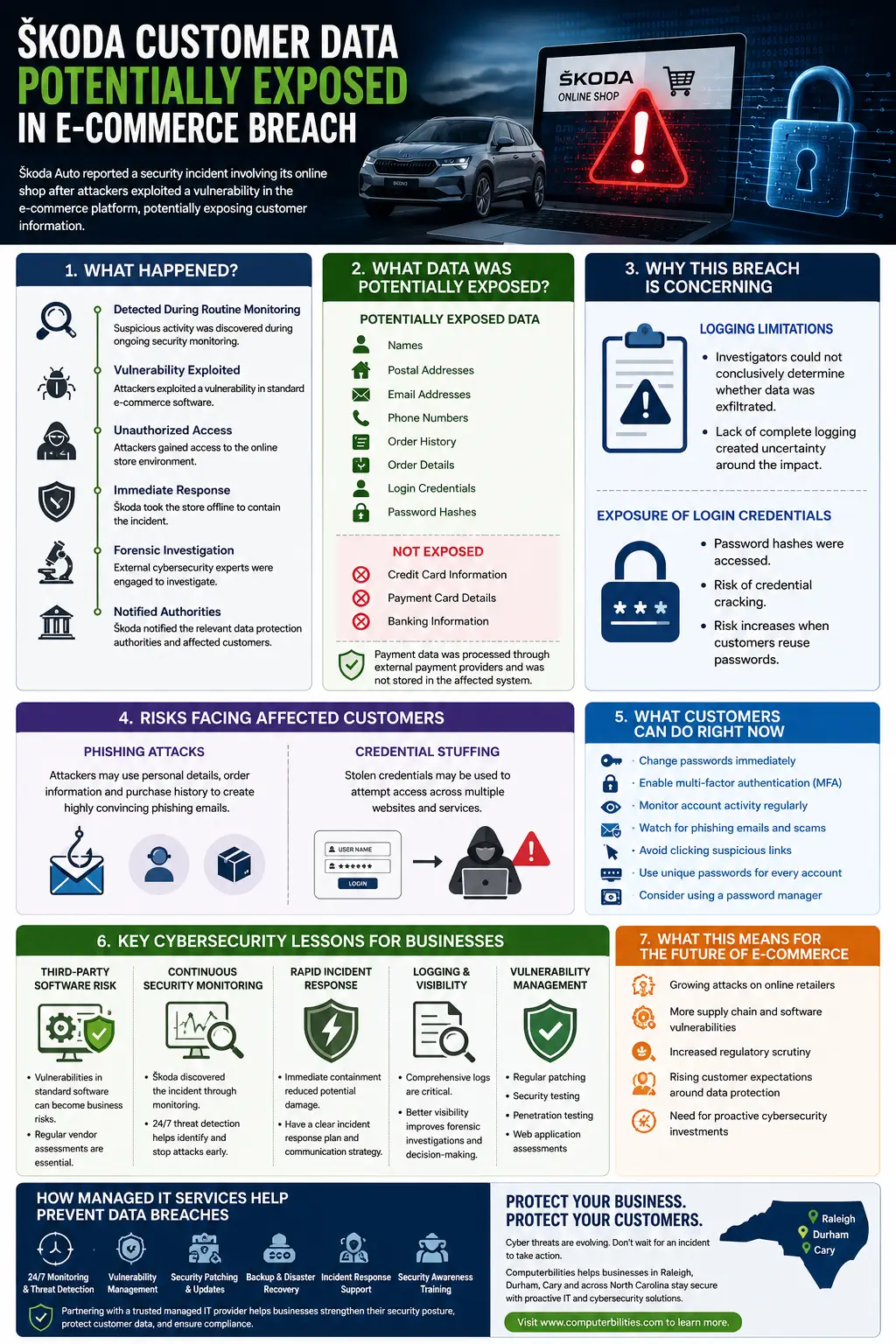
According to reports, Škoda discovered suspicious activity affecting its online store during routine security monitoring. Upon investigation, the company identified unauthorized access within its e-commerce environment. Early findings suggested attackers exploited a vulnerability in standard e-commerce software used by the online shop.
Unlike many cyberattacks that remain undetected for months, the incident was discovered through ongoing monitoring efforts. This allowed Škoda to respond quickly and initiate containment procedures before the situation potentially escalated further.
Immediate Response Measures
Once the issue was identified, Škoda took several important actions:
- Temporarily took the affected online store offline
- Began a forensic investigation
- Engaged external cybersecurity specialists
- Assessed the scope of the incident
- Notified appropriate authorities
- Started communicating with potentially affected customers
This response demonstrates a key principle of effective cybersecurity: speed matters. The sooner an organization identifies and contains a breach, the lower the potential impact.
How Attackers Gained Access
Current information suggests attackers leveraged an online shop vulnerability within the e-commerce environment. While technical details remain limited, incidents like this often involve:
- Unpatched software vulnerabilities
- Misconfigured web applications
- Third-party software weaknesses
- Compromised administrative accounts
- Insecure integrations between systems
The event reinforces the importance of vulnerability management and proactive security testing for all businesses that operate customer-facing digital platforms.
What Customer Information Was Potentially Exposed?
One of the most important questions following any customer data breach is determining exactly what information may have been accessed.
According to available reports, attackers potentially gained access to various categories of customer data associated with online shop accounts and purchase activity.
Information Potentially Exposed
The exposed data may include:
- Customer names
- Postal addresses
- Email addresses
- Phone numbers
- Purchase history
- Order details
- Account login information
- Password hashes
Although the exposure of names and contact information is concerning, the inclusion of login credentials and password hashes raises additional cybersecurity concerns.
Information Not Believed to Be Exposed
Fortunately, reports indicate that the following information was not stored within the compromised environment:
- Credit card numbers
- Debit card information
- Banking details
- Payment processing data
This separation significantly reduced the potential financial impact of the incident.
Why Payment Data Was Protected
Many modern e-commerce platforms utilize third-party payment processors to handle sensitive payment information. Rather than storing credit card data internally, transactions are processed through specialized payment providers that maintain their own security controls and compliance requirements.
This architecture helps reduce risk by limiting the amount of sensitive financial information stored within the retailer’s systems.
Why This Breach Is Particularly Concerning
Not all breaches present the same level of risk. Several factors make the Škoda cybersecurity incident especially noteworthy.
Logging Limitations Created Uncertainty
One of the challenges investigators faced involved incomplete logging data.
In cybersecurity investigations, logs serve as digital evidence. They help security teams determine:
- When attackers entered a system
- Which accounts were accessed
- What information was viewed
- Whether data was downloaded
- How long attackers remained active
In this case, investigators reportedly could not conclusively determine whether customer data was actually exfiltrated.
While there is evidence that attackers gained access, uncertainty remains regarding the extent of information removal.
This situation highlights an important lesson for businesses: visibility matters. Without comprehensive logging, organizations may struggle to fully understand the impact of a security incident.
Password Hash Exposure Creates Additional Risks
Another concern involves password hash exposure.
A password hash is not the actual password. Instead, it is a cryptographic representation of the password stored by a system.
While hashing provides protection, it is not foolproof.
Cybercriminals may attempt to:
- Crack weak password hashes
- Use automated tools to recover credentials
- Launch credential stuffing attacks
- Test recovered passwords across other services
The risk increases dramatically when users reuse the same password across multiple platforms.
For example, if a customer uses identical credentials for their online shopping account, email account, and banking platform, a compromised password can potentially open the door to multiple account takeovers.
Risks Facing Affected Customers
Although payment information may not have been exposed, customers still face several cybersecurity risks following a breach of this nature.
Phishing Attacks Become More Convincing
Cybercriminals frequently exploit stolen customer information to launch targeted phishing campaigns.
Using details such as:
- Customer names
- Purchase history
- Order information
- Contact details
attackers can create highly convincing emails that appear legitimate.
A phishing email referencing a recent purchase from the Škoda online store is far more likely to deceive recipients than a generic spam message.
These attacks may attempt to:
- Steal passwords
- Install malware
- Capture financial information
- Gain access to business systems
This is why customers should remain cautious of any unexpected emails, texts, or calls claiming to be associated with the incident.
Credential Stuffing and Account Takeover Risks
Beyond phishing attacks, one of the most significant dangers associated with the Škoda online shop customer data leak is the potential for credential stuffing attacks.
Credential stuffing occurs when cybercriminals use stolen usernames and passwords from one platform to attempt access to other online accounts. Since many people reuse the same password across multiple websites, a single compromised account can quickly lead to a chain reaction of security incidents.
Imagine a customer uses the same password for:
- Their Škoda online shop account
- Personal email account
- Online banking portal
- Business applications
- Social media platforms
If attackers successfully crack a password hash, they may use automated tools to test those credentials across hundreds of popular websites. Even a small success rate can result in significant account compromise.
For businesses, this risk extends beyond consumers. Employees who reuse passwords across work and personal accounts may unintentionally expose company systems to unauthorized access.
This is why cybersecurity professionals consistently recommend strong password security best practices, including unique passwords for every account and multi-factor authentication (MFA) whenever available.
Key Cybersecurity Lessons for Businesses
While the headlines focus on Škoda, the broader lesson applies to every organization that relies on digital platforms to serve customers.
For small and medium-sized businesses throughout Raleigh, Durham, Cary, and across North Carolina, this incident serves as a valuable case study in cybersecurity preparedness.
Third-Party Software Risk Is Business Risk
Many organizations assume cybersecurity risks only originate from their own systems.
In reality, modern businesses depend heavily on:
- E-commerce platforms
- Customer relationship management systems
- Cloud applications
- Payment processors
- Marketing platforms
- Software integrations
Each third-party solution introduces potential cybersecurity exposure.
The Škoda e-commerce breach demonstrates how vulnerabilities within standard software can become major business problems.
Organizations should regularly evaluate:
- Vendor security practices
- Patch management processes
- Compliance certifications
- Data handling procedures
- Incident response capabilities
Vendor risk management should be viewed as a core cybersecurity function rather than an administrative exercise.
Continuous Security Monitoring Makes a Difference
One reason the incident was discovered relatively quickly was the presence of security monitoring.
Cyber threats do not operate on a schedule.
Attackers often attempt access:
- Overnight
- During weekends
- On holidays
- During periods of reduced staffing
Without continuous cybersecurity monitoring, malicious activity can remain undetected for weeks or even months.
Effective monitoring solutions provide:
- Real-time threat detection
- Suspicious login alerts
- Unusual activity identification
- Rapid investigation capabilities
- Automated security responses
The faster an organization detects a threat, the faster it can contain the damage.
Incident Response Planning Reduces Damage
No organization can guarantee complete immunity from cyberattacks.
What separates resilient organizations from vulnerable ones is their ability to respond effectively.
Škoda’s immediate response included:
- Containment measures
- System isolation
- Forensic investigation
- Customer notification
- Regulatory communication
Businesses should establish formal cyber incident response plans that define:
- Roles and responsibilities
- Escalation procedures
- Communication protocols
- Recovery strategies
- Legal and compliance requirements
Waiting until an attack occurs is too late.
Logging and Visibility Are Essential
The uncertainty surrounding data exfiltration highlights a challenge many organizations face: inadequate visibility.
Security logs provide crucial evidence during investigations.
Without comprehensive logging, businesses may struggle to determine:
- What happened
- When it happened
- Who was affected
- What data was accessed
Organizations should prioritize:
- Centralized logging
- Security information and event management (SIEM)
- Extended log retention
- Automated alerting
- Continuous review of security events
Greater visibility leads to faster investigations and more informed decision-making.
Vulnerability Management Must Be Continuous
The root cause of many breaches is surprisingly simple: unpatched vulnerabilities.
Threat actors continuously scan the internet looking for systems running outdated software.
A strong vulnerability management program should include:
- Regular software updates
- Security patch deployment
- Vulnerability scanning
- Penetration testing
- Web application assessments
- Configuration reviews
Cybersecurity is not a one-time project. It requires ongoing attention and continuous improvement.
How Customers Can Protect Themselves
Customers affected by the Škoda customer data breach should take proactive steps to reduce their risk.
Change Passwords Immediately
Any potentially exposed account credentials should be updated immediately.
Use:
- Strong passwords
- Long passphrases
- Unique credentials for each account
Avoid password reuse whenever possible.
Enable Multi-Factor Authentication
MFA adds an additional layer of protection.
Even if a password becomes compromised, attackers are unlikely to gain access without the second authentication factor.
Monitor Account Activity
Review:
- Login history
- Account settings
- Purchase activity
- Email forwarding rules
Unexpected changes may indicate unauthorized access.
Be Alert for Phishing Attempts
Customers should be cautious of:
- Unexpected emails
- Urgent requests
- Suspicious attachments
- Requests for personal information
Always verify communications through official channels.
Use a Password Manager
Password managers make it easier to maintain unique passwords across all accounts while improving overall security.
What This Means for the Future of E-Commerce Security
The Škoda cybersecurity incident reflects a broader trend affecting organizations worldwide.
Cybercriminals increasingly target:
- Online retailers
- E-commerce platforms
- Customer portals
- Cloud applications
- Software supply chains
Several trends are likely to continue shaping the future of cybersecurity:
Increased Supply Chain Attacks
Attackers recognize that compromising a single vendor can provide access to multiple organizations.
Greater Regulatory Oversight
Governments and regulatory bodies continue to strengthen requirements related to:
- Data protection
- Breach disclosure
- Consumer privacy
- Security controls
Rising Customer Expectations
Consumers increasingly expect organizations to:
- Protect personal information
- Respond quickly to incidents
- Communicate transparently
- Invest in cybersecurity
Proactive Security Investments
Organizations are moving away from reactive approaches and investing in:
- Managed detection and response
- Security awareness training
- Threat intelligence
- Vulnerability management
- Zero-trust security architectures
How Managed IT Services Help Prevent Data Breaches
For many small and medium-sized businesses, maintaining enterprise-level cybersecurity capabilities internally can be challenging.
Managed IT services provide access to:
- 24/7 cybersecurity monitoring
- Vulnerability management
- Security patching
- Endpoint protection
- Backup and disaster recovery
- Security awareness training
- Incident response support
By partnering with a trusted IT provider, businesses can strengthen their security posture while focusing on their core operations.
At Computerbilities, we help organizations throughout Raleigh, Durham, Cary, and across North Carolina reduce cybersecurity risks through proactive monitoring, strategic IT management, and comprehensive security solutions designed to protect both business operations and customer data.
Conclusion
The Škoda customer data breach serves as another reminder that cybersecurity threats continue to evolve, particularly within e-commerce environments that store valuable customer information.
While the investigation remains ongoing, the incident highlights several critical lessons for businesses:
- Third-party software vulnerabilities can create significant risk.
- Continuous monitoring is essential for early threat detection.
- Incident response planning reduces business impact.
- Strong logging improves investigative capabilities.
- Vulnerability management remains one of the most effective security investments.
For organizations across North Carolina, the question is not whether cyber threats exist—it is whether your business is prepared to detect, respond to, and recover from them.
Investing in cybersecurity today can help prevent costly breaches tomorrow.
Frequently Asked Questions
What happened in the Škoda data breach?
Škoda reported unauthorized access to its online shop environment after attackers exploited a vulnerability in its e-commerce platform, potentially exposing customer information.
What customer information was potentially exposed?
Potentially exposed information includes names, email addresses, postal addresses, phone numbers, order history, account credentials, and password hashes.
Was payment card information compromised?
Reports indicate payment card information and banking details were not stored in the affected system and are not believed to have been exposed.
Why are password hashes important?
Although password hashes are encrypted representations of passwords, attackers may attempt to crack them and use recovered credentials in credential stuffing attacks.
How can affected customers protect themselves?
Customers should change passwords, enable MFA, monitor account activity, remain alert for phishing attempts, and avoid password reuse.
What is a credential stuffing attack?
Credential stuffing occurs when attackers use stolen usernames and passwords from one breach to attempt access to accounts on other websites.
How can businesses prevent e-commerce data breaches?
Businesses should implement vulnerability management, security monitoring, penetration testing, incident response planning, and vendor risk management practices.
Why is vendor risk management important?
Third-party software providers often have access to critical systems and data. Weak security practices among vendors can introduce significant cybersecurity risks.