
TELUS Digital Data Breach 2026: What Happened, Impact & Key Lessons for Businesses
In early 2026, the cybersecurity world was shaken by what many experts are calling one of the largest BPO-related breaches in recent history. The TELUS Digital breach—linked to the notorious hacker group ShinyHunters—has become a defining example of how modern cyberattacks are no longer confined to a single company.
Instead, they ripple across entire ecosystems.
For small and medium-sized businesses across Raleigh, Durham, Cary, and North Carolina, this incident is more than just headline news. It’s a warning.
Because if a global enterprise like TELUS Digital can be compromised, so can any business connected to today’s digital supply chain.
What Happened in the TELUS Digital Breach?
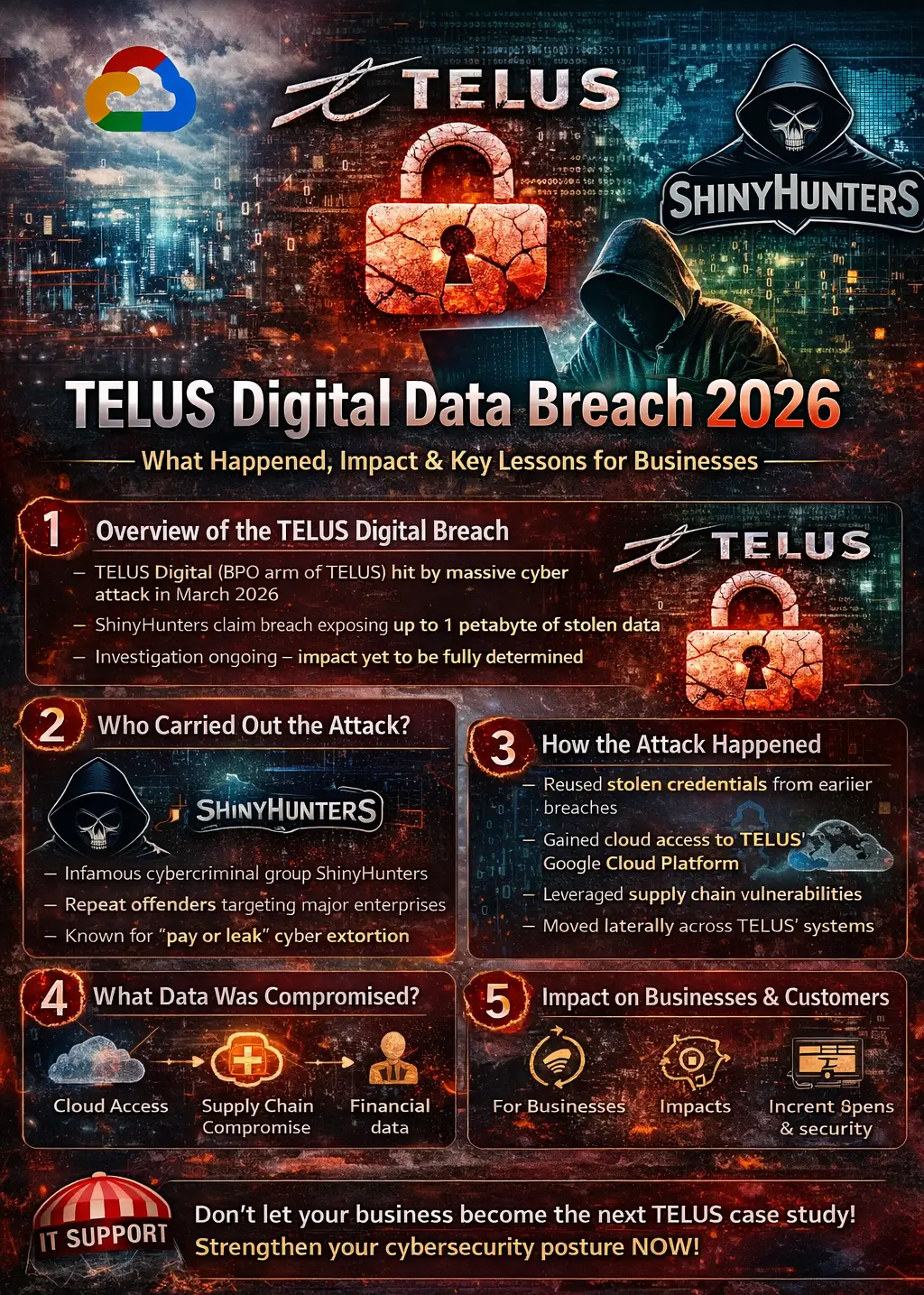
The TELUS Digital cybersecurity incident, confirmed in March 2026, involved unauthorized access to systems tied to its global business process outsourcing (BPO) operations.
What made headlines wasn’t just the breach—but the scale.
The hacking group ShinyHunters claimed to have accessed up to 1 petabyte of data, a staggering amount that could include customer records, internal systems, and sensitive enterprise information.
At the time of writing, investigations are still ongoing, and the full extent of the breach remains unclear.
But one thing is certain:
This wasn’t just a company breach — it was an ecosystem breach.
Who is Behind the Attack? Meet ShinyHunters
If the name sounds familiar, it should.
ShinyHunters has been linked to multiple high-profile cyberattacks over the years. Their signature approach?
- Target large organizations
- Extract massive datasets
- Demand ransom or threaten public leaks
This “pay or leak” cyber extortion model has proven highly effective—and increasingly common.
Unlike traditional hackers who focus on breaking systems, ShinyHunters focuses on exploiting weak points in identity, credentials, and third-party integrations.
How the TELUS Digital Cyberattack Happened
This is where things get particularly concerning.
The TELUS Digital cyberattack wasn’t a simple system hack—it was a supply chain cyberattack example that highlights how interconnected today’s systems are.
Key Attack Vectors:
- Credential Theft & Reuse
Hackers reportedly reused stolen credentials from earlier breaches (linked to platforms like Salesloft/Drift). - Cloud Access Exploitation
Access was gained to Google Cloud Platform (GCP) environments and BigQuery databases. - Credential Chaining
One compromised account led to another—like dominoes falling. - Lateral Movement
Once inside, attackers moved across systems to expand access.
Why This Matters
This wasn’t about breaking a firewall.
It was about exploiting:
- Identity and access management failure
- Cloud misconfigurations
- Third-party vulnerabilities
And that’s exactly why businesses today must rethink cybersecurity.
What Data Was Potentially Exposed?
While investigations continue, reports suggest that the TELUS data breach 2026 may have exposed:
- Customer data across multiple client organizations
- Personally identifiable information (PII)
- Call recordings and logs
- Financial and operational data
- Internal systems and possibly source code
Here’s the critical issue:
Because TELUS Digital operates as a BPO provider, it handles data for multiple enterprises.
So one breach doesn’t affect one company—it affects dozens, even hundreds.
Why This Breach is a Wake-Up Call for Enterprises
Let’s put it simply.
A traditional breach impacts one company.
A BPO breach impacts an entire network of businesses.
What This Incident Proves:
- Supply chain attacks are the new frontline
- Cloud security is only as strong as credential management
- Third-party vendors are often the weakest link
Think of it like this:
If your business is a house, your vendors are the doors.
And attackers don’t need to break your walls—they just need one unlocked door.
Ransom, Extortion & The Business of Cybercrime
Reports indicate that attackers demanded approximately $65 million in ransom.
That’s not unusual anymore.
Modern cybercriminal groups operate like businesses:
- They calculate ROI
- They target high-value data
- They leverage public pressure
The message is simple:
Pay—or we expose your data to the world.
Impact on Businesses and Customers
The ripple effects of the TELUS hack news extend far beyond the company itself.
For Businesses:
- Loss of sensitive enterprise data
- Regulatory risks (GDPR, HIPAA, etc.)
- Operational disruption
- Brand reputation damage
For Customers:
- Exposure of personal information
- Increased risk of identity theft
- Loss of trust
For SMBs in North Carolina, this is especially critical.
Because smaller businesses often lack the resources to recover from such incidents.
TELUS Response and Ongoing Investigation
TELUS confirmed the breach and stated that it is:
- Conducting a full investigation
- Working with cybersecurity experts
- Enhancing security protocols
- Monitoring affected systems
However, one point of discussion in the cybersecurity community is the timeline of disclosure.
In many breaches, delays in reporting can amplify damage.
Key Cybersecurity Lessons for Businesses
This incident offers powerful lessons—especially for SMBs.
- Third-Party Risk is Your Risk
Your vendors have access to your data.
If they’re compromised, so are you.
- Credential Security is Critical
Weak passwords and reused credentials are still one of the biggest threats.
- Cloud Security Requires Active Management
Cloud platforms are secure—but only if configured correctly.
- Adopt Zero Trust Architecture
Never trust, always verify.
Every access request should be authenticated and monitored.
- Incident Response Readiness
The faster you detect and respond, the less damage occurs.
Why BPO Companies Are Prime Targets
BPO providers like TELUS Digital are attractive targets because they:
- Handle large volumes of sensitive data
- Serve multiple industries
- Act as centralized hubs
To hackers, this is a goldmine.
The Bigger Trend: From Systems to Identities
Cybersecurity is evolving.
Attackers are no longer just hacking systems—they’re hacking identities.
This shift means:
- Credentials are more valuable than vulnerabilities
- Access is more powerful than exploits
And businesses must adapt accordingly.
How Managed IT Services Can Prevent Such Breaches
For businesses in Raleigh, Durham, Cary, and across North Carolina, prevention starts with the right partner.
With Managed IT Services, you can:
- Monitor systems 24/7
- Detect threats early
- Secure cloud environments
- Manage vendor risks
- Implement Zero Trust security
At Computerbilities, we help businesses stay ahead of evolving threats—so you’re not reacting after a breach, but preventing it.
Don’t let your business become the next TELUS case study.
FAQs
- What is the TELUS Digital breach 2026?
It is a major cybersecurity incident involving unauthorized access to TELUS Digital systems, potentially exposing large amounts of data.
- Who hacked TELUS Digital?
The breach has been linked to the cybercriminal group ShinyHunters.
- What data was compromised?
Potentially customer data, PII, call logs, and enterprise information.
- How did the attack happen?
Through credential theft, supply chain vulnerabilities, and cloud access exploitation.
- Why is this breach significant?
Because TELUS Digital serves multiple companies, the breach impacts an entire ecosystem.
- How can businesses prevent similar attacks?
By improving credential security, monitoring third-party risks, and adopting managed cybersecurity services.