
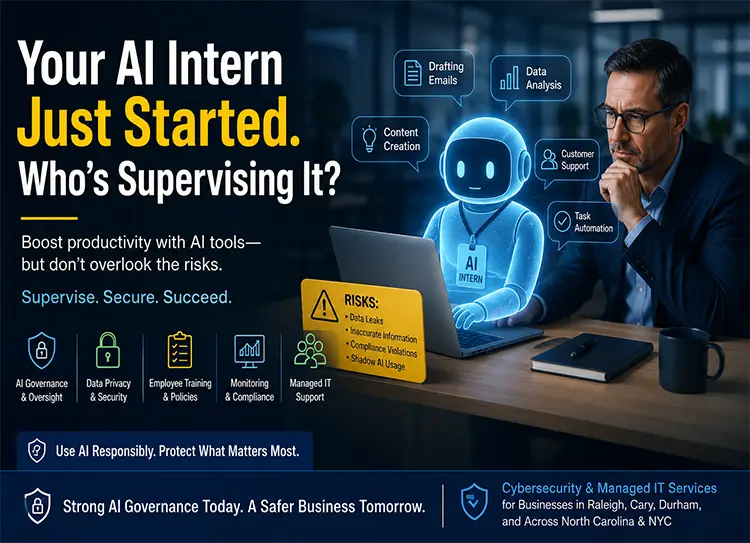
Your AI Intern Just Started. Who’s Supervising It?
Artificial intelligence is no longer a futuristic concept reserved for Silicon Valley tech giants. It’s already sitting in offices across Raleigh, Cary, Durham, New York City, and businesses throughout the United States—drafting emails, analyzing spreadsheets, summarizing meetings, automating customer support, and even generating reports in seconds.
The reality is simple: your employees are already using AI tools for business, whether leadership has approved them or not.
From ChatGPT and Microsoft Copilot to Google Gemini and AI-powered CRM platforms, workplace AI adoption is happening faster than many organizations can track. And while the productivity benefits are undeniable, there’s a growing problem many SMBs are overlooking:
Who’s supervising AI in the workplace?
Think about it this way. If you hired a new intern tomorrow and immediately gave them access to customer records, financial reports, confidential emails, and internal systems without oversight, you’d consider that risky. Yet many companies are unknowingly doing exactly that with generative AI in business.
AI works fast—but it also makes mistakes fast.
Without proper AI governance, cybersecurity oversight, and employee training, businesses could face data leakage, compliance violations, reputational damage, and serious AI cybersecurity risks.
For small and medium businesses in North Carolina and NYC, the challenge isn’t whether to adopt AI. The challenge is learning how to safely use AI while maintaining security, accountability, and compliance.
In this guide, we’ll explore:
- Why businesses are rapidly adopting AI
- The hidden risks of unsupervised AI usage
- Why AI governance matters
- How businesses can safely implement AI
- The role of managed IT services in AI security
- How Computerbilities helps businesses build a secure AI workplace
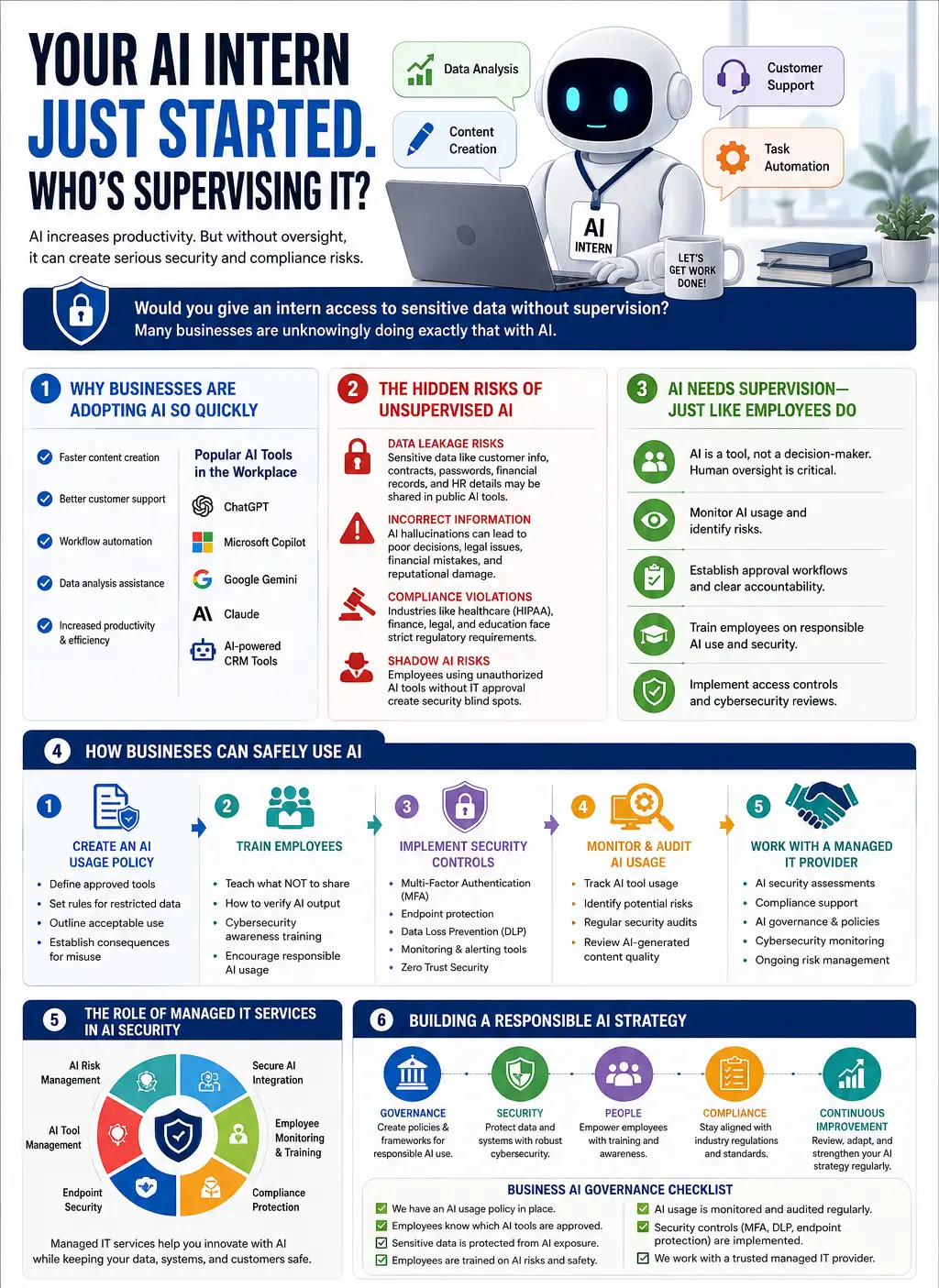
Why Employees Are Turning to AI Tools
The explosion of AI in the workplace didn’t happen by accident. Businesses are under constant pressure to improve efficiency, reduce operational costs, and remain competitive. AI offers an attractive solution because it can automate repetitive tasks and help employees work faster.
Today’s employees use AI tools for:
- Writing emails and proposals
- Creating marketing content
- Summarizing meetings
- Generating code
- Research assistance
- Data analysis
- Customer service automation
- Workflow management
- Brainstorming and strategic planning
Popular workplace AI tools include:
- ChatGPT
- Microsoft Copilot
- Google Gemini
- Claude
- AI-powered CRM systems
- AI scheduling assistants
- AI analytics platforms
For SMBs in Raleigh, Cary, and Durham, AI workplace productivity can be especially appealing because smaller teams often need to accomplish more with limited resources.
A five-person marketing department can suddenly produce content at the scale of a fifteen-person team. Customer support teams can respond faster. Sales departments can automate outreach. Executives can quickly analyze reports and trends.
The benefits are real.
But here’s where businesses often get caught off guard:
Employees frequently adopt AI tools without involving IT departments or cybersecurity teams.
This phenomenon is commonly known as Shadow AI—the use of unauthorized AI tools without company oversight.
And that’s where the risks begin.
The Hidden Security Risks of Workplace AI
AI automation risks are often underestimated because the tools themselves appear harmless and user-friendly. But beneath the convenience lies a complex web of cybersecurity, privacy, and compliance concerns.
Data Leakage Risks
One of the biggest AI cybersecurity concerns for SMBs is sensitive data exposure.
Employees may unknowingly upload:
- Customer records
- Financial data
- Internal business plans
- Contracts
- Employee information
- Passwords
- Legal documents
- Healthcare records
Into public AI systems.
Even when AI providers claim data protection measures, businesses still risk:
- Data retention issues
- Unauthorized access
- Third-party exposure
- Compliance violations
- Intellectual property leakage
For industries like healthcare, legal services, education, and finance, AI data privacy concerns become even more serious because of strict compliance regulations like HIPAA and data protection standards.
Imagine an employee pasting confidential client information into a public AI chatbot to summarize a report. That single action could expose sensitive business information without malicious intent.
That’s why AI oversight and accountability are becoming essential for modern businesses.
AI Hallucinations and Incorrect Information
AI systems can generate convincing but inaccurate information—commonly called “hallucinations.”
This creates serious risks, including:
- Legal mistakes
- Incorrect financial calculations
- Misleading customer communication
- False business recommendations
- Reputational damage
An employee relying entirely on AI-generated content without human review could unknowingly distribute inaccurate or harmful information.
AI should support employees—not replace human judgment.
Compliance Violations
Many SMBs don’t realize AI usage in the workplace may impact regulatory compliance.
Industries facing heightened risks include:
- Healthcare organizations handling patient records
- Financial firms processing sensitive financial data
- Legal firms managing confidential documentation
- Educational institutions storing student records
Without proper AI governance frameworks, businesses may unintentionally violate:
- HIPAA
- PCI DSS
- FERPA
- GDPR
- Industry-specific cybersecurity requirements
As AI regulations continue evolving, businesses that fail to establish governance strategies may face growing legal and financial exposure.
Shadow AI Risks
Shadow AI is rapidly becoming one of the biggest unmanaged technology risks for businesses.
Employees often use AI tools because:
- They want to work faster
- AI tools are easy to access
- Leadership hasn’t established clear policies
- There’s no approved AI implementation strategy
Unfortunately, unmanaged AI usage creates:
- Visibility gaps
- Security blind spots
- Compliance concerns
- Inconsistent data handling
- Increased cybersecurity exposure
Businesses cannot secure what they cannot see.
What Happens When AI Operates Without Oversight?
AI is incredibly capable—but it lacks context, ethics, accountability, and business judgment.
That’s why AI employee supervision matters.
Think of AI like a highly efficient intern:
- It can assist with tasks
- It can generate ideas
- It can accelerate workflows
- But it still requires supervision
No responsible business would allow an unsupervised intern to:
- Approve financial transactions
- Access confidential records
- Communicate with clients independently
- Make legal decisions
Yet businesses sometimes allow AI systems to influence these areas without oversight.
The result?
- Poor decisions
- Security incidents
- Compliance failures
- Operational confusion
Human oversight remains essential.
Why AI Governance Matters for Businesses
AI governance refers to the policies, controls, and oversight mechanisms businesses use to manage AI safely and responsibly.
An effective AI governance framework helps businesses:
- Define approved AI tools
- Protect sensitive data
- Establish accountability
- Monitor AI usage
- Reduce cybersecurity risks
- Ensure compliance
- Improve transparency
Without governance, AI becomes an unmanaged operational risk.
With governance, AI becomes a strategic productivity tool.
Businesses adopting AI implementation strategies early will likely gain competitive advantages while avoiding many of the security issues now emerging across industries.
How To Create Safe AI Usage Policies
Many businesses ask:
“How can companies supervise AI usage?”
The answer begins with a clear AI policy for employees.
- Define Approved AI Tools
Employees should know:
- Which AI tools are authorized
- Which platforms are prohibited
- What business purposes AI can support
For example:
Approved:
- Microsoft Copilot
- Secure enterprise AI platforms
Restricted:
- Public AI tools for confidential data
- Unverified third-party AI applications
- Establish Data Usage Rules
Businesses should clearly define:
- What data employees can upload
- What data is prohibited
- How AI-generated content should be reviewed
Sensitive information should never be shared with public AI systems unless explicitly authorized.
- Train Employees on AI Risks
Cybersecurity awareness training is critical.
Employees should understand:
- AI hallucination risks
- Data leakage concerns
- Social engineering threats
- Phishing scams involving AI
- How to verify AI-generated output
Responsible AI adoption for companies starts with educated employees.
- Implement Security Controls
Strong cybersecurity measures help reduce AI business security risks.
Recommended protections include:
- Multi-factor authentication (MFA)
- Endpoint protection
- Identity access management
- Zero Trust Security
- Data Loss Prevention (DLP)
- Managed Detection & Response (MDR)
- AI monitoring solutions
These tools help businesses monitor and control AI usage while protecting sensitive information.
- Monitor and Audit AI Usage
Businesses should regularly review:
- Which AI tools employees use
- How data is handled
- Potential compliance risks
- Security incidents involving AI
AI risk management is not a one-time project—it’s an ongoing process.
The Role of Cybersecurity in AI Adoption
As businesses accelerate AI adoption, cybersecurity must evolve alongside it.
AI can dramatically improve productivity, but it also expands the attack surface for cybercriminals.
Threat actors increasingly use AI for:
- Advanced phishing attacks
- Social engineering scams
- Automated malware generation
- Credential theft
- Deepfake impersonation
At the same time, businesses using AI without oversight may unintentionally expose confidential information.
That’s why cybersecurity for businesses now includes:
- AI governance
- AI access management
- AI usage monitoring
- Secure AI integration
- Compliance support
- AI risk assessments
Businesses that treat AI as both a productivity tool and a cybersecurity concern will be better positioned for long-term success.
How Managed IT Services Help Secure AI Use
For many SMBs, managing AI risks internally can feel overwhelming.
That’s where Managed IT Services North Carolina providers like Computerbilities can help.
AI Risk Assessments
Computerbilities helps businesses identify:
- Unauthorized AI usage
- Data exposure risks
- Compliance vulnerabilities
- Security gaps
AI Governance Planning
We help businesses develop:
- AI usage policies
- Employee AI guidelines
- AI governance frameworks
- Secure implementation strategies
Cybersecurity Monitoring
Our cybersecurity services include:
- Endpoint protection
- Threat monitoring
- Managed Detection & Response
- Security awareness training
- Zero Trust Security implementation
Employee Training
Employees remain the first line of defense.
Computerbilities provides training to help staff:
- Use AI responsibly
- Avoid data leakage
- Recognize AI-driven scams
- Verify AI-generated content
Secure AI Integration
We help businesses safely adopt AI tools while protecting:
- Customer data
- Intellectual property
- Compliance requirements
- Internal systems
For businesses seeking IT Support in North Carolina, Cary managed IT services, Durham cybersecurity services, or a trusted Raleigh IT company, Computerbilities helps organizations balance innovation with security.
Building a Responsible AI Strategy for Your Business
AI is not going away.
In fact, AI will likely become deeply integrated into:
- Customer service
- Operations
- Sales
- Marketing
- HR
- Financial management
- Data analytics
The businesses that succeed won’t necessarily be the ones using the most AI.
They’ll be the ones using AI responsibly.
A strong AI implementation strategy should include:
- Governance
- Cybersecurity
- Employee education
- Compliance planning
- Continuous monitoring
- Leadership oversight
Responsible AI adoption for companies is quickly becoming a business necessity—not just a technology trend.
The Future of AI in Business
The future of AI in the workplace is both exciting and challenging.
We’ll likely see:
- Increased AI automation
- More AI-powered workflows
- Stricter AI regulations
- Greater cybersecurity concerns
- Expanded compliance requirements
- More demand for AI oversight and accountability
Businesses that establish AI governance now will be better prepared for future regulatory and security challenges.
The organizations that fail to supervise AI may eventually face:
- Data breaches
- Compliance penalties
- Operational disruptions
- Reputational damage
AI can absolutely transform productivity.
But unmanaged AI can also become a major liability.
How Computerbilities Helps Businesses Secure AI Adoption
At Computerbilities, we help SMBs across North Carolina and beyond safely adopt AI while maintaining strong cybersecurity and compliance standards.
Our services include:
- Managed IT services
- Cybersecurity services
- AI risk assessments
- AI governance planning
- Compliance support
- Endpoint protection
- Security monitoring
- Employee cybersecurity training
- Secure cloud solutions
Whether your business is in Raleigh, Cary, Durham, NYC, or surrounding areas, our team helps organizations build secure, productive, and future-ready workplaces.
AI should empower your business—not expose it to unnecessary risk.
Conclusion
Your AI intern has already started working.
The question is whether anyone is supervising it.
AI can help businesses move faster, improve productivity, and gain competitive advantages. But without oversight, AI can also introduce serious cybersecurity, compliance, and operational risks.
The difference comes down to:
- Governance
- Cybersecurity
- Employee training
- Accountability
- Strategic oversight
Businesses that create secure AI policies today will be far more prepared for tomorrow’s rapidly evolving digital landscape.
If your organization is exploring AI adoption, now is the time to establish a secure foundation.
Because the most productive employee in your company shouldn’t also become your biggest unmanaged risk.
Frequently Asked Questions (FAQs)
Is AI safe for businesses to use?
Yes, AI can be safe when businesses implement proper governance, cybersecurity controls, employee training, and oversight. The biggest risks occur when AI tools are used without supervision or clear policies.
What are the risks of AI in the workplace?
Common AI risks include:
- Data leakage
- Compliance violations
- Incorrect information
- Shadow AI usage
- Cybersecurity threats
- Reputational damage
How can companies supervise AI usage?
Businesses can supervise AI by:
- Creating AI policies
- Monitoring approved AI tools
- Training employees
- Implementing cybersecurity controls
- Conducting regular audits
- Working with managed IT service providers
What is AI governance?
AI governance is the process of managing AI tools responsibly through policies, oversight, compliance standards, and security controls.
Can AI create cybersecurity risks?
Yes. AI can increase risks related to phishing, data exposure, social engineering, and unauthorized data sharing if businesses do not implement proper safeguards.
Should businesses have an AI policy?
Absolutely. Every organization using AI should establish an AI policy defining approved tools, acceptable use, restricted data, and employee responsibilities.
How do managed IT services help with AI security?
Managed IT services help businesses securely adopt AI through:
- Risk assessments
- Cybersecurity monitoring
- Compliance support
- Employee training
- Secure AI implementation
- AI governance planning