
Why Do Modern Ransomware Attacks Now Happen in Under 24 Hours?
Most modern ransomware attacks now unfold in 4 to 24 hours, with some fully executing in under 60 minutes. For small and mid-sized businesses (SMBs) across Raleigh, Durham, and Cary, this shift is not just alarming—it fundamentally changes how cybersecurity must be approached.
A decade ago, attackers would quietly sit inside a network for weeks or even months. Today, they move with precision and speed, leveraging automation, stolen credentials, and pre-built attack frameworks to compromise systems almost instantly. By the time most organizations detect suspicious activity, the attacker has already escalated privileges, moved laterally, and begun encrypting critical systems.
For education institutions and SMBs—often operating with lean IT teams and limited after-hours monitoring—this compressed attack timeline makes them especially vulnerable.
This article breaks down why ransomware attacks now happen so fast, what actually occurs in the first 24 hours, and how businesses can realistically stop them before encryption begins.
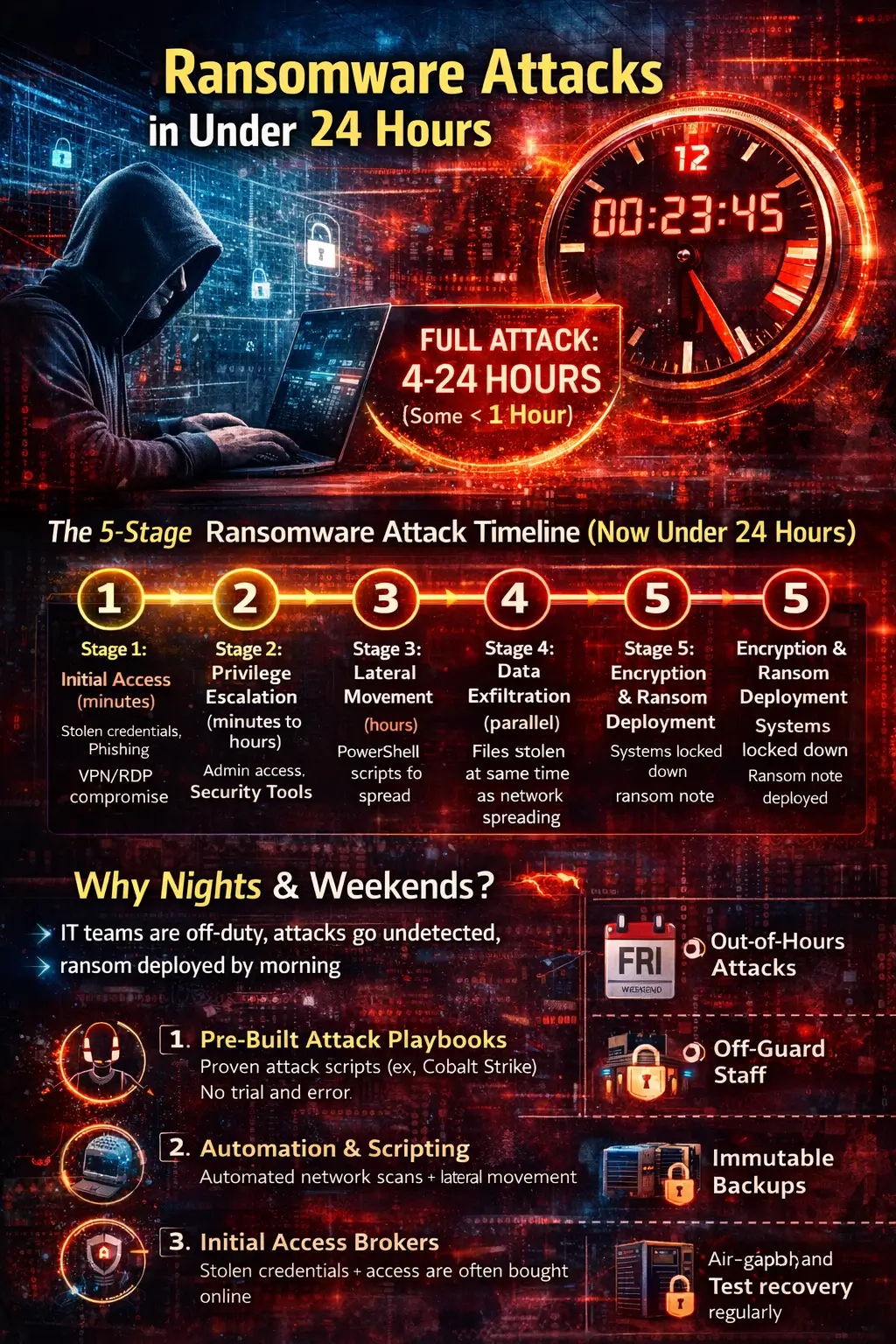
The 5-Stage Modern Ransomware Attack Timeline (Now Under 24 Hours)
Understanding the modern ransomware lifecycle is critical. The biggest shift isn’t just speed—it’s that many of these stages now happen simultaneously, not sequentially.
Stage 1: Initial Access (Minutes, Not Days)
Attackers rarely “break in” anymore—they log in.
Common entry points include:
- Stolen credentials purchased from initial access brokers
- Phishing attacks targeting employees or faculty
- Compromised VPN or RDP access
- MFA fatigue attacks
👉 For many SMBs, this means the attack effectively starts halfway through the kill chain.
Stage 2: Privilege Escalation (Minutes to Hours)
Once inside, attackers immediately attempt to:
- Gain admin or domain-level access
- Disable security controls
- Identify backup systems
This stage is often executed using legitimate tools, making detection extremely difficult.
Stage 3: Lateral Movement (Automated & Rapid)
This is where speed has increased dramatically.
Attackers use:
- PowerShell scripts
- Remote desktop tools
- Credential harvesting
They can move across dozens—or hundreds—of endpoints in under an hour.
Stage 4: Data Exfiltration (Happens in Parallel)
Modern ransomware is no longer just about encryption.
Attackers:
- Steal sensitive data
- Prepare for double extortion
- Maintain persistence
This often occurs at the same time as lateral movement.
Stage 5: Encryption & Ransom Deployment (Final Blow)
Once everything is in place:
- Files are encrypted across the network
- Backup systems are targeted
- Ransom notes are deployed
At this point, recovery becomes costly, slow, and sometimes impossible.
Why Ransomware Attacks Are Now So Fast
The shift to sub-24-hour attacks didn’t happen by accident. It’s the result of several major changes in how cybercriminals operate.
- Pre-Built Attack Playbooks
Attackers now operate like businesses.
They use:
- Proven frameworks
- Repeatable scripts
- Standardized processes
This eliminates trial-and-error and dramatically speeds execution.
- Automation + Scripting
Automation is the biggest accelerator.
Tasks like:
- Network scanning
- Credential harvesting
- Lateral movement
…are now fully automated, allowing attacks to scale rapidly.
- Initial Access Brokers
Attackers no longer need to find vulnerabilities themselves.
Instead, they buy:
- Verified credentials
- Pre-compromised environments
👉 This means your network may already be exposed before the attack begins.
- Weak or Limited Monitoring
Many SMBs:
- Lack 24/7 monitoring
- Don’t review logs in real time
- Rely on reactive tools
Attackers exploit this gap—especially during off-hours.
Why Ransomware Attacks Happen Overnight (And Why SMBs Are Targeted)
A consistent pattern across real-world incidents:
Most ransomware attacks occur at night or over weekends.
The Reason Is Simple:
- IT teams are offline
- Alerts go unnoticed
- Response times are delayed
For SMBs in North Carolina—especially in education, healthcare, and professional services—this creates a perfect window of opportunity.
Why Education & SMB Networks Are Prime Targets
- High Value, Lower Security
- Sensitive data (student records, financials)
- Limited cybersecurity budgets
- Flat Network Structures
- Easier lateral movement
- Fewer segmentation controls
- Shared Access Environments
- Multiple users with elevated permissions
- Increased credential exposure
Why Detecting Ransomware Before Encryption Is So Hard
This is the most critical challenge—and the biggest opportunity for MSPs.
- No Malware in Early Stages
Early attack activity often uses:
- Native system tools
- Legitimate credentials
👉 Nothing appears “malicious” at first.
- Identity-Based Attacks
Modern ransomware focuses on:
- User accounts
- Privilege escalation
- Authentication abuse
Traditional tools are not designed to detect this.
- Alert Fatigue
Security teams often face:
- Too many alerts
- Too little context
- Slow triage processes
This delays response when it matters most.
The First 24 Hours: What Actually Happens
Here’s what a real-world timeline often looks like:
Hour 0–1: Initial access gained
Hour 1–3: Privileges escalated
Hour 3–8: Lateral movement begins
Hour 6–12: Data exfiltration starts
Hour 12–24: Encryption deployed
👉 In many cases, organizations only detect the attack after hour 12—when damage is already done.
Real-World Scenario: A 3-Hour Containment That Prevented Disaster
A mid-sized professional services firm experienced a ransomware attempt at 2:17 AM.
- Compromised credentials triggered unauthorized login
- Lateral movement began within 30 minutes
- Suspicious activity was flagged by a monitored detection system
Response:
- Accounts disabled within 45 minutes
- Endpoints isolated within 2 hours
- No encryption occurred
Outcome:
- Zero downtime
- No data loss
- Attack contained in under 3 hours
👉 Without rapid detection, this would have been a full-scale ransomware event by morning.
How to Stop Ransomware Before Encryption (What Actually Works)
Preventing ransomware today requires a shift from prevention to rapid detection and response.
- 24/7 Monitoring (Non-Negotiable)
You must detect threats in real time, not the next business day.
- Endpoint Detection & Response (EDR)
Provides:
- Behavioral detection
- Visibility into endpoints
- Faster containment
- Managed Detection & Response (MDR)
Key advantage:
- Human + AI monitoring
- Faster response times
👉 Critical for SMBs without in-house SOC teams.
- Identity Protection
Focus on:
- MFA enforcement
- Login anomaly detection
- Privileged access control
- Backup & Recovery Strategy
Ensure:
- Immutable backups
- Regular testing
- Fast recovery capabilities
EDR vs MDR: Why Response Time Matters More Than Detection
Many SMBs already have EDR—but still get hit.
Why?
Because:
- Detection without response is too slow
- Alerts require human action
MDR solves this by:
- Acting immediately
- Reducing mean time to respond (MTTR)
- Containing threats before encryption
Key Takeaway: It’s Not Just Faster—It’s Fundamentally Different
Modern ransomware attacks are not simply “quicker versions” of old attacks.
They are:
- Pre-planned
- Automated
- Executed with precision
For SMBs in Raleigh, Durham, and Cary, this means one thing:
👉 Your response time matters more than your prevention tools.
FAQs
How quickly can ransomware encrypt a network?
In many cases, ransomware can encrypt critical systems within 4–24 hours, with some attacks completing in under 60 minutes depending on network size and defenses.
Why do ransomware attacks happen at night?
Attackers target nights and weekends because IT teams are less likely to detect and respond quickly, giving attackers more time to move laterally and deploy ransomware.
Can ransomware really spread in hours?
Yes. Modern ransomware uses automation and scripting to move across networks in hours—or even minutes.
What is the most critical stage to stop ransomware?
The most important window is before or during lateral movement. Once encryption begins, recovery becomes significantly harder.
How long do hackers stay before deploying ransomware?
Previously, attackers stayed for weeks. Today, many deploy ransomware within hours of gaining access.