
Foxconn Ransomware Attack Exposes Apple & Nvidia Data: What Businesses Must Learn
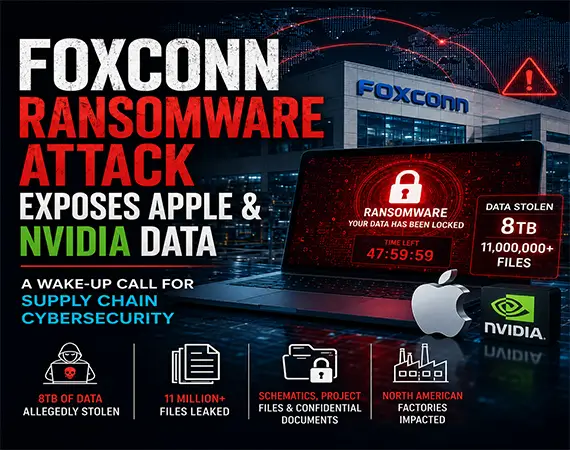
In May 2026, one of the world’s largest electronics manufacturers became the center of global cybersecurity headlines. Foxconn, the Taiwanese manufacturing giant responsible for producing hardware for Apple, Nvidia, Dell, Intel, Google, AMD, and other major technology companies, confirmed it had suffered a major cyberattack reportedly linked to the Nitrogen ransomware group.
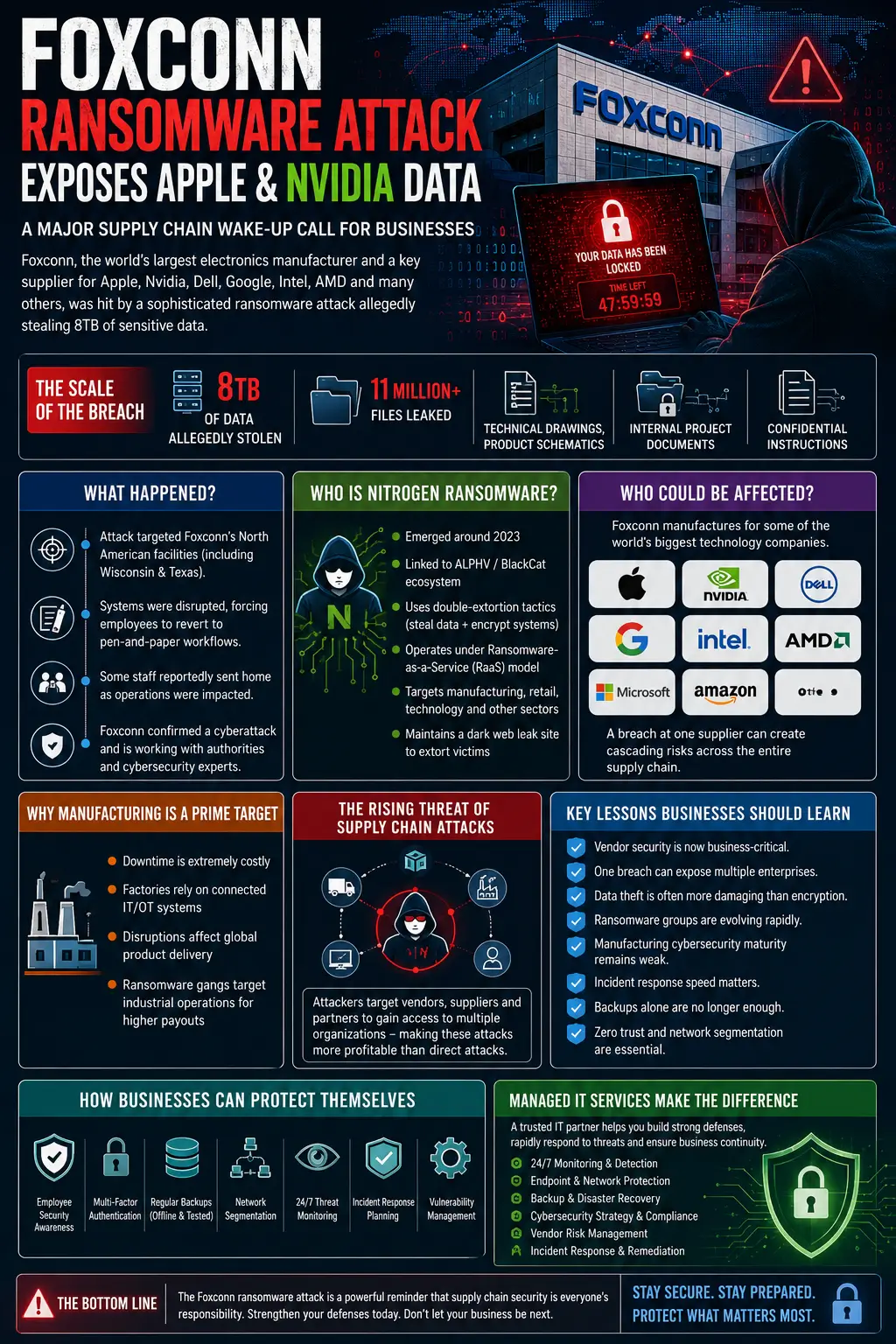
What makes this incident especially alarming is not just the scale of the breach, but what it reveals about the growing vulnerability of global supply chains. According to reports circulating across cybersecurity communities and industry media, the attackers claimed to have stolen approximately 8TB of sensitive data involving more than 11 million files. The allegedly exfiltrated information included technical drawings, confidential project files, operational documentation, and product schematics tied to some of the world’s most recognizable technology brands.
For businesses across North Carolina, including Raleigh, Durham, Cary, and surrounding areas, this incident serves as more than just another headline. It is a stark reminder that cybersecurity threats are no longer limited to large corporations. Small and medium-sized businesses are increasingly being targeted because they often serve as vendors, suppliers, or partners within larger enterprise ecosystems.
The Foxconn ransomware attack demonstrates how one compromised supplier can trigger widespread operational, financial, and reputational risks across multiple organizations simultaneously.
What Happened in the Foxconn Cyberattack?
The Foxconn cyberattack reportedly targeted several North American manufacturing facilities, including operations in Wisconsin and Texas. According to cybersecurity researchers and ransomware tracking organizations, the attack disrupted internal operations and forced portions of the company to fall back on manual workflows.
Some reports suggested employees reverted to pen-and-paper processes while systems were being restored. Others claimed production slowdowns and operational interruptions occurred across affected facilities. Although Foxconn has not publicly confirmed every detail circulating online, the broader cybersecurity community agrees that the incident reflects a sophisticated ransomware campaign aimed at industrial manufacturing infrastructure.
The ransomware group believed to be responsible, Nitrogen, allegedly posted claims on its dark web leak site stating it had stolen:
- 8TB of sensitive data
- More than 11 million files
- Internal corporate communications
- Product schematics
- Technical documentation
- Manufacturing instructions
- Confidential enterprise project files
The breach rapidly gained attention because Foxconn is deeply embedded within the global technology supply chain. Any disruption affecting Foxconn has the potential to impact some of the world’s largest technology companies.
This is precisely why supply chain cyberattacks are becoming one of the most dangerous forms of ransomware in 2026.
Why This Foxconn Data Breach Matters Globally
Many ransomware attacks affect only a single organization. The Foxconn ransomware attack is different because it highlights how interconnected global business ecosystems have become.
Foxconn manufactures products and components for:
- Apple
- Nvidia
- Dell
- Intel
- AMD
- Microsoft
- Amazon
When a supplier of this scale experiences a cybersecurity breach, the ripple effects extend far beyond one organization.
This incident demonstrates an uncomfortable reality for businesses everywhere: your cybersecurity is only as strong as the weakest vendor in your supply chain.
Attackers increasingly understand this concept. Instead of directly attacking heavily fortified enterprise environments, ransomware gangs now target suppliers, logistics providers, manufacturers, and service vendors because they often provide indirect access to valuable enterprise data.
This strategy is especially effective in manufacturing, where organizations rely heavily on interconnected systems, shared platforms, remote access technologies, and operational technology (OT) environments.
Who Is the Nitrogen Ransomware Group?
The Nitrogen ransomware group emerged around 2023 and quickly gained attention for its aggressive double-extortion tactics. Cybersecurity analysts believe the group has links to the broader ALPHV/BlackCat ransomware ecosystem, which has been associated with several high-profile attacks in recent years.
Nitrogen operates using a ransomware-as-a-service (RaaS) model. This means the organization behind the malware provides tools and infrastructure to affiliates who then carry out attacks against targeted organizations.
Their tactics commonly include:
- Data exfiltration before encryption
- Threatening to leak stolen files publicly
- Targeting manufacturing and retail sectors
- Exploiting weak vendor security
- Leveraging phishing and credential theft
- Using persistence mechanisms to maintain access
The group focuses heavily on industries where downtime is extremely costly. Manufacturing companies are particularly attractive because operational interruptions can halt production lines and create immediate financial pressure to pay ransoms quickly.
What Data Was Allegedly Stolen?
One reason this Foxconn security breach has attracted widespread media attention is the sheer volume and sensitivity of the allegedly stolen information.
Reports suggest the attackers obtained:
- Technical product designs
- Manufacturing schematics
- Confidential project documents
- Operational instructions
- Vendor information
- Internal communications
- Supply chain documentation
- Engineering files
If accurate, the exposure of this type of data could create long-term cybersecurity and intellectual property risks for multiple organizations connected to Foxconn’s manufacturing ecosystem.
Data theft is often more damaging than encryption alone.
Modern ransomware groups increasingly prioritize exfiltration because stolen intellectual property, engineering designs, and confidential business information can be monetized repeatedly through extortion, resale, or espionage.
This trend represents a major shift in the ransomware landscape.
Why Manufacturing Is Becoming the New Cybersecurity Battleground
The manufacturing industry has become one of the top ransomware targets globally.
Why?
Because manufacturing downtime is incredibly expensive.
Every hour of operational disruption can lead to:
- Delayed product shipments
- Supply chain bottlenecks
- Revenue losses
- Contract penalties
- Production backlogs
- Customer dissatisfaction
Manufacturers also rely heavily on connected systems that bridge IT and operational technology environments.
These environments often include:
- Industrial control systems
- Smart factory technologies
- Connected machinery
- ERP platforms
- Vendor portals
- Cloud integrations
- Remote monitoring systems
Unfortunately, many industrial environments were not originally designed with modern cybersecurity in mind.
As a result, ransomware gangs increasingly view manufacturing organizations as high-value targets with a greater likelihood of paying extortion demands quickly.
The Foxconn ransomware attack reinforces this growing reality.
Why Apple, Nvidia, and Other Tech Giants Are Concerned
Even if the primary target was Foxconn itself, companies connected to its manufacturing ecosystem may still face indirect consequences.
Potential concerns include:
- Exposure of confidential product development data
- Intellectual property theft
- Competitive intelligence risks
- Vendor trust issues
- Operational delays
- Regulatory scrutiny
- Brand reputation damage
This is why enterprise supply chain security has become a board-level issue across industries.
Large organizations now recognize that third-party vendor cyber risk can create vulnerabilities equivalent to direct attacks against their own infrastructure.
For small and medium-sized businesses in North Carolina, this should serve as a wake-up call. Many SMBs assume attackers only target Fortune 500 companies, but smaller organizations are often viewed as easier entry points into larger ecosystems.
Why Supply Chain Cyberattacks Are Increasing in 2026
Supply chain attacks are growing because they offer ransomware groups maximum leverage.
Instead of compromising one company, attackers can potentially impact dozens or even hundreds of organizations through a single breach.
This strategy creates:
- Larger extortion opportunities
- Increased media attention
- Greater business disruption
- Higher pressure on victims
- Expanded access to sensitive data
Recent ransomware trends show attackers increasingly targeting:
- Manufacturers
- Managed service providers
- Cloud vendors
- Healthcare suppliers
- Logistics companies
- Software providers
- Third-party contractors
The Foxconn cyberattack fits perfectly into this broader trend.
Cybercriminals understand that interconnected business environments create opportunities for cascading operational disruption.
Operational Impact: The Human Side of the Attack
Behind every ransomware headline are real employees and operational challenges.
Several reports surrounding the Foxconn ransomware attack indicated that workers at affected facilities experienced major disruptions, including:
- Temporary shutdowns
- Manual fallback operations
- Delayed production schedules
- System outages
- Reduced operational efficiency
Some reports even suggested employees had to return to handwritten documentation while digital systems were being restored.
This detail resonates because it highlights how dependent modern organizations have become on digital infrastructure.
When systems go offline, even highly advanced manufacturing environments can quickly revert to outdated processes.
Lessons Businesses Can Learn from the Foxconn Cyberattack
The Foxconn ransomware attack offers several critical cybersecurity lessons for businesses of every size.
- Vendor Security Is Business-Critical
Third-party vendors are no longer separate cybersecurity concerns.
Every supplier, contractor, and technology partner introduces potential risk into your environment.
Businesses should regularly evaluate:
- Vendor cybersecurity standards
- Access permissions
- Data-sharing practices
- Compliance frameworks
- Incident response capabilities
- Backups Alone Are No Longer Enough
Traditional ransomware protection strategies focused primarily on backups.
Today’s ransomware gangs steal data before encrypting systems.
That means organizations need:
- Data loss prevention
- Network segmentation
- Threat monitoring
- Endpoint detection and response
- Zero trust architecture
- Privileged access controls
- Incident Response Speed Matters
The faster an organization identifies and contains a threat, the smaller the damage becomes.
Businesses should maintain:
- Incident response plans
- Security monitoring
- Employee training
- Emergency communication protocols
- Recovery playbooks
- Manufacturing Cybersecurity Requires Specialized Protection
Industrial environments often contain legacy systems that were not built for modern cybersecurity threats.
Organizations operating manufacturing or operational technology environments should implement:
- OT network segmentation
- Industrial threat detection
- Access management
- Continuous monitoring
- Vulnerability management
How Managed IT Services Help Prevent Ransomware Attacks
For many small and medium-sized businesses in Raleigh, Durham, Cary, and across North Carolina, maintaining enterprise-grade cybersecurity internally can be extremely challenging.
This is where managed IT services play a critical role.
A proactive cybersecurity partner can help organizations implement:
- 24/7 threat monitoring
- Endpoint protection
- Security awareness training
- Ransomware prevention tools
- Backup and disaster recovery
- Vendor risk management
- Multi-factor authentication
- Network segmentation
- Incident response planning
The Foxconn ransomware attack proves that no organization is too large to become a target.
However, it also proves that preparation, visibility, and rapid response significantly improve resilience against modern cyber threats.
Businesses that invest in cybersecurity today are far more likely to avoid catastrophic disruptions tomorrow.
The Future of Cybersecurity in Global Supply Chains
The Foxconn cyberattack will likely become another defining example of how ransomware groups are evolving.
Attackers are no longer simply locking files and demanding payment.
Modern ransomware operations focus on:
- Data theft
- Operational disruption
- Supply chain compromise
- Public extortion
- Reputation damage
- Intellectual property exposure
As global supply chains become increasingly interconnected, organizations must adopt a broader view of cybersecurity.
Protecting your own systems is no longer enough.
You must also understand the risks introduced by vendors, partners, manufacturers, cloud providers, and contractors.
The businesses that survive the next decade of cyber threats will be the ones that treat cybersecurity as a core business strategy—not merely an IT responsibility.
Conclusion
The Foxconn ransomware attack exposes a dangerous reality facing businesses worldwide: a single supplier breach can impact multiple global enterprises simultaneously.
Whether the stolen data ultimately proves as extensive as attackers claim or not, the incident underscores the growing threat posed by ransomware groups targeting manufacturing and supply chain environments.
For businesses throughout North Carolina, including Raleigh, Durham, Cary, and surrounding regions, this attack serves as an important reminder that cybersecurity resilience requires more than antivirus software and backups.
Organizations must prioritize:
- Vendor security
- Continuous monitoring
- Incident response readiness
- Employee cybersecurity awareness
- Zero trust security models
- Managed cybersecurity services
Cyber threats are evolving rapidly. Businesses that proactively strengthen their defenses today will be far better positioned to protect their operations, customers, and reputation tomorrow.
FAQs
What is the Foxconn ransomware attack?
The Foxconn ransomware attack refers to a cyberattack allegedly carried out by the Nitrogen ransomware group against Foxconn’s North American manufacturing operations, reportedly involving the theft of 8TB of sensitive data.
Was Apple data leaked in the Foxconn breach?
Reports suggest attackers claimed to possess files connected to Apple-related manufacturing projects and documentation, though the full scope has not been officially confirmed.
Who is the Nitrogen ransomware group?
Nitrogen is a ransomware group believed to have emerged around 2023. The group reportedly uses double-extortion tactics and may have links to the ALPHV/BlackCat ransomware ecosystem.
Why are manufacturing companies targeted by ransomware?
Manufacturing organizations are attractive targets because operational downtime is extremely costly, increasing pressure to resolve attacks quickly.
What is a supply chain cyberattack?
A supply chain cyberattack targets vendors, suppliers, or third-party partners to indirectly compromise larger organizations connected to them.
How can businesses protect against ransomware?
Businesses can improve ransomware protection through employee training, endpoint security, backups, multi-factor authentication, network segmentation, continuous monitoring, and managed IT services.
What industries are most vulnerable to ransomware in 2026?
Manufacturing, healthcare, logistics, retail, financial services, and technology providers remain among the industries most frequently targeted by ransomware groups.