
Liberty Mutual Customer Data Leak Linked to Ransomware: What Businesses and Customers Need to Know
Cyberattacks have become a harsh reality for organizations of every size. From healthcare providers and banks to manufacturers and insurance companies, no industry is immune to the growing threat of ransomware. The recent Liberty Mutual customer data leak linked to the Everest ransomware group serves as another reminder that even large, well-established organizations can become targets.
The incident has sparked widespread concern among policyholders, cybersecurity professionals, and regulators. Reports suggest that sensitive customer information may have been exposed after threat actors allegedly gained access to data associated with Liberty Mutual. As investigations continue and lawsuits emerge, the event provides valuable lessons not only for affected customers but also for businesses throughout North Carolina and across the United States.
For organizations in Raleigh, Durham, Cary, and surrounding communities, the Liberty Mutual cyber incident highlights the importance of cybersecurity preparedness, vendor risk management, and proactive data protection strategies.
What Happened in the Liberty Mutual Data Breach?
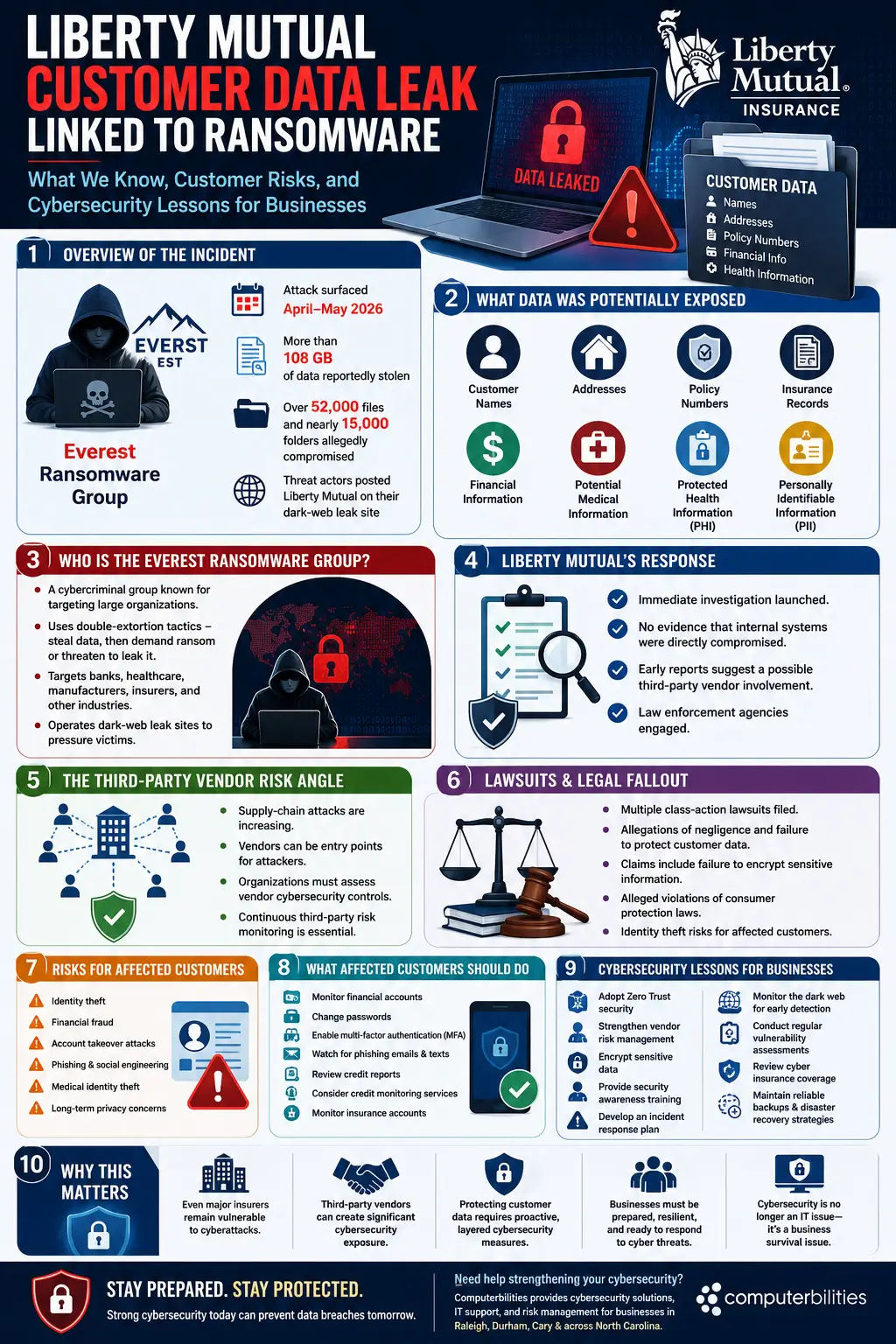
The Liberty Mutual data breach came to public attention when the Everest ransomware group claimed responsibility for obtaining and leaking data allegedly connected to the insurance company.
Reports indicate that:
- More than 108 GB of information was reportedly stolen.
- Approximately 52,000 files were allegedly compromised.
- Nearly 15,000 folders were reportedly exposed.
- The stolen information was allegedly published on a dark-web leak site operated by the ransomware group.
- The incident surfaced during April and May 2026.
Unlike traditional ransomware attacks that focus solely on encrypting systems, modern cybercriminals often use a double-extortion strategy. This means they steal sensitive information before deploying ransomware and then threaten to release the data publicly if ransom demands are not met.
The Liberty Mutual ransomware attack appears to follow this increasingly common playbook.
For businesses, this incident demonstrates that ransomware attacks are no longer just operational disruptions—they have become data breach events with legal, financial, and reputational consequences.
What Information Was Exposed?
One of the most concerning aspects of any insurance company data breach is the breadth of sensitive information that insurers typically collect.
According to reports surrounding the Liberty Mutual customer data leak, the exposed information may include:
- Customer names
- Home addresses
- Insurance policy numbers
- Claims information
- Financial information
- Contact details
- Personally Identifiable Information (PII)
- Protected Health Information (PHI)
- Internal company documents
When customer information stolen includes both financial and personal details, the potential impact becomes significantly greater.
Cybercriminals can use this data for:
- Identity theft
- Financial fraud
- Account takeover attempts
- Phishing campaigns
- Social engineering attacks
- Medical identity fraud
The combination of PII and PHI is particularly valuable on criminal marketplaces because it enables attackers to build highly convincing scams targeting affected individuals.
Who Is the Everest Ransomware Group?
The Everest ransomware group has become increasingly active in recent years and has been linked to attacks across multiple industries.
Like many modern ransomware gangs, Everest employs a double-extortion strategy:
Stage 1: Data Theft
Attackers infiltrate systems and quietly extract sensitive information.
Stage 2: Public Exposure Threat
The group threatens to publish the stolen information on dark-web leak sites if ransom demands are not satisfied.
This tactic places enormous pressure on victims because organizations must worry not only about operational disruption but also about regulatory penalties, lawsuits, and reputational damage.
Recent ransomware campaigns have targeted:
- Financial institutions
- Healthcare organizations
- Manufacturers
- Educational institutions
- Government agencies
- Insurance providers
The Liberty Mutual cyberattack demonstrates that insurance companies remain attractive targets because they store extensive amounts of personal, financial, and health-related data.
Liberty Mutual’s Response to the Incident
Following reports of the breach, Liberty Mutual launched a formal investigation into the alleged exposure.
According to publicly available information, the company indicated:
- An investigation was initiated immediately.
- Law enforcement agencies became involved.
- There was reportedly no evidence that Liberty Mutual’s core internal systems were directly compromised.
- Early reports suggested the incident may have involved a third-party vendor.
This distinction is significant.
Many organizations invest heavily in protecting their own infrastructure while overlooking vulnerabilities that may exist within their supply chain.
If a third-party vendor breach contributed to the incident, it would reinforce a growing cybersecurity challenge facing organizations worldwide.
The Growing Threat of Third-Party Vendor Breaches
One of the most important cybersecurity lessons from the Liberty Mutual ransomware data leak investigation involves third-party risk.
Businesses today rely on dozens or even hundreds of external vendors for:
- Cloud services
- Software applications
- Customer support
- Claims processing
- Payroll management
- Data storage
- Marketing automation
Every vendor introduces potential risk.
Think of cybersecurity like securing a building. A company may install reinforced doors, security cameras, and alarm systems. However, if a vendor leaves a side entrance unlocked, attackers can still gain access.
Why Vendor Risk Is Increasing
Modern supply chains are highly interconnected.
Attackers increasingly target:
- Managed service providers
- SaaS vendors
- Data processors
- Insurance partners
- Healthcare suppliers
Because compromising one vendor can provide access to multiple organizations simultaneously.
Vendor Security Best Practices
Organizations should:
- Conduct vendor risk assessments
- Require cybersecurity certifications
- Review security controls annually
- Enforce contractual security requirements
- Monitor vendor compliance continuously
- Limit third-party access privileges
For North Carolina businesses, vendor risk management should be considered a core cybersecurity strategy rather than an optional compliance exercise.
Lawsuits and Legal Implications
The Liberty Mutual security breach has already generated significant legal attention.
Several class-action lawsuits have reportedly been filed alleging that customer information was inadequately protected.
Key allegations include:
- Failure to protect sensitive customer data
- Negligence regarding cybersecurity safeguards
- Failure to adequately encrypt information
- Consumer protection law violations
- Increased identity theft risk for affected individuals
The legal consequences of a data breach often extend far beyond the initial incident.
Organizations may face:
- Regulatory investigations
- Compliance audits
- Litigation expenses
- Settlement costs
- Reputation damage
- Customer churn
As cybersecurity regulations continue to evolve, courts increasingly expect organizations to implement reasonable security measures to protect sensitive information.
Risks for Affected Customers
A breach involving insurance records creates multiple layers of risk.
Identity Theft
Criminals can combine personal information from multiple sources to open fraudulent accounts or impersonate victims.
Financial Fraud
Exposed financial details can facilitate unauthorized transactions or scams.
Account Takeovers
Attackers frequently use stolen information to gain access to online accounts.
Phishing Attacks
Cybercriminals may use breach data to create highly personalized phishing emails.
Medical Identity Theft
If PHI was exposed, criminals may attempt to use healthcare information for fraudulent purposes.
Long-Term Privacy Concerns
Unlike passwords, personal information cannot easily be changed. Once exposed, individuals may face risks for years.
How to Protect Yourself After a Data Breach
If you believe your information may have been exposed, taking immediate action is essential.
Step 1: Monitor Financial Accounts
Review bank statements and credit card activity regularly.
Step 2: Change Passwords
Update passwords for critical accounts and avoid password reuse.
Step 3: Enable Multi-Factor Authentication (MFA)
MFA provides an additional layer of security beyond passwords.
Step 4: Watch for Phishing Attempts
Be skeptical of unsolicited emails, texts, and phone calls.
Step 5: Review Credit Reports
Monitor for unauthorized accounts or suspicious activity.
Step 6: Consider Credit Monitoring
Identity monitoring services can provide early warning signs of fraud.
Step 7: Monitor Insurance Accounts
Review policies, claims activity, and account changes for anomalies.
Cybersecurity Lessons for Businesses
The Liberty Mutual customer data leak offers important lessons for businesses of all sizes.
Adopt a Zero Trust Security Model
Never automatically trust users, devices, or systems.
Strengthen Vendor Risk Management
Third-party security should receive the same scrutiny as internal security.
Encrypt Sensitive Data
Encryption can significantly reduce the value of stolen information.
Conduct Security Awareness Training
Employees remain one of the most important cybersecurity defenses.
Develop an Incident Response Plan
Organizations must know how to respond before an incident occurs.
Implement Dark Web Monitoring
Early detection can help organizations respond faster.
Perform Regular Vulnerability Assessments
Continuous testing helps identify weaknesses before attackers do.
Evaluate Cyber Insurance Coverage
Cyber insurance can help mitigate financial losses.
Maintain Reliable Backups
Backups remain one of the strongest defenses against ransomware.
For businesses across Raleigh, Durham, Cary, and North Carolina, partnering with a trusted IT services provider can help strengthen defenses against evolving cyber threats.
Why This Matters for North Carolina Businesses
Many small and medium-sized businesses assume cybercriminals only target large enterprises.
The reality is often the opposite.
Attackers frequently view SMBs as easier targets because they typically have:
- Smaller IT teams
- Limited cybersecurity budgets
- Fewer monitoring capabilities
- Less mature incident response processes
The Liberty Mutual ransomware attack serves as a reminder that every organization handling customer data must prioritize cybersecurity regardless of size.
Final Thoughts
The Liberty Mutual customer data leak linked to ransomware demonstrates that even some of the world’s largest insurance companies remain vulnerable to cyber threats.
Whether the incident ultimately proves to be a direct attack or the result of a third-party vendor breach, the lessons are clear.
Organizations must:
- Strengthen cybersecurity defenses
- Improve vendor oversight
- Protect sensitive customer data
- Prepare for ransomware threats
- Develop comprehensive incident response plans
For businesses throughout Raleigh, Durham, Cary, and North Carolina, proactive cybersecurity investments today can prevent costly incidents tomorrow.
The Liberty Mutual cyber incident serves as a powerful reminder that cybersecurity is no longer simply an IT issue—it is a business survival issue.
Frequently Asked Questions
What happened in the Liberty Mutual data breach?
Reports indicate that the Everest ransomware group allegedly obtained and published data connected to Liberty Mutual, potentially exposing customer information.
What information was exposed?
Reportedly exposed information may include names, addresses, policy details, financial information, PII, and potentially PHI.
Was Liberty Mutual directly hacked?
Public statements suggest investigators have not found evidence that Liberty Mutual’s internal systems were directly compromised, and a third-party vendor may have been involved.
Who is the Everest ransomware group?
Everest is a cybercriminal organization known for conducting ransomware and data extortion attacks against organizations worldwide.
What should affected customers do?
Customers should monitor financial accounts, change passwords, enable MFA, review credit reports, and remain alert for phishing attempts.
What can businesses learn from this incident?
Key lessons include strengthening vendor risk management, implementing Zero Trust security, encrypting sensitive data, and preparing for ransomware attacks.