
Verizon 2026 Breach Report Reveals Ransomware Surge: What North Carolina Businesses Need to Know
Cybersecurity threats are evolving faster than most businesses can adapt. The newly released Verizon 2026 Data Breach Investigations Report (DBIR) paints a concerning picture for organizations across the United States, especially small and medium-sized businesses (SMBs) in growing economic hubs like Raleigh, Durham, and Cary, North Carolina.
For years, cybersecurity experts warned that ransomware, AI-driven cyberattacks, and vulnerability exploitation would become more sophisticated and destructive. The Verizon 2026 DBIR confirms those fears are now reality.
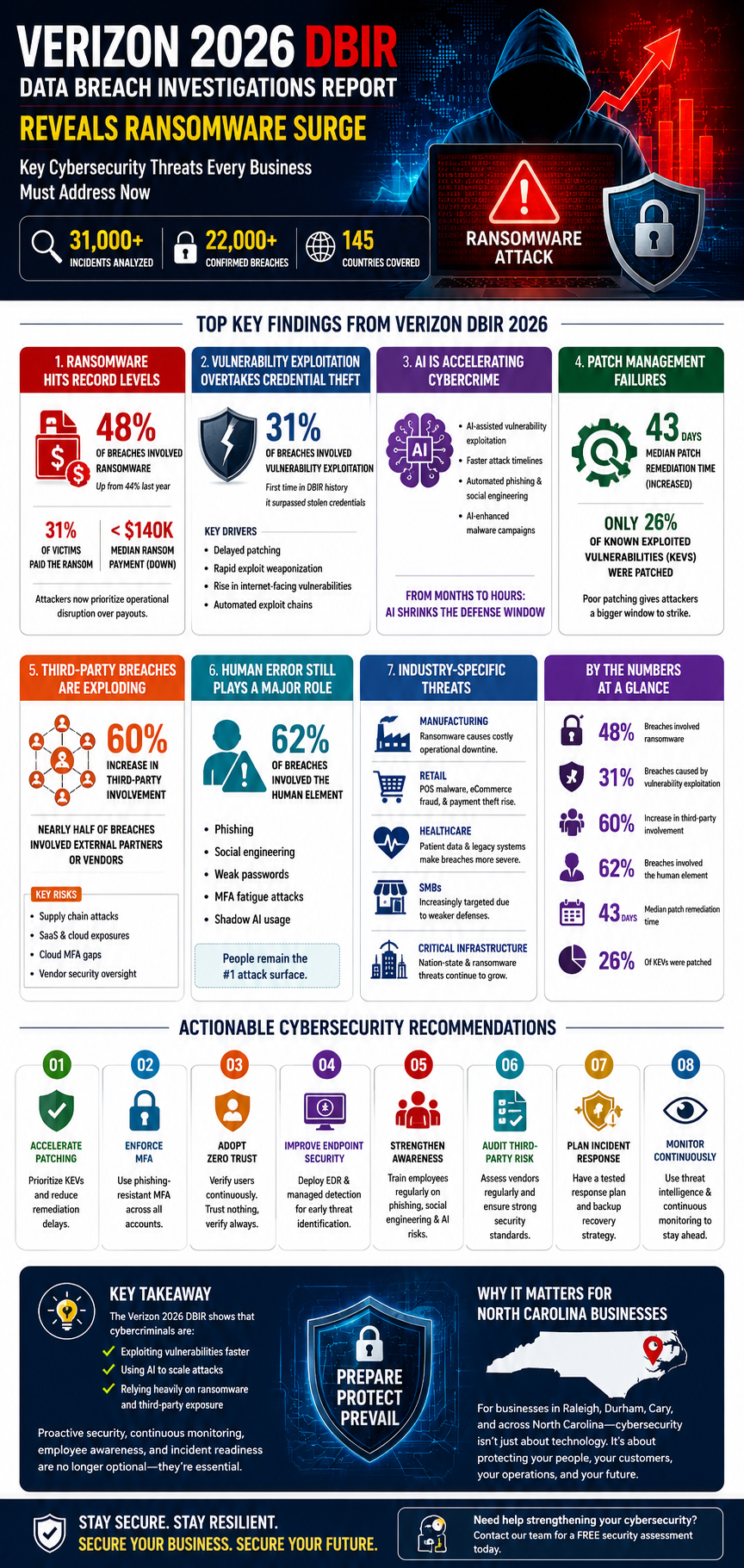
The report analyzed more than 31,000 cybersecurity incidents, including 22,000 confirmed data breaches across 145 countries, making it one of the most comprehensive cyber threat intelligence resources available today.
What makes this year’s report particularly alarming is the sharp rise in ransomware attacks, the surge in exploit-based breaches, and the increasing role artificial intelligence plays in accelerating cybercrime.
For businesses in North Carolina — from manufacturing companies in Raleigh to healthcare providers in Durham and retail businesses in Cary — the message is clear:
Cybersecurity can no longer be treated as an IT issue alone. It is now a core business survival strategy.
What Is the Verizon DBIR 2026?
The Verizon Data Breach Investigations Report (DBIR) is considered one of the cybersecurity industry’s most trusted annual reports. It combines real-world breach data gathered from global security researchers, law enforcement agencies, incident response teams, and cybersecurity vendors.
Unlike opinion-based trend reports, the DBIR focuses on actual confirmed breaches and attack patterns. That is why cybersecurity professionals, managed IT providers, CISOs, and compliance experts closely monitor its findings every year.
The 2026 report highlights several major shifts in the global cyber threat landscape:
- Ransomware reached record-breaking levels
- Vulnerability exploitation surpassed credential theft
- AI-assisted attacks became significantly more common
- Third-party compromise risks exploded
- Human error remained a dominant attack factor
For North Carolina businesses navigating digital transformation, hybrid work environments, and cloud adoption, these findings carry serious implications.
Ransomware Hits Record Levels in 2026
The headline finding from the Verizon 2026 DBIR is impossible to ignore:
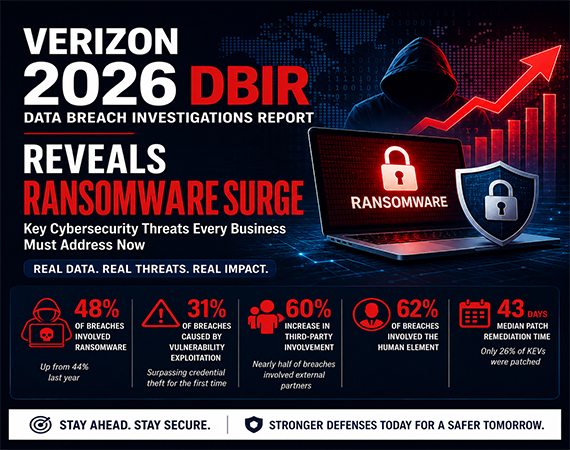
Ransomware was involved in 48% of all breaches.
That is a dramatic increase from 44% the previous year and represents one of the largest ransomware surges Verizon has documented to date.
Even more concerning, SMB ransomware risk continues to rise rapidly.
Many small and medium-sized businesses mistakenly assume cybercriminals only target large enterprises. In reality, attackers increasingly focus on SMBs because they often have:
- weaker endpoint security,
- limited IT staffing,
- slower patch management,
- and fewer incident response resources.
For businesses across Raleigh, Durham, and Cary, this trend should serve as a wake-up call.
Why Ransomware Continues Growing Despite Lower Payments
Interestingly, the report notes that only 31% of ransomware victims paid the ransom, while the median payment dropped below $140,000.
So why are ransomware attacks still increasing?
The answer lies in attacker strategy evolution.
Modern ransomware groups are no longer relying solely on ransom payments. Instead, they are increasingly focused on:
- operational disruption,
- data destruction,
- reputational damage,
- extortion,
- and double/triple extortion tactics.
Today’s attackers understand that even if a company refuses payment, the downtime alone can cause devastating financial losses.
For example, a manufacturing company in North Carolina losing production access for even 24 hours could face:
- missed shipments,
- supply chain disruptions,
- contractual penalties,
- and customer dissatisfaction.
This operational leverage is why ransomware trends for SMBs remain one of the most important cybersecurity concerns of 2026.
Vulnerability Exploitation Becomes the #1 Attack Vector
One of the most historic findings in the Verizon 2026 DBIR is this:
Vulnerability exploitation caused 31% of breaches — surpassing stolen credentials for the first time.
This marks a major turning point in cybersecurity trends 2026.
Historically, credential theft and phishing dominated breach entry methods. However, exploit-based attacks are now growing at unprecedented speed.
Why?
Because attackers are weaponizing vulnerabilities faster than organizations can patch them.
The Rise of Exploit-Based Attacks
Several factors are contributing to the vulnerability exploitation surge:
- Delayed Patching Cycles
Many organizations struggle to deploy security updates quickly due to:
- legacy infrastructure,
- software compatibility concerns,
- operational downtime fears,
- and staffing shortages.
- Internet-Facing Vulnerabilities
Cloud services, VPNs, remote desktop protocols, and SaaS platforms have dramatically expanded organizational attack surfaces.
- Automated Exploitation Attacks
Cybercriminals now use automation and AI-assisted hacking tools to scan for known exploited vulnerabilities (KEVs) within hours of disclosure.
- Rapid Exploit Weaponization
Threat actors can convert newly disclosed vulnerabilities into operational attack chains almost immediately.
The result?
Businesses often lose the race before remediation even begins.
From Months to Hours: AI Shrinks the Defense Window
Artificial intelligence is reshaping cybersecurity faster than many organizations realize.
The Verizon breach report highlights how AI-powered cyberattacks are significantly reducing attack preparation time.
Tasks that once required weeks or months can now happen in hours.
How AI Is Accelerating Cyberattacks
AI-Assisted Phishing
Attackers now use generative AI cyber threats to create:
- realistic phishing emails,
- executive impersonation messages,
- multilingual scams,
- and highly personalized social engineering campaigns.
These emails often bypass traditional spam filters because they appear professionally written and contextually accurate.
AI-Enhanced Malware Campaigns
Cybercriminal groups are increasingly using AI to:
- modify malware signatures,
- evade endpoint detection,
- automate reconnaissance,
- and optimize exploit delivery.
This makes traditional signature-based antivirus solutions far less effective.
Automated Exploitation
AI tools can rapidly identify vulnerable systems, prioritize weak targets, and automate attack sequencing.
This trend is especially dangerous for organizations with poor vulnerability management practices.
Why Businesses Are Falling Behind on Patching
Patch management failures are becoming one of the most critical cybersecurity weaknesses in 2026.
According to the report:
- median remediation time increased to 43 days,
- while organizations patched only 26% of known exploited vulnerabilities.
That means attackers often have weeks to exploit systems before remediation occurs.
Why Patch Management Continues to Fail
Skills Shortages
Many SMBs simply lack dedicated cybersecurity personnel.
Legacy Systems
Older manufacturing and healthcare systems often cannot be updated easily.
Operational Risk Concerns
Organizations fear downtime more than cyber risk — until a breach occurs.
Alert Fatigue
Security teams are overwhelmed by vulnerability alerts and struggle to prioritize effectively.
For businesses in North Carolina’s rapidly growing technology and healthcare sectors, this challenge is becoming increasingly severe.
Third-Party & Supply Chain Risks Are Exploding
Another alarming finding from the Verizon 2026 DBIR:
Third-party involvement increased by 60%.
Nearly half of breaches now involve external vendors, suppliers, cloud providers, or partners.
This highlights the growing importance of:
- supply chain cyberattacks,
- third-party breach risk,
- and vendor cybersecurity oversight.
Why Third-Party Risk Is Increasing
Modern businesses rely heavily on:
- SaaS platforms,
- cloud infrastructure,
- managed service providers,
- remote vendors,
- and outsourced applications.
Each vendor connection expands the organization’s attack surface.
A single compromised vendor can expose:
- customer data,
- financial records,
- login credentials,
- and operational systems.
For SMBs in Raleigh, Durham, and Cary using multiple cloud tools, third-party compromise increase should be considered a top cybersecurity priority.
Human Error Still Plays a Major Role
Technology alone cannot solve cybersecurity problems.
The Verizon 2026 DBIR found that:
Human involvement played a role in 62% of breaches.
Despite advanced security tools, attackers continue exploiting human behavior through:
- phishing,
- weak passwords,
- MFA fatigue attacks,
- social engineering,
- and shadow AI usage.
The Growing Threat of Shadow AI
Employees increasingly use unauthorized AI tools for:
- document creation,
- coding assistance,
- summarization,
- and customer communication.
Without proper governance, sensitive company data may unintentionally be exposed to third-party AI platforms.
This creates entirely new categories of AI and data breaches.
Industry-Specific Threats in 2026
The cyber threat landscape 2026 affects every industry differently.
Manufacturing Ransomware Attacks
Manufacturing organizations remain highly vulnerable because operational downtime directly impacts production revenue.
Attackers understand that manufacturers are more likely to pay quickly to restore operations.
Retail Cybersecurity Threats
Retail businesses continue facing:
- POS malware,
- credential theft,
- eCommerce fraud,
- and customer payment data breaches.
Healthcare Sector Risks
Healthcare providers remain prime targets due to:
- sensitive patient records,
- outdated infrastructure,
- and operational urgency.
SMB Ransomware Risk
Small businesses across North Carolina often underestimate their attractiveness to attackers.
Unfortunately, cybercriminals view SMBs as:
- easier to penetrate,
- less prepared,
- and slower to recover.
Key Lessons Businesses Must Learn from Verizon DBIR 2026
The report provides several critical lessons businesses cannot afford to ignore.
Cybersecurity Must Become Proactive
Reactive security strategies are no longer sufficient.
Organizations need:
- continuous monitoring,
- threat intelligence,
- and attack surface management.
Speed Matters More Than Ever
Attackers move rapidly.
Businesses that delay:
- patching,
- MFA deployment,
- or incident response planning
are placing themselves at significant risk.
Cyber Resilience Is the New Goal
No organization can guarantee perfect prevention.
The objective must shift toward:
- rapid detection,
- containment,
- recovery,
- and operational resilience.
Cybersecurity Best Practices for 2026
Businesses in Raleigh, Durham, Cary, and throughout North Carolina should prioritize the following cybersecurity recommendations from Verizon DBIR 2026.
- Accelerate Patch Management
- Prioritize known exploited vulnerabilities
- Automate patch deployment where possible
- Reduce remediation delays
- Enforce Multi-Factor Authentication
Phishing-resistant MFA remains one of the most effective security controls available.
- Adopt Zero Trust Security
Verify users continuously rather than trusting network access automatically.
- Improve Endpoint Security
Deploy:
- Endpoint Detection & Response (EDR),
- managed detection and response,
- and behavioral monitoring tools.
- Strengthen Security Awareness Training
Employees remain a critical security layer.
Train staff regularly on:
- phishing detection,
- social engineering,
- password hygiene,
- and AI-related risks.
- Conduct Third-Party Risk Audits
Review vendor cybersecurity posture regularly.
Assess:
- cloud security practices,
- MFA enforcement,
- incident response readiness,
- and compliance standards.
- Build Incident Response Plans
Every organization should maintain:
- documented response procedures,
- backup recovery plans,
- and cyber incident communication protocols.
Why These Findings Matter for North Carolina Businesses
North Carolina’s economy is rapidly expanding across:
- technology,
- healthcare,
- manufacturing,
- biotech,
- and retail sectors.
Unfortunately, that growth also attracts cybercriminal attention.
Businesses in Raleigh, Durham, and Cary increasingly face:
- sophisticated ransomware attacks,
- AI-driven cyberattacks,
- and supply chain compromise risks.
Organizations that invest in:
- cyber hygiene,
- security posture management,
- vulnerability remediation,
- and breach prevention
will be significantly better positioned to navigate the evolving threat landscape.
Conclusion
The Verizon 2026 DBIR confirms that cybersecurity threats are escalating faster than ever before.
Cybercriminals are:
- exploiting vulnerabilities faster,
- using AI to automate attacks,
- targeting third-party vendors,
- and launching ransomware campaigns at unprecedented scale.
For businesses across North Carolina, cybersecurity can no longer remain reactive.
Organizations must focus on:
- proactive threat detection,
- continuous monitoring,
- employee awareness,
- rapid patching,
- incident readiness,
- and long-term cyber resilience.
The businesses that prepare now will be far more capable of surviving the increasingly aggressive cyber threat landscape of 2026 and beyond.
FAQs
What is the Verizon 2026 DBIR?
The Verizon 2026 Data Breach Investigations Report is an annual cybersecurity report analyzing real-world data breaches, attack methods, ransomware trends, and global cyber threats.
Why is ransomware increasing in 2026?
Ransomware attacks continue growing because attackers increasingly prioritize operational disruption, extortion, and third-party compromise rather than relying only on ransom payments.
What industries are most vulnerable to ransomware?
Manufacturing, healthcare, retail, critical infrastructure, and SMBs remain among the highest-risk industries according to the Verizon breach report.
How are AI-driven cyberattacks changing cybersecurity?
AI-powered cyberattacks enable faster phishing campaigns, automated vulnerability exploitation, malware optimization, and large-scale social engineering attacks.
Why is vulnerability exploitation increasing?
Organizations struggle with delayed patching, legacy systems, and rapidly weaponized exploits, allowing attackers to exploit known vulnerabilities faster than defenses can adapt.